Dr. Gymbro
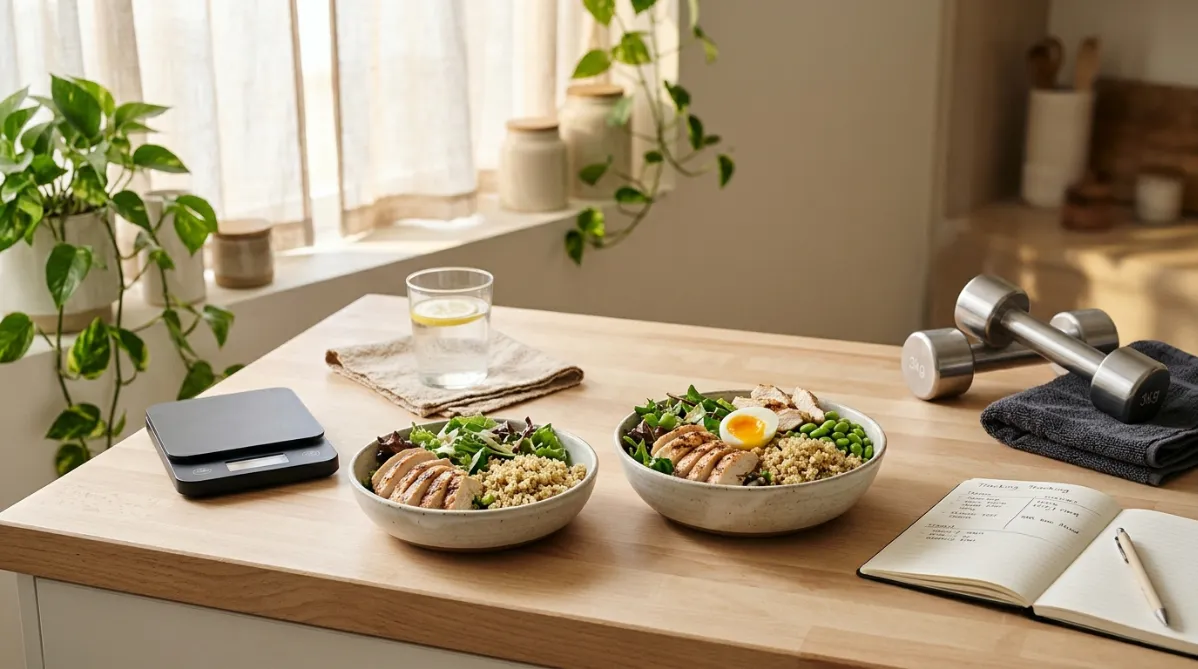
A wide landscape editorial photograph of a clean, sunlit kitchen counter in soft natural morning light, styled like a modern wellness journal cover. In the foreground, two matching ceramic bowls sit side by side on a pale oak butcher block. The left bowl holds a modest portion of sliced grilled chicken breast, quinoa, and greens. The right bowl holds a noticeably larger, double-sized portion of the same ingredients, with extra chicken, a soft-boiled egg, and edamame. The contrast in portion size is clear but elegant. Beside the bowls are a matte black digital kitchen scale, a tall glass of water with a lemon slice, and a small linen napkin in warm oatmeal tone. A pair of sleek brushed-steel dumbbells rests slightly out of focus on the counter's edge, and a folded charcoal gym towel sits next to them. In the soft-focus background, a large window with sheer curtains lets in diffused golden light, and a trailing green pothos plant adds an organic touch. A small, minimal notebook with a pen lies open to the side, suggesting careful tracking. The color palette is muted and cohesive: warm creams, sage green, soft terracotta, charcoal, and natural wood. Shallow depth of field, crisp focus on the bowls, gentle shadows, and subtle film-like grain. Composition follows the rule of thirds with generous negative space on the upper right for headline text. The mood is calm, thoughtful, and trustworthy, like a contemporary health and science magazine feature. There are no people, no text, and no futuristic elements.
Nutrition

3.2 g/kg Protein for 16 Weeks: Did It Hurt Lifters' Kidneys?

Dr. Gymbro · · 4 min read

You've heard the warning at every gym: eat too much protein and your kidneys will pay. A new 16-week randomized trial in resistance-trained men put double the standard lifter dose on the table, and the answer is more interesting than a simple yes or no. Protein did not produce statistically significant differences in kidney markers versus moderate intake. But the high-protein groups did show some changes that nobody should wave away.

What the researchers actually tested

The study, published in the Journal of the International Society of Sports Nutrition, was led by Reza Bagheri and colleagues, with sport nutrition researcher Richard Kreider among the authors. Forty-eight resistance-trained men (average age 26, BMI 25.6) were randomized into a 2 × 2 factorial design. They trained either with resistance training (RT) or concurrent training (CT, lifting plus endurance work), four sessions a week for 16 weeks. They also ate either 1.6 g/kg/day of protein or 3.2 g/kg/day.

For an 80 kg man, that is roughly 128 g versus 256 g of protein daily. The higher figure is about four times the RDA of 0.8 g/kg, and double the upper end of what most sports nutrition guidelines recommend for muscle gain. Forty-four participants had complete before-and-after data and were analyzed.

Researchers measured fasting blood urea nitrogen (BUN), the BUN/creatinine ratio, cystatin C, and estimated glomerular filtration rate (eGFR). They calculated eGFR three ways: creatinine-based (CKD-EPI 2021), cystatin C-based (2012), and a combined equation (2021). Using three equations matters, because creatinine can be nudged by muscle mass and meat intake, while cystatin C is less affected by both.

The headline finding: no significant interaction

The key statistical test was whether changes over time differed by protein level (Time × Protein) or by protein and training type together (Time × Training × Protein). None of them reached significance for any biomarker or eGFR estimate (all p ≥ 0.182). In plain language: the study could not show that 3.2 g/kg changed kidney markers differently than 1.6 g/kg, whether people lifted only or combined lifting with cardio.

The 1.6 g/kg groups showed no significant within-group changes at all. That is a reassuring baseline for the moderate-high intake most serious lifters actually use.

The detail clickbait would skip

Here is where honesty matters. In both 3.2 g/kg groups, BUN and cystatin C went up (p ≤ 0.017) and eGFR estimates went down (p ≤ 0.009). The BUN/creatinine ratio did not move. The authors describe these as modest increases and small decreases, and stress that these within-group results are descriptive only, because the interaction tests that would confirm a real difference between diets were not significant.

So the fair reading is not "high protein is proven harmless" and not "high protein damages kidneys." Rising BUN is expected when you eat more protein, since urea is a byproduct of protein breakdown. Cystatin C and eGFR shifts are less easy to dismiss, and they could reflect a physiological adaptation, such as higher filtration demand, or an early signal worth tracking. This trial cannot tell us which.

Limitations you need to know

  • Small sample: 44 analyzed men. The authors explicitly say this prevents ruling out clinically meaningful differences.
  • Healthy, young, trained men only: Results do not apply to women, older adults, or anyone with reduced kidney function, diabetes, or hypertension.
  • Surrogate markers: eGFR, BUN, and cystatin C are indirect. No hard kidney outcomes, such as disease diagnoses, were measured.
  • 16 weeks: Long-term effects over years remain unknown.
  • Exploratory design: The paper labels the analysis exploratory, so treat results as hypothesis-generating.

Practical takeaways

Dose: Evidence for muscle gain generally plateaus well below 3.2 g/kg, often around 1.6 g/kg. This study did not measure muscle outcomes, but it gives you little reason to chase the higher number. Doubling protein adds cost and food volume with no proven benefit here.

Timing: The trial didn't test timing. Spreading protein over several meals is a sensible default, particularly at high totals.

Who it's for: Healthy, resistance-trained adults who want a high-protein diet around 1.6 g/kg can feel reasonably confident based on these data, with no significant kidney marker changes in that group. Concurrent training didn't change the picture.

Who should skip very high intake: Anyone with existing kidney disease, a reduced eGFR, a family history of kidney problems, or conditions like diabetes and hypertension should consult a physician before pushing protein beyond standard recommendations. Also be cautious if you take other kidney-stressing agents such as frequent NSAIDs, or use heavy creatine without monitoring, since both can complicate lab interpretation.

Smart move: If you plan to run a very high-protein phase, get baseline bloodwork (creatinine, cystatin C, eGFR) and recheck it. Staying hydrated is sensible, though this study did not test hydration.

Bottom line

Sixteen weeks at 3.2 g/kg did not produce statistically detectable kidney differences compared with 1.6 g/kg in 44 healthy lifters. Still, the high-protein groups showed small shifts in BUN, cystatin C, and eGFR that deserve follow-up in bigger, longer trials. For most lifters, the evidence-based sweet spot remains far below the extreme dose, and that is the safest place to stay until better data arrive.
Original study

Read the original research on pubmed.ncbi.nlm.nih.gov →

This article summarizes published research for general information. It is not medical advice.

DG

Written by

Dr. Gymbro

Dr. Gymbro writes for Dr. Gymbro: science-backed fitness, nutrition & performance.

Related Articles

A wide, editorial flat-lay photograph shot from directly above on a pale warm-gray stone countertop, lit by soft natural morning window light with gentle diagonal shadows. On the left, a neatly arranged cluster of whole-food protein sources: two seared chicken breast slices with a golden crust, a small ceramic bowl of creamy Greek yogurt topped with blueberries, three halved soft-boiled eggs with jammy orange yolks, a handful of raw almonds, and a small pile of dried lentils scattered on a linen napkin. At the center, a matte white shaker bottle and a wooden scoop resting in a pile of fine vanilla-colored protein powder, a few grains dusted artfully across the surface. On the right, a minimalist kitchen scale in matte black displaying a portion of food, next to an open notebook with a hand-drawn curve that rises steeply and then flattens into a plateau, drawn in a deep terracotta ink pen, with a small dot marking the bend. A brass pen lies beside the notebook. A single dumbbell with a brushed steel finish sits partially in frame at the upper right corner, grounding the fitness theme without feeling gym-like. Color palette: warm cream, sage green, terracotta, soft charcoal, and butter yellow accents, with generous negative space along the top edge for title overlay. Shallow depth of field, crisp textures, subtle film grain, modern lifestyle magazine aesthetic, clean and calm composition, 16:9 landscape.
nutrition

How Much Protein Actually Maximizes Muscle? The 1.6 g/kg Plateau, Explained

BY DR. GYMBRO ·

Think you need 2+ grams of protein per pound to grow? A meta-analysis of 49 trials and 1,863 adults found muscle-building benefits leveled off around 1.6 g/kg per day. The upper confidence limit reached about 2.2 g/kg, giving lifters a practical range instead of an arbitrary mega-dose. Trained lifters gained the most from supplementation, while the benefit shrank with age. Here is what the numbers mean for your plate, your shaker bottle and your budget.

nutrition

Does Sipping 60 g of Carbs Mid-Workout Make You Stronger? Not Quite

BY DR. GYMBRO ·

Intra-workout carb drinks are everywhere, but do they actually make you stronger? A new randomised, placebo-controlled crossover pilot of 15 resistance-trained adults tested 60 g of maltodextrin during a workload-matched lifting session. Blood glucose rose by about 19 mg/dL, yet lactate, reactive strength and grip strength showed no clear change. Knee-extension reps to failure were roughly 2.5 higher with carbs, but that signal came from just 10 people and wasn't significant after adjustment. Here's what the trial really shows, who might still benefit, and why it's a hypothesis-generator rather than a green light.

A bright, minimalist still life on a soft sage-green and warm cream backdrop, shot from a slightly elevated angle in natural morning window light. In the center sits a matte ceramic bowl of creamy vanilla protein shake with a wooden spoon resting beside it. Next to it, a small glass jar with a few off-white probiotic capsules spilling onto a pale linen napkin. Around them are fresh, gut-friendly foods arranged with editorial restraint: a halved ripe banana, a small bowl of plain yogurt with a swirl on top, a few stalks of leeks, a handful of oats scattered on the surface, and a sprig of fresh mint. A tall glass of water with a lemon slice catches the light and casts a delicate caustic shadow across the table.

In the background, slightly out of focus, a folded gray gym towel and a sleek stainless steel shaker bottle hint at an athletic lifestyle without dominating the scene. The surface is a pale oak tabletop with subtle grain. A soft diffused shadow falls to the left, giving gentle depth.

The palette is calm and modern: sage green, oatmeal, warm white, soft butter yellow, and touches of terracotta from a small clay dish holding a pinch of sea salt. The composition leaves generous negative space on the right third for headline overlay. The mood is clean, wellness-focused, and quietly editorial, like a feature in a contemporary health and science journal. Shallow depth of field, crisp focus on the capsules and bowl, subtle film grain, and natural color grading. No people, no text, no logos, no futuristic elements.
nutrition

Protein Farts? Probiotic BB536 Cut Odor, But Only in Some Guts

BY DR. GYMBRO ·

Gassy, smelly gut trouble from all that whey? A new trial tested the probiotic Bifidobacterium longum BB536 in athletes on high-protein diets and spotted drops in odor compounds like methyl mercaptan and ammonia. The catch: the overall group showed no significant difference from placebo, and the promising results came from post hoc subgroups. The study was small, exploratory, and tied to the probiotic's maker. Here's what BB536 is, why your baseline microbiome may decide who benefits, and the cheaper fixes to try first.

A calm, modern editorial still life shot from a slightly elevated angle on a pale oak tabletop, bathed in soft natural window light from the left. At center sits a clear glass of water beside a small matte ceramic bowl holding a mound of fine white creatine powder, with a wooden scoop resting next to it and a few loose grains dusted across the surface. To the right, a neatly arranged printed lab report on cream paper, with blurred rows of numbers and a single line highlighted in soft coral pink marker, partially overlapped by a minimalist silver pen. A folded pair of thin-framed glasses sits at the edge of the paper. In the foreground, a small glass vial with a pale amber liquid sample and a second empty vial stand upright, suggesting blood and urine testing, with gentle refraction and soft caustic light on the wood. Behind them, a sprig of eucalyptus in a small stone vase adds a touch of green. The background is a softly blurred, warm off-white wall with a gentle gradient shadow and a hint of a window frame. The palette is muted and refined: warm creams, sage green, soft coral, pale amber, and light oak, with crisp whites in the powder. Shallow depth of field, with the powder bowl and highlighted lab line in sharp focus and the edges falling away into creamy blur. Generous negative space on the right third of the composition for text overlay. The overall feel is clean, trendy health-journal photography, tactile and editorial, with subtle film-like grain, natural shadows, and a quiet, reassuring mood. No people, no text legible, no futuristic elements.
supplements

Creatine Raised Kidney Markers in 26 Trials. Probably Not Damage

BY DR. GYMBRO ·

You start creatine, get bloodwork, and your creatinine is up while your eGFR looks worse. A 2026 meta-analysis of 26 randomized trials (1,036 participants) found exactly that: creatinine rose 0.14 mg/dL and creatinine-based GFR fell about 10.75 mL/min. But when kidney filtration was measured with Cr-EDTA, the drop didn't appear, and urea, albuminuria and proteinuria were unchanged. Here's why the lab number misleads, what to tell your doctor, and who should check with a nephrologist first.

This page is available in