Dr. Gymbro
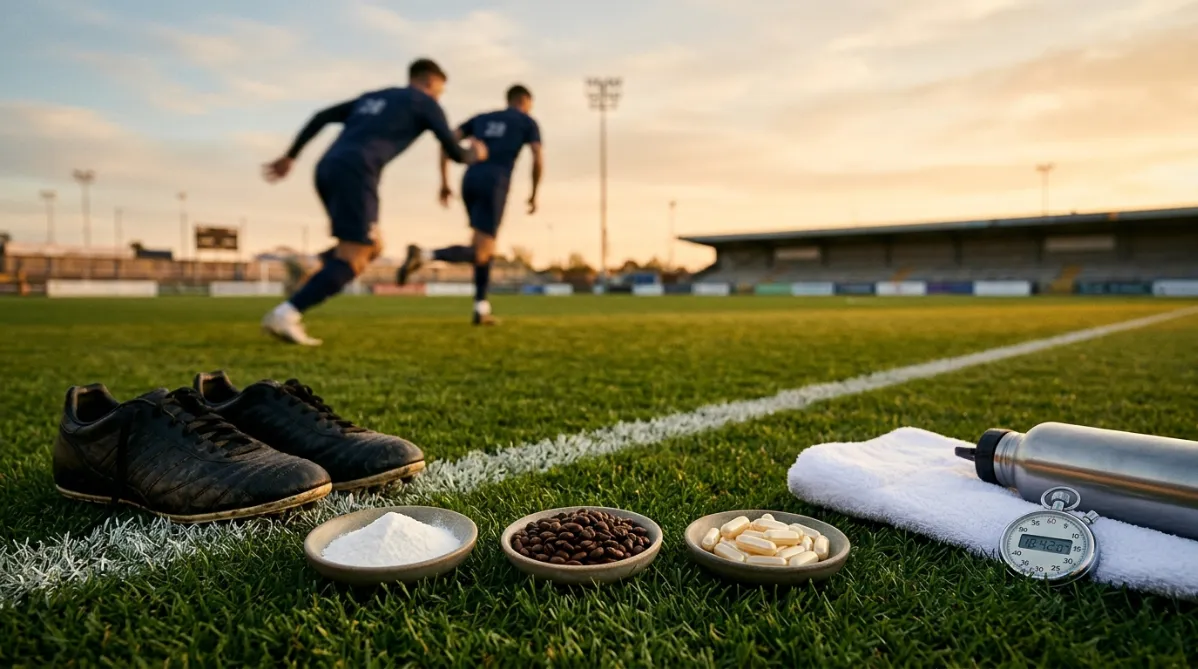
A wide, editorial-style photograph of a professional soccer pitch at golden hour, shot from a low angle at the edge of the grass. In the foreground, slightly off-center to the left, a pair of worn leather cleats sits beside a scatter of three small matte ceramic dishes. One holds fine white taurine powder, one holds dark roasted coffee beans, and one holds pale cream-colored softgel capsules. Soft warm light catches the textures: the grain of the beans, the powder's fine crystalline sheen, the glossy curve of the capsules. A clean white sports towel and a brushed-steel water bottle rest nearby, with a small stopwatch lying on the turf, its face softly glowing.

Behind them, the field stretches into a gentle blur. A lone player in a muted navy training kit mid-sprint leaves a faint streak of motion across the frame, with painterly bokeh from stadium floodlights and distant stands. The grass is a rich, deep green with crisp white line markings curving across the midground and leading the eye toward the athlete. Long amber shadows stretch across the pitch, and a hazy peach and pale blue sky fills the upper right, leaving open negative space for a title overlay.

The palette is restrained and modern: deep green, warm cream, soft amber, charcoal, and a touch of muted coral. The depth of field is shallow, with sharp detail on the supplements and cleats. The mood is calm, premium, and scientific without feeling clinical, like a contemporary sports-science magazine or wellness journal cover. The lighting is natural and cinematic, with gentle film grain and a subtle vignette. The composition follows the rule of thirds, with clean lines and no text, logos, or clutter.
Nutrition

Taurine, Caffeine + PS Stack Gave Pro Soccer Players an Edge. The Catch?

Dr. Gymbro · · 4 min read

The Headline Result, and the Fine Print That Matters

Professional footballers who took a taurine, caffeine and phosphatidylserine (PS) stack for two weeks sprinted 30 m with more favorable results than those on placebo. They also posted better scores on several reaction-time and mental-fatigue measures. Here is the twist: the researchers themselves say the trial does not prove the stack makes players more fatigue-resistant. It also cannot tell you whether PS is doing any of the work.

That tension is what makes this new randomized trial in Nutrients worth a close read.

What the Researchers Actually Did

The study enrolled 97 professional male football players in a randomized, triple-masked, placebo-controlled, parallel-group design. Players were split into four groups for 14 days:

  • Placebo (PLA): n = 24
  • Taurine + caffeine (TC): n = 24
  • Taurine + caffeine + 300 mg/day PS (TCP-300): n = 24
  • Taurine + caffeine + 600 mg/day PS (TCP-600): n = 25

The taurine dose was 1,500 mg/day and the caffeine dose was 200 mg/day in all active groups. Afterward, players completed a standardized football-specific exercise protocol. The team measured 30 m sprint time, visual and auditory reaction time, Stroop-task performance, perceived mental fatigue and GPS-derived locomotor variables.

The Wins: Sprint, Reaction Time and Mental Fatigue

After adjusting for baseline values, the analysis found a significant treatment-group effect on post-intervention 30 m sprint time. After Holm-Bonferroni correction for multiple comparisons, significant treatment-related effects held up for three cognitive and psychomotor outcomes:

  • Stroop reaction time
  • Visual reaction time
  • Perceived mental fatigue

Auditory reaction time did not make the cut. Its unadjusted p-value was 0.074, and the Holm-adjusted value was 0.096, so there was no statistically significant effect.

The GPS-derived locomotor outcomes during the football-specific protocol also differed significantly between groups after baseline adjustment. Overall, the active stacks were associated with more favorable selected outcomes than placebo.

300 mg vs 600 mg PS: Barely a Difference

It is tempting to assume that doubling the PS dose doubles the benefit. The data do not support that. Several outcomes were numerically more favorable in the 600 mg group, and the smallest first-to-second-half performance losses were generally seen in TCP-600. But the authors state that differences between TCP-300 and TCP-600 were modest and not consistently statistically significant. The study was also not powered to establish a dose-response relationship.

In plain terms, 600 mg looked slightly better on paper, but this trial cannot say it is worth the extra capsules over 300 mg.

The Big Caveat: This Is Not Proof of Fatigue Resistance

The trial also measured first-to-second-half performance-loss indices, which show how much output dropped over the course of the protocol. The groups differed on these after the intervention. That sounds like a fatigue-resistance win, but the authors explicitly warn against reading it that way. Comparable decline indices were not available at baseline, so there is no way to show the stack changed how players fade. The post-intervention differences cannot be framed as an intervention-related improvement in fatigue resistance.

A second limitation is just as important. PS was never tested on its own. Every active group received taurine and caffeine, and the design did not isolate PS. The findings reflect the combined multi-ingredient protocols, not PS alone. Caffeine is a well-known stimulant, so it could plausibly explain a good share of the sprint and reaction-time effects. This trial cannot untangle that.

Practical Takeaways: The Stack as Studied

Here is what was used in the trial, so you can compare it against your own plans:

  • Taurine: 1,500 mg/day
  • Caffeine: 200 mg/day
  • Phosphatidylserine: 300 or 600 mg/day, with only modest differences between them
  • Duration: 14 days

The abstract does not specify how the daily dose was timed relative to training or matches, so there is no evidence-based timing rule to pass along here. Check the full paper for those details before copying a protocol.

Who Is This For?

The evidence applies to professional male football players under the conditions of a 14-day trial. It does not directly address amateur athletes, female players, other sports or long-term use. If you are a competitive player curious about cognitive sharpness late in games, this is an interesting signal, not a prescription. Anyone sensitive to caffeine, taking medication or managing a health condition should talk to a sports dietitian or physician first. Teams should also ensure any supplement is batch-tested for banned substances.

The Bottom Line

This trial adds to the case that multi-ingredient stacks can sharpen reaction time, reduce perceived mental fatigue and improve sprint outcomes in elite footballers. The headline caveats are real, though. PS was not isolated, the 300 mg versus 600 mg gap was modest, and the fatigue-resistance question remains open. Treat it as a promising lead for future studies that include PS-only arms and baseline fatigue measures, not as proof that a three-ingredient stack is a match-day miracle.
Original study

Read the original research on pubmed.ncbi.nlm.nih.gov →

This article summarizes published research for general information. It is not medical advice.

DG

Written by

Dr. Gymbro

Dr. Gymbro writes for Dr. Gymbro: science-backed fitness, nutrition & performance.

Related Articles

nutrition

Caffeine Made Soccer Players Faster, But Not at Reacting

BY DR. GYMBRO ·

Everyone assumes caffeine makes athletes sharper all around, but a new double-blind trial in amateur soccer players tells a more nuanced story. A 300 mg dose (about 3.7 mg/kg) improved planned agility with an effect size of 0.62 and also boosted jump performance. But when players had to react to a light or a human opponent, the benefits were small or not statistically significant. Here is what the study found, how to read the results, and who might actually benefit.

A wide, editorial-style photograph of a soccer pitch at golden hour, shot from a low angle at the edge of the touchline. In the foreground, a pair of worn leather cleats sits beside a small, matte white scoop and a minimalist ceramic jar of fine white powder resting on the dewy grass. A few loose grains of powder dust the blades of grass and catch the warm light. The jar is unbranded, with a clean, modern look.

In the midground, slightly out of focus, a lone player in a plain charcoal training kit stands mid-stride on the pitch, caught in a sprint. The motion blur in the legs suggests speed, and long shadows stretch across the freshly mowed stripes of the turf. A soccer ball rests a few meters ahead of the player.

Behind them, the stadium stands curve softly into the distance, rendered in a hazy, muted gradient of peach, soft amber, and pale blue sky. The mowing pattern on the grass forms clean diagonal lines that lead the eye toward the horizon. A thin white chalk line cuts across the frame, adding a subtle graphic element.

The palette is warm and restrained: sage and deep green grass, cream white, soft apricot light, and touches of charcoal. The mood is calm, thoughtful, and slightly skeptical rather than hyped, like a magazine feature on sports science. Shallow depth of field with a creamy bokeh background, fine film grain, and gentle natural contrast. The composition follows the rule of thirds, with the jar and cleats in the lower left and open negative space in the upper right, which leaves room for a headline overlay. The look is contemporary and clean, like a premium health and performance journal.
nutrition

Creatine for Soccer: 41 Studies, One Awkward Truth About Sprints

BY DR. GYMBRO ·

Creatine is everywhere, and soccer's sprint-heavy demands make it look like a perfect match. A new systematic review of 41 unique studies tested that idea and delivered a verdict that's more cautious than the marketing. Some trials showed benefits for repeated sprints, anaerobic power and strength, but the evidence was inconsistent and rated very low certainty. Recovery claims got little support, and body mass often rose without clear lean-mass gains. Here's what to take from it, who might benefit, and who should think twice.

A wide, editorial-style still life photographed on a pale, matte stone countertop in soft morning window light. On the left, a small ceramic cup of black coffee sits beside a scattering of whole roasted coffee beans, with a thin wisp of steam rising. At the center, a shallow wooden bowl holds dried Rhodiola rosea root pieces, rust-orange and tan, with a few fresh succulent-like Rhodiola rosette stems with blue-green leaves and yellow-gold flowers laid across the surface. On the right, a minimalist matte white scoop and two small glass vials of fine powder, one dark brown and one soft amber, are lined up neatly like a measured dose. Behind them, softly out of focus, a blurred athletic setting suggests a training space: a muted sage-green wall, a folded gray towel, and a worn soccer ball resting on a low bench. A stopwatch with a clean white face lies in the foreground, slightly angled, hinting at timing and performance. The palette is warm and earthy: cream, terracotta, deep espresso brown, moss green, and a touch of marigold yellow. Shadows are long and gentle, with a shallow depth of field and fine natural texture in the stone, wood, and plant material. The composition is balanced and uncluttered, with generous negative space on the upper left for headline text. The overall look is modern, calm, and trendy, like a contemporary wellness and science journal cover, with crisp detail, subtle film grain, and a natural, tactile feel.
supplements

Rhodiola + Caffeine: The Stack That Beat Placebo on Wingate Power

BY DR. GYMBRO ·

Caffeine is the king of pre-workouts, but a new crossover trial suggests pairing it with Rhodiola rosea might unlock something extra. In trained soccer players, the combo (3 mg/kg of each, taken 60 minutes before) was the only condition to beat placebo on maximum Wingate power. Salivary cortisol, α-amylase and IgA each shifted in different ways across conditions. But with just 10 participants and a single acute dose, this is a signal, not a verdict. Here's what the study actually showed, who it applies to, and what you shouldn't read into it.

A lone trail runner pauses on a high alpine ridge at dawn, holding a small enamel camp mug of steaming coffee, with thin ribbons of steam curling into crisp, cold air. She wears a fitted charcoal running vest and a muted sage windbreaker, and her breath is faintly visible. Behind her, layered mountain ranges fade into soft blue and lavender haze, and a sea of low clouds fills the valley below. Warm golden sunlight skims the ridgeline and rim-lights her profile, shoulders, and the rising steam. In the foreground, a scattering of dried alpine grasses and lichen-covered stones is in sharp focus, with a worn trail snaking toward the summit. Near the mug sits a small pair of trail running shoes with dusty soles and a simple analog wristwatch resting on a flat rock.

The composition follows a wide 16:9 editorial layout. The subject sits slightly right of center on the rule of thirds, leaving generous negative space in the pale peach-and-powder-blue sky on the left, where headline text could sit. The palette is restrained and modern: warm amber, soft cream, dusty sage, slate blue, and a touch of terracotta. The look is cinematic but natural, with shallow depth of field on the foreground details, gentle film grain, and a slightly matte finish. It evokes a high-end outdoor lifestyle magazine or a contemporary wellness journal. The mood is calm, focused, and quietly determined, capturing the contrast between thin, cold altitude air and the warmth of a coffee ritual. The image has no text, logos, or futuristic elements, and no gym equipment, only natural light, texture, and atmosphere.
nutrition

Caffeine in Thin Air: The Endurance Boost Hypoxia Can't Erase

BY DR. GYMBRO ·

Thin air wrecks endurance, but a new meta-analysis suggests caffeine can claw some of it back. Pooling nine placebo-controlled crossover studies (117 participants), researchers found a moderate-to-large performance boost in hypoxia (g = 0.76). The surprise is that oxygen saturation and perceived exertion didn't change, while heart rate, lactate, and ventilation went up. The evidence is rated low certainty and only 19 participants were women, so this is promising rather than proven. Here's who stands to benefit, who should skip it, and how to think about dose and timing.

This page is available in
