Dr. Gymbro
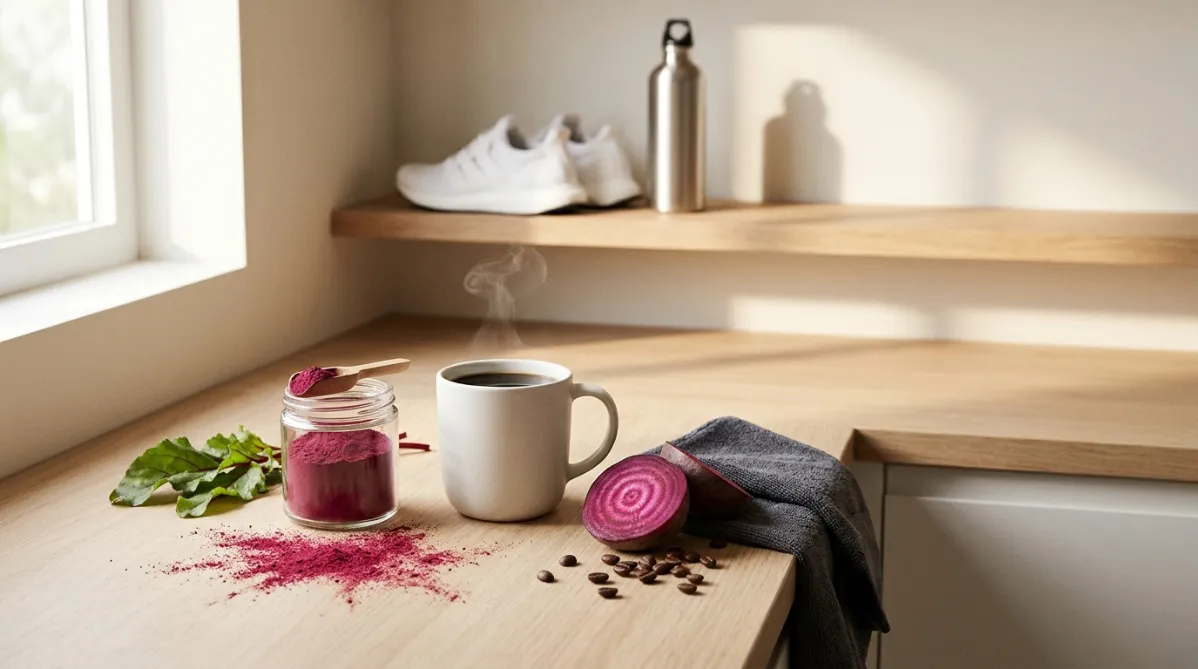
A sunlit, minimalist kitchen counter in a modern home, photographed from a slightly elevated three-quarter angle with soft natural morning light spilling in from a window on the left. In the center sits a matte white ceramic mug of black coffee with a thin curl of steam, beside a small glass jar of deep magenta beetroot powder with a wooden scoop resting on the lid. A scattering of fine crimson powder dusts the pale oak surface in an artful, casual swirl. Nearby, a halved raw beetroot reveals vivid concentric rings of purple and pink, next to a few roasted coffee beans and a neatly folded charcoal gym towel. In the soft-focus background, a pair of clean white running shoes and a stainless steel water bottle sit on a floating shelf, hinting at a pre-workout routine. A single sprig of green beet leaves adds a fresh accent.

The color palette is warm and editorial: creamy neutrals, espresso browns, and rich beet magenta, with gentle highlights and long soft shadows. The composition has generous negative space on the right side for headline text, shallow depth of field, and a crisp, tactile texture on the ceramic, powder, and wood grain. The mood is calm, health-conscious, and contemporary, like a lifestyle feature in a premium wellness magazine or a trendy nutrition journal. Clean, balanced, natural, with subtle film-like grain and a slightly muted, high-end finish.
Science & Research

Pre-Workout Caffeine Stiffens Arteries. Beetroot Powder Offset It

Dr. Gymbro · · 4 min read

If your pre-workout routine leans on a big scoop of caffeine, a new crossover trial suggests your arteries may notice, even when your blood pressure does not. The same study also found that a nitrate-rich beetroot powder taken alongside the caffeine brought those arterial changes back to placebo levels.

The paper, published in Food & Function in 2026 by McLellan and colleagues, is small and short-term. It is still an interesting look at how two of the most popular performance aids interact in the cardiovascular system.

What the Researchers Did

Twenty-four healthy adults (17 males, average age about 24) completed four trials in a randomized, double-blind, placebo-controlled crossover design. Every participant tried every condition, which makes the comparisons cleaner than in a study that splits people into groups.

The four conditions were:

  • PL: nitrate-depleted beetroot powder (92 mg nitrate) with no caffeine
  • CAF: nitrate-depleted beetroot powder plus 6 mg/kg caffeine
  • BR: nitrate-rich beetroot powder (400 mg nitrate) with no caffeine
  • BR-CAF: nitrate-rich beetroot powder plus 6 mg/kg caffeine

For a 80 kg person, 6 mg/kg works out to roughly 480 mg of caffeine. That is on the high end of what many pre-workout products deliver, and above what most people get from a single coffee. Researchers measured brachial and central blood pressure and arterial stiffness before and 2.5 hours after supplementation. Macrovascular endothelial function was assessed afterward with flow-mediated dilation (FMD).

The Headline Result: Caffeine Raised Stiffness Markers

Caffeine alone increased two arterial stiffness measures. Augmentation pressure rose by about 3 mmHg, compared with about 1 mmHg on placebo. Augmentation index rose by about 10%, versus about 4% on placebo and about 1% with nitrate-rich beetroot alone. The differences were statistically significant (P between 0.001 and 0.007).

Augmentation pressure and index reflect how much pressure waves bouncing back from the periphery add to the pressure the heart faces. Stiffer arteries return those waves sooner, which increases the load on the heart. Higher values are generally considered less favorable for cardiovascular health.

The Twist: Nitrate Cancelled It Out

When the 400 mg nitrate beetroot powder was taken with caffeine, the rise largely disappeared. Augmentation pressure rose by about 1 mmHg and augmentation index by about 3%, which was statistically indistinguishable from placebo or beetroot alone (P = 0.505-0.689).

Blood tests fit the expected nitrate pathway. Plasma nitrite was higher in both beetroot-rich conditions than in placebo or caffeine alone. Nitrite is a precursor of nitric oxide, which helps blood vessels relax. Interestingly, plasma cyclic GMP, a downstream signaling molecule, did not differ between conditions, so the exact mechanism is not nailed down by this study.

What Did Not Change

It is important not to overstate the findings. Several things stayed flat:

  • Brachial blood pressure was not significantly altered by caffeine or beetroot.
  • Central blood pressure was likewise unchanged.
  • Flow-mediated dilation, a measure of macrovascular endothelial function, showed no differences.

So the headline is not that caffeine spiked blood pressure or damaged vessel lining. The effect was specific to wave-reflection markers of arterial stiffness. That is a subtler signal, and its long-term health meaning is unclear from a single dose.

Practical Takeaways

Nitrate dose: The effective beetroot powder supplied 400 mg of nitrate. Check labels, because beetroot products vary widely and many do not list nitrate content. A product with no stated nitrate amount is a guess.

Timing: Caffeine and nitrate were consumed together, and measurements were taken 2.5 hours later. That roughly matches a pre-workout window, but the study did not test other timings or exercise itself.

Who might care: People who regularly take high-dose caffeine before training, especially those stacking multiple stimulant products, are the most obvious audience. Someone drinking one cup of coffee is far from the 6 mg/kg dose used here.

A sensible approach: If you already use beetroot or nitrate supplements for endurance, pairing them with your caffeine is a low-risk idea based on this data. It is not a reason to raise your caffeine dose.

What We Do Not Know

The limits are substantial:

  • One dose, one session. Nothing here speaks to daily use over weeks or years.
  • Healthy young adults only. Older people, those with hypertension, or those with existing vascular disease may respond differently.
  • No exercise component. The trial measured responses at rest after supplementation, not during or after training.
  • Small sample. Twenty-four participants, mostly male, limits generalizability.
  • Unclear mechanism. The unchanged cGMP leaves open how nitrate exerted its effect.
  • Clinical relevance. Whether a transient bump in augmentation index translates to meaningful risk is unproven.

Bottom Line

This randomized crossover trial suggests that a high pre-workout dose of caffeine can acutely increase arterial stiffness markers, and that 400 mg of dietary nitrate from beetroot powder can offset that increase. Blood pressure and endothelial function were not affected, so there is no cause for alarm. It is an early, mechanistic finding that points to a plausible, food-based way to soften one cardiovascular side effect of heavy caffeine use. Larger and longer trials in more diverse populations, ideally including exercise, are needed before anyone treats beetroot as a protective shield.
Original study

Read the original research on pubmed.ncbi.nlm.nih.gov →

This article summarizes published research for general information. It is not medical advice.

DG

Written by

Dr. Gymbro

Dr. Gymbro writes for Dr. Gymbro: science-backed fitness, nutrition & performance.

Related Articles

A landscape editorial photograph with a modern, clean magazine feel, shot on a pale warm-gray concrete surface in soft natural window light from the left. In the foreground, two matte white ceramic espresso cups sit side by side. The left cup holds a small amount of dark espresso with golden crema. The right cup is filled twice as high. Beside them, two small stainless steel scoops hold fine coffee-colored powder, one half full and one heaped, suggesting a dose comparison without any text or labels. A pair of worn red leather boxing gloves rests slightly out of focus behind the cups, laces loosely draped, with a white hand wrap rolled neatly beside them. A minimalist digital kitchen scale in matte black sits at the edge of the frame, with a few roasted coffee beans scattered across the surface. In the soft-focus background, a boxing gym corner appears: a hanging heavy bag in muted charcoal, pale wood plank flooring, and a tall window with diffused morning light. The palette is warm cream, espresso brown, brick red, and soft slate gray, with gentle shadows and a shallow depth of field. The composition follows the rule of thirds, with the cups and scoops in the lower left third and open negative space on the right for headline overlay. The look is tactile and refined, like a high-end health and performance journal. It has natural grain, subtle contrast, and a calm, confident mood. There are no people, no text, no logos, and no futuristic elements.
nutrition

Doubling Your Caffeine Barely Helped Boxers—Here's What Did

BY DR. GYMBRO ·

Think a double scoop of pre-workout means double the performance? A new crossover trial in 15 competitive boxers compared 3 mg/kg and 6 mg/kg of caffeine, and the bigger dose was not consistently better. Both doses raised jump height and power at 60 minutes, while 6 mg/kg only pulled ahead on a few outcomes like ballistic push-up power and knee torque. Here is the mg-per-kg conversion for common body weights, the timing the data supports, and the honest caveats, including that punching itself was never tested.

A wide, editorial-style flat lay on a warm, matte cream stone surface, shot from slightly above in soft natural morning light. On the left, a ceramic espresso cup in muted terracotta holds dark coffee, with a few roasted coffee beans scattered beside it. In the center, a small wooden board holds three bright red chili peppers, one sliced open to show pale seeds, next to a small pile of coarse red pepper flakes. On the right, a pair of minimalist off-white running shoes with sage green accents rests at an angle, and a slim stopwatch with a clean white face lies in front of them. Three small matte white capsules sit in a neat row at the center of the composition, a quiet nod to the placebo and the active doses. Soft shadows fall to the lower right. A sprig of dried eucalyptus and a folded linen cloth in oatmeal tones add texture at the edges. The palette is warm and restrained: terracotta, chili red, cream, sage, and charcoal brown, with a gentle pop of red as the focal accent. The depth of field is shallow, so the foreground beans are slightly soft and the chilies and capsules stay crisp. The mood is clean, modern, and magazine-like, in the style of a contemporary health and science journal. There is no text, no people, and no logos, and plenty of negative space on the upper left and right edges leaves room for a headline overlay.
nutrition

Caffeine + Capsaicin Beat Placebo in a 10K. Capsaicin Alone Didn't

BY COACH RYAN ·

A chili-pepper compound plus caffeine was the only combo that beat placebo over 10 km in a new crossover trial, yet capsaicin alone did nothing. Caffeine drove the statistical effect, and there's no proof of synergy. The dose, 6 mg/kg, works out to roughly 450 mg for a 75 kg runner, which is a lot. Insomnia, anxiety, headaches, and racing heart showed up more often with caffeine. Here's what the 20-runner study found and who should skip it.

A sunlit outdoor running track in late afternoon, shot from a low angle with shallow depth of field. In the foreground, a matte black bottle with a minimal off-white label sits on the edge of a warm terracotta-colored track lane, beside a folded white towel and a small glass of amber liquid catching golden light. Condensation beads on the bottle. A faint heat shimmer rises from the track surface and softens the background.

In the midground, slightly out of focus, a lean athlete in a sage-green tank top and charcoal shorts runs on a treadmill-like stretch of track, a thin sheen of sweat on their shoulders, their expression focused and calm. Their motion is gently blurred, suggesting endurance and rhythm. Long soft shadows stretch across the lane lines.

The background fades into hazy peach, apricot, and pale yellow tones, with the suggestion of tall trees and a distant stadium wall. Warm sun flare enters from the upper right, creating a subtle glow and a few soft light streaks across the frame.

Subtle editorial touches: a small notebook with a pencil and a stopwatch rest beside the bottle, hinting at data and timing without any text legible. The color palette is warm and muted, with terracotta, cream, sage, and charcoal accents, and a fine film-like grain. The composition leaves open negative space on the left third for a headline overlay. The overall mood is clean, modern, and health-journal inspired, natural and aspirational, with a calm scientific curiosity rather than hype.
nutrition

Ketone Drinks in the Heat: Longer Endurance and Sharper Memory?

BY DR. GYMBRO ·

Ketone drinks are supposed to be for fat-burning biohackers, but a new heat-stress trial suggests they might also help you finish stronger. In 17 trained men, ketone monoester plus caffeine extended time to exhaustion to 8.9 minutes versus 7.0 with carbs plus caffeine, after 90 minutes of loaded treadmill work at 34 °C. Working-memory accuracy on the 1-back task improved too, while heart rate and core temperature didn't differ meaningfully. But 2-back, reaction time and the hit-and-avoid task showed no benefit, and the study was small, male-only and single-session. Here's what the data show, and what they don't.

A wide editorial still life on a pale, warm-toned concrete surface in soft morning window light. In the center-left, a shallow matte ceramic bowl holds a small pile of bright red coffee cherries with glossy skins, a few sliced open to reveal pale mucilage and paired green-tan beans. Beside it, a small glass dish of fine, golden-brown powdered extract with a tiny wooden scoop resting on its edge. A sprig of coffee plant leaves, deep green and waxy, arcs across the foreground.

On the right side, slightly out of focus, a sleek road cyclist's handlebar and a matte black water bottle lean against a light plaster wall, suggesting athletic training without showing a person. A minimalist analog stopwatch with a clean white face and thin black hands sits in the mid-ground, angled toward the camera, its hands paused near the fifteen-minute mark. A folded linen cloth in oatmeal beige and a single small espresso cup with a thin crema ring add quiet texture.

The color palette is restrained and modern: cherry red, sage green, cream, soft terracotta, and charcoal accents. Light comes from the left, casting long, gentle shadows with a subtle warm glow and a hint of dust in the air. Shallow depth of field with crisp focus on the cherries and stopwatch, creamy bokeh in the background. Composition leaves open negative space in the upper right for a headline overlay. The overall feel is a clean, trendy health-and-science magazine cover: tactile, natural, minimal, and calm, shot in a 16:9 landscape frame with fine film-like grain and true-to-life tones.
nutrition

Coffee Cherry Extract: 200 mg Caffeine Lifted Cycling Output 4.6%

BY DR. GYMBRO ·

A low 200 mg caffeine dose from whole coffee cherry extract helped trained cyclists produce 4.6% more work in a 15-minute time trial. But the popular idea that it speeds up glycogen refuelling didn't hold up. This randomized, double-blind crossover trial involved just 12 cyclists and was industry-funded, with no plain-caffeine comparison group. Here's what the data show, what they don't, and who might want to try it.

This page is available in