Dr. Gymbro
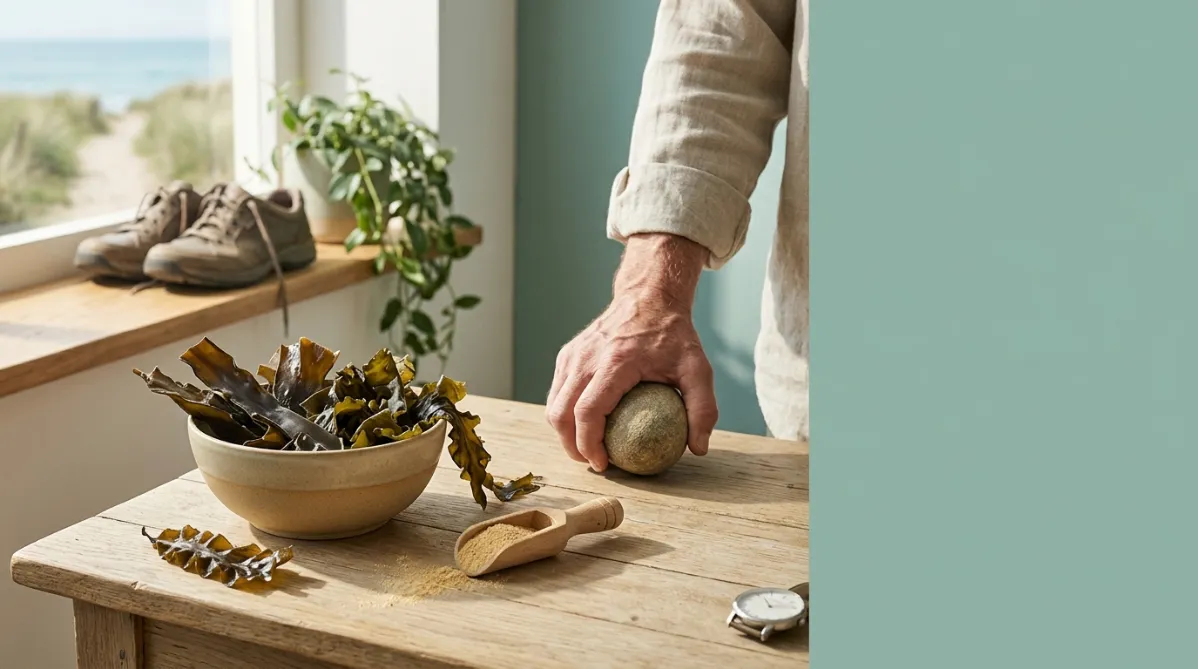
A wide, softly lit editorial photograph of a rustic light-oak table by a sunny window. On it, a handful of dried brown kelp and wakame seaweed fronds spill from a handmade matte ceramic bowl in warm sand tones, their glossy, ruffled edges catching the light. Beside the bowl sits a small wooden scoop holding fine golden-beige powder, with a little of it dusted across the table. In the middle ground, an older adult's weathered but strong hand grips a smooth, rounded river stone, with the knuckles and tendons subtly emphasized to suggest strength and vitality. Only the hand and part of a forearm in a soft oatmeal linen sleeve are visible.

In the background, slightly out of focus, a pair of worn leather walking shoes rests on a windowsill next to a trailing green plant. Beyond the window, a blurred coastal path winds through dune grass toward a pale blue sea, hinting at walking and an active daily life. A simple analog wristwatch lies on the table's edge, a quiet nod to the twelve-week timeline.

The palette is muted and natural: sage green, warm sand, soft ocean teal, and creamy off-white, with deep olive-brown accents from the seaweed. Morning light streams in from the left, casting long, gentle shadows and a faint golden glow. The depth of field is shallow, with crisp focus on the hand and seaweed and a creamy bokeh background. The composition follows the rule of thirds, with the hand and bowl on the left and generous negative space on the right for headline text. The mood is calm and hopeful, with a clean, contemporary wellness-magazine feel. The image is shot as if on a 50mm lens with subtle film grain and a natural, uncluttered, tactile look.
Science & Research

Seaweed Fucoidan Boosted Grip Strength in Over-60s in 12 Weeks

Dr. Gymbro · · 4 min read

The Problem: Strength Fades Faster Than Most People Expect

Sarcopenia, the age-related loss of muscle mass and function, is one of the quieter public health problems of aging societies. It rarely announces itself. Jars get harder to open, stairs feel steeper, and a walk that used to be easy becomes a chore. Resistance training remains the gold standard for slowing it, but not everyone can lift hard or often. Frailty, joint pain, chronic illness and plain lack of access all get in the way. That gap is why researchers keep looking for supplements that might help people who can't train much.

A new randomized trial in Archives of Gerontology and Geriatrics tested one candidate: a low-molecular-weight fucoidan extracted from brown seaweed. The results were encouraging for strength and function. They were less so for muscle size.

What Is Oligo-Fucoidan?

Fucoidan is a sulfated polysaccharide found in brown seaweed, and it has attracted attention for a range of biological activities, including potential muscle-supporting effects. The product tested here was an "oligo" form, meaning it has been broken down into smaller fragments of roughly 15 kDa. The assumption behind that is that smaller molecules are easier for the body to handle. The study used a branded product called OliFuco, so the results apply to that formulation and not to seaweed or fucoidan supplements in general.

How the Trial Worked

The 12-week, double-blind, placebo-controlled study randomized 60 community-dwelling adults aged 60 or older into three groups:

  • Oligo-Fucoidan alone
  • Oligo-Fucoidan plus branched-chain amino acids (BCAAs) and vitamin D
  • Placebo

The fucoidan dose was 825 mg twice daily, or 1,650 mg per day. Researchers measured handgrip strength, calf circumference, appendicular lean mass index (a DXA-style measure of limb muscle mass), the five-times sit-to-stand test, the six-minute walk test (6MWT) and isokinetic knee extension strength. A secondary summary of the study from Ergo-Log reports that 46 participants were included in the final analysis. The abstract itself doesn't describe any exercise program, so the findings should be read as supplement effects in everyday-living older adults, not as the result of a new training regimen.

The Headline Result: Grip Strength

Grip strength improved significantly with Oligo-Fucoidan (p < 0.001, effect size r = 0.82). In the fucoidan group, 64.7% of participants beat the minimal clinically important difference, meaning the change was large enough to plausibly matter in daily life. The Ergo-Log write-up puts the gain at roughly 18–23%, though that figure comes from the secondary source and not the abstract.

Grip strength is more than a party trick. It is widely used as a quick marker of overall muscle function in older people, and it is a standard component of sarcopenia screening. A clinically meaningful improvement in 12 weeks is therefore notable.

Walking performance improved too. The 6MWT distance increased significantly (p < 0.001), and 47.1% of participants surpassed the minimal detectable change threshold. A multivariate analysis (MANOVA) across six outcomes showed significant overall group differences, driven mainly by the grip strength gains in the fucoidan group compared with placebo.

The Surprises: No Muscle Gain, and No Bonus From BCAAs + Vitamin D

Two findings complicate the story.

First, muscle mass did not change significantly. The benefit showed up in strength and performance, not in lean tissue. That could mean fucoidan acts on muscle quality, neural function or something else, but this trial can't say which. The one mass-related signal was in the placebo group, whose calf circumference dropped (p = 0.012), while the fucoidan group didn't show that decline.

Second, adding BCAAs and vitamin D did not beat fucoidan alone. Many supplement stacks assume more ingredients mean better results, and this trial doesn't support that assumption. Based on the available summary, the combination arm offered no clear advantage over the simpler single-ingredient arm.

No adverse events were reported during the 12 weeks.

Caveats Worth Taking Seriously

This is a small trial: 60 randomized participants split across three arms. It lasted only 12 weeks, so we don't know whether the gains persist, plateau or fade. The intervention was a single branded, low-molecular-weight product at one dose, and we can't assume other fucoidan supplements behave the same way. The authors themselves call for further research on long-term effects and on optimizing the formulation. Small trials with large effect sizes also deserve replication before anyone treats them as settled.

Practical Takeaways

  • Who it might suit: Older adults, especially those with limited ability to do hard resistance training, are the population this research targets.
  • Dose studied: 825 mg twice daily (1,650 mg/day) of low-molecular-weight Oligo-Fucoidan for 12 weeks.
  • Don't expect bigger muscles: The measurable gains were in strength and walking performance, not muscle mass.
  • Skip the add-ons for now: BCAAs plus vitamin D didn't improve on fucoidan alone in this trial.
  • Training still wins: The authors reaffirm resistance training as the gold standard. If you can lift, keep lifting. Fucoidan, if it holds up, is a possible adjunct or alternative, not a replacement.
  • Talk to a clinician: Anyone with health conditions or on medication should check with a healthcare professional before adding a new supplement.

Bottom Line

This trial suggests that a specific seaweed-derived fucoidan can improve grip strength and walking performance in older adults within three months, with no reported adverse events. That makes it a promising, non-pharmacological idea for people who struggle to train. But it is early, small and product-specific, and it didn't move muscle mass. Treat it as a lead worth following, not a substitute for the barbell, the resistance band or the stairs.

Source: Chang et al. "The effects of Oligo-Fucoidan on muscle function in community-dwelling older adults: A double-blind, randomized, placebo-controlled trial." Archives of Gerontology and Geriatrics (2026). DOI: 10.1016/j.archger.2025.106055. PubMed: 41124892.
Original study

Read the original research on pubmed.ncbi.nlm.nih.gov →

This article summarizes published research for general information. It is not medical advice.

DG

Written by

Dr. Gymbro

Dr. Gymbro writes for Dr. Gymbro: science-backed fitness, nutrition & performance.

Related Articles

A landscape editorial photograph of a sunlit kitchen table in soft morning light. An older adult's hands, with silver hair and a cream knit sleeve just visible, rest around a ceramic mug. Beside the mug are two small matte white ceramic dishes. One holds a mound of fine white powder, and the other holds a slightly different crystalline white powder. Two wooden spoons lie next to them. A handheld hand-grip dynamometer in muted sage green sits on a linen placemat in the foreground, slightly out of focus. A small open notebook with a pencil and a pair of round tortoiseshell reading glasses sit nearby, with no legible text.

The tabletop is pale oak with a visible grain. Behind it, a window with sheer curtains lets in warm golden light, and the blurred shapes of a trailing green pothos plant and a pale terracotta vase show in the background. The color palette is warm cream, sage green, soft terracotta, and pale wood, with a touch of muted navy from a folded napkin. The mood is calm, thoughtful, and quietly scientific without any laboratory feel.

The composition follows the rule of thirds. The hands and dishes sit in the left-center, and generous negative space on the right is suitable for a title overlay. Shallow depth of field, 50mm lens look, gentle film grain, and soft shadows. Modern lifestyle-magazine and health-journal aesthetic, natural and unstaged, high-end editorial photography.
nutrition

Creatine's Precursor Beat Creatine for Grip Strength in Over-65s

BY DR. GYMBRO ·

A small trial in adults over 65 found that guanidinoacetic acid (GAA), the direct precursor of creatine, improved grip strength more than creatine monohydrate. The catch is that it was an 8-week pilot with just 21 completers, no exercise program, and a confidence interval that barely cleared zero. GAA also showed greater myostatin suppression and BIA-measured gains in muscle-related indices, though those readings may partly reflect hydration. Homocysteine is the safety question to watch, since GAA consumes methyl groups and has raised it in other studies. Here is what the study found, what it can't tell us, and why creatine monohydrate is still the proven default.

A bright, airy editorial still life photographed from slightly above on a pale oat-colored linen surface, in soft natural window light with gentle long shadows. In the foreground, a rustic ceramic bowl holds halved and whole oranges, glossy red bell pepper slices, and a few kiwi halves with emerald flesh. Beside it sit loose strawberries and a small pile of bright yellow lemon wedges. Their colors pop against the muted neutral palette. A single clear glass of water with a slice of orange rests nearby, catching the light.

On the right side of the frame, a pair of well-worn but clean walking sneakers in sage green and cream sits casually on the surface, with one lace loosely trailing. Behind them, a simple wooden chair with a light ash finish is partly visible and slightly out of focus, a quiet nod to the sit-to-stand test. A small stainless-steel stopwatch lies next to the shoes, with a subtle reflective glint.

A minimalist ceramic dish holds a few small, round, pale-yellow vitamin capsules, kept understated. A sprig of green leaves and a folded cotton napkin in soft terracotta add a warm accent. A small open notebook with a pencil rests in the upper left, its page blank except for faint, abstract pencil lines suggesting a simple rising graph, with no legible text.

The composition leaves generous negative space on the left third for title overlay, with a soft cream-to-peach gradient background. The mood is fresh, healthy, and contemplative, like a modern wellness magazine or a trendy online journal. The color palette is warm citrus orange, sunny yellow, sage green, and soft cream, with gentle terracotta accents. The depth of field is shallow, with crisp focus on the fruit and shoes and a creamy blur in the background. The overall look is clean, natural, and editorial, with fine film-like grain, true-to-life color, and a calm, optimistic tone. Landscape 16:9 framing.
nutrition

The Cheap Vitamin Linked to Stronger Legs as You Age

BY DR. GYMBRO ·

A large British study of more than 5,000 adults aged 48 to 92 found that people with optimal blood vitamin C (50 µmol/L or higher) walked faster and stood from a chair more quickly than those with low levels. Women also had stronger height-adjusted grip, while men showed no grip link. Food-based vitamin C showed associations only in women, and not in a tidy pattern. The design is cross-sectional, so it can't prove vitamin C causes better function. Here's what the numbers show, what they don't, and why your blood level may be worth checking.

A warm, softly lit modern home gym or sunlit studio, photographed in a clean editorial style. In the center-right of the frame, a silver-haired woman in her mid-60s with a calm, confident expression grips a matte black kettlebell at hip height. She wears a fitted sage-green athletic top and charcoal leggings. Her forearms and shoulders show lean, defined strength rather than bulk. Beside her, slightly out of focus, a man in his late 60s with short white hair and a trim beard performs a controlled bodyweight plank on a pale oak floor.

In the foreground on the left, a minimalist wooden tray holds two small ceramic bowls. One contains fine white powder and the other holds a few cream-colored capsules. Next to them sit a glass of water with a lemon slice and a folded linen towel. A subtle scatter of powder dusts the tray. The foreground is shot with shallow depth of field and a creamy bokeh falloff.

Behind them, tall windows pour in golden morning light, with long soft shadows across the floor. A potted fiddle-leaf fig and a stacked set of pastel-toned dumbbells on a low wooden shelf add texture. The wall is warm off-white plaster with a hint of terracotta in the corner.

The palette is muted and modern: sage green, warm cream, soft terracotta, natural oak, and charcoal, with gentle highlights. The mood is quietly optimistic, focused, and grounded, suggesting strength, vitality, and measured scientific curiosity. The composition leaves clean negative space in the upper-left for a headline overlay. The look is a high-end wellness magazine cover with natural film-like grain, soft contrast, and crisp detail on the hands and kettlebell. There is no text, no logos, and no futuristic elements, only authentic, aspirational realism.
nutrition

Creatine + HMB Made Over-60s Stronger in 6 Weeks, Not Bigger

BY DR. GYMBRO ·

Over-60s on a creatine + HMB stack got stronger in just six weeks, yet the muscle-mass numbers barely moved. This double-blind crossover trial of 30 active older adults found gains in leg, back and arm strength plus upper-body and core endurance. Regression analyses suggested the improvements were largely independent of muscle size, pointing toward a neuromuscular effect. Before you rush to buy, there are real caveats: a short six-week window, a small sample, and body composition measured by BIA. Here's what the study found, what it didn't, and how to read it.

A softly lit editorial still life on a pale oatmeal-colored linen surface, shot from a slightly elevated three-quarter angle with a shallow depth of field. In the left foreground, a small ceramic dish holds several translucent golden-amber fish oil softgel capsules, glowing as if lit from within by warm morning window light. A few capsules are scattered casually beside it, catching crisp highlights. Just behind them, a sliced fresh salmon fillet with vivid coral-orange flesh rests on a matte slate board next to a sprig of dill, a halved lemon, and a small glass dropper bottle of golden oil.

In the soft-focus midground, a pair of weathered, capable older adult hands rests on the edge of the table, gently holding a pale sage-green resistance band, a hint of an active lifestyle. Beside them sits a modest set of brushed-steel dumbbells and a folded heather-gray towel. Subtle natural details add warmth: a glass of water, a small ceramic mug, and a sprig of eucalyptus in a bud vase.

On the right side, a tidy stack of printed research papers with a few pastel sticky tabs and a pair of thin tortoiseshell reading glasses sits on top, suggesting scholarly review. A fountain pen lies across the pages, with a few abstract handwritten notes and a simple hand-drawn bar chart visible but unreadable.

The palette is warm and calming: cream, soft sage, terracotta, honey gold, and coral accents against muted neutral tones. Window light enters from the left, producing long gentle shadows and a faint dappled leaf-shadow pattern across the linen. The background fades into a creamy blur of pale wall and a hint of a wooden shelf.

The composition leaves clean negative space across the upper right third for headline text overlay. The mood is trustworthy, health-forward, and modern, reminiscent of a contemporary wellness and science journal's photography. Fine film-like grain, natural color grading, high-resolution editorial photography, 16:9 landscape format.
nutrition

Fish Oil for Aging Muscles: What 14 Studies Actually Show

BY DR. GYMBRO ·

Fish oil is being pitched as armor for aging muscles, but what does the evidence actually say? A 2026 umbrella review pooled seven RCTs and seven meta-analyses in adults 55 and older. It found modest but measurable strength gains, with the clearest signal for lower-body strength and function. Grip strength, walking speed, and upper-body strength were far less certain, and heavy overlap among the studies means the evidence is shakier than it looks. Here is what it means, who it may help, and who should check with a doctor first.

This page is available in