Dr. Gymbro
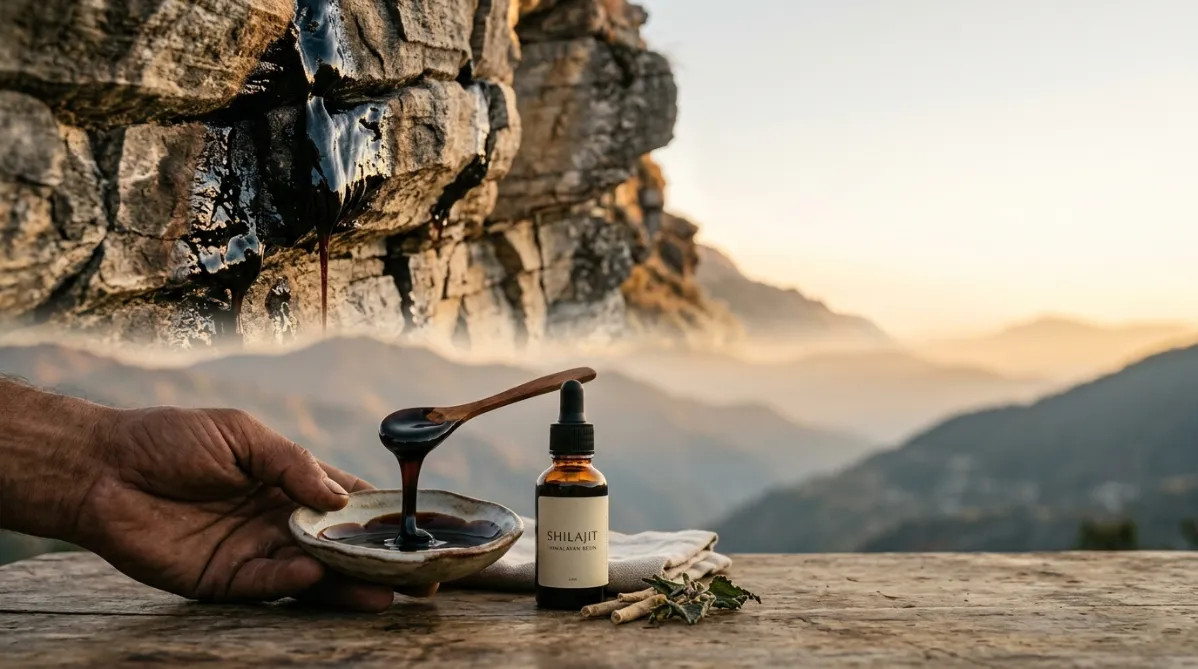
A wide, editorial-style photograph of a rugged Himalayan cliff face at golden hour, with dark, glossy resin seeping from the cracks in the layered stone. Thick, tar-like droplets catch the warm light and shine like polished obsidian. In the foreground, a weathered hand holds a small, rustic ceramic dish with a spoonful of purified Shilajit. The resin is deep brown-black, glossy, and stretches in a slow, viscous ribbon from the spoon. Beside the dish sits a simple, minimalist amber glass dropper bottle with a plain cream label, a folded linen cloth, and a few scattered dried herbs, suggesting a modern wellness ritual. The mid-ground shows soft layers of misty mountain ridges fading into a pale peach and dusty blue sky. The background is gently blurred, with shallow depth of field and creamy bokeh. The color palette is earthy and muted: warm ochre, charcoal, sage green, and soft cream, with a subtle film-grain texture. Natural side lighting creates long, gentle shadows and highlights the textures of the stone, resin, and ceramic. The composition follows the rule of thirds, with the dish and bottle in the lower left and open negative space on the right for headline overlay. The mood is calm, grounded, and credible, like a high-end health and science magazine feature, with a refined, contemporary, slightly documentary look. There is no text, no people's faces, and no futuristic elements.
Science & Research

Shilajit Tested: Can 'Mountain Tar' Really Raise Testosterone?

Dr. Gymbro · · 4 min read

Shilajit, the sticky, tar-like substance that seeps from rocks in the Himalayas and other mountain ranges, has been used in Ayurvedic medicine for centuries. Today it is marketed as a natural testosterone booster, usually with far more confidence than evidence. One randomized, double-blind, placebo-controlled trial is worth a closer look, because it tested a purified shilajit extract against placebo and measured actual hormone levels.

What the Study Did

The paper, by Pandit and colleagues, was published in Andrologia in 2016. It evaluated purified Shilajit, described as an Ayurvedic rasayana (a rejuvenating tonic), in healthy male volunteers aged 45 to 55. Participants took 250 mg twice daily for 90 consecutive days. The design was randomized, double-blind and placebo-controlled, which is the standard format for separating a real supplement effect from expectation and chance.

The researchers focused on male androgenic hormones. The key outcomes were total testosterone, free testosterone and dehydroepiandrosterone sulfate (DHEAS). They also tracked the gonadotropic hormones, luteinizing hormone (LH) and follicle-stimulating hormone (FSH).

What They Found

According to the abstract, 90 days of Shilajit significantly (P < 0.05) increased total testosterone, free testosterone and DHEAS compared with placebo. LH and FSH were "well maintained," meaning they stayed stable rather than rising or falling in a notable way.

The abstract reports statistical significance but no effect sizes, so this article won't put numbers on the size of the increase. Anyone quoting a specific percentage rise should check the full paper rather than rely on supplement marketing.

Why the LH and FSH Result Matters

LH is the pituitary signal that tells the testes to produce testosterone. If a compound raises testosterone while LH climbs sharply, that might suggest the body is compensating for something. If testosterone rises while LH and FSH stay flat, the picture is less clear. It could point to a mechanism that doesn't simply amplify the pituitary signal, but the abstract doesn't explain why this happened. Treat any mechanistic story as speculation unless the full paper supports it.

The DHEAS finding is also interesting. DHEAS is an adrenal androgen precursor that declines with age, so a rise in men in their late 40s and 50s is at least consistent with the idea that Shilajit may affect androgen status broadly rather than testosterone alone.

Important Caveats

This is a promising result, but it has real limits:

  • Modest sample. The trial was not a large, multi-center study. Small trials can produce results that don't replicate, and one study is not a consensus.
  • Middle-aged men, not young lifters. Participants were 45 to 55. Testosterone typically drifts downward with age, so a supplement might show more room to move in this group than in a 22-year-old with already robust levels. These results shouldn't be extrapolated to young athletes.
  • Hormone levels are not performance. The abstract reports hormone markers. It does not report gains in muscle mass, strength, libido or body composition, so don't assume a higher number on a lab test translates into visible gym results.
  • Healthy volunteers. The study doesn't speak to men with diagnosed hypogonadism or other medical conditions.
  • Purified extract. The trial used a purified Shilajit preparation as described in the paper. The result may not carry over to raw resin, random capsules or unverified products.

Practical Takeaways

Dose and duration: The studied protocol was 250 mg twice daily (500 mg total per day) for 90 days. That is a defined, specific regimen, so there's little reason to megadose beyond it. Higher doses haven't been shown here to do anything extra.

Quality matters. Shilajit is a natural material harvested from mountain rock, and unprocessed or poorly processed material can carry heavy metals, fulvic acid variability and other contaminants. That is the main reason the study's use of a purified extract matters. When shopping, look for products that clearly state they are purified and that provide third-party lab testing, ideally including heavy-metal screening (lead, arsenic, cadmium, mercury). A product that can't show a certificate of analysis is a gamble.

Who it might be for: Based on this trial, the most relevant audience is healthy men in their late 40s to mid-50s curious about supporting androgen levels. Younger men, men on testosterone therapy and men with medical conditions affecting hormones should be cautious about drawing conclusions from this paper. Anyone with a thyroid, prostate, iron-related or hormone-sensitive condition, or anyone on medication, should speak to a physician first. If you suspect low testosterone, get proper blood work rather than guessing with supplements.

The Bottom Line

This randomized, placebo-controlled trial offers genuine, if preliminary, evidence that purified Shilajit at 250 mg twice daily for 90 days can raise total testosterone, free testosterone and DHEAS in healthy middle-aged men, without disturbing LH and FSH. That makes it more credible than most "natural T booster" claims, which rest on tradition or test-tube data. But a modest trial in one age group is a starting point, not a verdict. Larger replications, outcome measures like strength and body composition, and long-term safety data would be needed before anyone can call Shilajit a proven testosterone solution.
Original study

Read the original research on pubmed.ncbi.nlm.nih.gov →

This article summarizes published research for general information. It is not medical advice.

DG

Written by

Dr. Gymbro

Dr. Gymbro writes for Dr. Gymbro: science-backed fitness, nutrition & performance.

Related Articles

A bright, modern editorial flat-lay photographed from above on a soft off-white stone surface. At the center sits a matte ceramic scoop heaped with fine white creatine powder, with a loose dusting of powder fanning out across the surface. Beside it is a minimalist frosted-glass jar with a plain label and a brushed-steel shaker bottle lying on its side. To the left, a wooden comb and a small folded strip of graph paper with a single hand-drawn upward curve in muted terracotta ink, suggesting a data spike without any text. A few loose strands of dark brown hair curve elegantly across the stone near the comb. To the right, a clean glass beaker filled with water and a sprig of green rosemary, and an open notebook with blank pages and a sleek pen. The palette is warm neutrals: cream, sand, soft sage green, and a single accent of terracotta orange. Natural window light falls from the upper left, casting long, gentle shadows and a subtle diffused glow. The composition leaves generous negative space on the right third for title overlay. Shallow depth of field with crisp focus on the powder scoop, a premium health-and-science magazine look, minimalist, calm, and trendy, with fine grain and soft contrast. Landscape 16:9 framing.
science research

Creatine and Hair Loss: The 56% DHT Spike Explained

BY DR. GYMBRO ·

A 2009 study found that a 7-day creatine load of 25 g/day raised DHT by 56%, with levels still about 40% higher on 5 g/day maintenance, while testosterone stayed flat. Since DHT is linked to male-pattern baldness, the finding fuelled the creatine hair-loss debate. But the trial had just 20 rugby players, lasted three weeks, and never measured hair at all. Later studies haven't consistently reproduced the DHT increase. Here is what the research really shows, who might care, and how to adjust your approach if you're worried.

A clean, editorial still life shot from a slightly elevated angle on a pale oatmeal-colored stone countertop, lit by soft natural window light from the left that casts long, gentle shadows. In the center sits an open, unlabeled amber glass supplement bottle on its side, with a small scatter of cream and white capsules spilling toward the viewer. Beside it, a matte ceramic dish holds a few capsules and a pinch of coarse sea salt. To the right, a neatly arranged group of whole foods that are natural zinc and magnesium sources: halved oysters on a small slate board, a small bowl of pumpkin seeds, a handful of raw cashews, and a few dark green spinach leaves. In the left foreground, a worn leather gym notebook lies open with minimal handwritten tally marks and a simple hand-drawn flat line graph in dark ink, with a brass pen resting across it. A single chrome dumbbell handle edges into the frame at the far left, softly out of focus, and a folded charcoal gym towel sits at the top right corner. The palette is warm and muted: sand, cream, sage green, amber, and charcoal, with a subtle terracotta accent in the ceramic dish. The depth of field is shallow, with the capsules and bottle in crisp focus and the background gently blurred into a soft beige haze. The mood is calm, thoughtful, and skeptical, like a modern health and science magazine feature. The composition leaves generous negative space on the upper right for headline text. The texture is tactile and fine-grained, with a subtle film-like softness and natural contrast. Wide landscape 16:9 framing.
science research

ZMA for Testosterone? 8 Weeks in Lifters Found Nothing

BY DR. GYMBRO ·

ZMA built its reputation on bold testosterone claims, a link to the BALCO scandal, and an early football study that seemed to show big gains. Then researchers put it to a tighter test: 42 resistance-trained men, double-blind, eight weeks of standardized training. Serum zinc rose 11-17%, but not significantly, and hormones, strength, body composition, endurance and anaerobic power were no different from placebo. Here's what the study did and didn't show, why deficiency is a separate question, and what lifters should do instead.

A wide, editorial-style flat lay photographed from above on a pale warm-gray stone countertop in soft morning window light. On the left, a small matte white ceramic bowl holds fine white arginine powder, with a wooden scoop resting beside it. At the center, two halved oranges and one whole lemon in saturated citrus tones, with a few glossy droplets of water on the cut surfaces, to suggest vitamin C. On the right, three slim amber glass capsule bottles with minimal cream labels and no legible text stand in a loose row, with a few white capsules spilling out. A single chrome dumbbell handle enters the frame from the upper right corner, partly cropped, its cool metallic sheen contrasting with the warm fruit. A sprig of green rosemary and a folded linen napkin in oatmeal beige add texture. Long soft shadows fall to the left. The palette is warm cream, sunny orange, soft yellow, and muted sage, with a few crisp accents of steel gray. The composition is airy and uncluttered, with generous negative space in the upper left for a title overlay. It has a shallow depth of field, a crisp foreground, and a faintly blurred background. The look is clean, contemporary, and wellness-magazine, like a premium health and fitness journal cover, with natural grain, high-end product photography quality, and a calm, fresh, trustworthy mood.
science research

3 g Arginine + 500 mg Vitamin C: Testosterone Up 26% in Lifters

BY DR. GYMBRO ·

Arginine has long been written off as an overhyped nitric oxide booster, but a new randomized trial adds a twist: pair it with vitamin C. In 50 male bodybuilders, 3 g of arginine (split into three doses) plus 500 mg of vitamin C for 45 days significantly raised testosterone and VO2max versus placebo, and body fat dropped. Growth hormone, cortisol and nitrogen balance did not significantly differ between groups. It's a cheap stack worth watching, but it comes from one small trial, and higher testosterone doesn't guarantee more muscle.

A landscape editorial still life on a warm, softly textured oatmeal-colored linen surface, photographed from a slightly elevated three-quarter angle in gentle morning window light. At the center sits a small matte ceramic dish in muted terracotta holding a handful of pale amber capsules, with a few spilled casually onto the linen. Beside it is a rustic wooden scoop holding a pile of fine, golden-tan powdered root extract. Behind these, a loose arrangement of raw Tongkat Ali root pieces, gnarled and fibrous with pale cream interiors and rough brown bark, rests on a slab of pale travertine stone.

On the left, a pair of older adult hands, seen only from the wrists down, with natural skin texture, hold a simple matte-black hand dynamometer in a relaxed grip. The tone is dignified and healthy, not athletic or posed. A sage-green ceramic mug of tea sits slightly out of focus nearby, with a thin curl of steam.

On the right, a minimalist open notebook with blank cream pages and a slim brass pen lies beside a sprig of dried eucalyptus. A small frosted glass jar adds a quiet pharmacy-apothecary note.

The palette is earthy and calm: warm beige, terracotta, sage, soft brown, and cream, with subtle brass accents. The shadows are long and soft, the depth of field shallow with a creamy blurred background of a sunlit neutral wall and a hint of a leafy plant. Negative space on the upper right suits headline overlay.

The style is modern wellness-journal photography, like a high-end health magazine or a Kinfolk-inspired lifestyle site: tactile, calm, and refined, with subtle film grain and natural color grading. There is no text, no logos, no futuristic elements, and no clinical lab equipment.
nutrition

Tongkat Ali: 400 mg for 5 Weeks Lifted Testosterone and Grip Strength

BY DR. GYMBRO ·

Tongkat Ali is one of the most-searched testosterone boosters on the internet, and a small pilot study gives it some real human data. Twenty-five active adults aged 57-72 took 400 mg of extract daily for 5 weeks, and both total and free testosterone rose, along with handgrip strength. Women's free testosterone climbed too, apparently because SHBG dropped. But there was no placebo group, so this is promising rather than proof. Here is what the study found, what it can't tell you, and how to approach it sensibly.

This page is available in