Dr. Gymbro
A wide, landscape editorial photograph with soft natural morning light. In the foreground, a rustic matte ceramic bowl rests on a pale oak wooden table, filled with vivid deep-green spirulina powder heaped in a gentle mound. A small wooden spoon dusted with the powder lies beside it, and a few scattered green flecks dust the surface. Next to the bowl sits a clear glass of water with a swirl of emerald green just blending in, catching sunlight and casting soft green-tinted shadows.

In the middle ground, slightly out of focus, a pair of worn running shoes in muted sage and cream tones sits on the edge of the table, laces loosely undone. A simple analog stopwatch with a clean white face lies beside them, its hands frozen at a moment suggesting a close finish. A folded linen towel in warm oatmeal tone drapes casually nearby.

The background is a softly blurred outdoor setting seen through a large window: a quiet tree-lined running path at dawn, with golden-hazy light, dewy greenery, and a faint mist. The color palette is calm and modern: deep emerald, sage, cream, warm wood, and touches of soft gold. The composition leaves generous negative space on the right side for headline text, with a shallow depth of field, crisp detail on the powder texture, and a clean, minimalist, lifestyle-magazine aesthetic. Subtle film-like grain, natural shadows, and a fresh, healthy, energetic mood. No people, no text, no logos.
Nutrition

Spirulina Helped Runners Last 32% Longer—Here's the Catch

Dr. Gymbro · · 4 min read

The Number That Grabs Attention

Runners who took spirulina for four weeks lasted about 32% longer in an all-out effort at the end of a grueling two-hour run. That is the headline from a double-blind crossover trial in Medicine & Science in Sports & Exercise, and it is why this green-blue algae keeps turning up in endurance athletes' supplement stacks.

The full picture is more modest, and more useful, than the headline suggests.

The Study: What Researchers Actually Did

A Greek research team (Kalafati and colleagues, 2010) recruited nine moderately trained men. The design was double-blind, placebo-controlled and counterbalanced crossover. Each man took 6 g of spirulina per day for four weeks, and each also did a four-week placebo phase.

After each phase, the men ran a punishing treadmill protocol:

  • 2 hours at 70–75% of VO2max
  • Then straight into 95% of VO2max until exhaustion

The team measured performance and respiratory quotient (a marker of which fuel the body burns) during the run. They also drew blood before, immediately after, and at 1, 24 and 48 hours after exercise to track oxidative stress markers.

The Results: Where the 32% Comes From

The key numbers, as reported:

  • Time to fatigue after the 2-hour run: 2.05 ± 0.68 minutes on placebo vs. 2.70 ± 0.79 minutes on spirulina. That is roughly 32% longer.
  • Fat oxidation: up 10.9% during the 2-hour run.
  • Carbohydrate oxidation: down 10.3%.
  • Reduced glutathione (GSH): higher with spirulina at rest and 24 hours post-exercise.
  • TBARS (a lipid peroxidation marker): rose after exercise on placebo but not after spirulina.
  • Protein carbonyls, catalase and total antioxidant capacity: rose similarly in both conditions, so no advantage there.

So the antioxidant story is real but partial. Some markers moved in spirulina's favor and others did not.

Why Might It Work?

The authors point to two plausible mechanisms. Neither is proven by this study alone.

1. A Shift Toward Burning Fat

A lower carbohydrate oxidation rate and a higher fat oxidation rate during prolonged running suggest the body leaned slightly more on fat. In theory, that spares glycogen. When you are two hours deep into a run, preserved glycogen can mean a bit more left in the tank for a hard finish. This is a reasonable interpretation, but the study did not measure muscle glycogen directly.

2. Antioxidant Support

Spirulina contains compounds such as phycocyanin that are linked to antioxidant activity. Higher GSH, the body's master antioxidant, and a blunted rise in TBARS suggest less exercise-induced lipid damage. Whether that translates into better performance, or merely sits alongside it, remains an open question.

The Catch: Read This Before You Buy a Tub

Here is where the clickbait gets a reality check.

  • Only nine men. Small samples are prone to false positives and may not generalize to women, older athletes or elites.
  • Crossover design. This helps because each person acts as their own control, but it does not make up for the tiny numbers.
  • The absolute gain is small. The improvement was about 0.65 minutes, or roughly 39 seconds, in an all-out run after two hours of running. A 32% relative gain sounds huge, but the effort itself was only a couple of minutes long.
  • Not a race result. Time to exhaustion tests are sensitive and variable. They do not equal a faster marathon or 10K.
  • Mixed redox findings. Several antioxidant markers did not differ between conditions.

Bottom line: this is an intriguing, promising signal, not proof that spirulina will transform your race day.

Practical Takeaways

Dose

The study used 6 g per day. Because that is a lot of powder or tablets, many people split it into two or three smaller doses through the day. The trial supports the total daily amount, not any specific split, so treat the split as a tolerability choice.

Timing

This was a chronic protocol: daily for four weeks, not a pre-race hit. Do not expect an acute boost from a single dose before a workout. If you try it, give it a full month and judge it against your own training data.

Who It's For

  • Endurance athletes: runners, cyclists and triathletes doing long steady sessions followed by hard efforts.
  • Long-session lifters and cardio enthusiasts: anyone whose workouts run well past the hour mark may find the fat-oxidation angle interesting, though the evidence here is from running only.
  • Short, explosive training: the data do not support big benefits for sprinters or low-volume strength work.

Quality Matters

Spirulina is grown in water, and contaminated batches can carry heavy metals or toxins such as microcystins. Choose a product that is third-party tested for heavy metals and contaminants, with a published certificate of analysis. Cheap, unverified powders are not worth the risk. Check with a doctor first if you are pregnant, have an autoimmune condition, have phenylketonuria or take medication.

The Verdict

Spirulina is not a magic bullet, but this study shows it may nudge fuel use toward fat, support glutathione and tame some exercise-induced lipid damage. For endurance athletes chasing marginal gains, it is a low-cost experiment worth considering. Just keep expectations realistic: the headline says 32%, the stopwatch says 39 seconds, and more research on larger, more diverse groups is needed.

Source: Kalafati M, et al. Ergogenic and antioxidant effects of spirulina supplementation in humans. Med Sci Sports Exerc. 2010;42(1):142-51. PubMed | DOI
Original study

Read the original research on pubmed.ncbi.nlm.nih.gov →

This article summarizes published research for general information. It is not medical advice.

DG

Written by

Dr. Gymbro

Dr. Gymbro writes for Dr. Gymbro: science-backed fitness, nutrition & performance.

Related Articles

A wide, editorial-style flat lay photographed from above on a pale warm-gray linen surface in soft natural window light. At the center, a small open amber glass jar tips gently onto its side, spilling a few cream-colored capsules across the fabric. Next to the jar sits a loose arrangement of fresh mushrooms: a cluster of golden-tan reishi with glossy, lacquered caps, a few slender white enoki stems, a halved shiitake showing its pale gills, and a curl of turkey tail with concentric bands of rust, cream, and charcoal. A small wooden scoop holds a pile of fine beige mushroom powder.

On the left third of the frame, a matte black sports watch with a minimal face lies beside a folded sage-green running shirt and a pair of lightweight off-white running shoes, hinting at athletic training without showing a person. A slim white notebook with a single pencil rests nearby, open to a blank page with a faint hand-drawn line graph trending upward, in thin graphite strokes.

On the right side, a pair of clear glass beakers and a single small petri dish with a soft amber-tinted liquid add a subtle laboratory note, kept calm and organic. A single sprig of dried herbs and a few scattered oat-colored grains add texture.

The palette is earthy and refined: oatmeal, soft sage, terracotta, warm amber, and charcoal accents against the muted neutral background. Shadows are soft and diffused, with a gentle highlight on the glass and the glossy reishi cap. The composition leaves generous negative space in the upper right for a headline overlay. Shallow depth of field blurs the edges slightly, while the central mushrooms and capsules stay crisp. The overall feel is modern, clean, and trendy, like a wellness and science magazine cover, with tactile natural textures, minimal styling, and a quiet sense of curiosity and skepticism.
science research

A Mushroom Capsule Lifted VO2max 14.8%—But There's a Big Catch

BY DR. GYMBRO ·

A mushroom capsule, 40 days, and a 14.8% rise in VO2max sounds almost too good to be true. In this new Antioxidants paper, 50 young male athletes taking 320 mg/day of a beta-glucan-rich multi-mushroom extract improved from 46.26 to 53.12 mL/kg/min. The big catch is that there was no placebo group, no randomization and no blinding, and the athletes kept training throughout. Cell experiments on rat heart cells add a hypoxia-related hint, but they tested single compounds, not the capsule. Here's what the study found, what it can't tell us, and who should think twice.

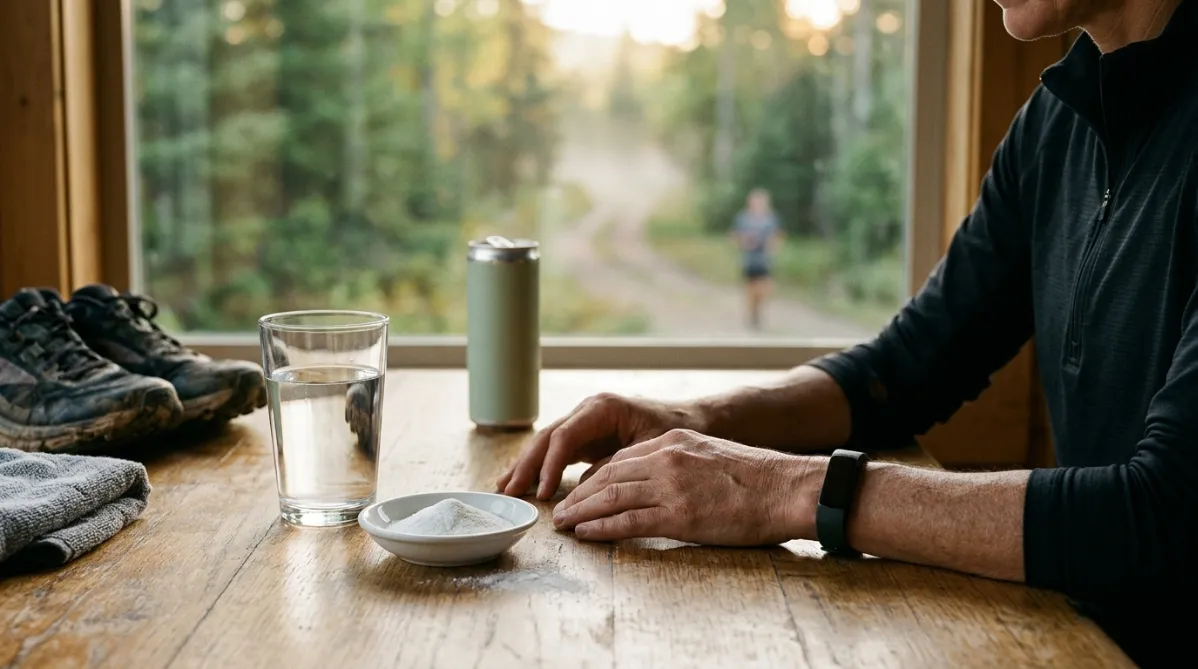
A landscape editorial photograph of a lone runner's hands resting on a weathered wooden table beside a small white ceramic dish of fine white powder and a clear glass of water, shot in soft morning light. A slim matte aluminum energy drink can, unbranded with a minimalist pale sage-green label, stands slightly out of focus in the background, with a single scoop of powder dusted lightly on the tabletop. A pair of worn running shoes and a folded gray towel sit at the edge of the frame. Through a large window behind them, a blurred misty trail winds through green trees at sunrise, with warm golden light spilling across the scene.

The color palette is calm and modern: creamy off-white, sage green, warm honey gold, and soft charcoal. The composition follows the rule of thirds, with the dish and glass in the lower left third and generous negative space on the right for a title overlay. The depth of field is shallow, with a crisp focus on the powder's delicate texture and tiny glints of light on the glass rim. The mood is clean, thoughtful, and quietly energetic, like a contemporary health and science magazine feature. Natural grain, subtle film-like softness, and gentle shadows give it an authentic lifestyle-editorial look. There are no text, logos, or futuristic elements, only tactile, real-world materials like wood, ceramic, glass, cotton, and metal.
nutrition

The Energy Drink Ingredient That Boosts Endurance on Its Own

BY DR. GYMBRO ·

Everyone talks about caffeine, but the other ingredient on the energy drink can may be quietly doing its own work. A 2018 meta-analysis of 10 studies found that isolated taurine improved endurance performance (Hedges' g = 0.40), and a single dose appeared to be enough. Neither dose (1–6 g) nor supplementation length changed the effect in a meaningful way. The catch is a small evidence base and wide confidence intervals, so this is a promising signal, not a guarantee. Here's what the study found and how to try taurine sensibly.

A wide, editorial-style flat lay on a warm, matte cream stone surface, shot from slightly above in soft natural morning light. On the left, a ceramic espresso cup in muted terracotta holds dark coffee, with a few roasted coffee beans scattered beside it. In the center, a small wooden board holds three bright red chili peppers, one sliced open to show pale seeds, next to a small pile of coarse red pepper flakes. On the right, a pair of minimalist off-white running shoes with sage green accents rests at an angle, and a slim stopwatch with a clean white face lies in front of them. Three small matte white capsules sit in a neat row at the center of the composition, a quiet nod to the placebo and the active doses. Soft shadows fall to the lower right. A sprig of dried eucalyptus and a folded linen cloth in oatmeal tones add texture at the edges. The palette is warm and restrained: terracotta, chili red, cream, sage, and charcoal brown, with a gentle pop of red as the focal accent. The depth of field is shallow, so the foreground beans are slightly soft and the chilies and capsules stay crisp. The mood is clean, modern, and magazine-like, in the style of a contemporary health and science journal. There is no text, no people, and no logos, and plenty of negative space on the upper left and right edges leaves room for a headline overlay.
nutrition

Caffeine + Capsaicin Beat Placebo in a 10K. Capsaicin Alone Didn't

BY COACH RYAN ·

A chili-pepper compound plus caffeine was the only combo that beat placebo over 10 km in a new crossover trial, yet capsaicin alone did nothing. Caffeine drove the statistical effect, and there's no proof of synergy. The dose, 6 mg/kg, works out to roughly 450 mg for a 75 kg runner, which is a lot. Insomnia, anxiety, headaches, and racing heart showed up more often with caffeine. Here's what the 20-runner study found and who should skip it.

A wide, editorial still life photographed in soft natural window light on a pale oatmeal-colored linen surface. At the center sits a small, rustic ceramic dish holding a handful of dried golden-orange Rhodiola rosea root pieces and a few fresh, fleshy green-gray succulent rosettes with rosy-pink tips. Beside it, a single matte amber glass capsule bottle lies on its side, with two cream-colored capsules spilling out. On the left, a minimalist analog stopwatch with a brushed brass case rests slightly out of focus, its hands suggesting a duration just past the quarter-hour mark. On the right, a worn, chalk-dusted steel kettlebell handle and a folded charcoal gym towel fill the negative space, hinting at lifting without showing a full gym scene.

In the foreground, a neat row of seven tiny ceramic pill cups arranged in a gentle diagonal line, the first cup holding one capsule and the rest sitting empty, as a quiet visual metaphor for a single dose versus daily dosing. A sprig of dried alpine moss and a few small speckled pebbles add organic texture. The background is a softly blurred warm-gray plaster wall with a gentle gradient shadow cast by a window frame, creating diagonal light stripes across the scene.

The palette is muted and earthy: sage green, terracotta, warm cream, brushed brass, and soft charcoal, with one subtle pop of coral from the Rhodiola tips. Shallow depth of field, crisp focus on the root and capsules, and fine film-like grain. The composition leaves generous clean negative space in the upper left for a headline overlay. The overall feel is a modern wellness and science journal: calm, tactile, minimal, and sophisticated, with a slightly moody, high-end magazine look. There is no text, no people, and no futuristic elements.
nutrition

200 mg of Rhodiola Bought Lifters 24 Extra Seconds. Then Four Weeks of Daily Dosing Added Nothing

BY DR. GYMBRO ·

A single 200 mg dose of Rhodiola rosea taken an hour before exercise nudged time to exhaustion from 16.8 to 17.2 minutes and raised VO2peak in a double-blind crossover trial. The twist is that four weeks of daily dosing didn't build on that effect or change any measured variable. The gain was small, about 24 seconds, and strength, reaction time and attention didn't budge. Here is what the study actually found, who might try an acute dose, and why you shouldn't count on "loading" rhodiola.

This page is available in