Dr. Gymbro
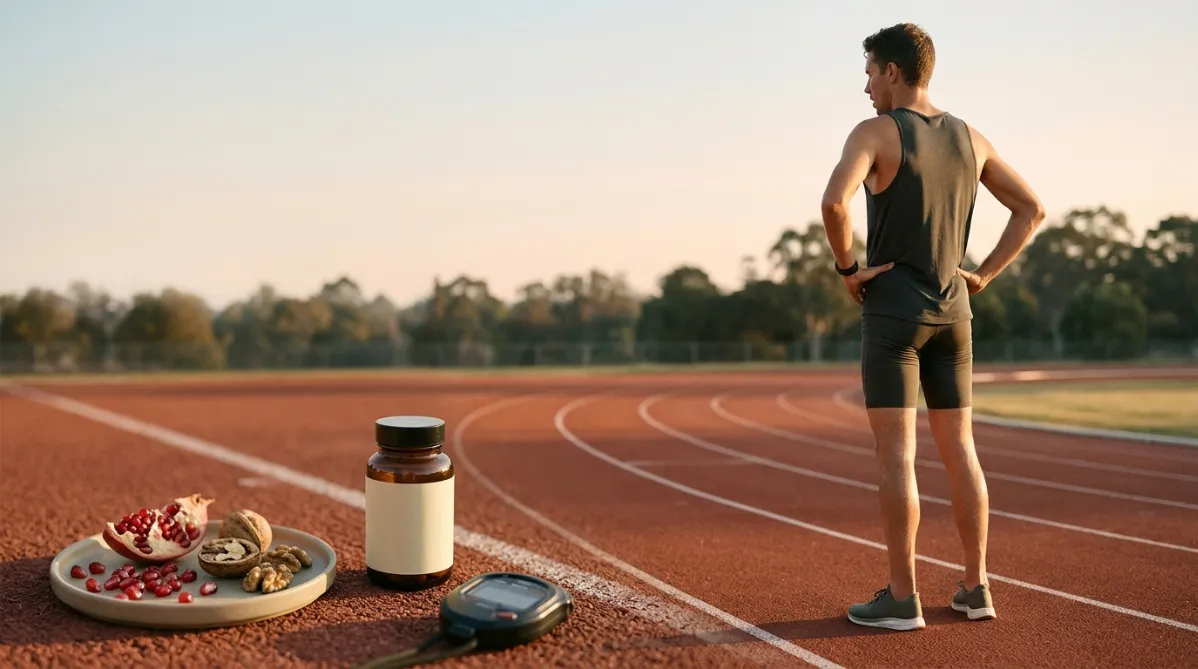
A wide landscape editorial photograph of a lone male distance runner, seen from behind in soft three-quarter profile, pausing on a red-clay outdoor running track at golden hour. He wears a minimalist charcoal singlet and fitted shorts, with a faint sheen of sweat on his calves and shoulders. His hands rest loosely on his hips as he catches his breath, and the white lane lines curve gracefully into the distance. Low amber sunlight rakes across the track and casts long, soft shadows. A hazy line of trees and a pale peach sky blur into creamy bokeh behind him.

In the lower foreground, slightly out of focus, a small matte ceramic dish holds a few pomegranate seeds and halved walnuts, a nod to the natural food sources of urolithin A. Beside it sits a minimalist amber glass supplement bottle with a plain cream label, and a stopwatch lies face-up on the track's edge. The stopwatch is blurred just enough to read as an object, not a number.

The palette is warm and earthy, with terracotta, burnt orange, soft cream, and muted sage green. The look is refined and contemporary, like a high-end wellness or sports-science magazine, with natural film-like grain, shallow depth of field, and gentle contrast. The composition follows the rule of thirds. The runner sits in the right third, the still life anchors the lower left, and open negative space in the upper left leaves room for a headline overlay. The mood is calm and thoughtful, suggesting recovery, measured results, and quiet scientific skepticism rather than hype. No text, no logos, no futuristic elements.
Nutrition

Urolithin A Didn't Make Elite Runners Faster—But Cut Muscle Damage

Dr. Gymbro · · 4 min read

The "mitochondria supplement" hype machine has a new test case, and the results are not what the marketing would predict. Urolithin A (UA) was given to highly trained male distance runners with a VO2max around 66 mL·kg⁻¹·min⁻¹. It did not make them faster over 3000 m. It did lower a key marker of muscle damage and the athletes' perceived effort after racing. That may matter more to runners than it sounds.

What the researchers actually did

The study, published in Sports Medicine in 2025, was a double-blind, placebo-controlled, parallel-group trial (NCT04783207). It enrolled 42 competitive male distance runners, averaging 27.2 years old. They were randomized to 1000 mg/day of urolithin A (n = 22) or placebo (n = 20) for 4 weeks during an altitude training camp at roughly 1700-2200 m.

Athletes were tested at baseline and at the end of camp for body composition, hemoglobin mass, running economy and VO2max. Each week they also did a downhill running bout, a deliberate muscle-damaging challenge, with capillary blood drawn to track inflammation (CRP) and creatine kinase (CK). Two smaller subsets did extra testing: a 3000 m track time trial (11 per group) and skeletal muscle biopsies (9 placebo, 11 UA).

UA is a metabolite produced by gut bacteria after you eat ellagitannin-rich foods. Earlier trials in middle-aged and older adults linked it to better muscle strength, endurance and mitochondrial health markers. This study asked whether those benefits carry over to young, elite-level endurance athletes.

The headline result: no speed boost

On the performance question, the answer was no. The 3000 m time trial did not improve significantly in either group (UA p = 0.116; placebo p = 0.771). If you were hoping a capsule would shave seconds off your race, this trial does not support that.

The surprise: less muscle damage, lower perceived effort

After the 3000 m time trial, the UA group showed:

  • Lower ratings of perceived exertion (p = 0.02) compared with placebo.
  • Lower CK, an indirect marker of muscle damage, with a total area under the curve of p < 0.0001.

CK is not a perfect measure of damage, and the paper calls it "indirect." Still, a drop in CK combined with an easier perceived effort is the kind of signal that fits a recovery story. The authors concluded that UA "facilitates recovery by downregulating inflammatory pathways and indirect markers of muscle damage."

The VO2max numbers: read the fine print

This is where headlines can mislead. VO2max rose 5.4% in the UA group (66.4 to 70.0 mL·kg⁻¹·min⁻¹; p = 0.009), a large within-group effect. The placebo group also rose, by 3.6% (66.4 to 68.7; p = 0.098).

The time × treatment interaction was not statistically significant (p = 0.138). That means the study cannot say UA raised VO2max more than placebo. Both groups were training hard at altitude, and both improved. The 5.4% vs 3.6% gap is suggestive at best, not proof.

Inside the muscle: promising, but exploratory

Proteomic screening of the biopsies found that UA upregulated mitochondria-related pathways and downregulated inflammatory pathways. Markers of mitophagy, the cellular process that clears out damaged mitochondria, showed a medium effect size (d = 0.74) but did not reach statistical significance. Mitochondrial function itself did not change.

So the "mitochondria supplement" label is only partly supported here. The molecular signals moved in the expected direction, but they did not translate into measurable gains in mitochondrial function or race performance. These biopsy analyses involved only about 20 athletes and were exploratory.

Practical takeaways

  • Dose and duration: 1000 mg/day for 4 weeks, as used in this trial. The abstract does not specify timing relative to training, so there is no evidence-based timing hack to share.
  • Who it might suit: Endurance athletes in heavy training blocks, such as altitude camps or high-volume phases, who care about recovery and muscle stress more than about a direct performance bump.
  • Who this doesn't cover: The participants were all highly trained young men. The results don't tell us about women, recreational runners or older athletes.
  • What not to expect: Faster 3000 m times. In this study, they didn't happen.

Caveats you should know about

Several limitations matter here:

  • Small subgroups. The time trial included only 11 athletes per arm, and the biopsy work only 9 and 11. A modest performance effect could easily be missed at that size.
  • Industry ties. The trial was funded by Amazentis SA, the company behind the UA product Mitopure. Three authors are Amazentis employees. One author is a former Nestlé Research and Nestlé Health Science employee with other industry affiliations. The authors disclosed these ties, and the study was prospectively registered, but readers should weigh them.
  • Short duration and a confounded setting. Four weeks at altitude with heavy training makes it harder to separate supplement effects from training effects, as the placebo group's VO2max rise shows.
  • Indirect markers. CK and perceived exertion are proxies. The study doesn't show that UA lets athletes train harder or recover faster in the real world.

The bottom line

Urolithin A is not a performance shortcut for elite runners, and this paper says so plainly. What it offers is a modest recovery-oriented signal: less post-race CK, lower perceived effort and a favorable shift in inflammatory pathways. The VO2max story is a within-group improvement without a significant difference from placebo. For now, UA looks like a recovery experiment worth following, not a proven edge. Independent, larger replications would settle whether the muscle-protection signal holds up.
Original study

Read the original research on pubmed.ncbi.nlm.nih.gov →

This article summarizes published research for general information. It is not medical advice.

DG

Written by

Dr. Gymbro

Dr. Gymbro writes for Dr. Gymbro: science-backed fitness, nutrition & performance.

Related Articles

A wide, softly lit editorial still life on a warm off-white stone countertop. In the center sits a matte ceramic bowl of fine pale cream whey protein powder with a wooden scoop resting in it, a few fine grains dusted across the surface. To the left, a clear glass shaker bottle filled with a creamy, lightly frothy shake catches a gentle highlight. To the right, a minimalist arrangement of fresh produce and wellness cues: a halved lemon, a sprig of green rosemary, and a small folded sage-green linen towel. In the soft-focus background, a neatly rolled yoga mat and a pair of brushed-steel dumbbells rest on a pale oak floor beside a tall window. Morning sunlight streams in diagonally, creating long, gentle shadows and a luminous, airy atmosphere.

Subtle nods to the "liver" and "lab results" themes come through in tasteful, abstract ways: a small sheet of cream paper with a simple, hand-drawn downward-trending line graph in muted terracotta ink sits beside the bowl, with a slim brass pen laid across it. A delicate terracotta-colored ceramic dish nearby evokes organic form without being anatomical.

The color palette is calm and modern: warm creams, soft sand, sage green, muted terracotta, and touches of brushed brass. Shallow depth of field, crisp focus on the powder and scoop, with a creamy blurred background. Shot in a clean, contemporary magazine style with natural film-like grain, gentle contrast, and generous negative space on the left and right edges for headline overlay. Feels trustworthy, fresh, and approachable, like a trendy health and science journal cover.
supplements

Does Whey Wreck Your Liver? 59 Athletes Say the Opposite

BY DR. GYMBRO ·

Think whey protein is hard on your liver? A randomized, double-blind trial in 59 trained athletes found the opposite trend: after 8 weeks of 30 g/day, ALT, AST and CK dropped, while placebo groups stayed flat or rose. Only ALT showed a true difference between power and endurance athletes, and the CRP result was just a within-group trend. Here's what the study really shows, what the markers can't prove, and who should still be cautious.

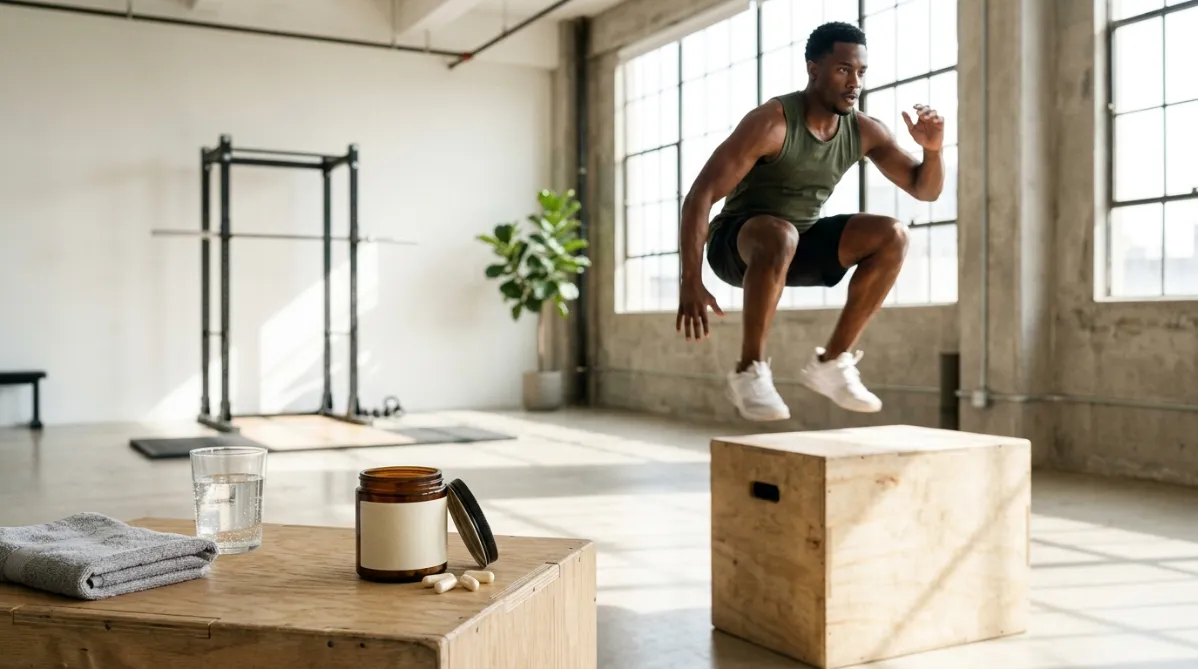
A wide, bright editorial photograph of a male athlete captured mid-jump in a minimalist, sunlit indoor training studio with pale concrete floors and tall windows. He is suspended at the peak of a plyometric box jump, knees tucked, with soft natural light and gentle motion blur at his feet. In the foreground, slightly out of focus, sits a small matte amber glass jar with a plain cream label, its lid resting beside it. Next to it are a few creamy white capsules spilled on a light oak wooden plyo box. A clear glass of water and a folded gray towel sit nearby.

The color palette is fresh and modern: warm off-white, sage green, soft sand, and touches of muted terracotta. A few green leaves of a potted fiddle-leaf plant in the corner add an organic feel. Shadows are long and soft, and the atmosphere is calm, clean, and health-focused, like a high-end wellness magazine spread.

The composition follows the rule of thirds. The jumping figure sits on the right third, and the supplement jar and capsules anchor the lower left. Negative space in the upper left leaves room for a headline overlay. The depth of field is shallow with a creamy bokeh background, shot on a 50mm lens with a subtle film-like grain. The overall look is crisp, airy, and contemporary, a lifestyle science journal cover aesthetic with no text, no logos, and no futuristic elements.
recovery

This Probiotic Strain Cut Muscle Damage After 100 Max Jumps

BY DR. GYMBRO ·

A new randomized trial suggests a specific probiotic, L. plantarum GKK1, may soften the blow of a brutal plyometric session. After four weeks at 1.0 × 10^11 CFU per day, 48 untrained men did 100 maximal jumps and the supplemented group lost less jump, strength, and Wingate performance than placebo. Muscle damage markers like CK and myoglobin, plus hs-CRP, TBARS, and urinary 3-methylhistidine, also looked better. But the study is small, limited to untrained men, and involves authors from the strain's manufacturer. Here is what the data show and who might actually benefit.

A wide landscape editorial photograph of a modern, softly lit home gym corner with pale oak flooring and a matte white wall. In the foreground, a chalk-dusted barbell rests across a minimalist bench, shot at a low angle with shallow depth of field. On a small natural-wood side table beside it sits a ceramic dish holding a few amber-colored capsules, a handful of dried ashwagandha roots, and a few green leaves. A matte glass of water and a folded linen towel sit nearby. A slim open notebook with a pen lies next to the dish, suggesting careful reading and note-taking, with blurred handwritten columns that suggest comparison, but no legible text.

Soft morning window light enters from the left, casting long, gentle shadows and a warm golden glow across the scene. The palette is muted and earthy: sage green, warm sand, cream, charcoal gray, and touches of terracotta. A single potted green plant in the background adds texture. Two weight plates in stacked, muted tones lean against the wall, slightly out of focus.

The composition follows the rule of thirds, with the barbell and supplement dish on the left and generous negative space on the right for headline overlay. The mood is calm, trustworthy, and analytical, like a contemporary health and science magazine cover. Crisp detail, natural film-like grain, subtle color grading, and a clean, uncluttered, premium lifestyle feel. No people, no text, no logos, no futuristic elements.
supplements

Ashwagandha SR Doubled Bench Gains in 90 Days—Read the Fine Print

BY DR. GYMBRO ·

A once-daily sustained-release ashwagandha capsule roughly doubled bench press gains versus placebo in a 90-day randomized trial. Participants taking 300 mg of AshwaSR added 15.31 kg to their 1-RM, compared with 7.33 kg on placebo. But the testosterone rise in men did not beat placebo, the study was funded by the product's developer, and the VO2max numbers look unusually large. Here's what the trial actually shows, the dose used, who it may suit, and who should skip it.

A wide, softly lit editorial photograph of a bright, minimalist gym studio with pale oak flooring and large windows letting in diffuse morning light. In the foreground, a matte white ceramic scoop of fine white powder sits beside a simple frosted glass jar on a light concrete bench. A neutral linen towel and a stainless steel water bottle rest next to them. Slightly out of focus in the midground, a young woman in a sage-green athletic set and a young man in a soft gray tee are mid-circuit, one stepping over a low plyometric box and the other holding a kettlebell. Their motion is captured with a gentle blur. Behind them, a row of painted lines on the floor marks a shuttle-run lane, with small terracotta-colored cones spaced evenly along it. The palette is calm and modern: warm cream, sage, soft terracotta, and muted charcoal, with a touch of pale blue in the shadows. The composition uses generous negative space on the right side of the frame for a title overlay. Depth of field is shallow, the grain is subtle and film-like, and the style is contemporary lifestyle journalism, clean and crisp, with a slightly airy, high-key exposure and natural shadows. No text, no logos, no futuristic elements.
science research

Beta-Alanine Raised Carnosine in Beginners but Didn't Boost Fitness

BY DR. GYMBRO ·

Beginners are often told beta-alanine is a shortcut to better workouts. A new randomized, placebo-controlled trial in untrained young adults found the supplement raised plasma carnosine but added nothing measurable to fitness. Six weeks of circuit training alone significantly improved shuttle-run performance and estimated VO2max (both p<0.001). Here is what the study found, what its limits are, and who beta-alanine may actually be for.

This page is available in