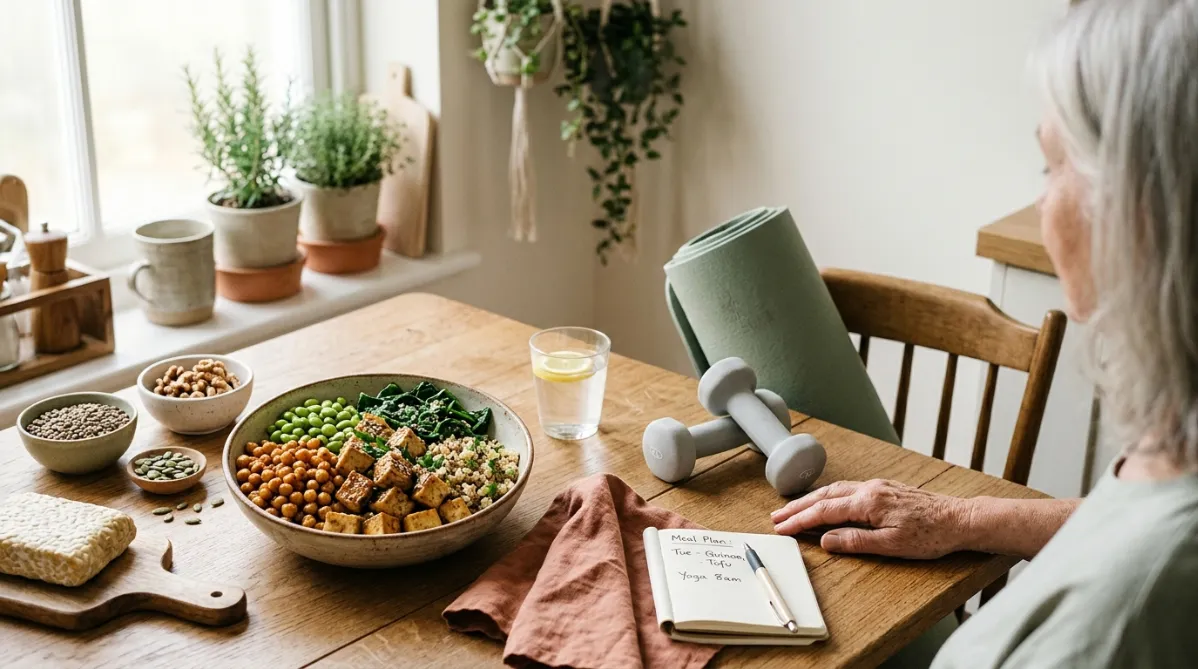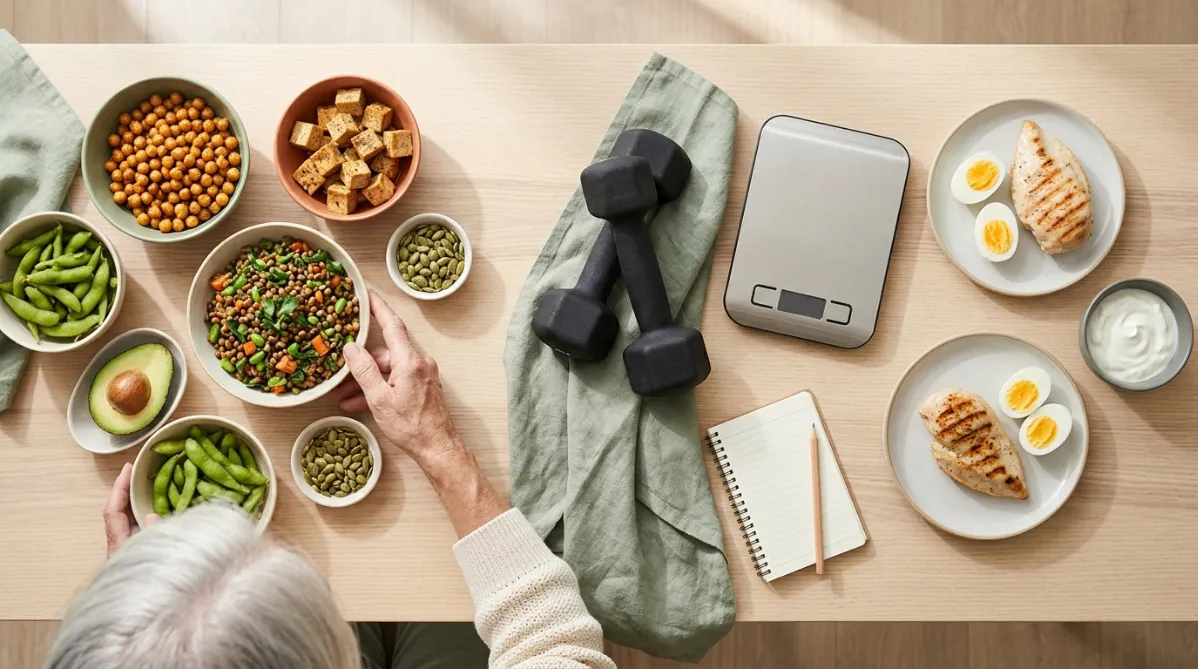
Can you build muscle on a vegetarian diet after 55? Yes, according to a new randomized trial. But the vegetarians ate less protein and gained less muscle, and the researchers could not show the two diets were equivalent.
The study is the IMPACT trial, published in The American Journal of Clinical Nutrition by van Oppenraaij, Weijs, Verlaan and colleagues. Here is what it found, what it didn't, and what it means for your plate.
The Study Design: What Was Actually Tested
IMPACT was a randomized noninferiority trial. It asked whether a lacto-ovo vegetarian diet (plant foods plus dairy and eggs, no meat or fish) could match an omnivorous diet for protein intake and muscle gain during resistance training.
- Participants: 108 adults aged 55 and older (median age 66; 58% women; average BMI 25.7 kg/m²)
- Training: 12 weeks, three resistance sessions per week, in both groups
- Diet: Dietary counseling for either a lacto-ovo vegetarian or an omnivorous diet. Participants chose their own foods, aiming for at least 1.2 g/kg/day of protein.
- Protein source targets: At least 60% plant-based protein in the vegetarian group and at least 60% animal-based protein in the omnivorous group
- Primary outcomes: Protein intake (3-day food records) and appendicular muscle mass (the lean mass of arms and legs, measured by DXA)
- Secondary outcomes: Leg press strength, chair stand performance and handgrip strength
The authors reported no conflicts of interest. The abstract does not describe funding. The trial is registered as NCT06172725.
The Headline Numbers
Both groups hit their targets, but not by the same margin.
| Vegetarian | Omnivorous | |
|---|---|---|
| Protein intake | 1.24 g/kg/day | 1.58 g/kg/day |
| Protein source | 76% plant-based | 67% animal-based |
| Appendicular muscle change | +0.38 kg | +0.66 kg |
Both muscle gains were statistically significant (vegetarian P = 0.004, omnivorous P < 0.001). Leg press strength and chair stand performance improved in both groups, with no differences between them.
The Catch: Noninferiority Was Not Shown
The researchers set a margin in advance: the vegetarian group could eat up to 0.12 g/kg/day less protein, or gain up to 0.25 kg less muscle, and still count as noninferior. Neither bar was cleared.
The protein gap was -0.33 g/kg/day (95% CI -0.49 to -0.17), clearly beyond the margin. The muscle gap was -0.33 kg (95% CI -0.69 to 0.03). That interval touches zero, so this study cannot say the diets truly differ in muscle gain. It also extends past the -0.25 kg margin, so it cannot say they are equivalent. The honest summary is that the muscle result is inconclusive, not that vegetarians lose.
Because protein intake differed too, the trial cannot say whether protein quantity, protein type or something else explains the muscle difference. It was not designed to separate those factors.
Practical Takeaways for Plant-Leaning Lifters
Dose. The trial's floor was at least 1.2 g/kg/day. The vegetarian group averaged 1.24, while omnivores averaged 1.58. As simple arithmetic, for an 80 kg person that is about 99 g versus 126 g a day. If you go vegetarian, treat 1.2 g/kg as a minimum, not a goal to coast on. Aiming above it is a reasonable way to close the gap, though this trial did not test higher vegetarian intakes.
Food choices. Participants self-selected foods under counseling. The abstract doesn't list which foods were eaten, so no specific menu is backed by the paper. Dairy and eggs were allowed in the vegetarian arm, so these results don't apply to vegans.
Timing. The abstract doesn't report any protein timing or distribution strategy, so there is no timing advice to draw from it.
Who it's for. Older adults who want to eat less meat for health or sustainability reasons and are willing to plan protein deliberately. Both groups improved muscle mass, strength and function with resistance training.
Who should be cautious. Anyone with a small appetite, low baseline protein intake or a goal of maximizing muscle gain should be careful. Vegetarian diets in this trial produced lower protein intake and numerically smaller muscle gains. People with kidney disease or other medical conditions should talk to a clinician before changing protein intake.
Limitations to Keep in Mind
- Short duration: 12 weeks says little about long-term muscle retention or health outcomes.
- Self-reported intake: 3-day food records are useful but imperfect.
- Self-selected diets: This reflects real-life behavior, but it means protein intake varied by choice rather than being controlled.
- Surrogate measure: DXA appendicular lean mass is a proxy for muscle, not a direct measure of muscle tissue.
- Population: Mostly healthy, community-dwelling adults with an average BMI of 25.7. The findings may not apply to frail or underweight older adults.
- Detail not in the abstract: Handgrip results aren't reported there.
The Bottom Line
Resistance training worked in both diets. Older adults on a counseled lacto-ovo vegetarian diet gained muscle and got stronger. But they ate less protein and gained less appendicular muscle, and noninferiority wasn't established. The practical lesson is not to avoid vegetarian eating, but to be deliberate about protein: hit at least 1.2 g/kg/day, and don't assume a plant-based plate will get you there on its own.