Dr. Gymbro
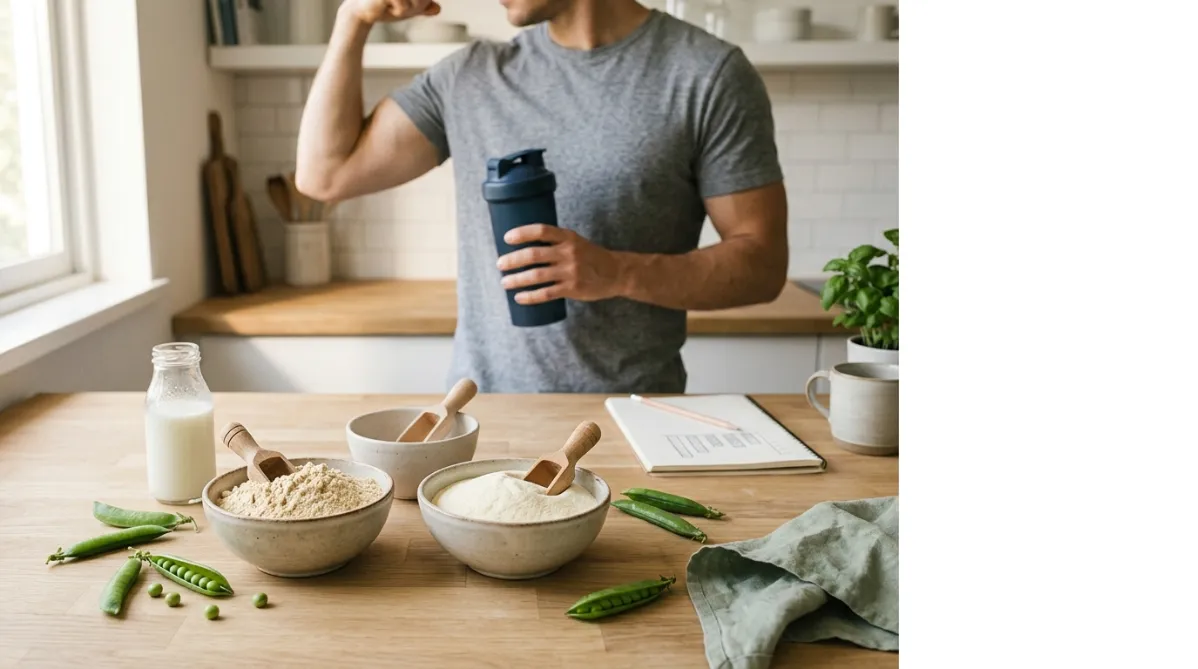
A wide landscape editorial photograph shot from above at a slight angle, showing a bright, minimalist kitchen counter of pale oak wood. Three matching ceramic bowls in soft matte tones (warm cream, sage green, and muted terracotta) sit in a loose row. Each holds a different protein powder: fine ivory whey, slightly coarser beige soy, and speckled pale yellow-green pea protein. A small fourth pile of tiny gray-black chia seeds sits apart on a folded linen napkin, off to the side, to suggest the lone outlier. Wooden scoops rest in each bowl, with a few soft dustings of powder on the surface. In the foreground, a clear glass shaker with a creamy blended drink and a single sprig of fresh mint stands beside a small stack of fresh produce: a halved avocado, a handful of edamame pods, and a few green peas in an open pod. A matte white notebook and a thin brass pen are tucked at the edge of the frame, suggesting research and note-taking. Natural morning light pours in from the left through an unseen window, casting long, soft shadows and gentle highlights on the powder textures. The color palette is calm and earthy, with creams, sage, soft terracotta, and warm wood tones, and a clean, slightly muted editorial grade. Shallow depth of field keeps the bowls crisp while the background, a blurred white tiled wall and a hint of a trailing green plant, melts away. Plenty of negative space on the right side of the frame leaves room for a headline overlay. The overall mood is fresh, trustworthy, and modern, like a contemporary wellness and science journal.
Nutrition

Whey Isn't Special for Beginners? Soy and Pea Just Matched It

Dr. Gymbro · · 4 min read

If you've just started lifting and you're staring at a tub of whey and a tub of pea protein, wondering whether the plant option will cost you gains, a new meta-analysis has something to say. When researchers pooled the DEXA-measured trials, the plant-based group did not do significantly worse than the whey group. That is not the same as proving they're identical, and the authors say so too.

The Study in 30 Seconds

Callegari and colleagues from São Paulo State University (UNESP) in Brazil published a systematic review and meta-analysis in the Journal of the International Society of Sports Nutrition (2026;23(1):2752317). They searched PubMed, Web of Science, and ScienceDirect, following PRISMA 2020 and registering the protocol in PROSPERO (CRD420251145410). Five studies made the cut.

The inclusion rules were strict:

  • Population: untrained adults aged 18-59
  • Intervention: resistance training plus plant-based or whey protein supplementation
  • Outcome measure: body composition by Dual-Energy X-Ray Absorptiometry (DEXA)

The study is open access, with the DOI at https://doi.org/10.1080/15502783.2026.2752317 and the PubMed record at PMID 42954267.

The Headline Finding

Both plant-based and whey protein, combined with resistance training, were associated with improvements in lean body mass and body fat mass. Between the two groups, there were no statistically significant differences. The authors conclude that soy- and pea-based supplements may support favorable body composition changes in adults starting resistance training, and can be considered practical alternatives to whey.

The finding is notable because whey has long been treated as the default "best" protein for muscle. In this analysis, with training and total protein intake matched across groups, protein source did not produce a detectable difference in body composition outcomes for beginners.

Read the Fine Print Before You Switch

"No significant difference" is not the same as "proven equal." The authors stress this repeatedly. With only five studies and wide confidence intervals, the analysis can't rule out a real difference in either direction. The paper explicitly says its findings should not be read as evidence of physiological equivalence and that adequately powered trials are still needed.

Three more limits matter:

  • Untrained adults only. Beginners respond strongly to almost any sensible training and protein combination. The results don't tell us what happens in experienced lifters, where margins are smaller and differences might be easier or harder to detect.
  • Matched protein. The comparison held total protein intake and training variables constant. It says nothing about what happens if you swap a whey scoop for the same scoop size of a weaker plant product, or if you under-eat protein overall.
  • Small evidence base. Five trials is a thin foundation for sweeping claims.

The fair reading is that whey is probably not essential for beginners, not that plant protein is proven to be its twin.

What About Chia Protein?

Skip the hype for now. The review found only a single chia protein study, and it did not show significant changes in lean body mass. The authors state that firm conclusions about chia's efficacy can't be drawn. The soy and pea conclusions don't extend to chia.

Practical Takeaways

The paper's abstract doesn't prescribe doses, so the following is general sports nutrition guidance, not findings from this meta-analysis.

Total daily protein comes first. A widely cited benchmark for people training with weights is roughly 1.6 g of protein per kg of body weight per day. A 75 kg lifter would aim for about 120 g daily from all sources. A supplement helps you reach that number; it is not magic by itself.

Dose per serving. Plant proteins often contain less leucine per gram than whey, and leucine is a key trigger for muscle protein synthesis. A common practical response is to use a slightly larger serving of pea or soy, or to choose a blend, and to spread protein across 3-4 meals. This is a reasoned precaution, not something this study tested.

Timing. The study doesn't address timing. Consistency matters more than a rigid "anabolic window." Take it when it helps you hit your daily target, such as after training or as a snack.

Who Should Pick What

Plant protein (soy or pea) makes sense if you:

  • are vegan or vegetarian
  • have trouble with dairy or lactose
  • prefer a more sustainable option, a point the authors raise
  • are new to lifting and want a cost-effective supplement that fits your diet

Whey still makes sense if you:

  • tolerate dairy well and already like it
  • want the protein with the largest research base behind it
  • find it cheaper or more convenient where you live

Be cautious if you:

  • have a soy or pea allergy, so check labels
  • are an advanced lifter, since this evidence comes from untrained adults
  • were planning on chia protein for muscle, since the evidence isn't there yet

Bottom Line

The old assumption that whey is uniquely necessary for beginners looks shakier after this analysis. With matched protein and training, soy and pea protein didn't significantly trail whey for lean mass or fat mass changes in untrained adults. But five studies and wide confidence intervals mean the case is open, not closed. Hit your total protein, train consistently, and pick the powder you'll actually use.

Source: Callegari IOM, Silva GM, Oliveira AG. Is plant-based protein supplementation as effective as whey protein? A systematic review and meta-analysis in untrained adults undergoing resistance training. J Int Soc Sports Nutr. 2026;23(1):2752317. doi:10.1080/15502783.2026.2752317. PMID: 42954267.
Original study

Read the original research on pubmed.ncbi.nlm.nih.gov →

This article summarizes published research for general information. It is not medical advice.

DG

Written by

Dr. Gymbro

Dr. Gymbro writes for Dr. Gymbro: science-backed fitness, nutrition & performance.

Related Articles

A wide, softly lit editorial flat-lay on a pale oat-colored linen surface, shot from slightly above. Three matte ceramic bowls sit in a loose diagonal across the frame. One holds fine, creamy beige pea protein concentrate, another holds paler, powdery pea protein isolate, and the third holds bright white whey protein isolate. Each bowl has a small wooden scoop resting beside it, with a few fine dustings of powder on the linen. Fresh green pea pods, split open to show round peas, spill naturally in the left foreground. A small glass pitcher of milk sits near the right edge, next to a half-full glass of a smooth, pale green-beige shake with condensation on the surface.

Behind the bowls, a few sprigs of dried wheat and soft eucalyptus leaves add organic texture. In the upper right, a shallow white ceramic plate holds a small arrangement of gut-friendly foods: sliced banana, a spoonful of plain yogurt, and a few oats. Delicate watercolor-style abstract shapes in sage green, warm coral, and soft mustard float subtly in the background. They suggest microscopic organisms, like loose dots, rods, and clustered circles, but stay painterly and minimal, not scientific or futuristic.

Natural window light enters from the left, casting long, gentle shadows and a warm, airy glow. The palette is muted and modern: sage green, cream, warm beige, blush, and touches of terracotta. The composition leaves generous clean negative space on the right third for a headline overlay. The depth of field is shallow, with the nearest pea pods and the front bowl crisp and the background softly blurred. The style is high-end wellness magazine photography with a subtle tactile, handmade feel, calm, fresh, and contemporary, in a 16:9 landscape format.
science research

Which Protein Powder Reshapes Your Gut? Pea Did It in 4 Weeks

BY DR. GYMBRO ·

A four-week Swedish trial put pea protein concentrate, pea protein isolate and whey protein isolate head to head, with gut bacteria as the main outcome. Both pea proteins significantly changed gut diversity, and each form boosted different beneficial species. Concentrate lifted Bifidobacterium longum and Anaerobutyricum hallii, while isolate raised Lactobacillus crispatus and Limosilactobacillus frumenti. But the researchers say we still don't know what those shifts mean for function. Here's what it means for your next tub of powder.

A wide, editorial-style flat lay shot from directly above on a pale oak table in soft morning window light. At the center, an open matte cream-colored protein powder tub sits tipped slightly, with a wooden scoop resting beside it and a small, elegant dusting of fine powder spilling across the wood grain. To the left, a neat balanced arrangement of whole foods: two soft-boiled eggs in a ceramic dish, a small bowl of Greek yogurt with a drizzle of honey, a handful of almonds, and a halved avocado. To the right, a minimalist brass kitchen scale holding a small ceramic bowl, with a handwritten notebook page beside it showing simple pencil-drawn bar charts and a few scribbled numbers, no legible text. A matte shaker bottle in muted sage green stands near the top edge, along with a folded linen napkin in warm oatmeal tone. The color palette is restrained and modern: warm creams, soft sage, terracotta accents, and natural wood, with gentle diffused shadows and subtle film-like grain. Composition leaves generous negative space on the left third of the frame for headline overlay. The mood is calm, thoughtful, and quietly skeptical, like a contemporary health and science magazine cover. Shallow depth of field, crisp textures on powder and ceramic, high-end lifestyle photography, clean and uncluttered.
nutrition

Protein Powder's Dirty Secret: Gains Fade When Calories Match

BY DR. GYMBRO ·

Does protein powder really make you perform and recover better, or are you just eating more calories? A Bayesian meta-analysis of 75 randomized trials and 1,206 athletes found real but limited benefits. The twist is that every significant result came from studies where energy intake wasn't matched between groups. The paper's most concrete advice is about dose: about 1 g/kg/day extra from supplements, for roughly 2 g/kg/day total. Here is what the data supports, what it doesn't say about timing and protein source, and who should skip the tub.

A bright, airy, minimalist kitchen counter in soft morning light, shot from a slightly elevated three-quarter angle in a wide landscape composition. Two matching ceramic bowls sit side by side on a pale oak butcher-block surface. The left bowl holds fine, creamy-beige pea protein powder with a small wooden scoop resting in it. The right bowl holds smooth, ivory-white whey powder with an identical scoop. Between and slightly behind them sits a third, smaller empty bowl with a plain scoop, hinting at the placebo. Scattered around the bowls are fresh green pea pods, some split open to reveal bright, round peas, and a small glass bottle of milk with delicate condensation. A sage-green linen napkin is folded loosely at the edge of the frame.

In the soft-focus background, a young man in a fitted heather-gray t-shirt is seen from the shoulders down, casually flexing one arm while holding a matte shaker bottle, the biceps subtly defined and the pose relaxed and natural. A minimalist notebook with a pencil and a simple hand-drawn bar chart lies open on the counter, suggesting analysis without legible text. A small potted herb plant and a ceramic mug add warmth.

The color palette is muted and editorial: warm cream, sage green, soft terracotta, pale wood, and touches of charcoal. Light streams in from a window on the left, casting gentle long shadows and a subtle golden glow across the powders so their textures look fine and tactile. Shallow depth of field keeps the bowls crisp while the background melts into a creamy blur. The look is modern lifestyle-magazine photography, clean and uncluttered, with generous negative space on the right third of the frame for headline overlay. It is natural, appetizing, and trustworthy, in the style of a contemporary wellness and nutrition journal.
nutrition

Pea Protein vs Whey: The Beginner Result Nobody Expected

BY DR. GYMBRO ·

Can plant protein really build muscle like whey? A 12-week trial of 161 men put pea protein, whey, and placebo head-to-head, and the beginner results turned heads: +20.2% biceps thickness for pea versus +8.6% for placebo. But the full-group difference was only a trend, and the standout finding came from a subgroup analysis. Here's what the study found, what it didn't prove, and how vegan or lactose-intolerant lifters can use it.

A wide, editorial flat-lay photograph shot from directly above on a pale warm-gray stone countertop, lit by soft natural morning window light with gentle diagonal shadows. On the left, a neatly arranged cluster of whole-food protein sources: two seared chicken breast slices with a golden crust, a small ceramic bowl of creamy Greek yogurt topped with blueberries, three halved soft-boiled eggs with jammy orange yolks, a handful of raw almonds, and a small pile of dried lentils scattered on a linen napkin. At the center, a matte white shaker bottle and a wooden scoop resting in a pile of fine vanilla-colored protein powder, a few grains dusted artfully across the surface. On the right, a minimalist kitchen scale in matte black displaying a portion of food, next to an open notebook with a hand-drawn curve that rises steeply and then flattens into a plateau, drawn in a deep terracotta ink pen, with a small dot marking the bend. A brass pen lies beside the notebook. A single dumbbell with a brushed steel finish sits partially in frame at the upper right corner, grounding the fitness theme without feeling gym-like. Color palette: warm cream, sage green, terracotta, soft charcoal, and butter yellow accents, with generous negative space along the top edge for title overlay. Shallow depth of field, crisp textures, subtle film grain, modern lifestyle magazine aesthetic, clean and calm composition, 16:9 landscape.
nutrition

How Much Protein Actually Maximizes Muscle? The 1.6 g/kg Plateau, Explained

BY DR. GYMBRO ·

Think you need 2+ grams of protein per pound to grow? A meta-analysis of 49 trials and 1,863 adults found muscle-building benefits leveled off around 1.6 g/kg per day. The upper confidence limit reached about 2.2 g/kg, giving lifters a practical range instead of an arbitrary mega-dose. Trained lifters gained the most from supplementation, while the benefit shrank with age. Here is what the numbers mean for your plate, your shaker bottle and your budget.

This page is available in