Dr. Gymbro
A sunlit outdoor running track in late afternoon, shot from a low angle with shallow depth of field. In the foreground, a matte black bottle with a minimal off-white label sits on the edge of a warm terracotta-colored track lane, beside a folded white towel and a small glass of amber liquid catching golden light. Condensation beads on the bottle. A faint heat shimmer rises from the track surface and softens the background.

In the midground, slightly out of focus, a lean athlete in a sage-green tank top and charcoal shorts runs on a treadmill-like stretch of track, a thin sheen of sweat on their shoulders, their expression focused and calm. Their motion is gently blurred, suggesting endurance and rhythm. Long soft shadows stretch across the lane lines.

The background fades into hazy peach, apricot, and pale yellow tones, with the suggestion of tall trees and a distant stadium wall. Warm sun flare enters from the upper right, creating a subtle glow and a few soft light streaks across the frame.

Subtle editorial touches: a small notebook with a pencil and a stopwatch rest beside the bottle, hinting at data and timing without any text legible. The color palette is warm and muted, with terracotta, cream, sage, and charcoal accents, and a fine film-like grain. The composition leaves open negative space on the left third for a headline overlay. The overall mood is clean, modern, and health-journal inspired, natural and aspirational, with a calm scientific curiosity rather than hype.
Nutrition

Ketondrinks in der Hitze – mehr Ausdauer und schärfere Erinnerungsleistung?

Dr. Gymbro · · 4 min read

Was die Forschenden taten

Ein Team um Lints und Arent von der University of South Carolina untersuchte 17 gut trainierte Ausdauer‑Athleten (Durchschnittsalter 23,8 Jahre, VO₂max 58,6 ml kg⁻¹ min⁻¹). Das Studiendesign war randomisiert, doppelblind, balanciert und als Crossover‑Studie konzipiert, sodass jede‑r Teilnehmende beide Versuchsbedingungen durchlief.

Bei jedem Besuch nahmen die Probanden 4 mg/kg Koffein zusammen mit einem von zwei Zusatzstoffen ein:

  • KET: ein Keton‑Monoester, (R)-3‑Hydroxybutyl-(R)-3‑Hydroxybutyrat.
  • CHO: ein energiemäßig äquivalentes Kohlenhydrat‑Control (Cluster Dextrin).

Anschließend absolvierten sie ein 90‑minütiges belastetes Laufbandtraining bei 34 °C und 45 % relativer Luftfeuchte, gefolgt von einem hochintensiven Time‑to‑Exhaustion‑Test (TTE). Der militärische Hintergrund lautet: Spezialkräfte müssen bei extremer Hitze geistig klar und körperlich einsatzfähig bleiben, obwohl Durchblutung des Gehirns, Brennstoffverfügbarkeit und Hitzetoleranz stark eingeschränkt sein können.

Die Schlagzeile: fast zwei Minuten länger bis zur Erschöpfung

Die Erschöpfungszeit war mit Keton‑Monoester länger: 8,9 ± 4,6 Minuten gegenüber 7,0 ± 2,1 Minuten (p = 0,04). Das entspricht einem Unterschied von etwa 1,9 Minuten – ein Viertel der Gesamtdauer einer harten, heißen Einheit und potenziell entscheidend für den letzten Sprint.

Der statistische Effekt ist jedoch bescheiden. Der p‑Wert liegt knapp unter 0,05 und die Streuung in der Keton‑Gruppe (SD = 4,6 Min) ist groß, was auf stark unterschiedliche individuelle Reaktionen hindeutet. Das Ergebnis sollte daher als vielversprechendes Signal, nicht als Garantie, interpretiert werden.

Das Hirn‑Resultat: besser beim 1‑Back, aber nicht überall

Die kognitiven Ergebnisse waren selektiv. Im Vergleich zum Kohlenhydrat‑Condition zeigten die Keton‑Teilnehmer:innen:

  • Höhere Gesamttrefferquote im 1‑Back: +2,8 % (p = 0,001).
  • Höhere Ziel‑Trefferquote im 1‑Back: +8,9 % (p < 0,001).
  • Bessere Ziel‑Diskriminierung (d′): +0,3 (p = 0,001).

Diese Effekte bestanden über alle Messzeitpunkte hinweg. Der Nutzen erstreckte sich jedoch nicht auf die anspruchsvollere 2‑Back‑Aufgabe, die Dynavision‑Reaktionszeit oder die Objekt‑Hit‑and‑Avoid‑Aufgabe, wo keine Unterschiede zwischen den Bedingungen erkennbar waren. Keton‑Monoester machten die Teilnehmenden also nicht durchweg schärfer, sondern verbesserten nur bestimmte Aspekte des Arbeitsgedächtnisses.

Der metabolische Fingerabdruck

Die Blutwerte bestätigen, dass die Keton‑Substanz das tat, was man von Keton‑Monoestern erwartet:

  • Beta‑Hydroxybutyrat (BHB) lag im Mittel 1,7 mmol/L höher während des Trainings und 3,5 mmol/L nach dem Training (beide p < 0,001).
  • Blutglukose war in der Keton‑Gruppe um 14,7 mg/dL während des Trainings und um 27,6 mg/dL nach dem Training niedriger (p < 0,001).

Das bedeutet, dass Leistungs‑ und Gedächtnisvorteile trotz geringerer Glukosekonzentration im Blut auftraten – bemerkenswert, da Kohlenhydrate üblicherweise als Hauptbrennstoff für intensive Belastungen gelten.

Was sich nicht änderte: Herzfrequenz und Kerntemperatur

Die Autoren betonen, was die Keton‑Supplemente nicht bewirkten. Die durchschnittliche Herzfrequenz zeigte einen Haupteffekt der Zeit (niedriger in den ersten 45 Minuten als im zweiten Abschnitt), jedoch keinen Effekt der Versuchsbedingung (p = 0,453). Auch die maximale Herzfrequenz während des TTE‑Tests unterschied sich nicht signifikant (p = 0,112).

Die Kerntemperatur stieg über die Zeit hinweg in beiden Bedingungen, jedoch ohne signifikanten Unterschied (p = 0,065). Der p‑Wert liegt knapp unter der klassischen Schwelle, sodass größere Studien Klarheit schaffen könnten. Vorläufig lässt sich sagen, dass Keton‑Monoester keinen zusätzlichen kardio‑ oder thermischen Stress hervorriefen und die Leistungsgewinne nicht mit einer messbaren zusätzlichen Wärmebelastung einhergingen.

Einschränkungen, die du kennen solltest

  • Kleine Stichprobe: nur 17 Teilnehmende.
  • Nur Männer: junge, ausdauertrainierte Männer; die Übertragbarkeit auf Frauen, ältere Menschen oder weniger Trainierte ist unklar.
  • Einzelsitzung pro Bedingung: kein wiederholter Konsum, daher keine Aussage zur Konsistenz des Effekts.
  • Koffein in beiden Armen: die Studie vergleicht Keton + Koffein mit Kohlenhydraten + Koffein. Sie sagt nichts darüber aus, was Keton‑Monoester allein bewirken würden.
  • Gemischte kognitive Ergebnisse: Nutzen nur im 1‑Back, nicht im 2‑Back, bei Reaktionszeit oder Hit‑and‑Avoid‑Aufgabe.
  • Hohe Variabilität im TTE‑Ergebnis: die große Streuung in der Keton‑Gruppe verdeutlicht unterschiedliche individuelle Reaktionen.

Die Autoren erklärten, dass keine Interessenkonflikte bestanden.

Praktische Erkenntnisse

Dosis: Das Abstract bestätigt 4 mg/kg Koffein in beiden Bedingungen, gibt jedoch keine Angabe zur Keton‑Monoester‑Dosis. Für genaue Angaben bitte den Volltext (PMCID PMC13378723) konsultieren und sich an die dort beschriebene Portionierung halten.

Timing: Die Substanzen wurden zusammen mit dem Koffein kurz vor einer 90‑minütigen Hitze‑Session und einer harten Endbelastung eingenommen.

Für wen geeignet: Gut trainierte Athlet:innen und taktisches Personal, das bei hoher Hitze arbeiten muss, das Arbeitsgedächtnis erhalten und einen Endspurt absolvieren will. Am besten zunächst im Training testen, nicht am Wettkampftag.

Für wen Vorsicht geboten ist:

  • Personen, die empfindlich auf Koffein reagieren (4 mg/kg ist eine hohe Dosis).
  • Menschen mit medizinischen Vorgeschichten, Schwangere oder Personen, die Medikamente einnehmen, die den Glukosestoffwechsel beeinflussen – wegen des beobachteten Glukosesenkungseffekts.
  • Erwartung eines generellen kognitiven Boosts – die Daten unterstützen das nicht.
  • Athlet:innen, die zu Magen‑Beschwerden neigen – ketogene Produkte können gastrointestinale Nebenwirkungen hervorrufen, obwohl das im Abstract nicht thematisiert wird.

Fazit

In dieser kleinen, sorgfältig kontrollierten Studie erzielte Keton‑Monoester + Koffein im Vergleich zu Kohlenhydrate + Koffein eine längere Erschöpfungszeit und eine Verbesserung einer Arbeits‑Gedächtnis‑Aufgabe nach langem, heißem Training, ohne messbare Unterschiede in Herzfrequenz oder Kerntemperatur. Das ist ein interessanter Hinweis, besonders für Leistungen unter Hitze‑Stress, aber es bedarf größerer und diverserer Studien, bevor man davon ausgehen kann, dass Keton‑Monoester allgemein leistungssteigernd wirken.
Original study

Read the original research on pubmed.ncbi.nlm.nih.gov →

This article summarizes published research for general information. It is not medical advice.

DG

Written by

Dr. Gymbro

Dr. Gymbro writes for Dr. Gymbro: science-backed fitness, nutrition & performance.

Related Articles

Wide landscape editorial photograph of a mountain biker mid-ride on a dusty red-orange singletrack trail in the South African Western Cape, golden hour light raking across the scene. The rider is in sharp focus on the right third of the frame, wearing a weathered cycling kit with a race number plate on the handlebars, dust kicking up from the rear tire. Behind them, rolling hills covered in fynbos shrubland and silhouetted protea plants fade into soft, hazy blue mountains. Warm amber sunlight creates long shadows and a soft rim light around the rider and bike.

In the lower left foreground, slightly out of focus, a small minimalist glass vial and a clear water bottle sit on a flat sun-bleached rock, with a few drops of liquid catching the light. Next to them, a simple matte paper notecard and a pencil suggest data collection, with no legible text. The vial and bottle are clean, understated, and modern, with no branding.

The color palette is earthy and refined: terracotta, ochre, sage green, dusty teal sky, and cream highlights. The composition uses shallow depth of field, a generous negative space in the upper left sky for headline overlay, and subtle film grain. The mood is contemplative, skeptical, and quietly sophisticated, like a feature photograph from a high-end outdoor sports and science magazine. Natural, candid, cinematic, shot on a 50mm lens with soft contrast and muted saturation. No futuristic elements, no glowing effects, no molecular graphics, no text.
science research

Ketone IQ erhöhten die Blutketone beim Cape Epic, aber sonst nichts

BY DR. GYMBRO ·

Rennende beim acht­tägigen Cape Epic tranken zweimal täglich Ketone IQ und erreichten etwa 1 mM Blutketone, doch ihr Ermüdungsgrad, ihre Herzfrequenz, Reaktionszeit und Erholung waren genauso wie bei den Placebo‑Renner*innen. Die doppelblinde Studie testete R‑1,3‑Butandiol unter realen Rennbedingungen statt im Labor. Die Autoren schließen, dass die moderate Ketose nicht wirksam war und dass Butandiol nicht mit Ketonestern verwechselt werden darf. Mit nur 18 Teilnehmenden hat die Untersuchung offensichtliche Grenzen, liefert aber ein nüchternes Datenstück für alle, die ein teures Keton‑Drink zur Regeneration erwägen.

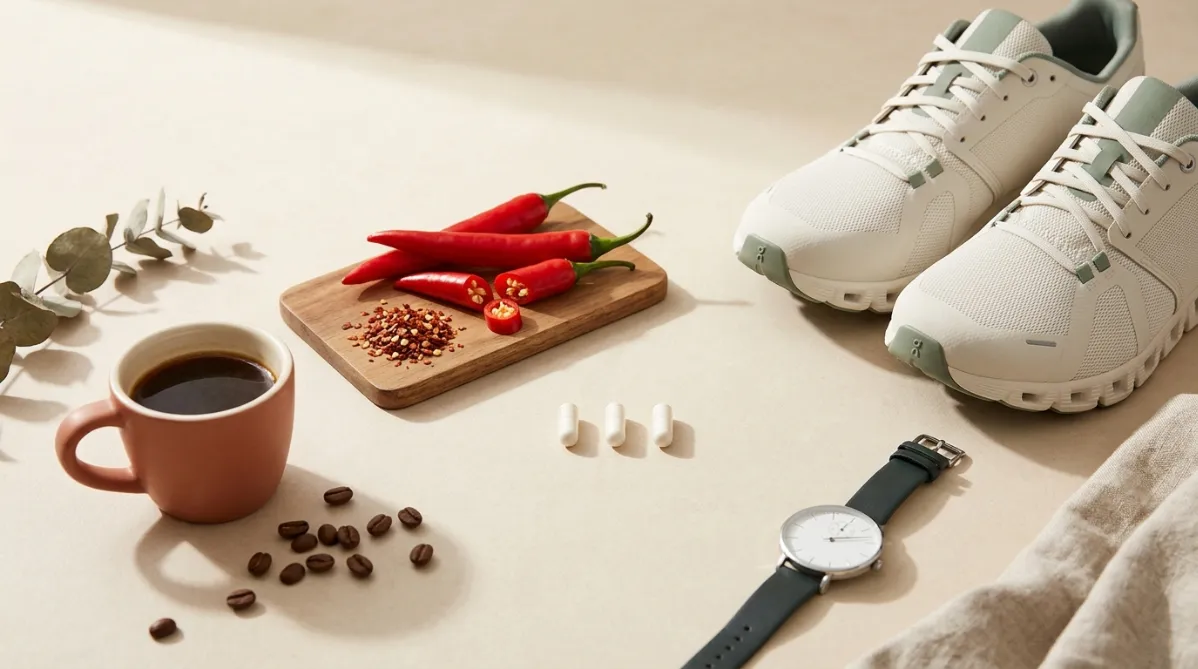
A wide, editorial-style flat lay on a warm, matte cream stone surface, shot from slightly above in soft natural morning light. On the left, a ceramic espresso cup in muted terracotta holds dark coffee, with a few roasted coffee beans scattered beside it. In the center, a small wooden board holds three bright red chili peppers, one sliced open to show pale seeds, next to a small pile of coarse red pepper flakes. On the right, a pair of minimalist off-white running shoes with sage green accents rests at an angle, and a slim stopwatch with a clean white face lies in front of them. Three small matte white capsules sit in a neat row at the center of the composition, a quiet nod to the placebo and the active doses. Soft shadows fall to the lower right. A sprig of dried eucalyptus and a folded linen cloth in oatmeal tones add texture at the edges. The palette is warm and restrained: terracotta, chili red, cream, sage, and charcoal brown, with a gentle pop of red as the focal accent. The depth of field is shallow, so the foreground beans are slightly soft and the chilies and capsules stay crisp. The mood is clean, modern, and magazine-like, in the style of a contemporary health and science journal. There is no text, no people, and no logos, and plenty of negative space on the upper left and right edges leaves room for a headline overlay.
nutrition

Koffein + Capsaicin schlägt Placebo bei 10 km – Capsaicin allein wirkt nicht

BY COACH RYAN ·

Eine Chili‑Paprika‑Verbindung zusammen mit Koffein war die einzige Kombination, die im neuen Crossover‑Trial über 10 km das Placebo übertraf, während Capsaicin allein keinen Effekt zeigte. Koffein trieb den statistischen Effekt, und es gibt keinen Hinweis auf eine Synergie. Die Dosis von 6 mg/kg entspricht etwa 450 mg für einen 75‑kg‑Läufer – das ist viel. Schlaflosigkeit, Angst, Kopfschmerzen und Tachykardie traten häufiger bei Koffein auf.

A wide, editorial-style flat lay photographed from above on a pale warm-gray linen surface in soft natural window light. At the center, a small open amber glass jar tips gently onto its side, spilling a few cream-colored capsules across the fabric. Next to the jar sits a loose arrangement of fresh mushrooms: a cluster of golden-tan reishi with glossy, lacquered caps, a few slender white enoki stems, a halved shiitake showing its pale gills, and a curl of turkey tail with concentric bands of rust, cream, and charcoal. A small wooden scoop holds a pile of fine beige mushroom powder.

On the left third of the frame, a matte black sports watch with a minimal face lies beside a folded sage-green running shirt and a pair of lightweight off-white running shoes, hinting at athletic training without showing a person. A slim white notebook with a single pencil rests nearby, open to a blank page with a faint hand-drawn line graph trending upward, in thin graphite strokes.

On the right side, a pair of clear glass beakers and a single small petri dish with a soft amber-tinted liquid add a subtle laboratory note, kept calm and organic. A single sprig of dried herbs and a few scattered oat-colored grains add texture.

The palette is earthy and refined: oatmeal, soft sage, terracotta, warm amber, and charcoal accents against the muted neutral background. Shadows are soft and diffused, with a gentle highlight on the glass and the glossy reishi cap. The composition leaves generous negative space in the upper right for a headline overlay. Shallow depth of field blurs the edges slightly, while the central mushrooms and capsules stay crisp. The overall feel is modern, clean, and trendy, like a wellness and science magazine cover, with tactile natural textures, minimal styling, and a quiet sense of curiosity and skepticism.
science research

Eine Pilzkapsel steigerte VO2max um 14,8 % – aber es gibt einen großen Haken

BY DR. GYMBRO ·

Eine Pilzkapsel, 40 Tage und ein Anstieg von 14,8 % im VO2max klingen fast zu schön, um wahr zu sein. In der neuen *Antioxidants*-Studie verbesserten 50 junge männliche Athleten, die täglich 320 mg eines beta‑Glukan‑reichen Mehrpilz‑Extrakt‑Komplexes einnahmen, ihr VO2max von 46,26 auf 53,12 mL/kg/min. Der große Haken: Es gab keine Placebo‑Gruppe, keine Randomisierung und kein Blind‑Design, und die Sportler trainierten währenddessen weiter. Zellversuche an Rattenherzzellen lieferten Hinweise im Zusammenhang mit Hypoxie, testeten jedoch Einzelsubstanzen, nicht den kompletten Extrakt.

A wide, editorial-style still life shot from a slightly elevated angle on a pale oatmeal-colored linen surface in soft, diffused morning light. At the center, a shallow matte ceramic bowl in warm terracotta holds a small mound of fine, golden-tan ashwagandha root powder. Beside it lie a few gnarled, dried ashwagandha roots and a sprig of green leaves with tiny orange-red berries in their papery husks. To the left, a minimalist amber glass supplement bottle sits with a few capsules spilled beside it, label blank and clean. A wooden scoop rests on the surface, dusted with powder.

On the right side of the frame, a pair of sleek, muted sage-green running shoes sits slightly off-center. A folded cream towel and a stainless steel water bottle sit just behind them, with a single brushed-steel kettlebell partly out of focus in the background to hint at strength training without dominating the scene. The running shoes and the botanical elements share equal visual weight, suggesting the endurance theme.

A thin, curved line of scattered powder sweeps across the linen from the bowl toward the shoes, like a gentle path or track. Soft shadows fall to the left, and a warm sunbeam crosses the surface and picks out the texture of the powder and the roots.

The palette is restrained and modern: warm terracotta, sage green, cream, soft gold, and touches of charcoal. The background is a blurred pale plaster wall with a hint of a window shadow. Shallow depth of field, crisp focus on the bowl and roots, and generous negative space in the upper left for a headline. Contemporary wellness magazine aesthetic, calm, natural, tactile, high-end lifestyle photography, no text, no people, no futuristic elements.
science research

Ashwagandha überrascht: Es verbessert die Ausdauer stärker als die Kraft

BY DR. GYMBRO ·

Ashwagandha wird häufig als Kraft‑ und Muskelbooster beworben, doch eine aktuelle Metaanalyse zeigt, dass die Wirkung vor allem in der aeroben Ausdauer liegt. Bei 13 randomisierten Studien mit insgesamt 599 Teilnehmenden erzielte das Kraut einen mittleren Effekt von g = 0,54 für die Ausdauer, während Kraftzuwächse unsicher bleiben und Daten zur Power‑Leistung spärlich sind. Der vermeintlich optimale Dosisbereich liegt bei 500‑600 mg pro Tag – jedoch mit wichtigen Vorbehalten. Hier erfährst du, welche Evidenz vorliegt, wer davon profitieren könnte und wer besser darauf verzichtet.

This page is available in