Dr. Gymbro
←

#ketones

2 articles
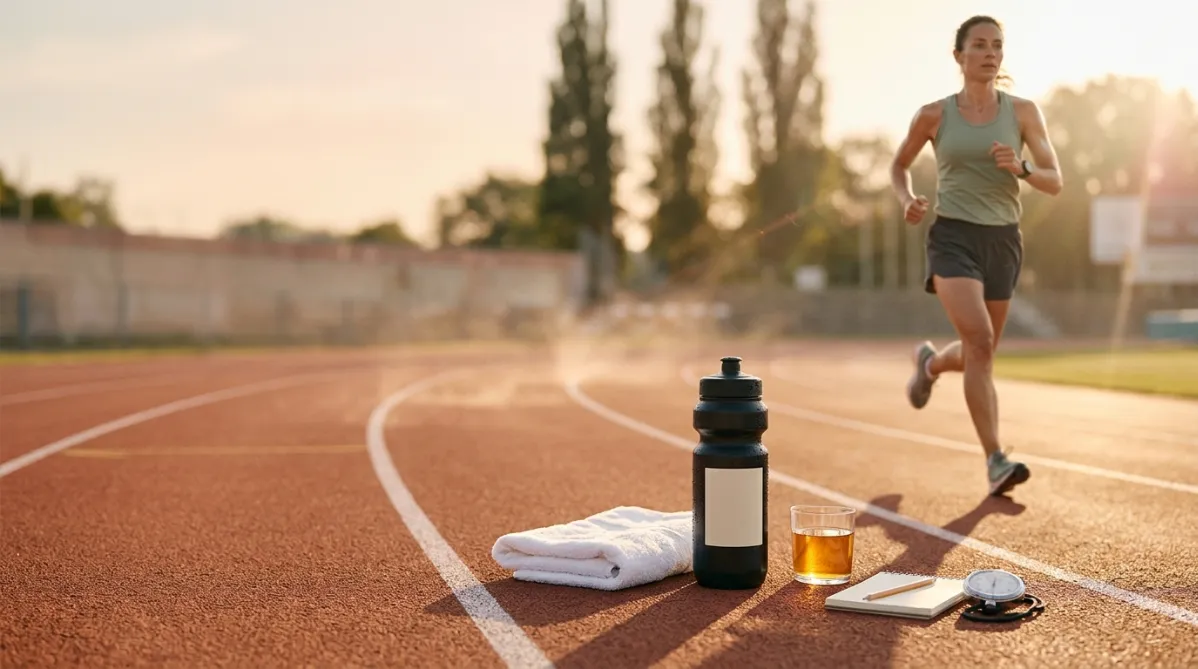
A sunlit outdoor running track in late afternoon, shot from a low angle with shallow depth of field. In the foreground, a matte black bottle with a minimal off-white label sits on the edge of a warm terracotta-colored track lane, beside a folded white towel and a small glass of amber liquid catching golden light. Condensation beads on the bottle. A faint heat shimmer rises from the track surface and softens the background.

In the midground, slightly out of focus, a lean athlete in a sage-green tank top and charcoal shorts runs on a treadmill-like stretch of track, a thin sheen of sweat on their shoulders, their expression focused and calm. Their motion is gently blurred, suggesting endurance and rhythm. Long soft shadows stretch across the lane lines.

The background fades into hazy peach, apricot, and pale yellow tones, with the suggestion of tall trees and a distant stadium wall. Warm sun flare enters from the upper right, creating a subtle glow and a few soft light streaks across the frame.

Subtle editorial touches: a small notebook with a pencil and a stopwatch rest beside the bottle, hinting at data and timing without any text legible. The color palette is warm and muted, with terracotta, cream, sage, and charcoal accents, and a fine film-like grain. The composition leaves open negative space on the left third for a headline overlay. The overall mood is clean, modern, and health-journal inspired, natural and aspirational, with a calm scientific curiosity rather than hype.
nutrition

Ketondrinks in der Hitze – mehr Ausdauer und schärfere Erinnerungsleistung?

BY DR. GYMBRO ·

Ketondrinks werden häufig als Brennstoff für die Fettverbrennung angepriesen, doch eine neue Studie zum Hitze‑Stress legt nahe, dass sie die Ausdauer und das Arbeitsgedächtnis verbessern könnten. Bei 17 sportlich trainierten Männern verlängerte ein Keton‑Monoester + Koffein die Erschöpfungszeit auf 8,9 Minuten im Vergleich zu 7,0 Minuten mit Kohlenhydraten + Koffein nach einer 90‑minütigen Belastung bei 34 °C. Gleichzeitig steigerte sich die Genauigkeit bei einer 1‑Back‑Aufgabe, während Herzfrequenz und Kerntemperatur nahezu unverändert blieben. Bei der 2‑Back‑Aufgabe, Reaktionszeit und einer Hit‑and‑Avoid‑Aufgabe zeigte sich kein Unterschied; die Studie ist zudem klein, ausschließlich an Männern durchgeführt und nur eine Messung pro Bedingung enthalten. Im Folgenden ein Überblick, was die Daten tatsächlich belegen.
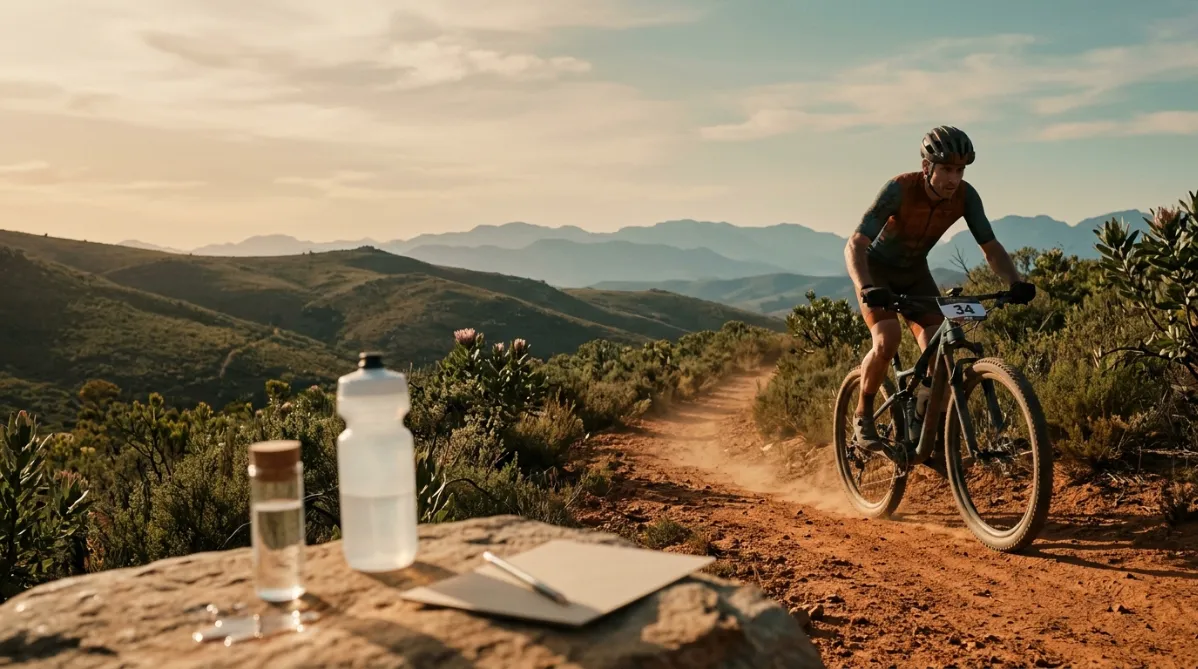
Wide landscape editorial photograph of a mountain biker mid-ride on a dusty red-orange singletrack trail in the South African Western Cape, golden hour light raking across the scene. The rider is in sharp focus on the right third of the frame, wearing a weathered cycling kit with a race number plate on the handlebars, dust kicking up from the rear tire. Behind them, rolling hills covered in fynbos shrubland and silhouetted protea plants fade into soft, hazy blue mountains. Warm amber sunlight creates long shadows and a soft rim light around the rider and bike.

In the lower left foreground, slightly out of focus, a small minimalist glass vial and a clear water bottle sit on a flat sun-bleached rock, with a few drops of liquid catching the light. Next to them, a simple matte paper notecard and a pencil suggest data collection, with no legible text. The vial and bottle are clean, understated, and modern, with no branding.

The color palette is earthy and refined: terracotta, ochre, sage green, dusty teal sky, and cream highlights. The composition uses shallow depth of field, a generous negative space in the upper left sky for headline overlay, and subtle film grain. The mood is contemplative, skeptical, and quietly sophisticated, like a feature photograph from a high-end outdoor sports and science magazine. Natural, candid, cinematic, shot on a 50mm lens with soft contrast and muted saturation. No futuristic elements, no glowing effects, no molecular graphics, no text.
science research

Ketone IQ erhöhten die Blutketone beim Cape Epic, aber sonst nichts

BY DR. GYMBRO ·

Rennende beim acht­tägigen Cape Epic tranken zweimal täglich Ketone IQ und erreichten etwa 1 mM Blutketone, doch ihr Ermüdungsgrad, ihre Herzfrequenz, Reaktionszeit und Erholung waren genauso wie bei den Placebo‑Renner*innen. Die doppelblinde Studie testete R‑1,3‑Butandiol unter realen Rennbedingungen statt im Labor. Die Autoren schließen, dass die moderate Ketose nicht wirksam war und dass Butandiol nicht mit Ketonestern verwechselt werden darf. Mit nur 18 Teilnehmenden hat die Untersuchung offensichtliche Grenzen, liefert aber ein nüchternes Datenstück für alle, die ein teures Keton‑Drink zur Regeneration erwägen.

This page is available in