Dr. Gymbro
←

#ketones

2 articles
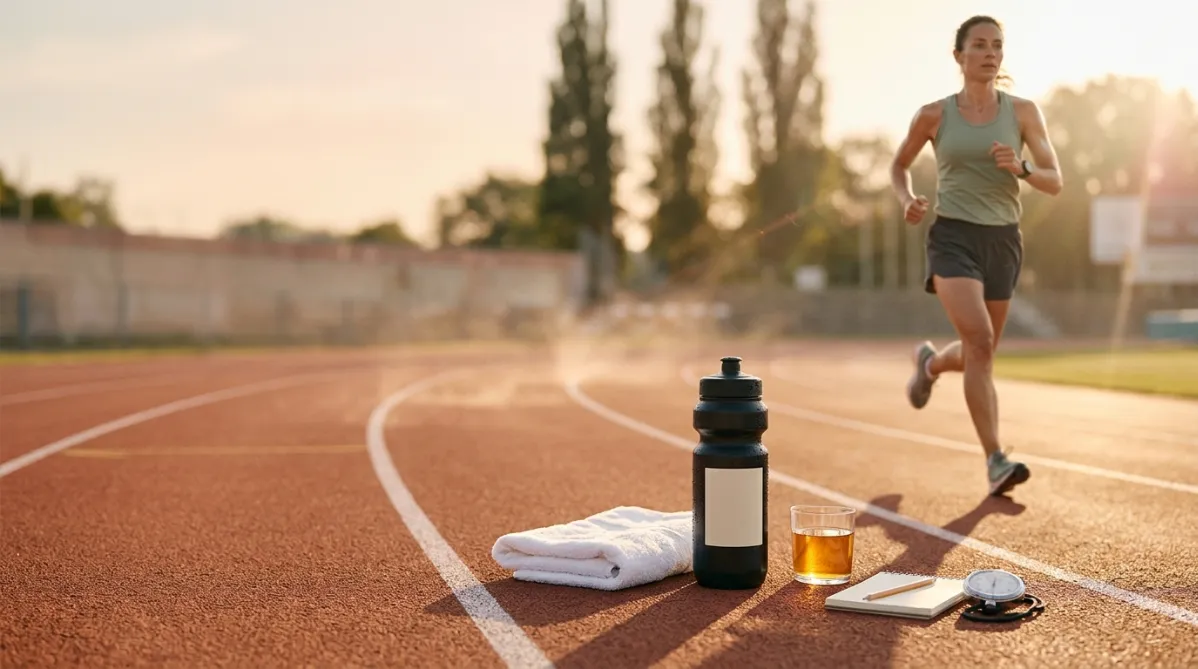
A sunlit outdoor running track in late afternoon, shot from a low angle with shallow depth of field. In the foreground, a matte black bottle with a minimal off-white label sits on the edge of a warm terracotta-colored track lane, beside a folded white towel and a small glass of amber liquid catching golden light. Condensation beads on the bottle. A faint heat shimmer rises from the track surface and softens the background.

In the midground, slightly out of focus, a lean athlete in a sage-green tank top and charcoal shorts runs on a treadmill-like stretch of track, a thin sheen of sweat on their shoulders, their expression focused and calm. Their motion is gently blurred, suggesting endurance and rhythm. Long soft shadows stretch across the lane lines.

The background fades into hazy peach, apricot, and pale yellow tones, with the suggestion of tall trees and a distant stadium wall. Warm sun flare enters from the upper right, creating a subtle glow and a few soft light streaks across the frame.

Subtle editorial touches: a small notebook with a pencil and a stopwatch rest beside the bottle, hinting at data and timing without any text legible. The color palette is warm and muted, with terracotta, cream, sage, and charcoal accents, and a fine film-like grain. The composition leaves open negative space on the left third for a headline overlay. The overall mood is clean, modern, and health-journal inspired, natural and aspirational, with a calm scientific curiosity rather than hype.
nutrition

Boissons cétoniques sous la chaleur : plus d'endurance et une mémoire plus vive ?

BY DR. GYMBRO ·

Les boissons cétoniques sont souvent présentées comme le carburant des biohackers qui souhaitent brûler les graisses. Une nouvelle étude, menée sous stress thermique, suggère qu’elles pourraient également vous aider à tenir plus longtemps. Chez 17 hommes entraînés, le monoester cétonique associé à de la caféine a prolongé le temps d’épuisement à 8,9 minutes contre 7,0 minutes avec des glucides et de la caféine, après 90 minutes d’effort sur tapis à 34 °C. La précision de la mémoire de travail sur la tâche 1‑back s’est également améliorée, tandis que la fréquence cardiaque et la température centrale n’ont pas présenté de différences significatives. En revanche, les tâches 2‑back, le temps de réaction et le test « hit‑and‑avoid » n’ont montré aucun bénéfice, et l’étude était petite, masculine et limitée à une seule session. Voici ce que les données prouvent, et ce qu’elles ne prouvent pas.
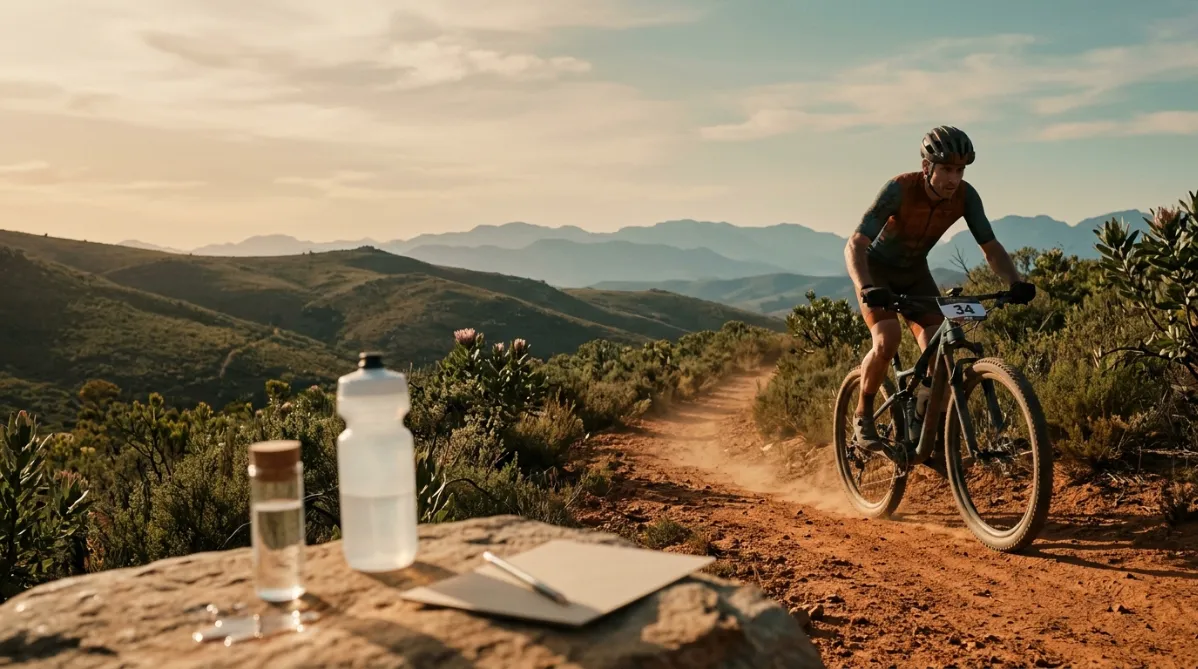
Wide landscape editorial photograph of a mountain biker mid-ride on a dusty red-orange singletrack trail in the South African Western Cape, golden hour light raking across the scene. The rider is in sharp focus on the right third of the frame, wearing a weathered cycling kit with a race number plate on the handlebars, dust kicking up from the rear tire. Behind them, rolling hills covered in fynbos shrubland and silhouetted protea plants fade into soft, hazy blue mountains. Warm amber sunlight creates long shadows and a soft rim light around the rider and bike.

In the lower left foreground, slightly out of focus, a small minimalist glass vial and a clear water bottle sit on a flat sun-bleached rock, with a few drops of liquid catching the light. Next to them, a simple matte paper notecard and a pencil suggest data collection, with no legible text. The vial and bottle are clean, understated, and modern, with no branding.

The color palette is earthy and refined: terracotta, ochre, sage green, dusty teal sky, and cream highlights. The composition uses shallow depth of field, a generous negative space in the upper left sky for headline overlay, and subtle film grain. The mood is contemplative, skeptical, and quietly sophisticated, like a feature photograph from a high-end outdoor sports and science magazine. Natural, candid, cinematic, shot on a 50mm lens with soft contrast and muted saturation. No futuristic elements, no glowing effects, no molecular graphics, no text.
science research

Ketone IQ a augmenté les corps cétoniques au Cape Epic, mais n’a servi à rien

BY DR. GYMBRO ·

Lors du Cape Epic, course de huit jours, les coureurs ont consommé du Ketone IQ deux fois par jour, atteignant environ 1 mM de corps cétoniques dans le sang. Pourtant, leur fatigue, leur fréquence cardiaque, leurs temps de réaction et leur récupération n’ont pas différé de ceux du groupe placebo. Cette étude en double aveugle a testé le R‑1,3‑butanediol en conditions de course réelles, et non en laboratoire. Les auteurs concluent que la cétose modeste n’était pas efficace et précisent que le butanediol ne doit pas être confondu avec les esters cétoniques. Avec seulement 18 participants, l’étude reste limitée, mais elle constitue une donnée précieuse pour quiconque envisage un supplément cétonique coûteux pour la récupération.

This page is available in