Dr. Gymbro
←

#roseburia

1 article
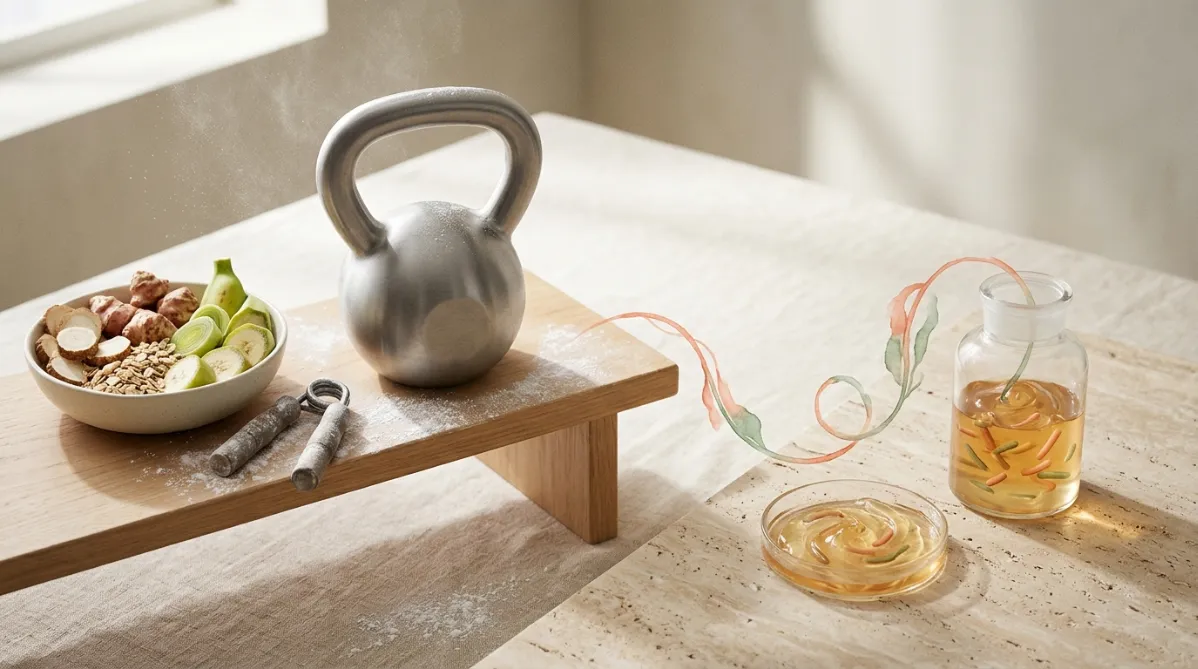
A landscape editorial still life on a soft, warm-neutral background of pale oat linen and light travertine stone. In the center-left, a matte brushed-steel kettlebell and a pair of worn chalk-dusted hand grippers rest on a low pale wooden bench. Beside them sits a shallow ceramic bowl of fermented and fiber-rich foods: sliced chicory root, Jerusalem artichokes, oats, leeks, and a few green banana slices. Soft powdery chalk drifts in the air like fine dust in a sunbeam.

On the right, a minimalist glass apothecary jar and a delicate petri-style glass dish hold a swirl of translucent amber-gold gel with tiny, organic rod-shaped forms. They are rendered as abstract, elegant botanical-looking filaments in soft coral and sage green, like watercolor ink bleeding through water. A single fine thread of this ink-like color curls out of the jar and gently loops across the surface toward the kettlebell, suggesting a quiet connection between gut and muscle without literal anatomy.

Late-morning window light enters from the upper left and casts long, soft shadows with gentle highlights on the metal and glass. Sage green, terracotta, cream, and muted gold make up the palette, with a subtle film-grain finish. The composition is airy, with generous negative space on the far right and top for headline overlay. The shallow depth of field, crisp focus on the foreground objects, and creamy blur behind them give it the polished, modern feel of a wellness and science magazine cover.
science research

Das Darmbakterium, das zu mehr Kraft führt: Roseburia inulinivorans

BY DR. GYMBRO ·

Ein Darmbakterium, *Roseburia inulinivorans*, wurde mit höherer Handkraft, stärkerer Beinpresse und mehr Bankdrücken bei Menschen in Verbindung gebracht. Bei Mäusen, denen das Bakterium verabreicht wurde, stieg ebenfalls die Griffkraft. Andere *Roseburia*-Arten zeigten diese Wirkung nicht, und das Bakterium ist bei älteren Erwachsenen seltener als bei jungen. Der kausale Nachweis stammt jedoch ausschließlich aus Mausstudien, und ein probiotisches Präparat gibt es noch nicht. Wir erklären, was die Studie in *Gut* herausfand, wie das Bakterium wirken könnte und welchen spekulativen, risikoarmen Ansatz du verfolgen kannst, während die Wissenschaft weiter voranschreitet.

This page is available in