Dr. Gymbro
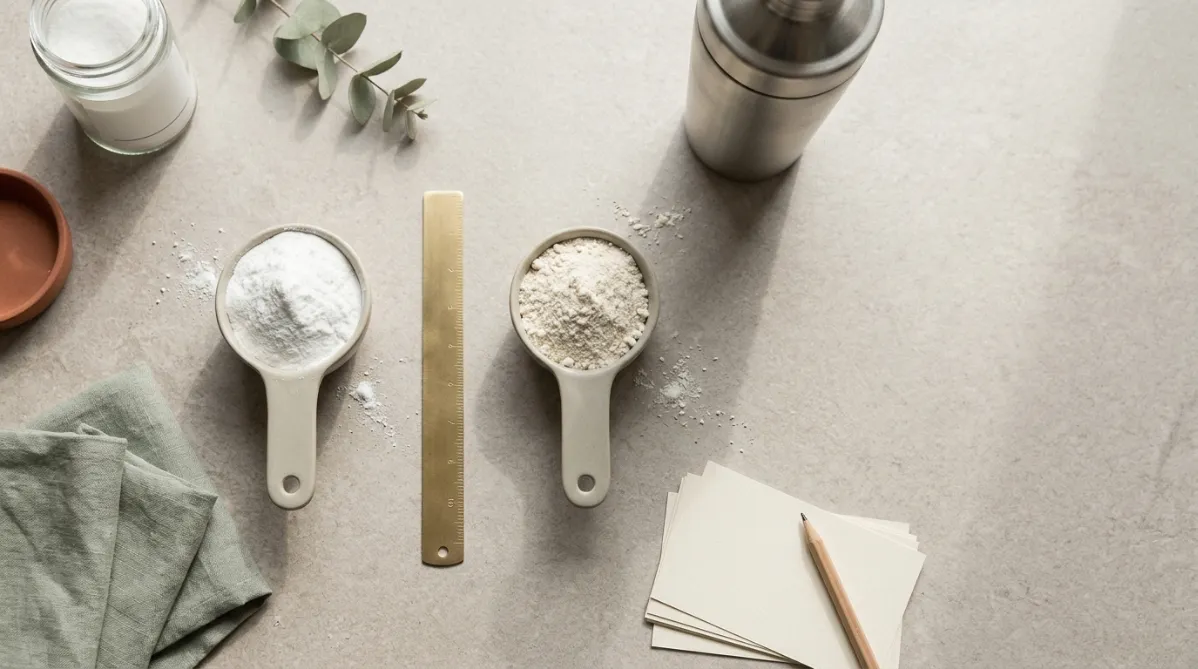
A bright, minimalist flat-lay photograph of two supplement scoops on a pale warm-gray stone surface, shot from directly above in soft natural window light. On the left, a matte ceramic scoop holds fine white creatine monohydrate powder, heaped in a clean mound. On the right, a second scoop of the same shape holds slightly coarser off-white beta-alanine powder, with a small, deliberate gap between the two. Each scoop sits in its own soft shadow, which suggests separation rather than combination. Between them, a thin brushed-brass ruler or a single slim line of fine powder runs across the surface and subtly divides the composition.

Around the scoops, a few restrained props in a muted editorial palette of sage green, cream, terracotta, and soft charcoal: a small glass jar with a minimalist label that has no readable text, a folded linen napkin, a single sprig of eucalyptus, and a stainless-steel shaker bottle softly out of focus in the upper corner. A few loose powder grains are scattered naturally across the stone. A small stack of blank cream index cards with a pencil rests in the lower right, hinting at research and note-taking without any legible writing.

The composition follows a clean rule-of-thirds layout, with generous negative space on the right third for headline overlay. The lighting is gentle and diffused, with long, soft shadows falling to the lower left. The color grading is calm and slightly desaturated, with creamy highlights and a subtle film-like grain. The overall look is a modern wellness and science journal cover, with an airy, trustworthy, contemporary editorial feel, shallow depth of field, and crisp detail on the powders.
Nutrition

Creatina + beta‑alanina: el supuesto beneficio del stack que los investigadores no hallaron

Dr. Gymbro · · 4 min read

Creatina + beta‑alanina: el supuesto beneficio del stack que los investigadores no hallaron

Seguro que has visto los envases, las etiquetas de pre‑entrenamiento y los paquetes que prometen el “stack definitivo”. La combinación de creatina y beta‑alanina se vende como un dúo que potencia mutuamente sus efectos. Sin embargo, una revisión sistemática y un meta‑análisis de redes publicados en el Journal of the International Society of Sports Nutrition pusieron a prueba esa idea y descubririon que la creatina hizo todo el trabajo y la combinación no añadió nada medible.

Lo que realmente hicieron los investigadores

Bai y Xu, del Instituto de Ciencia y Tecnología de Jiangxi (China), siguieron las directrices PRISMA. Buscaron en PubMed, Scopus y Web of Science hasta agosto de 2025 y seleccionaron ensayos controlados aleatorizados (ECA) que investigaran la creatina, la beta‑alanina o ambas, con una duración mínima de dos semanas y con participantes adultos sanos.

Cincuenta y dos ECA, todos con una puntuación de 6 o más en la escala de calidad PEDro, cumplieron los criterios. Un meta‑análisis de redes permite comparar varias intervenciones simultáneamente, incluso aquellas que nunca se han probado cara a cara. En este caso se comparó la creatina sola, la beta‑alanina sola, la combinación de ambas y el placebo. Los resultados evaluados fueron sprint, salto, agilidad, resistencia muscular de la parte superior e inferior y capacidad de sprint repetido (RSA).

El titular: la creatina cumplió, el stack no

En comparación con el placebo, la creatina sola mejoró de forma significativa:

  • Rendimiento en sprint: SMD = ‑0.64 (p = 0.04). El signo negativo indica tiempos más rápidos.
  • Rendimiento en salto: SMD = 0.33 (p = 0.002).
  • Capacidad de sprint repetido: SMD = ‑0.78 (p = 0.01).
  • Resistencia muscular de la parte superior: SMD = 0.43 (p = 0.01).

Los “P‑scores” de la creatina, métrica de clasificación del meta‑análisis de redes, fueron de 0.90 o superiores en todos esos dominios, situándola entre las mejores opciones.

La beta‑alanina mostró "efectos no significativos o dependientes del contexto" y la combinación no reveló beneficios sinérgicos. Los autores concluyeron que la co‑suplementación no aporta ventaja adicional sobre la creatina sola.

Por qué la lógica de “dos vías” no funcionó

En teoría el stack tiene sentido: la creatina favorece la resíntesis de fosfocreatina y la rápida reposición de ATP; la beta‑alanina eleva la concentración de carnosina muscular, que ayuda a tamponar el ácido láctico. Mecanismos diferentes sugieren beneficios aditivos.

Los datos agrupados no lo confirmaron. Los autores indican que la ventaja de tamponamiento de la beta‑alanina parece específica a ciertas tareas y no es suficiente para potenciar el efecto de la creatina. Según su interpretación, la consistencia de la creatina proviene de una mejor recuperación de fosfocreatina y de una mayor salida neuromuscular, aspectos críticos en sprints, saltos y esfuerzos repetidos.

Lo que no cambió

La creatina no alteró de forma significativa agilidad ni resistencia muscular de la parte inferior (ambas p > 0.05). No es una solución universal y los datos no respaldan expectativas de mejora en todas las pruebas de rendimiento.

¿Qué tan robusta es esta evidencia?

El estudio tiene varios puntos fuertes: solo incluye ECA con puntuación PEDro ≥ 6 y reporta ausencia de inconsistencia global y de sesgo de publicación sustancial.

Sin embargo, presenta limitaciones que deben ponderarse:

  • Heterogeneidad: El I² varía entre 0 % y 73 %, por lo que algunos resultados provienen de ensayos bastante inconsistentes.
  • Población: La muestra se compone de atletas adultos sanos; los hallazgos pueden no extrapolarse a adultos mayores, poblaciones clínicas o principiantes.
  • Sexo y deporte: Los autores piden más investigaciones sobre respuestas específicas por sexo y disciplina, ya que los efectos promedio podrían ocultar variaciones en subgrupos.
  • Duración y diseño: Recomiendan ensayos aleatorizados multibrazo, estandarizados y de larga duración para clarificar posibles interacciones. La evidencia actual no es la palabra final sobre la existencia de sinergia.
  • Beta‑alanina no es «inútil»: El hallazgo es que, en este análisis, sus efectos fueron no significativos o dependientes del contexto y no potenciaron a la creatina.
  • Detalle a nivel de abstracto: El resumen no indica el número total de participantes ni la distribución por brazos en cada ensayo, por lo que conviene revisar el artículo completo antes de sacar conclusiones finas.

Consejos prácticos

Dosis y momento: El abstract no detalla los protocolos de dosificación ni de timing, así que este trabajo no puede indicarte cuánto ni cuándo tomar. En la literatura más amplia, la práctica habitual es consumir entre 3 y 5 g de creatina monohidrato al día de forma continua. El análisis requería al menos dos semanas de suplementación, así que dale tiempo antes de evaluar resultados.

Para quién es: Según estos resultados, la creatina conviene a atletas cuyo desempeño depende de sprints, saltos, esfuerzos de alta intensidad repetidos o resistencia muscular de la parte superior. Ejemplos: jugadores de deportes de equipo, velocistas y levantadores.

Para quiénes pueden saltarse el stack: Si tu objetivo principal es obtener un impulso extra por “apilar” suplementos, este análisis ofrece escasas razones para pagar por la combinación. Si ya consumes beta‑alanina y te sienta bien, nada aquí indica que sea perjudicial; simplemente no potencia la creatina en los datos analizados.

Para quiénes deben ser cautelosos: La revisión se centra en atletas adultos sanos. Cualquier persona con condición médica, especialmente problemas renales, embarazadas o bajo medicación, debería consultar a un profesional antes de iniciar cualquier suplemento. Este consejo es general y no se extrae directamente del estudio.

Conclusión

Si estás decidiendo a dónde destinar tu presupuesto de suplementos, este meta‑análisis de redes con 52 ECA respalda a la creatina como el agente consistente para trabajos de alta intensidad y anaeróbicos. La beta‑alanina puede ser útil en contextos específicos, pero no convirtió a la creatina en una versión mejorada de sí misma. Ensayos más largos y mejor diseñados podrían refinar el panorama, pero por ahora el stack no ha demostrado su supuesto “bonus”.
Original study

Read the original research on pubmed.ncbi.nlm.nih.gov →

This article summarizes published research for general information. It is not medical advice.

DG

Written by

Dr. Gymbro

Dr. Gymbro writes for Dr. Gymbro: science-backed fitness, nutrition & performance.

Related Articles

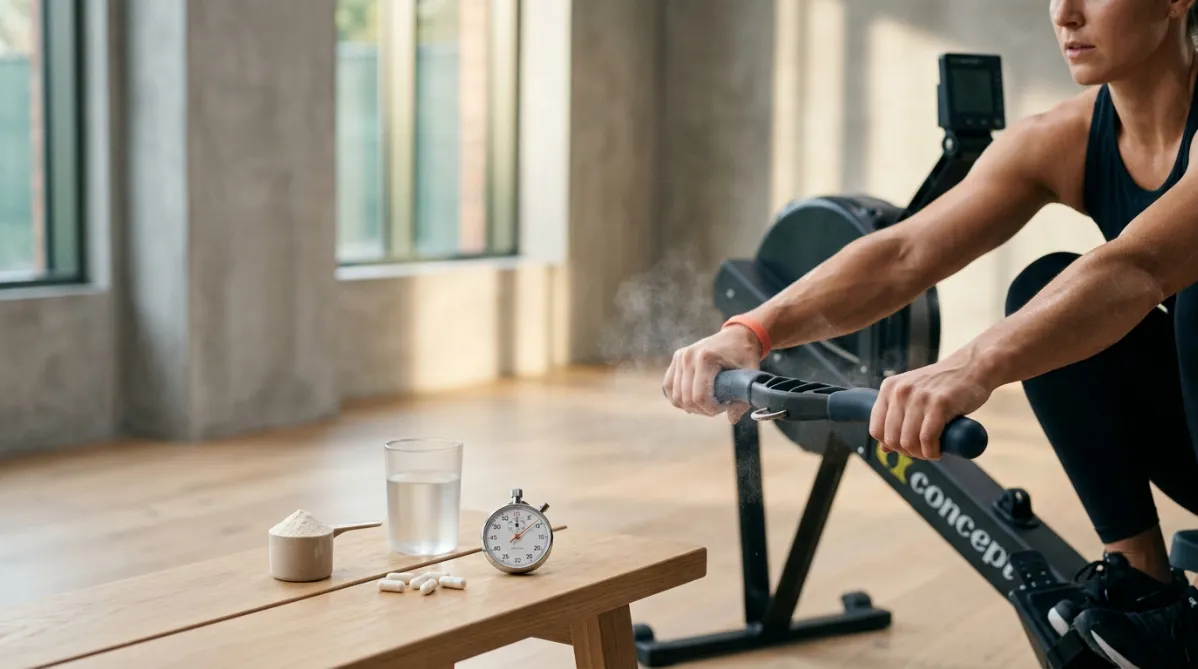
A wide, minimalist editorial scene of an athlete's hands and forearms gripping the handles of a rowing ergometer, shot in soft natural light from a large window in a clean, airy training studio. The athlete is mid-pull, forearm muscles subtly defined, a light sheen of sweat on the skin, chalk dust floating in the air. In the foreground on a pale oak bench sits a small ceramic scoop of fine white powder beside a matte glass of water, with a few loose white capsules arranged neatly in a gentle curve. A minimalist analog stopwatch with a clean white face lies next to them, its hand paused near the two-minute mark.

The color palette is calm and modern: warm off-white, soft sand, muted sage green, and a single accent of coral orange in the stopwatch hand and the rower's wristband. The background is softly blurred concrete and pale wood with long, gentle shadows stretching across the floor. Shallow depth of field keeps the hands, powder, and stopwatch crisp while the rest dissolves into creamy bokeh.

Composition follows the rule of thirds: the rowing handles and hands occupy the right third, the bench still life sits in the lower left, and open negative space in the upper left leaves room for a title overlay. The mood is focused, quiet, and intentional, like a high-end health and science journal feature. Fine film grain, subtle matte finish, editorial photography style, natural color grading, and no text or logos.
nutrition

¿Funciona la Beta‑Alanina? Un Meta‑análisis Dice que Sí para Esfuerzos de 60–240 Segundos

BY DR. GYMBRO ·

La beta‑alanina se ha promocionado durante años como la estrategia para combatir la “quemadura” del ejercicio intenso, pero ¿cumple lo que promete? Un meta‑análisis que recopiló 15 estudios y 360 participantes halló un beneficio real, aunque modesto, con un aumento medio estimado del 2,85 %. El efecto fue más evidente en esfuerzos de entre 60 y 240 s, disminuyó más allá de los cuatro minutos y no se observó en sprints de menos de un minuto. El artículo también analiza la estrategia de carga habitual de 3,2–6,4 g diarios durante al menos cuatro semanas, cómo repartir las dosis ayuda a reducir el hormigueo y qué deportistas son los que más pueden ganar.

A wide, editorial-style still life photographed from slightly above on a pale oat-colored linen surface, lit by soft morning window light from the left. In the center sits a small matte ceramic bowl holding a mound of fine white powder, with a minimalist wooden scoop resting beside it. Next to the bowl is an open amber glass supplement jar with a plain cream label, and a few white capsules spill across the linen in a loose arc.

To the right, a neatly arranged cluster of analog "study" objects suggests careful measurement: a vintage stopwatch with a clean white face, a slim notebook with a sage-green cover open to a hand-drawn bar chart (blurred, no legible text), and a mechanical pencil lying across the page. A small row of six identical ceramic dishes, each holding a pinch of powder, is lined up along the top edge of the frame to hint at the six-week trial. One dish is slightly out of alignment, a subtle visual cue for ambiguity.

A shallow glass of water and a single sprig of green eucalyptus add a calm, organic note in the foreground. Soft, long shadows fall across the textured linen, and the palette stays restrained: warm cream, soft sage, muted terracotta, pale gray, and touches of amber from the glass jar. A few translucent paper cutouts in two tones (sage and blush) overlap in the upper right corner as a modern graphic accent, evoking overlapping data points without showing any numbers.

Depth of field is shallow, with the bowl and stopwatch in crisp focus and the edges gently softened. The composition leaves generous negative space on the left third for title text overlay. The overall mood is thoughtful, balanced, and quietly skeptical, in the style of a contemporary wellness and science magazine: clean, tactile, minimal, with a subtle film-like grain and natural color grading. No people, no futuristic or sci-fi elements, no readable text or logos.
nutrition

¿Es el GAA un potenciador cerebral? El resultado del ensayo de 6 semanas es complicado

BY DR. GYMBRO ·

El GAA, precursor de la creatina que se vende como potenciador cerebral, acaba de recibir su primera prueba seria en humanos. En un ensayo doble ciego de seis semanas con 58 adultos sanos, se observaron algunas mejoras en la velocidad de reacción y leves indicios de cambios en el ánimo y el estrés. Sin embargo, la mayoría de las pruebas cognitivas no mostraron efectos y muchos resultados primarios fueron solo tendencias. Los marcadores de seguridad fueron normales, pero el estudio fue pequeño, exploratorio y no incluyó un grupo de comparación con solo creatina. Aquí se explica qué evidencia existe realmente, a quién podría interesar y por qué el veredicto es mixto.

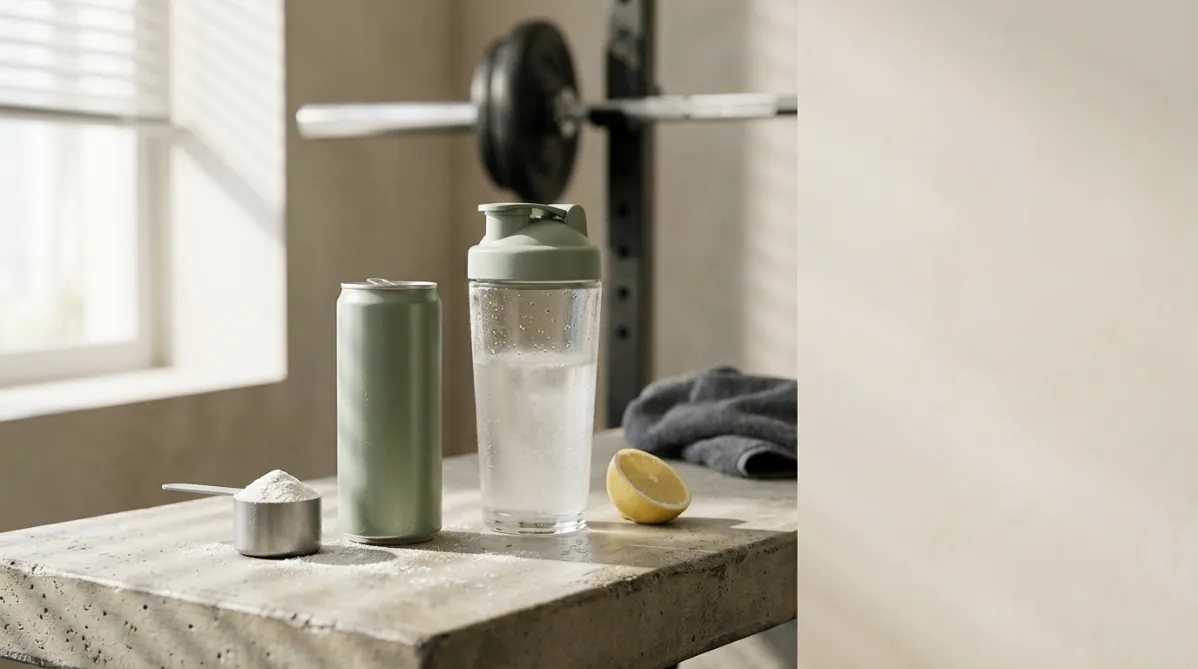
A sleek aluminum energy drink can and a matte scoop of white pre-workout powder sit side by side on a pale concrete gym bench, lit by soft morning window light. The can is slim and minimalist, with a muted sage green label and no legible text. Beside it is a clear glass shaker half full of cloudy, lightly frothy liquid with condensation beading on its surface. A few fine grains of powder are scattered across the bench, catching the light. Behind them, slightly out of focus, a stainless steel barbell rests on a rack, and a folded charcoal gym towel sits at the edge of the frame.

The color palette is warm neutral: oatmeal, soft gray, and sage, with a single accent of pale citrus yellow from a halved lemon wedge placed near the glass. A thin, elegant shadow from the window blinds falls diagonally across the scene, giving it an editorial, magazine-style rhythm. The composition leaves generous negative space on the right third of the frame, a smooth blurred wall in warm off-white, suitable for headline text overlay.

The shot is a low-angle, shallow depth-of-field product-style photograph, as if taken with an 85mm lens at f/2. The foreground objects are tack sharp and the background melts into creamy blur. The mood is calm, clean, and modern, like a wellness or science journal feature. Subtle film grain and gentle contrast add a tactile, contemporary lifestyle feel. There are no people, no logos, and no futuristic or sci-fi elements, just a quiet, considered still life that suggests the choice between a canned drink and a scooped supplement.
nutrition

Tu bebida energética puede funcionar como un pre‑entrenamiento—con un detalle

BY DR. GYMBRO ·

La cafeína y la taurina aparecen juntas en bebidas energéticas y pre‑entrenamientos, pero ¿realmente mejoran el rendimiento? Un meta‑análisis de 11 ensayos aleatorizados (234 participantes) encontró mejoras moderadas en la potencia máxima y en el tiempo hasta el agotamiento, además de una menor percepción del esfuerzo. La frecuencia cardíaca no cambió y el tiempo de reacción resultó demasiado inconsistente como para confiar en él. El inconveniente es que los estudios son pequeños y no pueden demostrar si la taurina aporta algo más allá de la cafeína. Aquí te mostramos qué dicen los datos y a quién conviene pensarlo dos veces.

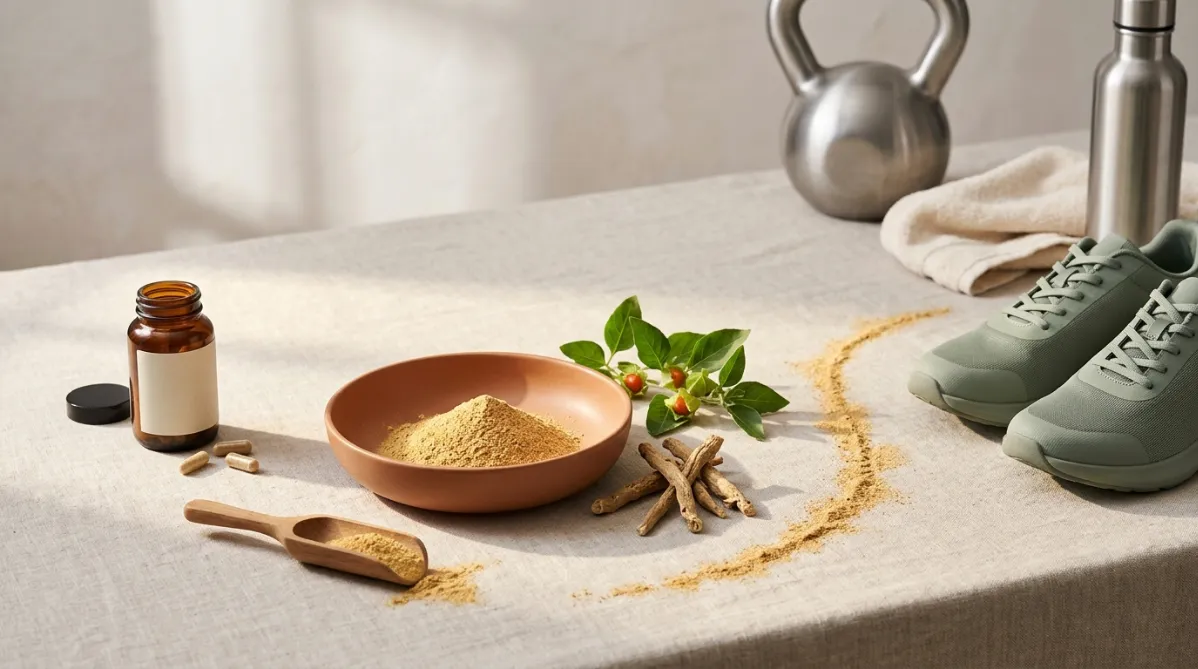
A wide, editorial-style still life shot from a slightly elevated angle on a pale oatmeal-colored linen surface in soft, diffused morning light. At the center, a shallow matte ceramic bowl in warm terracotta holds a small mound of fine, golden-tan ashwagandha root powder. Beside it lie a few gnarled, dried ashwagandha roots and a sprig of green leaves with tiny orange-red berries in their papery husks. To the left, a minimalist amber glass supplement bottle sits with a few capsules spilled beside it, label blank and clean. A wooden scoop rests on the surface, dusted with powder.

On the right side of the frame, a pair of sleek, muted sage-green running shoes sits slightly off-center. A folded cream towel and a stainless steel water bottle sit just behind them, with a single brushed-steel kettlebell partly out of focus in the background to hint at strength training without dominating the scene. The running shoes and the botanical elements share equal visual weight, suggesting the endurance theme.

A thin, curved line of scattered powder sweeps across the linen from the bowl toward the shoes, like a gentle path or track. Soft shadows fall to the left, and a warm sunbeam crosses the surface and picks out the texture of the powder and the roots.

The palette is restrained and modern: warm terracotta, sage green, cream, soft gold, and touches of charcoal. The background is a blurred pale plaster wall with a hint of a window shadow. Shallow depth of field, crisp focus on the bowl and roots, and generous negative space in the upper left for a headline. Contemporary wellness magazine aesthetic, calm, natural, tactile, high-end lifestyle photography, no text, no people, no futuristic elements.
science research

La sorpresa de la ashwagandha: favorece la resistencia más que la fuerza

BY DR. GYMBRO ·

La ashwagandha suele promocionarse como potenciadora de fuerza y músculo, pero un metaanálisis reciente muestra que su mayor beneficio está en la resistencia aeróbica. Analizando 13 ensayos aleatorizados con 599 participantes, los autores hallaron un efecto medio de g = 0.54 para la resistencia, mientras que los incrementos de fuerza fueron positivos pero inciertos. La dosis que parece más eficaz se sitúa entre 500‑600 mg al día, aunque con importantes advertencias. Aquí se resume la evidencia, quién podría beneficiarse y quién debería pensarlo dos veces.

This page is available in