Dr. Gymbro
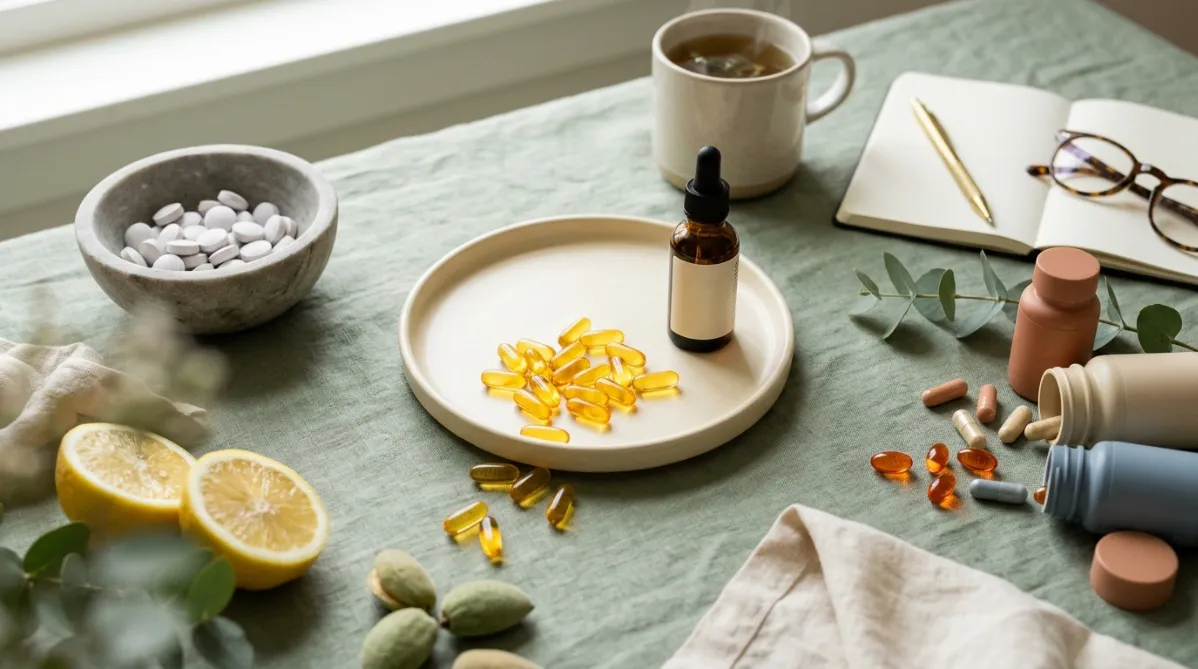
A bright, modern editorial still life shot from slightly above on a soft sage-green linen surface, in a wide landscape composition. At the center sits a small, elegant glass amber dropper bottle and a handful of vivid golden-yellow riboflavin capsules spilling from a minimalist ceramic dish, glowing warmly as the focal point. To the left, a scattering of pale, chalky white magnesium tablets rests in a muted gray stone bowl, pushed slightly out of focus and cooler in tone, suggesting they are less important. On the right, a few small, neatly arranged supplement bottles and capsules in soft terracotta, cream and dusty blue tones stand in a loose row, with a few orange CoQ10 softgels catching the light.

Around the supplements, fresh natural ingredients add texture: a halved lemon, a few green almonds, a sprig of eucalyptus, and a folded cream-colored linen napkin. A ceramic mug of herbal tea sits near the edge, with delicate steam. A small, open notebook with a pen and a pair of round tortoiseshell glasses sits in the upper corner, hinting at research and reading, with no legible text.

Lighting is soft, diffused natural window light from the upper left, creating gentle long shadows and a calm, airy mood. Color palette: warm butter yellow, sage green, soft cream, and muted terracotta, with a touch of cool gray. Shallow depth of field with crisp focus on the golden capsules and creamy blurred edges. The overall feel is clean, trendy wellness-journal photography, with generous negative space on the right side for headline overlay, minimalist, calm, and sophisticated, high resolution, 16:9.
Science & Research

El magnesio no mostró beneficio; la riboflavina 400 mg redujo las migrañas

Dr. Gymbro · · 5 min read

El magnesio no mostró beneficio; la riboflavina 400 mg redujo las migrañas

Puede que tengas magnesio guardado en el armario para la migraña. Un nuevo meta‑análisis de red sugiere que quizá no sea el suplemento en el que debas confiar. El mismo análisis encontró una vitamina mucho más modesta, la riboflavina (B2), con la evidencia más fiable para reducir los ataques.

El artículo, publicado en Headache (DOI: 10.1111/head.70268), clasificó vitaminas y nutracéuticos cara a cara para la prevención de la migraña. Los resultados son más matizados que una simple historia de "el suplemento X funciona".

Qué hicieron realmente los investigadores

El equipo agrupó 20 ensayos controlados aleatorios doble ciego (1 829 participantes randomizados, 1 600 analizados) en un meta‑análisis de red registrado en PROSPERO. Un meta‑análisis de red permite comparar tratamientos que nunca se han probado directamente entre sí, enlazándolos a través de brazos de placebo comunes.

La pregunta principal era la frecuencia mensual de ataques de migraña en adultos, informada por 10 ensayos. Los resultados secundarios incluyeron la proporción de personas que redujeron los ataques al menos un 50 % ("respondedores"), la duración del ataque, la intensidad del dolor y los días con migraña. Los autores también calificaron la confianza que se puede depositar en cada hallazgo usando el marco CINeMA.

Hallazgo principal: riboflavina 400 mg

En adultos, riboflavina 400 mg mostró la reducción más fiable en la frecuencia de ataques. Disminuyó los episodios en aproximadamente 1,95 al mes (IC 95 % −2,42 a −1,49). La certeza de la evidencia fue moderada, la mejor puntuación de cualquier opción en el análisis.

Otros suplementos presentaron estimaciones puntuales mayores, pero vienen acompañados de fuertes advertencias (ver más abajo). La riboflavina 400 mg sobresalió por la consistencia y calidad de su evidencia. Las dosis menores —100 mg y 200 mg— no aportaron datos de frecuencia de ataques en adultos; la señal de 200 mg que se había reportado antes proviene de un ensayo pediátrico.

Números mayores que merecen escepticismo

Algunos nutrientes parecían aún más potentes en el papel:

  • Vitamina B12 500 µg: −2,50 ataques al mes (IC 95 % −4,35 a −0,65)
  • Vitamina B6 80 mg: −2,33 ataques al mes (IC 95 % −4,19 a −0,48)
  • Vitamina D3: −2,29 ataques al mes (IC 95 % −3,03 a −1,54)

Antes de emocionarse, fíjense de dónde provienen esos números. Las estimaciones de B12 y B6 se basan en un solo ensayo pequeño cada una. La estimación de vitamina D3 proviene de dos ensayos pequeños. Los tres se calificaron con cercanía baja a muy baja, y los intervalos de confianza amplios demuestran lo imprecisos que son. Un efecto grande en un conjunto de datos diminuto no equivale a un tratamiento más potente; son pistas para futuras investigaciones, no ganadores probados.

CoQ10: interesante, pero con cautela

La coenzima Q10 contó una historia distinta, con beneficios en otros resultados:

  • CoQ10 300 mg fue la única intervención con una ventaja estadísticamente significativa para alcanzar un estado de respondedores ≥ 50 % en adultos (odds ratio 4,83, IC 95 % 1,17–19,89). La certeza era muy baja, y el amplio intervalo refleja una red escasa e imprecisa.
  • CoQ10 400 mg acortó la duración del ataque en unos 3,3 horas (IC 95 % −5,72 a −0,88; cercanía baja, degradada por imprecisión).
  • CoQ10 400 mg también redujo la intensidad del dolor (diferencia media estandarizada −0,70, IC 95 % −1,12 a −0,27; cercanía baja).

Así, el CoQ10 podría ayudar a que los ataques sean más breves y menos dolorosos, más que menos frecuentes. Eso sería útil, pero la evidencia sigue siendo tenue. Los autores advierten que los hallazgos de respondedores, en particular, deben interpretarse con cautela.

La sorpresa del magnesio

El magnesio es uno de los suplementos más conocidos para la migraña, por lo que este resultado puede sorprender a los lectores. En este análisis, el magnesio no mostró ningún beneficio detectable en los diferentes resultados.

Los autores también informaron que la proporción de eventos adversos fue mayor para el magnesio. Insisten en que esas cifras son solo descriptivas y no comparativas, por lo que no deben leerse como prueba de que el magnesio sea menos seguro. "Sin beneficio detectable" tampoco prueba que el magnesio nunca pueda ayudar a algún individuo; simplemente indica que los ensayos agrupados no mostraron un efecto significativo.

Resumen rápido del ranking de evidencia

Clasificado por la confianza en la evidencia, no por el tamaño del efecto:

  1. Riboflavina 400 mg: menos ataques al mes; certeza moderada.
  2. CoQ10 400 mg: ataques más cortos y menor intensidad del dolor; certeza baja.
  3. Vitamina D3, B12 500 µg, B6 80 mg: reducciones mayores de frecuencia, pero certeza baja a muy baja basada en pocos ensayos pequeños.
  4. CoQ10 300 mg: más respondedores; certeza muy baja.
  5. Magnesio: sin beneficio detectable.

Conclusiones prácticas

  • Dosis estudiadas: la evidencia más sólida corresponde a la riboflavina a 400 mg. El CoQ10 se evaluó a 300 mg (respondedores) y 400 mg (duración y dolor).
  • Conoce la certeza: solo la riboflavina 400 mg alcanzó certeza moderada. Traten los hallazgos de B12, B6, D3 y CoQ10 como preliminares.
  • Ten paciencia: los enfoques preventivos suelen tardar semanas o meses en mostrar efectos; no juzgues un suplemento después de unos pocos días.
  • Orina amarilla brillante: la riboflavina suele volver la orina de un amarillo intenso. Es inofensivo.
  • Lleva un diario: registra la frecuencia, duración e intensidad de los ataques para comprobar si algo está funcionando.
  • Consulta al médico: si sufres migrañas frecuentes, habla con un profesional antes de iniciar suplementos, sobre todo si ya tomas otros medicamentos, estás embarazada o tienes alguna condición de salud.

La letra pequeña

Los autores advierten que sus conclusiones deben interpretarse con cautela. Varias comparaciones se sustentan en solo unos pocos estudios, y las estimaciones de respondedores son imprecisas. Los ensayos pediátricos se resumieron por separado de la red de adultos. Se requieren ensayos más grandes, estandarizados y con suficiente potencia estadística para confirmar cuáles opciones realmente funcionan mejor y cuán seguras son.

Por ahora, la conclusión medida es: entre los suplementos evaluados, la riboflavina 400 mg tiene la evidencia más fiable para reducir la cantidad de ataques de migraña en adultos; el CoQ10 puede ayudar con la duración y el dolor del ataque; y el magnesio no mostró un beneficio detectable en este análisis.

Original study

Read the original research on pubmed.ncbi.nlm.nih.gov →

This article summarizes published research for general information. It is not medical advice.

DG

Written by

Dr. Gymbro

Dr. Gymbro writes for Dr. Gymbro: science-backed fitness, nutrition & performance.

Related Articles

A wide, editorial-style still life photographed on a pale warm-gray concrete surface in soft morning window light. In the center sits an open, matte white supplement tub with a scoop resting beside it, a small mound of fine white powder spilling onto the surface. Next to it is a clear glass of water with a faint cloudy swirl of dissolved powder. A few loose capsules in muted coral and cream tones are scattered casually in the foreground. Behind them, slightly out of focus, is a clean running track lane in terracotta red with crisp white lines curving across the background. A pair of minimalist off-white sprint spikes rests on the edge of the track, laces loosely undone. A stopwatch with a brushed metal casing lies partially in frame at the right, its face reading a blurred, indistinct time.

The composition uses generous negative space on the left third, leaving a calm area of soft gray and cream for headline text. Shadows are long, gentle, and slightly cool, contrasting with the warm terracotta of the track. The palette is restrained: terracotta, bone white, soft sage green accents from a small leaf sprig tucked near the tub, and charcoal gray details. Shallow depth of field with a crisp focus on the scoop and powder, creamy bokeh behind. The mood is thoughtful, skeptical, and calm, like a modern wellness or science journal cover. Subtle film grain, natural color grading, and a tactile, tangible feel, with no text, no logos, and no futuristic elements.
nutrition

Beta‑alanina: presente en casi todos los pre‑entrenamientos, pero los datos de sprint indican que quizá no funcione

BY DR. GYMBRO ·

La beta‑alanina se encuentra en casi todos los pre‑entrenamientos y el hormigueo que provoca suele hacer creer que está funcionando. Sin embargo, un meta‑análisis multinivel de 2026 que reunió 17 ensayos controlados aleatorios no mostró ningún beneficio en la capacidad de sprint repetido, sea cual sea la métrica analizada. La dosis, la duración de la suplementación y el nivel de entrenamiento no modificaron el resultado. Los autores explican que, en sprints repetidos, el factor limitante es la recuperación de fosfocreatina más que la acidosis que la beta‑alanina intenta contrarrestar.

A wide, editorial-style still life photographed in soft natural window light on a pale oak gym bench. In the foreground, a small rustic ceramic bowl in warm sand tones holds a mound of fine golden-beige ashwagandha root powder, with a few dried gnarled ashwagandha roots and a sprig of green leaves with tiny orange-red berries resting beside it. A wooden scoop dusted with powder lies at an angle. Just behind, a matte black barbell with a single chalk-dusted steel plate sits slightly out of focus, a light haze of white chalk hanging in the air and catching the sunlight.

On the left side, a neat stack of printed research papers with a sharp black pen and a few muted sage-green sticky tabs. One page shows a simple, abstract forest-plot-style line graph with small squares and horizontal lines, subtly out of focus, hinting at statistics without legible text. A pair of minimal round reading glasses rests on the pages. A small linen gym towel is folded near the edge of the bench.

The palette is restrained and modern: warm cream, soft sage green, muted terracotta, charcoal black, and brushed steel highlights. The background is a softly blurred minimalist studio space with a pale plaster wall and a long soft shadow cast by a window frame, giving a calm, contemplative mood. Shallow depth of field, crisp detail on the powder and roots, gentle film-like grain, and generous negative space on the right third of the frame for a headline overlay. The overall look is a clean, trendy health-and-science journal cover, thoughtful and skeptical rather than promotional, balancing the natural herbal element against the discipline of strength training.
nutrition

Ashwagandha para levantadores: ¿Impulso de fuerza o espejismo estadístico?

BY DR. GYMBRO ·

Ashwagandha se vende a los levantadores como potenciador de fuerza y masa, y un nuevo metaanálisis de ensayos controlados de entrenamiento de resistencia mostró aumentos en press de banca y sentadilla que parecen impresionantes en papel. Sin embargo, sólo se pudieron agrupar tres estudios con 161 participantes. Los resultados de fuerza perdieron significación bajo pruebas HKSJ más rigurosas y dependían de un único ensayo influyente. La evidencia fue calificada por GRADE como baja a muy baja, y no se observó un efecto fiable sobre la grasa corporal. Aquí se resume lo que realmente muestra la revisión y quién podría aún querer probarla.

A lone trail runner pauses on a high alpine ridge at dawn, holding a small enamel camp mug of steaming coffee, with thin ribbons of steam curling into crisp, cold air. She wears a fitted charcoal running vest and a muted sage windbreaker, and her breath is faintly visible. Behind her, layered mountain ranges fade into soft blue and lavender haze, and a sea of low clouds fills the valley below. Warm golden sunlight skims the ridgeline and rim-lights her profile, shoulders, and the rising steam. In the foreground, a scattering of dried alpine grasses and lichen-covered stones is in sharp focus, with a worn trail snaking toward the summit. Near the mug sits a small pair of trail running shoes with dusty soles and a simple analog wristwatch resting on a flat rock.

The composition follows a wide 16:9 editorial layout. The subject sits slightly right of center on the rule of thirds, leaving generous negative space in the pale peach-and-powder-blue sky on the left, where headline text could sit. The palette is restrained and modern: warm amber, soft cream, dusty sage, slate blue, and a touch of terracotta. The look is cinematic but natural, with shallow depth of field on the foreground details, gentle film grain, and a slightly matte finish. It evokes a high-end outdoor lifestyle magazine or a contemporary wellness journal. The mood is calm, focused, and quietly determined, capturing the contrast between thin, cold altitude air and the warmth of a coffee ritual. The image has no text, logos, or futuristic elements, and no gym equipment, only natural light, texture, and atmosphere.
nutrition

Cafeína en el aire rarefaccionado: el impulso de resistencia que la hipoxia no puede borrar

BY DR. GYMBRO ·

El aire escaso reduce la capacidad de resistencia, pero un nuevo meta‑análisis sugiere que la cafeína puede recuperar parte de esa pérdida. Al agrupar nueve estudios cruzados controlados con placebo (117 participantes), los investigadores observaron un aumento moderado‑a‑grande en el rendimiento bajo hipoxia (g = 0.76). Sorprendentemente, la saturación de oxígeno y la percepción del esfuerzo no cambiaron, mientras que la frecuencia cardíaca, el lactato y la ventilación sí aumentaron. La evidencia tiene una certeza baja y solo 19 mujeres participaron, por lo que los resultados son prometedores pero no concluyentes.

A soft-lit editorial still life on a pale warm-gray concrete surface, shot from a slightly elevated three-quarter angle in a wide landscape frame. On the left, a single amber glass supplement bottle with a minimalist cream label, its lid set beside it. A few golden-yellow softgel capsules are scattered in a loose arc across the surface, catching the light like small drops of honey. At the center-right, a matte sage-green yoga mat is partly unrolled, with a polished chrome dumbbell resting on it. Next to the dumbbell sits a worn canvas hand gripper, a nod to the handgrip finding. Behind them, a wooden gym bench is slightly out of focus, and a folded linen towel sits on top of it.

Warm morning sunlight enters from the upper left through a large window. It casts long, gentle diagonal shadows and a faint golden glow across the scene, a quiet reference to vitamin D and sunshine. A sprig of dried eucalyptus or a small potted succulent adds an organic touch near the bottom right. A small, neatly stacked pile of two or three matte pastel-toned weight plates in butter yellow and dusty terracotta adds color blocking.

The palette is muted and modern: butter yellow, sage, warm sand, soft terracotta, and off-white, with a single strong amber accent from the bottle. The depth of field is shallow, with crisp focus on the capsules and bottle and a creamy blur falling off toward the background. The negative space on the upper right is clean and uncluttered, which leaves room for a headline overlay. The overall feel is calm, minimalist, and contemporary, like a premium health and wellness magazine or a trendy online journal. The grain is subtle, the contrast gentle, and the textures tactile: brushed metal, frosted glass, linen, and concrete. There are no people, no text, and no futuristic elements.
science research

La vitamina D no te hará perder grasa ni ganar músculo, salvo una excepción

BY DR. GYMBRO ·

Un meta‑análisis de dosis‑respuesta que incluyó 28 ensayos aleatorios y 1.675 adultos evaluó si la suplementación con vitamina D junto al ejercicio superaba al entrenamiento solo. Los niveles sanguíneos de vitamina D aumentaron alrededor de 34 nmol/L, pero el peso corporal, el IMC, la masa grasa, el porcentaje de grasa corporal y la masa libre de grasa no mejoraron más que con el ejercicio únicamente. La fuerza en la prensa de piernas tampoco mostró cambios. La única excepción fueron modestos incrementos en la extensión de rodilla (+4,36 kg) y mejoras en la fuerza de agarre en adultos mayores y con dosis más altas. Aquí quién podría beneficiarse y qué hacer antes de comprar otro frasco.

This page is available in