Dr. Gymbro
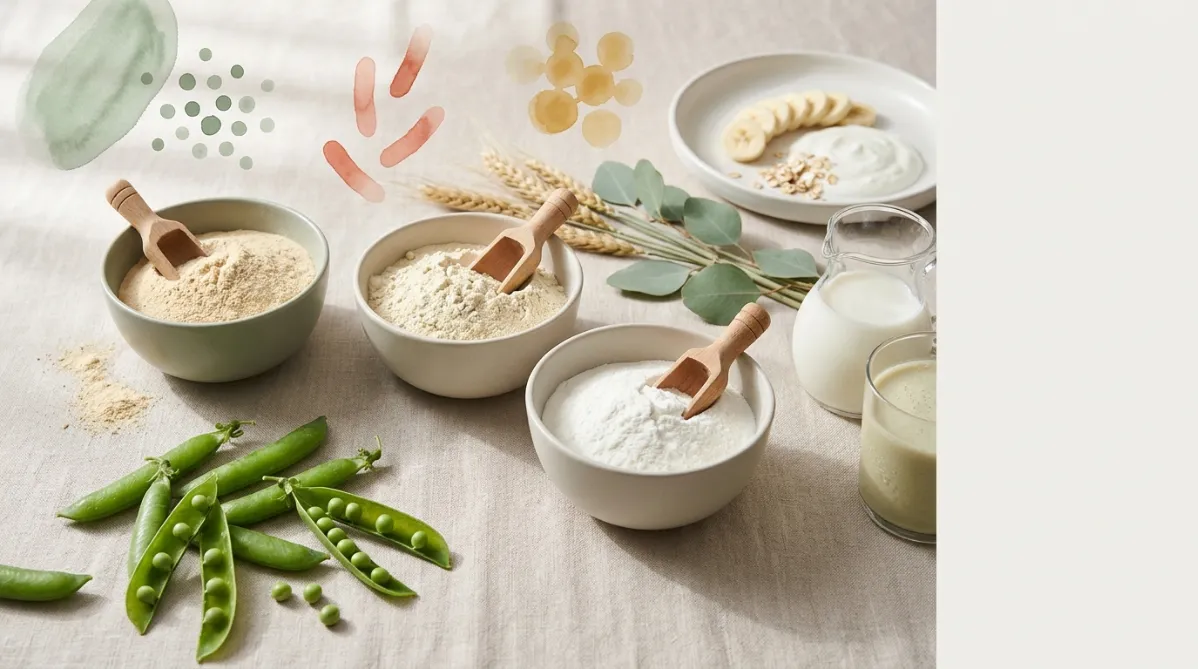
A wide, softly lit editorial flat-lay on a pale oat-colored linen surface, shot from slightly above. Three matte ceramic bowls sit in a loose diagonal across the frame. One holds fine, creamy beige pea protein concentrate, another holds paler, powdery pea protein isolate, and the third holds bright white whey protein isolate. Each bowl has a small wooden scoop resting beside it, with a few fine dustings of powder on the linen. Fresh green pea pods, split open to show round peas, spill naturally in the left foreground. A small glass pitcher of milk sits near the right edge, next to a half-full glass of a smooth, pale green-beige shake with condensation on the surface.

Behind the bowls, a few sprigs of dried wheat and soft eucalyptus leaves add organic texture. In the upper right, a shallow white ceramic plate holds a small arrangement of gut-friendly foods: sliced banana, a spoonful of plain yogurt, and a few oats. Delicate watercolor-style abstract shapes in sage green, warm coral, and soft mustard float subtly in the background. They suggest microscopic organisms, like loose dots, rods, and clustered circles, but stay painterly and minimal, not scientific or futuristic.

Natural window light enters from the left, casting long, gentle shadows and a warm, airy glow. The palette is muted and modern: sage green, cream, warm beige, blush, and touches of terracotta. The composition leaves generous clean negative space on the right third for a headline overlay. The depth of field is shallow, with the nearest pea pods and the front bowl crisp and the background softly blurred. The style is high-end wellness magazine photography with a subtle tactile, handmade feel, calm, fresh, and contemporary, in a 16:9 landscape format.
Science & Research

¿Qué proteína en polvo remodela tu intestino? La de guisante lo hizo en 4 semanas

Dr. Gymbro · · 4 min read

Tu batido de proteína puede estar haciendo algo más que alimentar tus músculos. Un nuevo ensayo aleatorizado sueco sugiere que el tipo de polvo que elijas puede modificar la bacteria que vive en tu intestino en tan solo cuatro semanas. Dos formas de proteína de guisante lograron ese efecto, y cada una favoreció microbios diferentes.

El estudio: tres polvos, una dosis, cuatro semanas

Investigadores de la Universidad de Örebro publicaron un ensayo aleatorizado, doble ciego y de tres brazos paralelos en la European Journal of Nutrition. Adultos sanos recibieron uno de tres suplementos: concentrado de proteína de guisante (PPC), aislado de proteína de guisante (PPI) o aislado de proteína de suero (WPI). La dosis fue 0,5 g de proteína por kg de peso corporal al día durante cuatro semanas.

La composición de la microbiota intestinal fue el criterio principal. El equipo recogió muestras fecales y cuestionarios de estilo de vida semanalmente. También tomaron sangre en ayunas y orina de 24 h en la línea base, a mitad de la intervención y al final para seguir marcadores metabólicos. Es investigación humana, no un estudio en ratones o en placa. El ensayo está registrado bajo el código NCT05611138.

Los investigadores compararon PPC vs PPI y PPI vs WPI. Así pudieron observar diferencias entre proteína vegetal y animal, y entre dos matrices vegetales distintas.

Hallazgo principal: la proteína de guisante alteró la diversidad

Ambos polvos de guisante produjeron un cambio medible. Su suplementación redujo significativamente la α‑diversidad (variedad de especies dentro del intestino de cada persona) y aumentó la β‑diversidad (cuán distinta es la comunidad entre distintas muestras). Los autores señalan que estos efectos estuvieron parcialmente modulados por el IMC.

Una caída en la α‑diversidad puede sonar alarmante, pues a menudo se asocia mayor diversidad con un intestino sano. El resumen del artículo no indica si este cambio es positivo, negativo o neutro. Los autores advierten que los cambios composicionales todavía deben vincularse a la función, por lo que no se puede extraer una conclusión definitiva.

Las bacterias que aumentaron

Los resultados a nivel de especie son donde los dos polvos de guisante se diferencian:

  • Concentrado de proteína de guisante (PPC): Anaerobutyricum hallii y Bifidobacterium longum aumentaron de forma significativa.
  • Aislado de proteína de guisante (PPI): Lactobacillus crispatus y Limosilactobacillus frumenti aumentaron de forma significativa.

Los autores describen estas especies como beneficiosas y concluyen que diferentes proteínas dietéticas las modulan selectivamente. El resumen no menciona qué especies cambiaron en el grupo de suero, por lo que no podemos comparar a nivel de especie con ese polvo.

Lo que este estudio no demuestra

Algunos puntos a considerar antes de cambiar tu bote:

  • Solo adultos sanos. No sabemos qué ocurre en personas con trastornos digestivos.
  • Composición, no función. Se necesita más investigación para comprobar cómo estos cambios se traducen en actividad microbiana.
  • Marcadores metabólicos no reportados. Se tomaron sangre y orina, pero el resumen no incluye resultados.
  • Variabilidad individual. Los autores enfatizan la importancia de la respuesta individual; el IMC moduló parcialmente los efectos sobre la diversidad.
  • Cuatro semanas es poco tiempo. Ignoramos si las alteraciones persisten, aumentan o desaparecen.

Consejos prácticos: elige tu polvo

Dosis. El ensayo utilizó 0,5 g/kg de peso corporal al día. Para una persona de 80 kg eso equivale a 40 g de proteína diaria proveniente del suplemento. El resumen no especifica el momento de ingesta (pre‑entrenamiento, post‑entrenamiento o con las comidas), así que no hay recomendación basada en este estudio.

Concentrado de proteína de guisante. En el ensayo, el PPC se asoció a aumentos de B. longum y A. hallii. Si buscas un polvo de origen vegetal y te interesan sus efectos sobre el intestino, es una opción a considerar. Los concentrados suelen estar menos procesados que los aislados, aunque el estudio no probó esa hipótesis.

Aislado de proteína de guisante. El PPI mostró incrementos de L. crispatus y L. frumenti. Es la forma más purificada, preferida por muchos deportistas por su densidad proteica.

Aislado de proteína de suero. El WPI sirvió como comparador animal. Nada del resumen sugiere que el suero sea perjudicial; simplemente no se reportaron cambios bacterianos específicos, por lo que no se puede afirmar una ventaja intestinal frente a la proteína de guisante.

¿A quién le importa?

Atletas veganos o vegetarianos son los que obtienen el mayor valor directo. Si dependes de la proteína de guisante para alcanzar tu objetivo diario, el estudio indica que no es neutra para el intestino; modifica especies bacterianas y la forma elegida puede influir.

Personas con problemas gastrointestinales deben proceder con cautela. Los participantes eran sanos, de modo que los hallazgos no son aplicables a afecciones como SII o EII. Si tu intestino ya es sensible, prueba cualquier polvo nuevo de forma gradual y consulta a un profesional de la salud o a un dietista antes de hacer cambios.

Conclusión

Cuatro semanas de proteína de guisante, ya sea en forma de concentrado o aislado, remodelaron la comunidad microbiana del intestino de adultos sanos. Cada forma impulsó diferentes especies consideradas beneficiosas. La gran incógnita es qué implica eso para la salud, cuestión que el estudio deja abierta. Por ahora, considera la elección de tu polvo de proteína como otro factor que influye en tu ecosistema intestinal, no solo en tus macronutrientes.
Original study

Read the original research on pubmed.ncbi.nlm.nih.gov →

This article summarizes published research for general information. It is not medical advice.

DG

Written by

Dr. Gymbro

Dr. Gymbro writes for Dr. Gymbro: science-backed fitness, nutrition & performance.

Related Articles

A bright, airy, minimalist kitchen counter in soft morning light, shot from a slightly elevated three-quarter angle in a wide landscape composition. Two matching ceramic bowls sit side by side on a pale oak butcher-block surface. The left bowl holds fine, creamy-beige pea protein powder with a small wooden scoop resting in it. The right bowl holds smooth, ivory-white whey powder with an identical scoop. Between and slightly behind them sits a third, smaller empty bowl with a plain scoop, hinting at the placebo. Scattered around the bowls are fresh green pea pods, some split open to reveal bright, round peas, and a small glass bottle of milk with delicate condensation. A sage-green linen napkin is folded loosely at the edge of the frame.

In the soft-focus background, a young man in a fitted heather-gray t-shirt is seen from the shoulders down, casually flexing one arm while holding a matte shaker bottle, the biceps subtly defined and the pose relaxed and natural. A minimalist notebook with a pencil and a simple hand-drawn bar chart lies open on the counter, suggesting analysis without legible text. A small potted herb plant and a ceramic mug add warmth.

The color palette is muted and editorial: warm cream, sage green, soft terracotta, pale wood, and touches of charcoal. Light streams in from a window on the left, casting gentle long shadows and a subtle golden glow across the powders so their textures look fine and tactile. Shallow depth of field keeps the bowls crisp while the background melts into a creamy blur. The look is modern lifestyle-magazine photography, clean and uncluttered, with generous negative space on the right third of the frame for headline overlay. It is natural, appetizing, and trustworthy, in the style of a contemporary wellness and nutrition journal.
nutrition

Proteína de guisante vs suero: el resultado inesperado para principiantes

BY DR. GYMBRO ·

¿Puede la proteína vegetal generar músculo como el suero? Un ensayo de 12 semanas con 161 hombres comparó proteína de guisante, suero y placebo, y los resultados para principiantes llamaron la atención: +20,2 % de grosor de bíceps con guisante frente a +8,6 % con placebo. Sin embargo, la diferencia en el grupo completo fue solo una tendencia, y el hallazgo destacado surgió de un análisis de subgrupos. Aquí lo que descubrió el estudio, lo que no demostró y cómo los levantadores veganos o intolerantes a la lactosa pueden aprovecharlo.

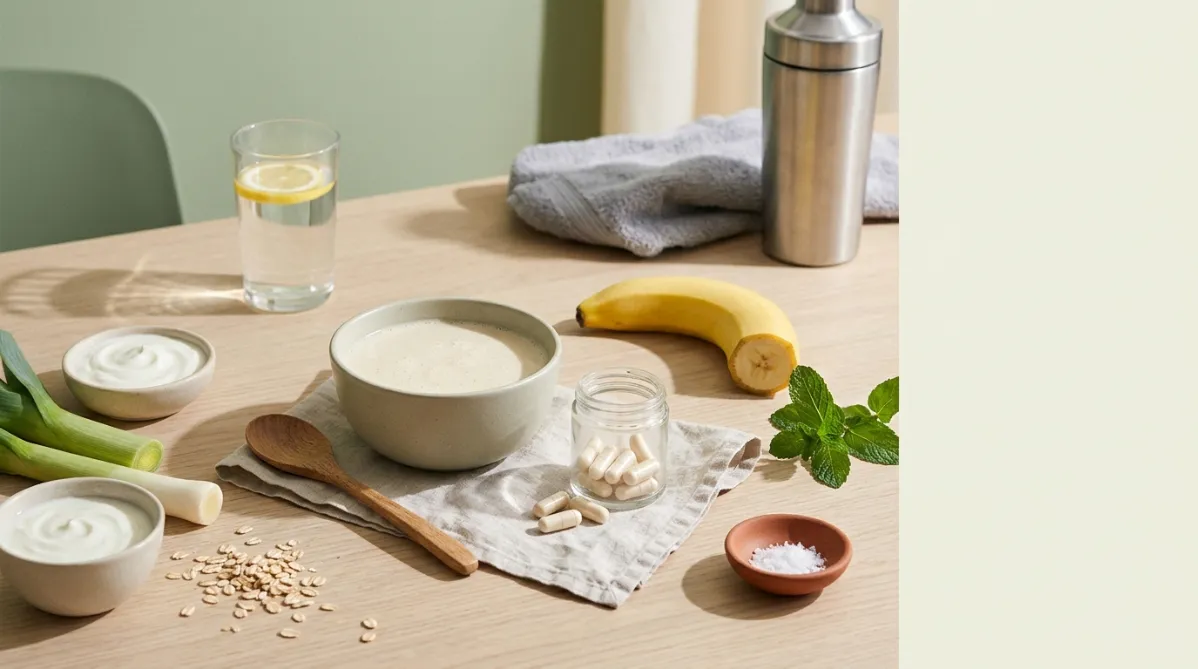
A bright, minimalist still life on a soft sage-green and warm cream backdrop, shot from a slightly elevated angle in natural morning window light. In the center sits a matte ceramic bowl of creamy vanilla protein shake with a wooden spoon resting beside it. Next to it, a small glass jar with a few off-white probiotic capsules spilling onto a pale linen napkin. Around them are fresh, gut-friendly foods arranged with editorial restraint: a halved ripe banana, a small bowl of plain yogurt with a swirl on top, a few stalks of leeks, a handful of oats scattered on the surface, and a sprig of fresh mint. A tall glass of water with a lemon slice catches the light and casts a delicate caustic shadow across the table.

In the background, slightly out of focus, a folded gray gym towel and a sleek stainless steel shaker bottle hint at an athletic lifestyle without dominating the scene. The surface is a pale oak tabletop with subtle grain. A soft diffused shadow falls to the left, giving gentle depth.

The palette is calm and modern: sage green, oatmeal, warm white, soft butter yellow, and touches of terracotta from a small clay dish holding a pinch of sea salt. The composition leaves generous negative space on the right third for headline overlay. The mood is clean, wellness-focused, and quietly editorial, like a feature in a contemporary health and science journal. Shallow depth of field, crisp focus on the capsules and bowl, subtle film grain, and natural color grading. No people, no text, no logos, no futuristic elements.
nutrition

¿Gases de proteína? El probiótico BB536 reduce el olor, pero solo en algunos intestinos

BY DR. GYMBRO ·

¿Te molestan los gases y olores intestinales provocados por una dieta alta en proteína? Un nuevo ensayo probó el probiótico Bifidobacterium longum BB536 en atletas que consumían dietas ricas en proteína y observó una disminución de compuestos malolientes como el metilmercaptano y el amoníaco. Sin embargo, el efecto sólo se observó en subgrupos analizados a posteriori; en el conjunto total no hubo diferencias significativas frente al placebo. El estudio, pequeño y exploratorio, fue patrocinado por el fabricante del probiótico. Aquí te explicamos qué es BB536, por qué tu microbioma basal puede decidir quién se beneficia y qué ajustes económicos puedes probar antes.

A bright, minimalist editorial still life on a pale oat-colored linen surface, shot from a slightly elevated three-quarter angle in soft natural window light. On the left, a matte ceramic bowl of fine white collagen powder with a wooden scoop resting beside it, a light dusting of powder spilling across the linen. On the right, a matching bowl of creamy off-white whey powder with a brushed-steel scoop. Between them sits a small, neatly balanced stack of simple geometric wooden blocks and a single smooth gray stone, hinting at a scale or comparison without showing a literal scale. Behind them, a lightly blurred row of three clean amber glass supplement jars with plain cream labels, unbranded. A single rolled yoga towel and a pair of small chrome dumbbells sit softly out of focus in the background on a pale plaster shelf. Accents of muted sage green and warm terracotta appear in a ceramic cup and a folded napkin, giving the palette a calm, contemporary wellness-magazine feel. A thin, elegant sprig of dried eucalyptus lies at the edge of the frame. Shadows are long, gentle, and slightly cool, with a creamy shallow depth of field and fine grain. The composition leaves generous negative space across the upper third for title overlay, with a subtle gradient from warm ivory to pale gray-blue in the background wall. The styling is clean and modern like a trendy health journal website, with a refined, tactile, editorial photography look, balanced symmetry, and no text, no people, no futuristic or laboratory elements.
nutrition

¿Colágeno supera al suero en el músculo según un análisis de 78 ensayos?

BY DR. GYMBRO ·

Un meta‑análisis de red de 2026 que incluyó 78 ensayos aleatorizados y 4 755 personas clasificó al colágeno como el primero en ganancias de fuerza y masa libre de grasa con entrenamiento de resistencia, por delante del suero. Más sorprendente aún, ningún otro suplemento proteico superó al placebo. Sin embargo, el colágeno es una proteína incompleta, baja en leucina, y los intervalos de confianza son amplios. Aquí mostramos qué revelan realmente los números, por qué el resultado necesita confirmación directa y qué hacer con tu stack de suplementos mientras tanto.

A wide, softly lit editorial still life on a pale oat-colored linen surface, shot from a slightly elevated three-quarter angle. On the left, a matte ceramic bowl in warm cream holds fine, pale golden-beige yeast protein powder, with a small wooden scoop resting beside it and a few loose dusty swirls on the linen. In the center, two tall frosted glass tumblers stand side by side. One holds a creamy, light tan shake with a delicate froth, and the other holds clear water with a faint ripple, creating a quiet visual contrast. On the right, a loosely folded charcoal gym towel, a brushed-steel shaker bottle, and a single small kettlebell in muted sage green sit slightly out of focus.

A few elements hint at the science without looking clinical. A minimalist matte-white notebook lies open with soft, blurred handwriting and a hand-drawn bar chart in thin pencil. Beside it rests a slim brass pen. A single sprig of dried wheat and a small dish of baker's yeast granules on a wooden board nod to the ingredient's fermentation origin.

Natural morning window light enters from the upper left, casting long, gentle shadows and a warm highlight along the glass rims. The palette is earthy and calm: oat, cream, soft terracotta, sage, and warm gray, with a subtle peachy glow in the background. The backdrop is a smooth plaster wall in muted putty tone, with a faint shadow of a window frame across it.

The composition leaves generous negative space in the upper third for a title overlay. Shallow depth of field keeps the glasses and bowl crisp while the gym props melt softly into the background. The overall mood is modern, wholesome, and trustworthy, with the feel of a contemporary health and nutrition magazine. The photograph has fine film-like grain and natural texture, and no text, logos, or labels appear anywhere.
recovery

Mezcla de proteína de levadura compite con el suero en dolor muscular y CK, pero con reservas

BY DR. GYMBRO ·

La proteína de levadura está ganando terreno como alternativa sostenible al suero. Un estudio aleatorizado en atletas bien entrenados comparó una mezcla de levadura‑suero con agua y suero puro tras un entrenamiento excéntrico muy intenso. La mezcla redujo la creatina quinasa y, en hombres, el dolor muscular, comportándose de forma similar al suero. Sin embargo, el control consistió solo en agua, sin igualar calorías, y muchos hallazgos fueron exploratorios tras correcciones por comparaciones múltiples. Aquí analizamos qué demuestran los datos, qué dudas quedan y quién podría estar interesado en probarla.

This page is available in