Dr. Gymbro
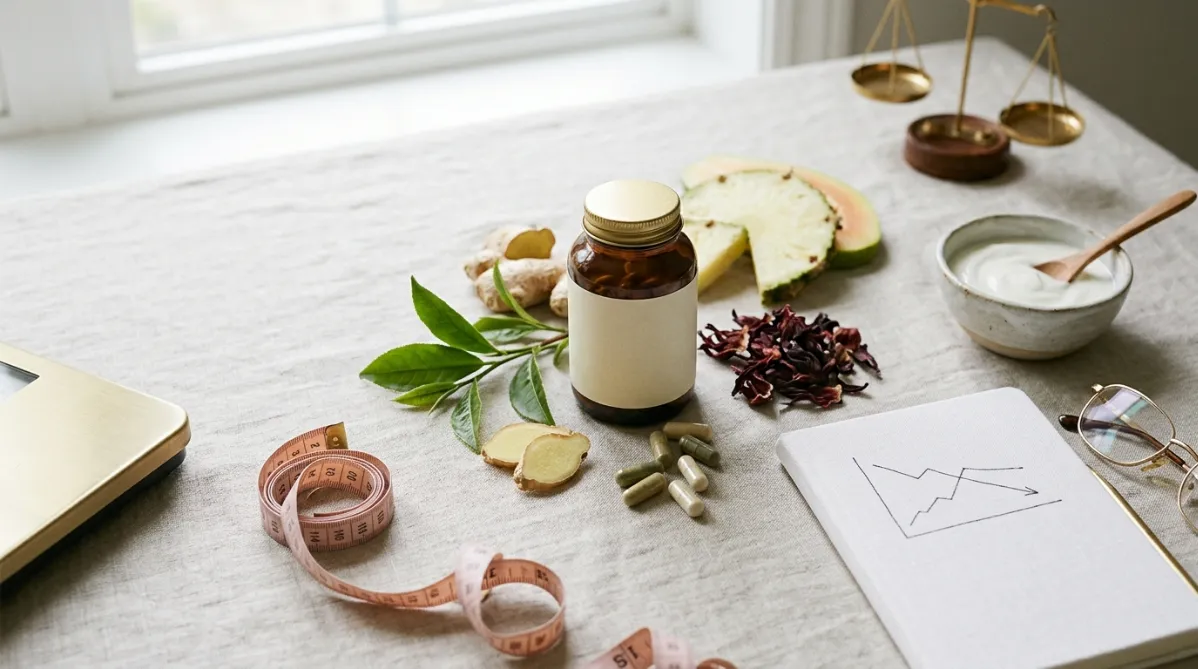
A clean, modern editorial flat-lay on a pale oat-colored linen surface, shot from slightly above in soft diffused natural window light. At the center sits an amber glass supplement bottle with a minimalist cream label, unbranded, with a few capsules spilling onto the fabric in soft greens and ivory tones. Around it are fresh botanical elements: a sprig of green tea leaves, sliced ginger root, a small bundle of dried hibiscus petals, and a few pale green pineapple and papaya slices hinting at digestive enzymes. A small ceramic bowl of creamy plain yogurt with a wooden spoon suggests probiotics. To the left, a flexible tailor's measuring tape in soft blush pink loosely curls across the linen, with a slim brushed-brass scale partly visible at the frame edge. On the right, a minimalist white notebook lies open with a hand-drawn simple line chart showing two diverging lines, one trending downward and one flat, with no readable text. A pair of reading glasses with thin gold frames rests beside it, and a tiny pair of balanced brass scales sits in the background, subtly suggesting weighing evidence and caution.

The palette is muted sage green, warm cream, soft terracotta, and touches of blush and brass. Shadows are gentle and long, the depth of field is shallow with a creamy blurred background, and the negative space on the left third of the frame leaves room for a headline overlay. The overall feel is a contemporary health and science journal, calm, trustworthy, and slightly skeptical, in the style of a premium wellness magazine photographed with a 50mm lens, with crisp texture on linen, glass, and botanicals.
Nutrition

SlimSEB: Mezcla probiótica‑enzimática supera al placebo, pero hay una trampa

Dr. Gymbro · · 4 min read

Una combinación probiótica y enzimática supera al placebo en peso, circunferencia de cintura y lípidos sanguíneos

Antes de añadirla al carrito, lea la letra pequeña; los detalles importan tanto como los números principales.

Qué probó realmente el estudio

El artículo, publicado en Frontiers in Nutrition en 2026 (Rathi et al., DOI 10.3389/fnut.2026.1956865), evaluó un suplemento llamado SlimSEB. Se trata de una mezcla multicomponente que contiene:

  • Probióticos (1,5 mil millones de UFC)
  • Enzimas digestivas, entre ellas una denominada SucroSEB, que el fabricante asegura convierte los azúcares dietéticos en fibra prebiótica
  • Extracto de hoja de morera
  • Té verde
  • Polvo de canela
  • Picolinato de cromo

El diseño fue prospectivo, aleatorizado, doble ciego, de grupos paralelos y controlado con placebo. Ochenta y siete adultos con riesgo de diabetes tipo 2 recibieron diariamente SlimSEB o placebo durante 84 días (12 semanas). De ellos, 43 fueron clasificados como con sobrepeso y 44 como obesos. El ensayo quedó registrado bajo el número CTRI/2023/11/059798.

Los números principales

En comparación con el placebo, SlimSEB produjo reducciones adicionales estadísticamente significativas (diferencias de medias ajustadas):

  • Peso corporal: ‑2,60 kg en el grupo con sobrepeso (p = 0,0045) y ‑4,51 kg en el grupo obeso (p < 0,0001)
  • IMC: ‑0,92 y ‑1,80 kg/m², respectivamente
  • Circunferencia de cintura: ‑3,86 cm en el grupo con sobrepeso (p = 0,0169) y ‑11,03 cm en el grupo obeso (p = 0,0014)

La reducción de 11 cm en la cintura del grupo obeso es el hallazgo más llamativo. Una diferencia de esa magnitud en 12 semanas es grande para un suplemento, lo que genera tanto curiosidad como cautela.

También se movieron los marcadores metabólicos

El resumen reporta mejoras en los indicadores de glucosa: la glucosa plasmática en ayunas descendió 0,45 mmol/L en ambos grupos, la HbA1c cayó 0,65 % y 0,67 %, y el HOMA‑IR (una estimación de resistencia a la insulina) disminuyó 0,47 y 0,69, respectivamente. La cobertura mediática citó caídas de HOMA‑IR del 21,5 % vs. 9,0 % con placebo en el grupo con sobrepeso, y del 24,8 % vs. 4,3 % en el grupo obeso.

El colesterol mostró el contraste más marcado:

  • Colesterol total: ‑14,21 % y ‑16 % con SlimSEB; con placebo bajó 3,85 % en el grupo con sobrepeso y subió 8,65 % en el grupo obeso.
  • LDL: ‑11,61 % y ‑14,63 % con SlimSEB; con placebo disminuyó 0,88 % en el grupo con sobrepeso y aumentó 13,39 % en el grupo obeso.
  • Proteína C‑reactiva (CRP): ‑13,6 % y ‑17,3 %, aunque la diferencia entre grupos fue significativa solo en los participantes obesos.

Obsérvese que los lípidos del grupo placebo empeoraron en la subcapa obesa, lo que hace que la comparación parezca más dramática de lo que la mejora intrínseca del suplemento sugiere.

Perfil de seguridad

Se reportaron ocho eventos adversos leves, ninguno considerado relacionado con el producto, y no hubo eventos adversos graves. Es tranquilizador, pero un ensayo con 87 personas durante 12 semanas no puede descartar problemas raros o a largo plazo.

Aquí está la trampa

Varias limitaciones impiden considerar esto como una recomendación inmediata:

  1. Vínculo con la industria. El producto fue suministrado por Specialty Enzymes and Probiotics (EE. UU.), su propio fabricante. Eso probablemente implique participación industrial; no invalida los resultados, pero sí exige replicación independiente.
  2. Tamaño pequeño y un solo país. Fue un único estudio en la India con 87 participantes divididos en dos subgrupos. Los hallazgos pueden no trasladarse a otras dietas, etnias o entornos.
  3. Duración corta. Doce semanas no dicen nada sobre si la pérdida de peso se mantiene o si los beneficios persisten.
  4. Mezcla, no compuesto único. Con probióticos, enzimas, morera, té verde, canela y cromo en un mismo producto, no se puede atribuir el efecto a un ingrediente concreto.
  5. Dosis desconocida. La cantidad diaria exacta del producto terminado no se indica en el material disponible, por lo que no podemos hacer suposiciones al respecto.

¿Qué tan grande es realmente?

Una pérdida de 2,6 a 4,5 kg ajustada por placebo es modesta. Los fármacos recetados GLP‑1 operan en una escala distinta: en el ensayo pivotal STEP 1, la semaglutida produjo una pérdida media de peso de aproximadamente el 15 % del peso corporal en 68 semanas. SlimSEB no está en esa liga, y los datos no sugieren que sea un sustituto. Podría representar un pequeño efecto auxiliar que merece más investigación.

Conclusiones prácticas

Dosis y tiempo: El ensayo utilizó un esquema diario durante 84 días, pero el tamaño de la porción y el momento exacto no están disponibles en la fuente revisada. Siga las indicaciones del etiquetado y consulte el artículo completo antes de adoptar cualquier protocolo concreto. El único dato verificable es el contenido probiótico de 1,5 mil millones de UFC.

A quién podría convenir: La evidencia se aplica a adultos con sobrepeso u obesidad y riesgo de diabetes tipo 2. No incluye a personas con diabetes establecida, niños ni individuos ya delgados.

A quién debería evitarlo o consultar a un profesional primero (precauciones generales, no hallazgos del estudio):

  • Personas que ya toman medicación antidiabética, ya que la mezcla contiene ingredientes asociados con la reducción de glucosa.
  • Mujeres embarazadas o lactantes.
  • Personas inmunocomprometidas, por la presencia de probióticos vivos.
  • Quienes son sensibles a la cafeína o a los extractos de té verde.
  • Quienes esperan una pérdida de peso dramática al estilo GLP‑1.

Conclusión: Se trata de un resultado prometedor pero preliminar, vinculado al fabricante. La calidad de la dieta, la actividad física y el sueño siguen siendo la base, y un ensayo independiente más amplio determinaría si esta mezcla merece un lugar al lado de esas estrategias.
Original study

Read the original research on doi.org →

This article summarizes published research for general information. It is not medical advice.

DG

Written by

Dr. Gymbro

Dr. Gymbro writes for Dr. Gymbro: science-backed fitness, nutrition & performance.

Related Articles

A softly lit editorial flat-lay on a pale oat-colored linen surface, shot from slightly above in a wide landscape composition. On the left, a small cluster of fresh Coleus forskohlii plant sprigs with velvety, scalloped green leaves and a few delicate lavender-blue flowers lies beside a rustic ceramic bowl of fine, golden-brown powdered root extract. A wooden scoop rests in the powder. In the center, a minimalist amber glass dropper bottle and a few cream-colored capsules are spilled neatly onto the linen, with no readable labels or logos. On the right, a slim analog kitchen scale in matte white shows a small, subtle weight, and beside it a soft sage-green measuring tape is loosely coiled in a gentle curve, hinting at waist measurement. A small open notebook with blank cream pages and a thin brass pen suggests careful tracking, with a few abstract pencil tick marks and no legible text. Accents include a halved lemon, a glass of water with condensation, and a sprig of eucalyptus for a calm wellness feel. Natural morning window light enters from the upper left, casting long, soft, diffused shadows and warm highlights across the textures of linen, ceramic, glass, and leaves. The palette is muted and modern: sage green, warm cream, soft terracotta, honey amber, and touches of dusty lavender. Shallow depth of field gently blurs the far edges, with the focus on the center objects. The mood is calm, trustworthy, and quietly skeptical, like a high-end health and science magazine cover. It is clean and uncluttered, with generous negative space at the top for headline overlay. Photographic, high-resolution, with subtle film grain and true-to-life color.
nutrition

Quemador de grasa Forskolin: 2 kg en 12 semanas — ¿Modesto pero real?

BY DR. GYMBRO ·

Forskolin se ha promocionado como el milagro quemador de grasa durante años, pero ¿un nuevo ensayo de 2026 le aporta respaldo real? En 60 adultos con sobrepeso durante 12 semanas, un extracto de *Coleus forskohlii* redujo el peso corporal en unos 1,93 kg y la cintura en 1,83 cm, además de mejorar triglicéridos y HDL. Los marcadores de seguridad también estaban limpios. Sin embargo, el estudio fue cuasi‑aleatorizado, de tamaño reducido y patrocinado por el fabricante, y el efecto es diminuto comparado con los fármacos GLP‑1. Veamos qué dicen realmente los datos y cómo abordar el forskolin con expectativas realistas.

A sunlit outdoor running track in late afternoon, shot from a low angle with shallow depth of field. In the foreground, a matte black bottle with a minimal off-white label sits on the edge of a warm terracotta-colored track lane, beside a folded white towel and a small glass of amber liquid catching golden light. Condensation beads on the bottle. A faint heat shimmer rises from the track surface and softens the background.

In the midground, slightly out of focus, a lean athlete in a sage-green tank top and charcoal shorts runs on a treadmill-like stretch of track, a thin sheen of sweat on their shoulders, their expression focused and calm. Their motion is gently blurred, suggesting endurance and rhythm. Long soft shadows stretch across the lane lines.

The background fades into hazy peach, apricot, and pale yellow tones, with the suggestion of tall trees and a distant stadium wall. Warm sun flare enters from the upper right, creating a subtle glow and a few soft light streaks across the frame.

Subtle editorial touches: a small notebook with a pencil and a stopwatch rest beside the bottle, hinting at data and timing without any text legible. The color palette is warm and muted, with terracotta, cream, sage, and charcoal accents, and a fine film-like grain. The composition leaves open negative space on the left third for a headline overlay. The overall mood is clean, modern, and health-journal inspired, natural and aspirational, with a calm scientific curiosity rather than hype.
nutrition

Bebidas de cetona en el calor: ¿Más resistencia y mejor memoria?

BY DR. GYMBRO ·

Se dice que las bebidas de cetona son para los biohackers que buscan quemar grasa, pero un nuevo ensayo bajo estrés térmico sugiere que también pueden ayudar a terminar más fuerte. En 17 hombres entrenados, el monoéster de cetona más cafeína extendió el tiempo hasta el agotamiento a 8,9 minutos frente a 7,0 con carbohidratos más cafeína, después de 90 minutos de ejercicio en cinta a 34 °C. La precisión de la memoria de trabajo en la tarea de 1‑back también mejoró, mientras que la frecuencia cardíaca y la temperatura central no mostraron diferencias relevantes. Sin embargo, en la tarea de 2‑back, el tiempo de reacción y la prueba de golpear‑evitar no hubo beneficio, y el estudio es pequeño, solo con hombres y de una sola sesión.

A wide, editorial-style still life photographed from slightly above on a pale oat-colored linen surface, lit by soft morning window light from the left. In the center sits a small matte ceramic bowl holding a mound of fine white powder, with a minimalist wooden scoop resting beside it. Next to the bowl is an open amber glass supplement jar with a plain cream label, and a few white capsules spill across the linen in a loose arc.

To the right, a neatly arranged cluster of analog "study" objects suggests careful measurement: a vintage stopwatch with a clean white face, a slim notebook with a sage-green cover open to a hand-drawn bar chart (blurred, no legible text), and a mechanical pencil lying across the page. A small row of six identical ceramic dishes, each holding a pinch of powder, is lined up along the top edge of the frame to hint at the six-week trial. One dish is slightly out of alignment, a subtle visual cue for ambiguity.

A shallow glass of water and a single sprig of green eucalyptus add a calm, organic note in the foreground. Soft, long shadows fall across the textured linen, and the palette stays restrained: warm cream, soft sage, muted terracotta, pale gray, and touches of amber from the glass jar. A few translucent paper cutouts in two tones (sage and blush) overlap in the upper right corner as a modern graphic accent, evoking overlapping data points without showing any numbers.

Depth of field is shallow, with the bowl and stopwatch in crisp focus and the edges gently softened. The composition leaves generous negative space on the left third for title text overlay. The overall mood is thoughtful, balanced, and quietly skeptical, in the style of a contemporary wellness and science magazine: clean, tactile, minimal, with a subtle film-like grain and natural color grading. No people, no futuristic or sci-fi elements, no readable text or logos.
nutrition

¿Es el GAA un potenciador cerebral? El resultado del ensayo de 6 semanas es complicado

BY DR. GYMBRO ·

El GAA, precursor de la creatina que se vende como potenciador cerebral, acaba de recibir su primera prueba seria en humanos. En un ensayo doble ciego de seis semanas con 58 adultos sanos, se observaron algunas mejoras en la velocidad de reacción y leves indicios de cambios en el ánimo y el estrés. Sin embargo, la mayoría de las pruebas cognitivas no mostraron efectos y muchos resultados primarios fueron solo tendencias. Los marcadores de seguridad fueron normales, pero el estudio fue pequeño, exploratorio y no incluyó un grupo de comparación con solo creatina. Aquí se explica qué evidencia existe realmente, a quién podría interesar y por qué el veredicto es mixto.

A sunlit, minimalist home gym corner photographed in soft golden morning light, with a young athletic man seated on a wooden bench, leaning forward with his elbows resting on his knees, catching his breath after a hard leg session. He wears a muted sage-green t-shirt and charcoal shorts, his face turned slightly away from the camera, calm and focused. A matte ceramic dish in the foreground holds a few small, translucent golden softgel capsules, with a glass of water beside it catching the light and casting a soft caustic shadow across a pale oak floor. Behind him, a loaded barbell rests on a squat rack, slightly out of focus, and a tall window pours warm sunlight diagonally across the scene, creating long gentle shadows and a hazy glow. A small potted green plant sits on a shelf at the edge of the frame. The color palette is warm and editorial: cream, soft gold, sage green, pale wood, and charcoal accents. Shallow depth of field, with crisp focus on the capsules and glass in the lower third and a creamy bokeh background. The composition leaves generous negative space on the right side for a headline overlay. The mood is clean, modern, and aspirational, like a high-end wellness magazine or a trendy health journal feature. Shot on a 50mm lens, natural light, fine film grain, subtle matte finish, landscape 16:9 framing.
recovery

Vitamina D acelera la recuperación de la fuerza en hombres con niveles suficientes

BY DR. GYMBRO ·

Hombres con niveles de vitamina D perfectamente normales recuperaron la fuerza más rápido tras una sesión intensa de piernas al tomar 4 000 UI diarias. En este ensayo aleatorizado, controlado con placebo, con 28 hombres activos, la fuerza isométrica máxima se recuperó aproximadamente un 8 % más a las 24 horas. Los marcadores de daño muscular ALT y AST también aumentaron menos. La sorpresa es que la sensación de dolor muscular no mejoró en absoluto. A continuación se detallan los hallazgos del estudio, sus limitaciones y a quién podría interesar.

This page is available in