Dr. Gymbro
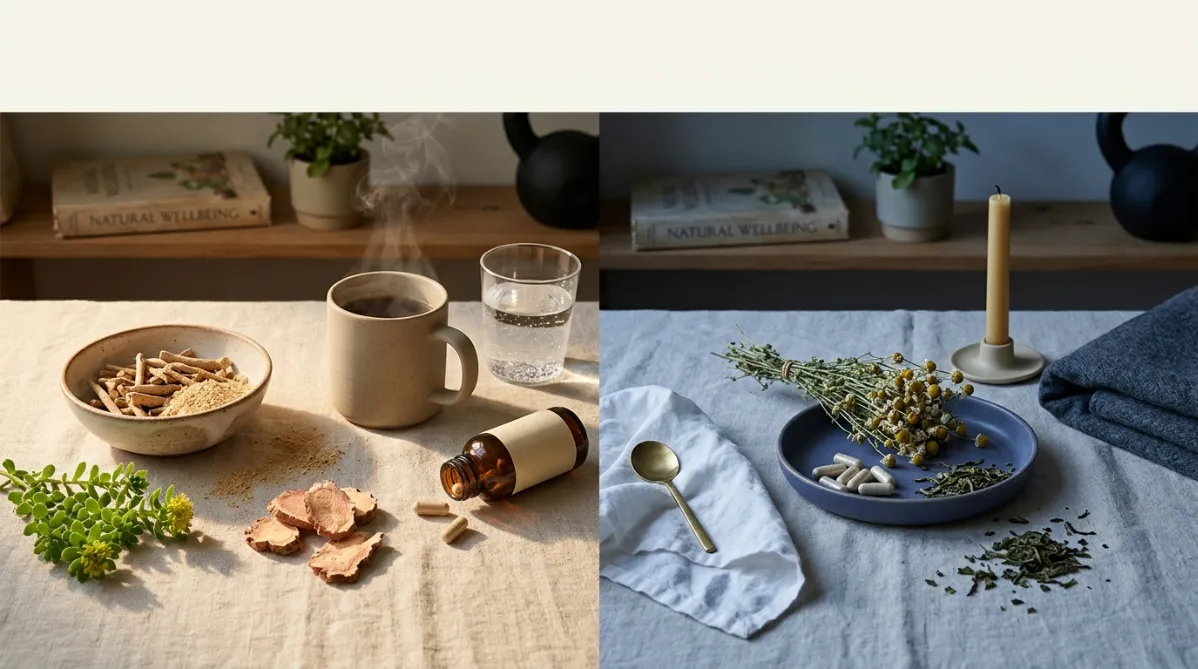
A landscape editorial still life shot from slightly above on a pale oat-colored linen surface, lit by soft morning window light with gentle long shadows. On the left, in warm golden sunlight, sits a small ceramic bowl of dried ashwagandha root pieces and a scatter of fine tan powder. Beside it are a few rough, rosy-gold slices of Rhodiola rosea root and a sprig of tiny succulent-like green leaves with yellow blossoms. A matte sand-colored stoneware mug of steaming tea and a simple glass of water stand nearby. A small amber glass bottle with a minimal unbranded label tips out two capsules.

The right side of the frame is cooler and bluer, as if dusk is arriving. It holds a muted indigo ceramic dish with a few pale capsules, a small bundle of dried chamomile flowers (the source of apigenin), and a few green tea leaves. A slim, unlit beeswax candle and a folded charcoal wool blanket suggest evening. The warm and cool halves meet softly in the center, where a rumpled white cotton napkin sits beneath a small brass spoon.

In the background, out of focus, a wooden shelf holds a worn paperback, a small potted plant, and the edge of a kettlebell in matte black, hinting at an active lifestyle. Subtle film grain, shallow depth of field, and a muted palette of cream, terracotta, sage green, and deep indigo give it a clean, modern wellness-magazine feel. Leave generous negative space in the upper third for a headline overlay. No text, no logos, no people.
Recovery

Ashwagandha + Rhodiola : le combo du matin porte ses fruits, le stack du soir n’apporte rien

Dr. Gymbro · · 5 min read

Ashwagandha + Rhodiola : le combo du matin porte ses fruits, le stack du soir n’apporte rien

Un résultat inattendu

Voici le rebondissement que personne n’attendait : dans un nouvel essai à quatre bras, le supplément qui a réellement fait bouger les indicateurs de stress et de sommeil était celui du matin. Ashwagandha + Rhodiola rosea a fait la différence. Le stack nocturne populaire – magnésium L‑thréonate, L‑théanine et apigénine – n’a rien ajouté. Prendre les deux ensembles a même semblé aggraver un indice d’humeur.

Si vous pratiquez la musculation, la course ou tout autre entraînement intensif tout en gérant le stress du travail et des nuits irrégulières, cela vaut le coup d’œil.

Ce que l’étude a mis en place

Des chercheurs de l'University of South Carolina et leurs collègues ont publié un essai randomisé, double‑aveugle, contrôlé par placebo dans le Journal of the International Society of Sports Nutrition (2026). Ils ont recruté 103 adultes en bonne santé et physiquement actifs (53 femmes, âge moyen 34,8 ans) et les ont répartis en quatre groupes :

  • Matin seulement (n = 26) : 600 mg d’ashwagandha + 300 mg de Rhodiola rosea le matin, placebo le soir.
  • Soir seulement (n = 25) : placebo le matin, puis 2 g de magnésium L‑thréonate (équivalent à 145 mg de magnésium), 200 mg de L‑théanine et 50 mg d’apigénine le soir.
  • Matin + soir (n = 25) : les deux stacks actifs.
  • Placebo (n = 27) : placebos aux deux moments.

L’étude complète a duré quatre semaines : une semaine de ligne de base, seulement deux semaines de supplémentation, puis une semaine de wash‑out. Les participants remplissaient chaque jour des questionnaires de stress et chaque semaine des questionnaires PROMIS évaluant le stress perçu, l’affect et le sommeil. Ils complétaient aussi le Pittsburgh Sleep Quality Index (PSQI) au départ et après la période de wash‑out. Un dispositif portable mesurait objectivement le sommeil chaque nuit.

Ce qu’ils ont trouvé

Le groupe recevant l’adaptogène le matin s’est démarqué. Voici les chiffres rapportés dans l’article :

  • Le stress perçu hebdomadaire a diminué dans le groupe matin (p = 0,034 ; η² = 0,020). Le stress quotidien n’a présenté aucune différence.
  • Les troubles liés au sommeil ont baissé dans le groupe matin (p = 0,032 ; d = 2,74).
  • Le temps d’éveil après l’endormissement a diminué dans le groupe matin (p = 0,047 ; η² = 0,020), d’après les données du dispositif portable.
  • La qualité du sommeil selon le PSQI s’est améliorée dans le groupe matin comparé au groupe matin + soir (différence moyenne = 0,66 AU, p < 0,001, d = 1,45).
  • L’affect positif a augmenté dans le groupe matin à la fin de la période de wash‑out (p = 0,003 ; d = 1,68) et a continué à grimper. Le groupe matin + soir, en revanche, a montré une baisse (p = 0,009 ; d = 0,16).

Les auteurs concluent que l’ashwagandha + Rhodiola le matin était associé à une amélioration du stress subjectif, de la qualité du sommeil et de l’affect positif après 14 jours, par rapport au placebo.

Le stack nocturne, seul ou ajouté aux deux autres, n’a pas montré d’avantage dans les résultats mis en avant. Pour ceux qui ont investi dans un rituel coûteux de suppléments du soir, c’est la partie inconfortable.

Pourquoi la combinaison n’a pas « empilé » les effets

Le résumé de l’article ne propose aucun mécanisme expliquant pourquoi le stack du soir n’a pas apporté de bénéfice ; toute explication reste donc hypothétique. Deux pistes possibles :

  1. Les participants sains et actifs avaient peu de marge d’amélioration sur ces paramètres.
  2. Ajouter davantage d’ingrédients ne signifie pas forcément plus d’effet. Les données montrent que l’approche « tout empiler » n’a pas surpassé les seuls adaptogènes du matin, et pour l’affect positif, elle a même semblé moins efficace.

Les réserves

Avant de remanier votre étagère de compléments, gardez à l’esprit les limites de l’étude :

  • Durée très courte. La supplémentation n’a duré que deux semaines.
  • Population en bonne santé. Ce sont des adultes actifs sans trouble du stress ni du sommeil. L’effet limité sur d’autres variables peut simplement refléter le manque de marge d’amélioration chez des personnes saines pendant une période brève.
  • Taille des groupes réduite. Chaque bras comptait environ 25 participants, avec de multiples comparaisons statistiques.
  • Valeurs p parfois marginales. Plusieurs p‑value sont juste sous 0,05 (0,032, 0,034, 0,047) et les η² de 0,020 sont modestes.
  • Taille d’effet hétérogène. Les d de Cohen varient de 0,16 à 2,74 ; les valeurs les plus élevées sont inhabituelles pour la recherche sur les compléments. Prenez‑les avec prudence.
  • Résultat d’affect positif surprenant. Il était significatif à la fin de la période de wash‑out, pas pendant la phase de supplémentation.

Les auteurs appellent à des interventions plus longues et à des populations présentant un stress et des troubles du sommeil plus prononcés.

Comment l’utiliser concrètement

  • Dose : 600 mg d’ashwagandha et 300 mg de Rhodiola rosea par jour.
  • Moment : Le matin – c’est le moment qui a montré des bénéfices dans l’étude.
  • Durée : L’essai s’est limité à 14 jours ; aucune preuve n’est disponible pour une utilisation prolongée.
  • Forme : Le résumé ne précise pas le type d’extrait ni le niveau de standardisation. Privilégiez les produits qui indiquent clairement le type d’extrait (par ex. extrait racémique standardisé à 5 % de withanolides) et son degré de pureté, en respectant les doses ci‑dessus.
  • Public cible : Adultes actifs et en bonne santé qui ressentent du stress et souhaitent soutenir la qualité du sommeil et l’humeur – c’est la population étudiée.
  • Contre‑indications : Les femmes enceintes ou allaitantes, les personnes présentant des troubles thyroïdiens, hépatiques ou auto‑immuns, celles qui prennent des sédatifs, des antidépresseurs ou tout autre médicament sur ordonnance, ainsi que les personnes diagnostiquées avec un trouble du sommeil devraient consulter un professionnel de santé avant d’essayer.

Conclusion pour les sportifs

Cet essai ne prouve pas que le stack du matin est un miracle, pas plus qu’il ne prouve que le magnésium L‑thréonate, la L‑théanine ou l’apigénine sont inutiles. Il montre simplement que, chez 103 adultes actifs et sains pendant deux semaines, un protocole simple d’ashwagandha + Rhodiola le matin a généré les signaux les plus cohérents, tandis que superposer le stack du soir n’a apporté aucun bénéfice supplémentaire. Si vous songez à empiler davantage de suppléments, les données suggèrent qu’une approche plus épurée peut être tout aussi efficace. L’hygiène du sommeil, la charge d’entraînement et la récupération restent les vrais leviers.
Original study

Read the original research on pubmed.ncbi.nlm.nih.gov →

This article summarizes published research for general information. It is not medical advice.

DG

Written by

Dr. Gymbro

Dr. Gymbro writes for Dr. Gymbro: science-backed fitness, nutrition & performance.

Related Articles

A softly lit bedroom nightstand scene in landscape format, photographed in a modern editorial lifestyle style. In the center of the frame sits a handmade ceramic mug in warm oatmeal tones, filled with a pale creamy drink. A thin wisp of steam rises from it. Beside the mug, a small wooden scoop rests on a matte linen-textured surface with a fine dusting of white collagen powder. A minimal amber glass jar with a cream label stands just behind, with no readable text. The nightstand is pale oak with subtle grain.

To the left, a neatly folded pair of gray cotton athletic socks and a worn leather-bound training journal with a pen on top hint at a lifter's routine. A small brass alarm clock reads about 9:30 and is slightly out of focus. On the right side, a sheer curtain filters the last blue-violet twilight from a window, while a warm bedside lamp with a linen shade casts a honey-colored glow across the scene. The glow contrasts gently with the cool dusk tones.

Behind the nightstand, the edge of a rumpled bed with soft white and sand-colored bedding is visible, with a dumbbell resting quietly on the floor in the soft-focus background to suggest recovery after training. The depth of field is shallow, with the mug and scoop in crisp focus and the background dissolving into creamy bokeh.

The palette is calm and earthy: warm beige, soft cream, muted terracotta, and dusk blue accents. The lighting is cinematic and low-key, with gentle highlights on the ceramic rim and a subtle rim light on the steam. The composition follows the rule of thirds, with the mug placed on the left third and generous negative space on the right for title overlay. The mood is serene, restorative, and quietly scientific without any clinical elements. The finish is clean, high-end, and magazine-worthy, with fine film grain and natural color grading, like a wellness feature in a contemporary online journal.
recovery

Le collagène à raison de 15 g au coucher : réduction de 27 % des réveils nocturnes

BY DR. GYMBRO ·

Se réveiller plusieurs fois pendant la nuit peut discrètement compromettre votre récupération, même si votre entraînement et votre alimentation sont impeccables. Un petit essai a montré que 15 g de peptides de collagène, pris une heure avant le coucher, réduisaient le nombre de réveils enregistrés par polysomnographie, passant de 29,3 à 21,3, soit environ 27 %. Les participants ont également obtenu de meilleurs scores au test Stroop matinal. En revanche, la durée totale du sommeil, la latence d’endormissement et l’efficacité du sommeil n’ont pas changé, et l’étude ne portait que sur 13 hommes suivis pendant 7 nuits, avec un produit fourni par l’industrie.

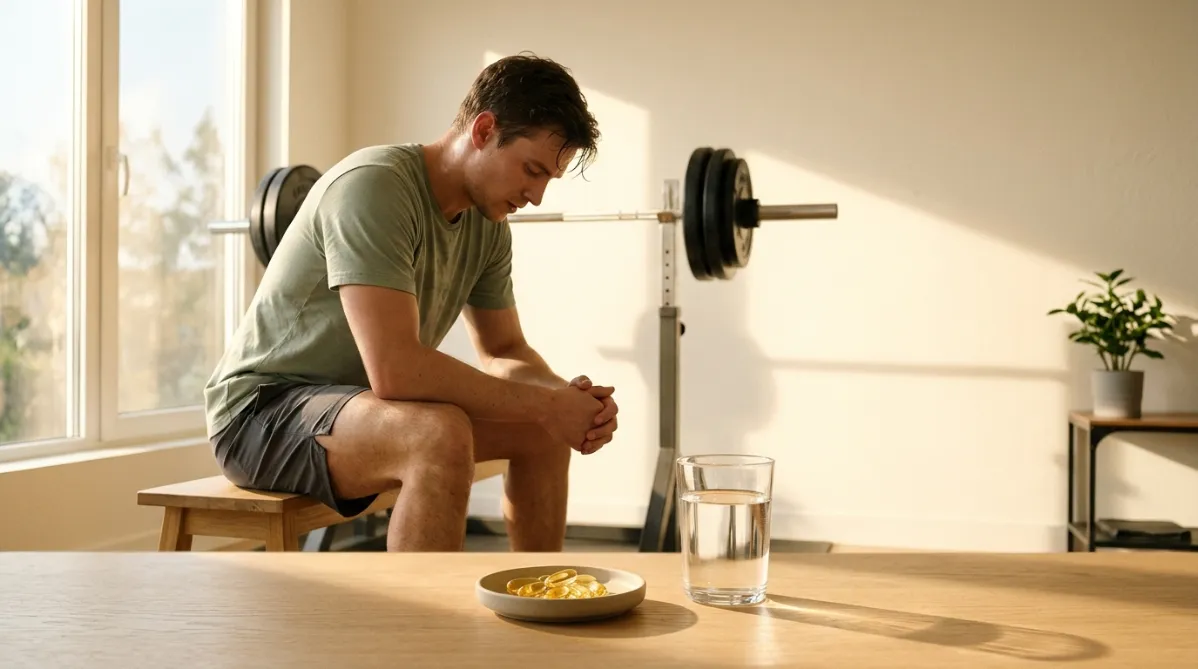
A sunlit, minimalist home gym corner photographed in soft golden morning light, with a young athletic man seated on a wooden bench, leaning forward with his elbows resting on his knees, catching his breath after a hard leg session. He wears a muted sage-green t-shirt and charcoal shorts, his face turned slightly away from the camera, calm and focused. A matte ceramic dish in the foreground holds a few small, translucent golden softgel capsules, with a glass of water beside it catching the light and casting a soft caustic shadow across a pale oak floor. Behind him, a loaded barbell rests on a squat rack, slightly out of focus, and a tall window pours warm sunlight diagonally across the scene, creating long gentle shadows and a hazy glow. A small potted green plant sits on a shelf at the edge of the frame. The color palette is warm and editorial: cream, soft gold, sage green, pale wood, and charcoal accents. Shallow depth of field, with crisp focus on the capsules and glass in the lower third and a creamy bokeh background. The composition leaves generous negative space on the right side for a headline overlay. The mood is clean, modern, and aspirational, like a high-end wellness magazine or a trendy health journal feature. Shot on a 50mm lens, natural light, fine film grain, subtle matte finish, landscape 16:9 framing.
recovery

La vitamine D accélère la récupération de force chez les hommes non déficients

BY DR. GYMBRO ·

Des hommes dont le taux de vitamine D était déjà normal récupèrent plus rapidement leur force après une séance intensive d’entraînement des jambes lorsqu’ils prennent 4 000 UI par jour. Dans cet essai randomisé contrôlé par placebo, portant sur 28 hommes actifs, la force isométrique maximale a rebondi d’environ 8 % à 24 h. Les marqueurs de dommages musculaires (ALT et AST) ont également augmenté moins fortement, mais aucune réduction des courbatures n’a été observée. Voici ce que l’étude a démontré, ses limites, et qui pourrait réellement en bénéficier.

A softly lit bedside table in a calm, modern bedroom at dusk, photographed in wide landscape format with shallow depth of field. In the foreground, a matte white shaker bottle sits beside a tall frosted glass of creamy, pale vanilla-colored protein shake, with a few condensation droplets catching warm light. Next to the glass rests a slim fitness band on a dark charcoal fabric strap, its small LED glowing a gentle green, lying casually on a light oak wooden surface. A small scoop of fine white protein powder rests on a ceramic dish nearby, with a light dusting of powder on the wood.

In the soft-focus background, a neatly made bed with oatmeal-colored linen bedding and a textured knit throw blanket. A sheer curtain filters the last peach and lavender light of evening from a large window. A small potted olive branch in a terracotta vase and a closed paperback book add a quiet editorial touch. A bedside lamp with a warm, cream-colored shade casts a golden glow across the scene and creates gentle highlights on the glass.

The palette is muted and harmonious: warm cream, soft sand, oatmeal beige, faint sage green accents, and touches of dusty lavender in the window light. The mood is peaceful, reassuring, and clean, like a contemporary wellness magazine or a trendy health journal feature. Lighting is natural and cinematic, with soft shadows and a subtle film-like grain. The composition follows the rule of thirds, with the shake and band on the left third and open negative space on the right for headline overlay. Minimalist, Scandinavian-inspired styling, high-end lifestyle photography, crisp details, and a tranquil, premium editorial feel.
recovery

La caséine avant de se coucher ne ruine pas votre sommeil, selon les données WHOOP

BY DR. GYMBRO ·

Un shake de 40 g de caséine avant de se coucher sabote-t-il secrètement votre sommeil ? Un essai randomisé, en double‑aveugle et en cross‑over mené chez 21 sportives de Division I de la NCAA, suivi avec les bracelets WHOOP 4.0, n’a trouvé aucune détérioration du temps de sommeil, de son efficacité, de la fréquence cardiaque au repos ou de la variabilité de la fréquence cardiaque. L’α‑lactalbumine et les glucides ont donné les mêmes résultats. Mais il y a un rebondissement : aucun de ces apports n’a amélioré le sommeil non plus. Voici ce que révèlent les données, les limites de l’étude et qui devrait encore éviter le shake nocturne.

A wide, editorial-style still life shot from a slightly elevated angle on a pale oatmeal-colored linen surface in soft, diffused morning light. At the center, a shallow matte ceramic bowl in warm terracotta holds a small mound of fine, golden-tan ashwagandha root powder. Beside it lie a few gnarled, dried ashwagandha roots and a sprig of green leaves with tiny orange-red berries in their papery husks. To the left, a minimalist amber glass supplement bottle sits with a few capsules spilled beside it, label blank and clean. A wooden scoop rests on the surface, dusted with powder.

On the right side of the frame, a pair of sleek, muted sage-green running shoes sits slightly off-center. A folded cream towel and a stainless steel water bottle sit just behind them, with a single brushed-steel kettlebell partly out of focus in the background to hint at strength training without dominating the scene. The running shoes and the botanical elements share equal visual weight, suggesting the endurance theme.

A thin, curved line of scattered powder sweeps across the linen from the bowl toward the shoes, like a gentle path or track. Soft shadows fall to the left, and a warm sunbeam crosses the surface and picks out the texture of the powder and the roots.

The palette is restrained and modern: warm terracotta, sage green, cream, soft gold, and touches of charcoal. The background is a blurred pale plaster wall with a hint of a window shadow. Shallow depth of field, crisp focus on the bowl and roots, and generous negative space in the upper left for a headline. Contemporary wellness magazine aesthetic, calm, natural, tactile, high-end lifestyle photography, no text, no people, no futuristic elements.
science research

La surprise de l'Ashwagandha : elle favorise l'endurance plus que la force

BY DR. GYMBRO ·

L'Ashwagandha est souvent vendue comme un booster de force et de masse musculaire, mais une nouvelle méta‑analyse montre que son principal atout se situe ailleurs : l'endurance aérobie. En regroupant 13 essais randomisés et 599 participants, les chercheurs ont observé un effet moyen de g = 0,54 sur l'endurance, tandis que les gains de force restent incertains. La dose « idéale » semble se situer entre 500 et 600 mg d'extrait par jour, même si cette recommandation comporte d’importantes réserves. Voici ce que disent réellement les données, qui peut en profiter et qui devrait rester prudent.

This page is available in