Dr. Gymbro
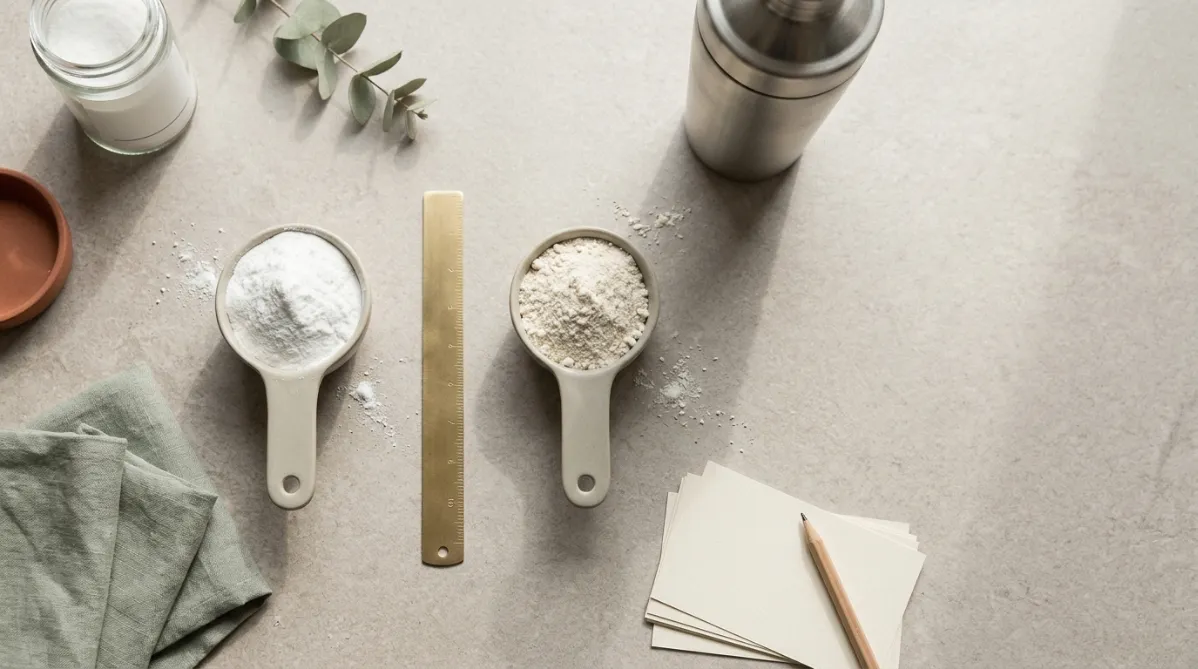
A bright, minimalist flat-lay photograph of two supplement scoops on a pale warm-gray stone surface, shot from directly above in soft natural window light. On the left, a matte ceramic scoop holds fine white creatine monohydrate powder, heaped in a clean mound. On the right, a second scoop of the same shape holds slightly coarser off-white beta-alanine powder, with a small, deliberate gap between the two. Each scoop sits in its own soft shadow, which suggests separation rather than combination. Between them, a thin brushed-brass ruler or a single slim line of fine powder runs across the surface and subtly divides the composition.

Around the scoops, a few restrained props in a muted editorial palette of sage green, cream, terracotta, and soft charcoal: a small glass jar with a minimalist label that has no readable text, a folded linen napkin, a single sprig of eucalyptus, and a stainless-steel shaker bottle softly out of focus in the upper corner. A few loose powder grains are scattered naturally across the stone. A small stack of blank cream index cards with a pencil rests in the lower right, hinting at research and note-taking without any legible writing.

The composition follows a clean rule-of-thirds layout, with generous negative space on the right third for headline overlay. The lighting is gentle and diffused, with long, soft shadows falling to the lower left. The color grading is calm and slightly desaturated, with creamy highlights and a subtle film-like grain. The overall look is a modern wellness and science journal cover, with an airy, trustworthy, contemporary editorial feel, shallow depth of field, and crisp detail on the powders.
Nutrition

Créatine + Bêta‑alanine : le prétendu avantage du combo que les chercheurs n’ont pas confirmé

Dr. Gymbro · · 5 min read

Créatine + Bêta‑alanine : le prétendu avantage du combo que les chercheurs n’ont pas confirmé

Vous avez sans doute remarqué les pots, les étiquettes de pré‑entraînement et les packs « stack ultime pour la performance ». La créatine + bêta‑alanine est commercialisée comme une offre groupée, comme si l’un renforçait l’autre. Une nouvelle revue systématique et méta‑analyse en réseau publiée dans le Journal of the International Society of Sports Nutrition a mis cette idée à l’épreuve et a montré que c’est la créatine qui porte la majeure partie du travail, tandis que le combo n’apporte aucune amélioration mesurable.

Ce que les chercheurs ont réellement fait

Bai et Xu, de la Jiangxi University of Science and Technology (Chine), ont suivi les directives PRISMA. Ils ont interrogé PubMed, Scopus et Web of Science jusqu’en août 2025. Ils ont sélectionné les essais contrôlés randomisés portant sur la créatine, la bêta‑alanine ou les deux combinés, d’une durée d’au moins deux semaines, chez des athlètes adultes en bonne santé.

Cinquante‑deux ECR, tous notés 6 ou plus sur l’échelle de qualité PEDro, ont été inclus. Une méta‑analyse en réseau permet de comparer simultanément plusieurs interventions, y compris celles qui n’ont jamais été testées en comparaison directe. Ici, les groupes étudiés étaient : créatine seule, bêta‑alanine seule, combinaison des deux et placebo. Les paramètres mesurés comprenaient le sprint, le saut, l’agilité, l’endurance musculaire du haut et du bas du corps, ainsi que la capacité de sprint répété (RSA).

Résultat principal : la créatine porte la vedette, le combo n’apporte rien

Par rapport au placebo, la créatine seule a amélioré de façon significative :

  • Performance au sprint : SMD = ‑0,64 (p = 0,04). Le signe négatif indique des temps plus rapides.
  • Performance au saut : SMD = 0,33 (p = 0,002).
  • Capacité de sprint répété : SMD = ‑0,78 (p = 0,01).
  • Endurance musculaire du haut du corps : SMD = 0,43 (p = 0,01).

Les P‑scores de la créatine, indicateur de supériorité dans la méta‑analyse en réseau, dépassaient 0,90 dans ces domaines, la plaçant clairement en tête.

La bêta‑alanine a engendré des effets non significatifs ou dépendants du contexte. La combinaison des deux suppléments n’a montré aucune synergie. Les auteurs concluent que la co‑supplémentation n’apporte aucun avantage supplémentaire par rapport à la créatine seule.

Pourquoi la logique des "deux voies" n’a pas fonctionné

Sur le papier, le stack paraît logique : la créatine favorise la resynthèse de phosphocréatine et la régénération rapide de l’ATP, tandis que la bêta‑alanine augmente la concentration de carnosine musculaire, qui tamponne l’acide lactique. Des mécanismes différents laissent penser à des bénéfices additionnels.

Les données agrégées n’ont pas confirmé cette hypothèse. Les auteurs expliquent que l’effet tamponneur de la bêta‑alanine semble limité à certaines tâches et insuffisant pour amplifier l’effet de la créatine. Selon eux, la constance de la créatine provient d’une meilleure récupération de phosphocréatine et d’une activation neuromusculaire plus efficace, des facteurs décisifs pour les sprints, les sauts et les efforts répétés.

Ce qui n’a pas changé

La créatine n’a pas modifié de façon significative l’agilité ni l’endurance musculaire du bas du corps (p > 0,05 pour les deux). Elle n’est donc pas une panacée ; les gains observés sont spécifiques à certains types d’efforts.

Rigueur méthodologique

Points forts :

  • seuls des essais randomisés de qualité (PEDro ≥ 6) ont été retenus ; aucun biais de publication majeur n’a été détecté.

Limites :

  • Hétérogénéité variable : l’I² variait de 0 % à 73 %, indiquant que certains résultats proviennent d’essais assez hétérogènes.
  • Population : athlètes adultes en bonne santé. Les conclusions ne s’appliquent pas nécessairement aux seniors, aux patients ou aux débutants non entraînés.
  • Sexe et discipline : les auteurs appellent à davantage d’études explorant les réponses selon le sexe et le type de sport, car les effets moyens peuvent masquer des différences de sous‑groupes.
  • Durée et conception : il faut des essais à bras multiples, standardisés et de plus longue durée pour éclaircir d’éventuelles interactions. Les preuves actuelles ne sont pas définitives quant à l’existence d’une synergie.
  • La bêta‑alanine n’est pas « inutile » : elle était non significative ou contextuelle dans cette analyse, mais cela ne signifie pas qu’elle ne peut être bénéfique dans d’autres circonstances.
  • Informations manquantes dans le résumé : le nombre total de participants et la répartition par groupe ne sont pas précisés, il faut donc consulter le texte complet avant de tirer des conclusions fines.

Implications pratiques

Dose et timing : le résumé ne détaille pas les protocoles de dosage ou de prise, de sorte que cet article ne peut pas vous préciser combien ou quand consommer les suppléments. En dehors de cette étude, la pratique courante consiste à prendre de la créatine monohydrate quotidiennement à raison de 3 à 5 g, de façon régulière, pendant au moins deux semaines avant d’en évaluer les effets.

Qui peut en bénéficier : selon ces résultats, la créatine convient aux athlètes dont la performance dépend du sprint, du saut, d’efforts intenses répétés ou de l’endurance musculaire du haut du corps : joueurs d’équipes, sprinteurs, haltérophiles, etc.

Qui peut se passer du combo : si votre objectif principal est le petit plus apporté par le « stacking », cette méta‑analyse ne fournit que peu de raisons de privilégier le mélange. Si vous prenez déjà de la bêta‑alanine et que vous l’aimez, rien ici ne prouve qu’elle est nocive ; le constat est simplement qu’elle n’a pas renforcé la créatine dans les données agrégées.

Qui doit rester prudent : la revue porte sur des athlètes adultes en bonne santé. Toute personne présentant une condition médicale (notamment des problèmes rénaux), enceinte, ou sous traitement médicamenteux devrait consulter un professionnel de santé avant d’entamer une supplémentation. Cette recommandation est générale et ne provient pas directement de l’étude.

Conclusion

Si vous décidez où placer votre budget de compléments, cette méta‑analyse en réseau de 52 ECR confirme la créatine comme le produit le plus constant pour les efforts de haute intensité et anaérobies. La bêta‑alanine peut être utile dans des contextes spécifiques, mais elle n’a pas transformé la créatine en une version améliorée d’elle‑même. Des essais plus longs et mieux conçus à bras multiples pourraient affiner le tableau, mais pour l’instant le stack n’a pas mérité son prix premium.
Original study

Read the original research on pubmed.ncbi.nlm.nih.gov →

This article summarizes published research for general information. It is not medical advice.

DG

Written by

Dr. Gymbro

Dr. Gymbro writes for Dr. Gymbro: science-backed fitness, nutrition & performance.

Related Articles

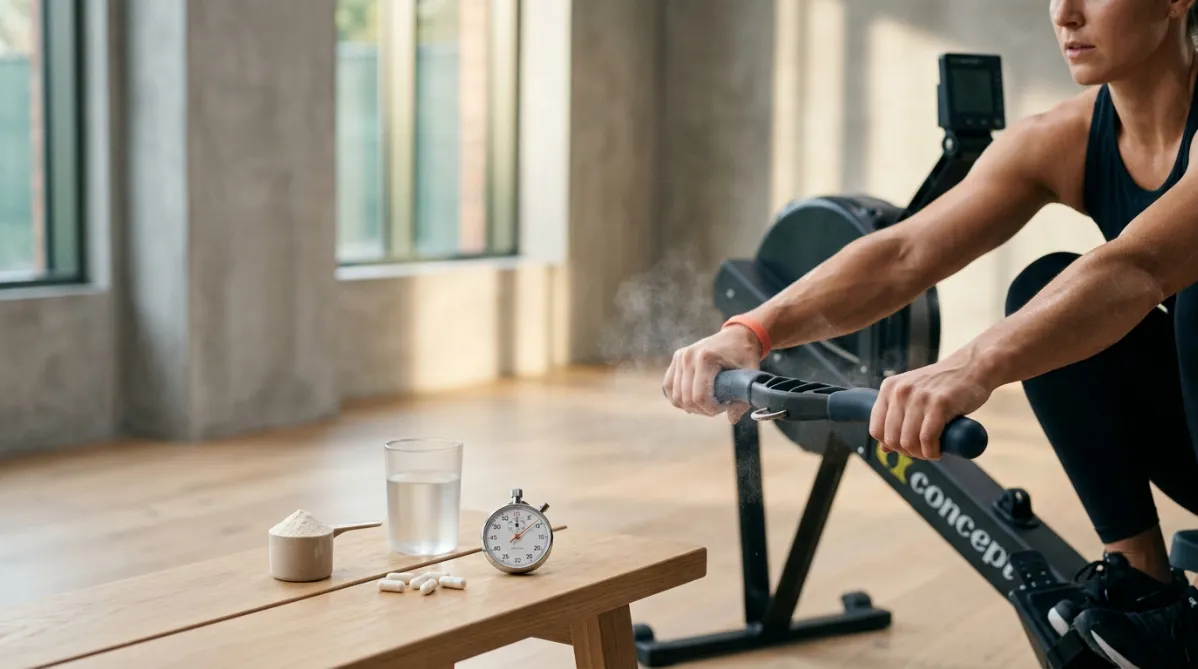
A wide, minimalist editorial scene of an athlete's hands and forearms gripping the handles of a rowing ergometer, shot in soft natural light from a large window in a clean, airy training studio. The athlete is mid-pull, forearm muscles subtly defined, a light sheen of sweat on the skin, chalk dust floating in the air. In the foreground on a pale oak bench sits a small ceramic scoop of fine white powder beside a matte glass of water, with a few loose white capsules arranged neatly in a gentle curve. A minimalist analog stopwatch with a clean white face lies next to them, its hand paused near the two-minute mark.

The color palette is calm and modern: warm off-white, soft sand, muted sage green, and a single accent of coral orange in the stopwatch hand and the rower's wristband. The background is softly blurred concrete and pale wood with long, gentle shadows stretching across the floor. Shallow depth of field keeps the hands, powder, and stopwatch crisp while the rest dissolves into creamy bokeh.

Composition follows the rule of thirds: the rowing handles and hands occupy the right third, the bench still life sits in the lower left, and open negative space in the upper left leaves room for a title overlay. The mood is focused, quiet, and intentional, like a high-end health and science journal feature. Fine film grain, subtle matte finish, editorial photography style, natural color grading, and no text or logos.
nutrition

La bêta‑alanine fonctionne‑t‑elle ? Une méta‑analyse confirme son efficacité pour les efforts de 60 à 240 secondes

BY DR. GYMBRO ·

La bêta‑alanine est souvent présentée comme le moyen de retarder la sensation de brûlure liée à un effort intense, mais délivre‑t‑elle réellement ses promesses ? Une méta‑analyse de 15 études, portant sur 360 participants, a mis en évidence un bénéfice réel mais modeste, avec un gain médian de 2,85 %. L’effet était le plus net pour les efforts de 60 à 240 secondes, s’atténuant au‑delà de quatre minutes et absent pour les sprints de moins d’une minute. L’article détaille également le protocole de charge habituel (3,2 à 6,4 g /jour pendant au moins quatre semaines), les moyens de limiter les fourmillements en fractionnant les doses, et les athlètes qui peuvent le plus en bénéficier.

A wide, editorial-style still life photographed from slightly above on a pale oat-colored linen surface, lit by soft morning window light from the left. In the center sits a small matte ceramic bowl holding a mound of fine white powder, with a minimalist wooden scoop resting beside it. Next to the bowl is an open amber glass supplement jar with a plain cream label, and a few white capsules spill across the linen in a loose arc.

To the right, a neatly arranged cluster of analog "study" objects suggests careful measurement: a vintage stopwatch with a clean white face, a slim notebook with a sage-green cover open to a hand-drawn bar chart (blurred, no legible text), and a mechanical pencil lying across the page. A small row of six identical ceramic dishes, each holding a pinch of powder, is lined up along the top edge of the frame to hint at the six-week trial. One dish is slightly out of alignment, a subtle visual cue for ambiguity.

A shallow glass of water and a single sprig of green eucalyptus add a calm, organic note in the foreground. Soft, long shadows fall across the textured linen, and the palette stays restrained: warm cream, soft sage, muted terracotta, pale gray, and touches of amber from the glass jar. A few translucent paper cutouts in two tones (sage and blush) overlap in the upper right corner as a modern graphic accent, evoking overlapping data points without showing any numbers.

Depth of field is shallow, with the bowl and stopwatch in crisp focus and the edges gently softened. The composition leaves generous negative space on the left third for title text overlay. The overall mood is thoughtful, balanced, and quietly skeptical, in the style of a contemporary wellness and science magazine: clean, tactile, minimal, with a subtle film-like grain and natural color grading. No people, no futuristic or sci-fi elements, no readable text or logos.
nutrition

GAA, stimulateur cérébral ? Le résultat d’un test de six semaines reste mitigé

BY DR. GYMBRO ·

Le GAA, précurseur de la créatine commercialisé comme stimulant cérébral, vient de subir son premier test humain sérieux. Lors d’un essai en double‑aveugle de six semaines mené sur 58 adultes en bonne santé, il a légèrement accéléré les temps de réaction et a produit quelques effets sur l’humeur et le stress. En revanche, la majorité des tests cognitifs n’ont rien révélé, et les résultats les plus prometteurs n’étaient que des tendances. Les indicateurs de sécurité étaient rassurants, mais l’étude était petite, exploratoire et n’incluait pas de groupe comparatif à la créatine seule. Voici ce qu’elle montre réellement, à qui elle pourrait convenir, et pourquoi le verdict reste mitigé.

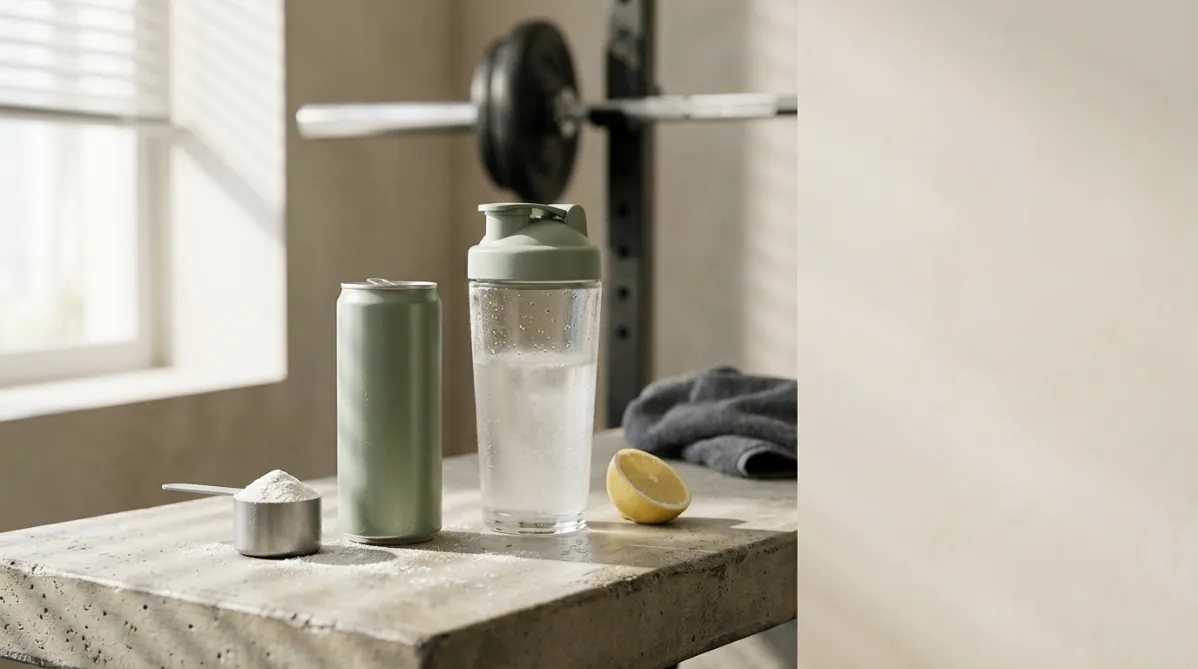
A sleek aluminum energy drink can and a matte scoop of white pre-workout powder sit side by side on a pale concrete gym bench, lit by soft morning window light. The can is slim and minimalist, with a muted sage green label and no legible text. Beside it is a clear glass shaker half full of cloudy, lightly frothy liquid with condensation beading on its surface. A few fine grains of powder are scattered across the bench, catching the light. Behind them, slightly out of focus, a stainless steel barbell rests on a rack, and a folded charcoal gym towel sits at the edge of the frame.

The color palette is warm neutral: oatmeal, soft gray, and sage, with a single accent of pale citrus yellow from a halved lemon wedge placed near the glass. A thin, elegant shadow from the window blinds falls diagonally across the scene, giving it an editorial, magazine-style rhythm. The composition leaves generous negative space on the right third of the frame, a smooth blurred wall in warm off-white, suitable for headline text overlay.

The shot is a low-angle, shallow depth-of-field product-style photograph, as if taken with an 85mm lens at f/2. The foreground objects are tack sharp and the background melts into creamy blur. The mood is calm, clean, and modern, like a wellness or science journal feature. Subtle film grain and gentle contrast add a tactile, contemporary lifestyle feel. There are no people, no logos, and no futuristic or sci-fi elements, just a quiet, considered still life that suggests the choice between a canned drink and a scooped supplement.
nutrition

Votre boisson énergétique peut agir comme un pré‑workout – mais il y a un hic

BY DR. GYMBRO ·

Caféine et taurine sont souvent associées dans les boissons énergisantes et les pré‑workouts, mais cette combinaison améliore‑t‑elle réellement la performance ? Une méta‑analyse récente de 11 essais randomisés (234 participants) montre des gains modérés en puissance maximale et en temps d’épuisement, ainsi qu’une perception d’effort moindre. Le rythme cardiaque n’a pas bougé et les résultats sur le temps de réaction restent trop variables pour être fiables. Le problème, c’est que les études sont petites et ne permettent pas de conclure que la taurine apporte quelque chose de plus que la caféine.

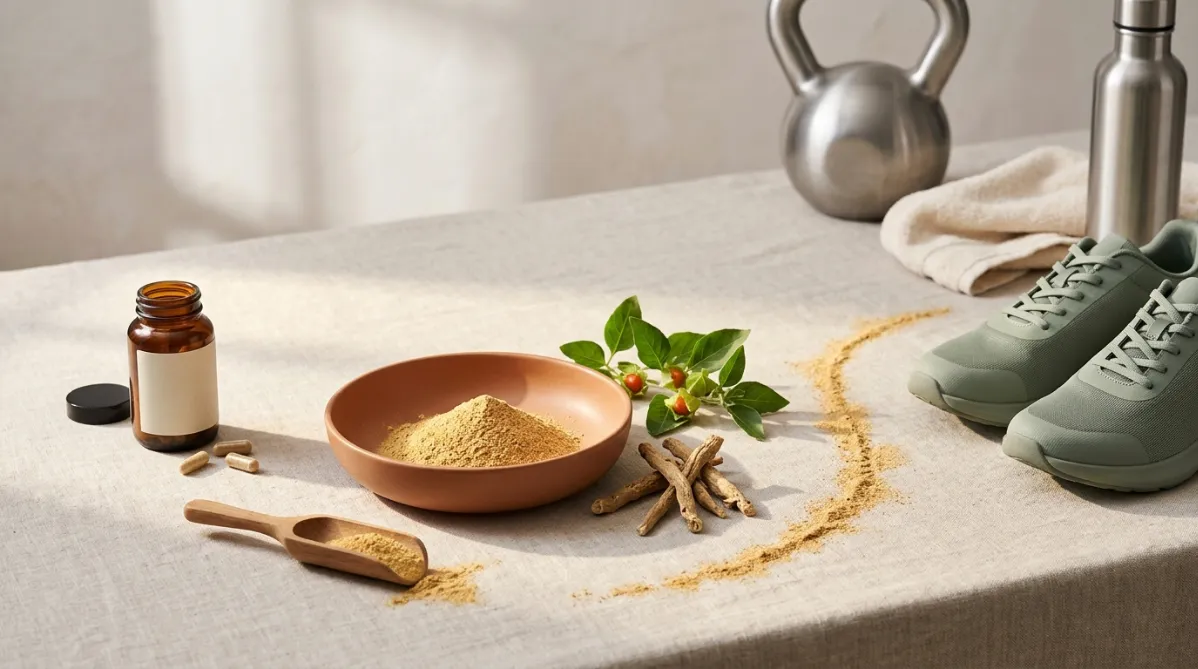
A wide, editorial-style still life shot from a slightly elevated angle on a pale oatmeal-colored linen surface in soft, diffused morning light. At the center, a shallow matte ceramic bowl in warm terracotta holds a small mound of fine, golden-tan ashwagandha root powder. Beside it lie a few gnarled, dried ashwagandha roots and a sprig of green leaves with tiny orange-red berries in their papery husks. To the left, a minimalist amber glass supplement bottle sits with a few capsules spilled beside it, label blank and clean. A wooden scoop rests on the surface, dusted with powder.

On the right side of the frame, a pair of sleek, muted sage-green running shoes sits slightly off-center. A folded cream towel and a stainless steel water bottle sit just behind them, with a single brushed-steel kettlebell partly out of focus in the background to hint at strength training without dominating the scene. The running shoes and the botanical elements share equal visual weight, suggesting the endurance theme.

A thin, curved line of scattered powder sweeps across the linen from the bowl toward the shoes, like a gentle path or track. Soft shadows fall to the left, and a warm sunbeam crosses the surface and picks out the texture of the powder and the roots.

The palette is restrained and modern: warm terracotta, sage green, cream, soft gold, and touches of charcoal. The background is a blurred pale plaster wall with a hint of a window shadow. Shallow depth of field, crisp focus on the bowl and roots, and generous negative space in the upper left for a headline. Contemporary wellness magazine aesthetic, calm, natural, tactile, high-end lifestyle photography, no text, no people, no futuristic elements.
science research

La surprise de l'Ashwagandha : elle favorise l'endurance plus que la force

BY DR. GYMBRO ·

L'Ashwagandha est souvent vendue comme un booster de force et de masse musculaire, mais une nouvelle méta‑analyse montre que son principal atout se situe ailleurs : l'endurance aérobie. En regroupant 13 essais randomisés et 599 participants, les chercheurs ont observé un effet moyen de g = 0,54 sur l'endurance, tandis que les gains de force restent incertains. La dose « idéale » semble se situer entre 500 et 600 mg d'extrait par jour, même si cette recommandation comporte d’importantes réserves. Voici ce que disent réellement les données, qui peut en profiter et qui devrait rester prudent.

This page is available in