Dr. Gymbro
←

#fatigue

2 articles
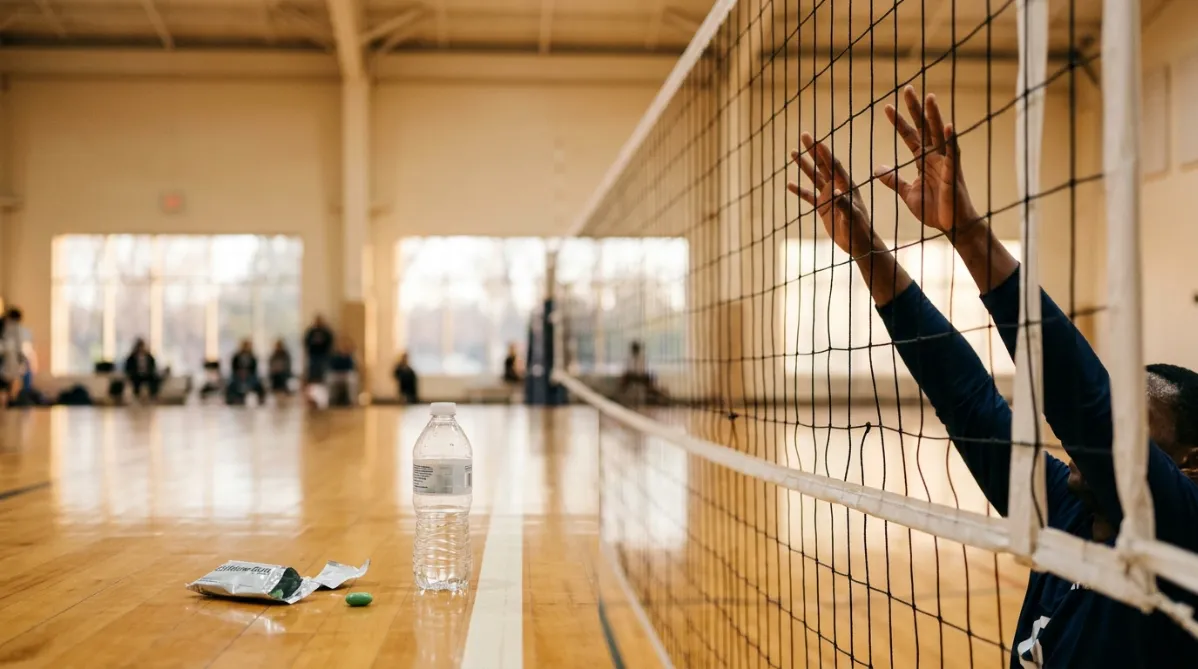
A landscape editorial photograph of a volleyball net in a softly lit indoor gym, shot from a low angle on the court. In the foreground, a pair of athletic hands in mid-block reach above the net, fingers spread, caught in crisp focus. The athlete's face is out of frame, so the attention stays on the hands and the net. In the lower left foreground, a small open foil pack of caffeine chewing gum sits on the polished maple floor, with two mint-green gum pieces beside it and a clear water bottle. The pack is unbranded and minimal.

The background is a warm blur of honey-toned hardwood, pale gym walls, and tall windows with diffused late-afternoon light streaming in. Dust motes glow in the light shafts. The palette is muted and modern: warm wood amber, soft cream, sage green, and a touch of deep navy from the athlete's jersey. Shallow depth of field and gentle film grain give the image a refined, magazine-like feel. The composition follows the rule of thirds, with the hands and net on the right and open negative space on the left, where headline text could sit.

The mood is calm, focused, and slightly cinematic, like a feature in a contemporary sports science journal. The lighting is soft and natural, with long gentle shadows across the court lines. No futuristic or digital elements, no charts, no text. The overall look is clean, tactile, and editorial.
nutrition

Fatigue : les temps de réaction ralentissent de 18 %. Le chewing‑gum à la caféine ne les réduit qu’à 3 %

BY DR. GYMBRO ·

Après un protocole de fatigue très exigeant, les joueuses de volleyball d’élite sous placebo ont vu leurs temps de réaction augmenter de 18,4 %. Un chewing‑gum contenant 6 mg/kg de caféine n’a limité ce ralentissement qu’à 3,0 %, tandis que 3 mg/kg n’ont entraîné qu’une hausse de 6,4 %. La puissance au saut‑bloc et la raideur du saut‑dégressif se sont également mieux maintenues avec la caféine. L’étude, toutefois, ne comporte que 15 athlètes, l’aveugle était incomplet et les effets indésirables étaient plus fréquents à la dose la plus élevée.

A wide landscape editorial photograph of a minimalist wooden desk by a large window in soft morning light. On the left, two small matte ceramic bowls sit side by side on a pale oak surface. One holds a modest mound of fine white amino acid powder, and the other holds a visibly larger mound, a quiet visual echo of two different doses. Beside them rest two brushed-brass measuring spoons, one slightly larger than the other. A glass of water with delicate condensation stands nearby, catching the light.

In the middle ground, a linen-bound notebook lies open with blurred handwritten columns and a simple hand-drawn line chart. A thin pen rests across the page. A pair of clean white running shoes sits on the floor at the edge of the frame, laces loosened, suggesting a recent jog. A soft green plant, such as a eucalyptus sprig in a small ceramic vase, adds an organic touch on the right.

The background is a softly blurred bright interior with sheer curtains and a hint of a leafy city street outside. The palette is warm and muted: cream, sand, soft sage green, pale terracotta, and touches of brushed brass. Gentle diffused sunlight casts long, delicate shadows across the desk, with a shallow depth of field that keeps the bowls crisp and the rest dreamy. The mood is calm and contemplative, with a modern wellness-journal aesthetic, generous negative space at the top and right for headline overlay, and subtle film grain. Shot as if on a 50mm lens at eye level with the tabletop, with a slightly desaturated, editorial color grade.
science research

La dose de L‑Arginine qui a réduit la fatigue — et celle qui n’a pas fonctionné

BY DR. GYMBRO ·

Tous les dosages de L‑arginine ne se valent pas. Dans un essai randomisé de huit semaines portant sur 120 adultes actifs souffrant de fatigue, 6 g/jour ont fait diminuer les scores de fatigue davantage que le placebo (‑6,41 contre ‑2,23) et ont réduit le lactate après une course de 30 minutes, tandis que 3 g/jour n’ont eu aucun effet. La qualité du sommeil s’est légèrement améliorée pour les deux doses, et le nitrite plasmatique à jeun est resté inchangé. Même la dose efficace n’a fait que modérer la fatigue, sans l’éradiquer, et l’étude a été financée par l’industrie.

This page is available in