Dr. Gymbro
←

#mitochondria

1 article
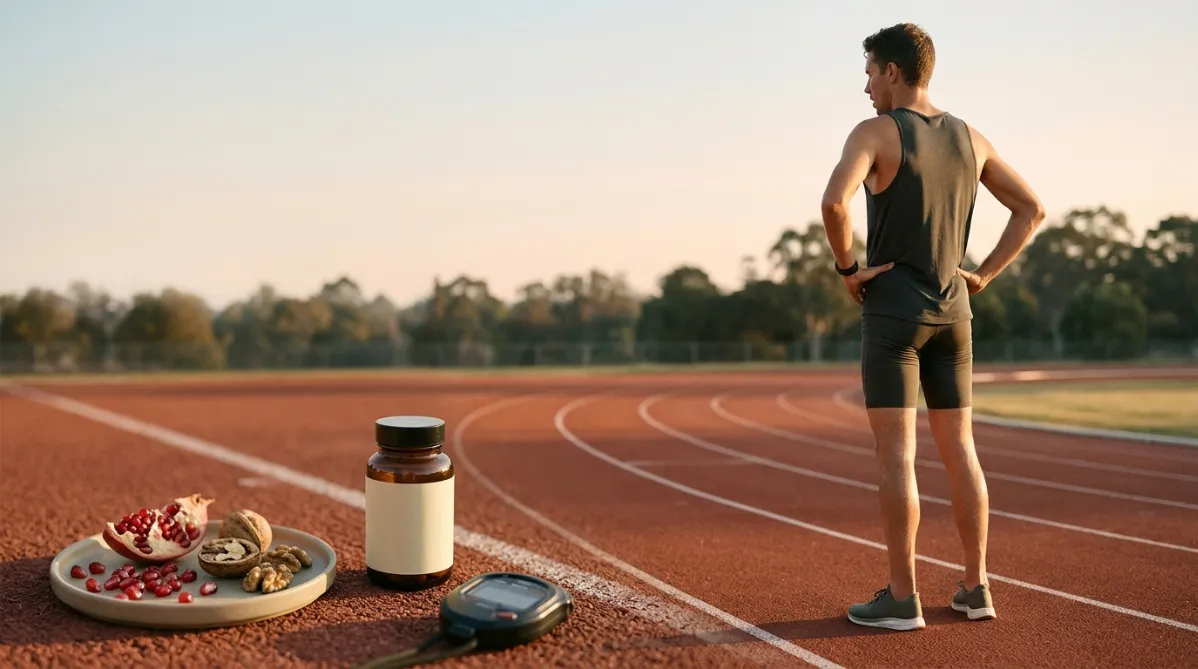
A wide landscape editorial photograph of a lone male distance runner, seen from behind in soft three-quarter profile, pausing on a red-clay outdoor running track at golden hour. He wears a minimalist charcoal singlet and fitted shorts, with a faint sheen of sweat on his calves and shoulders. His hands rest loosely on his hips as he catches his breath, and the white lane lines curve gracefully into the distance. Low amber sunlight rakes across the track and casts long, soft shadows. A hazy line of trees and a pale peach sky blur into creamy bokeh behind him.

In the lower foreground, slightly out of focus, a small matte ceramic dish holds a few pomegranate seeds and halved walnuts, a nod to the natural food sources of urolithin A. Beside it sits a minimalist amber glass supplement bottle with a plain cream label, and a stopwatch lies face-up on the track's edge. The stopwatch is blurred just enough to read as an object, not a number.

The palette is warm and earthy, with terracotta, burnt orange, soft cream, and muted sage green. The look is refined and contemporary, like a high-end wellness or sports-science magazine, with natural film-like grain, shallow depth of field, and gentle contrast. The composition follows the rule of thirds. The runner sits in the right third, the still life anchors the lower left, and open negative space in the upper left leaves room for a headline overlay. The mood is calm and thoughtful, suggesting recovery, measured results, and quiet scientific skepticism rather than hype. No text, no logos, no futuristic elements.
nutrition

Urolithine A n’a pas rendu les coureurs d’élite plus rapides — mais a réduit les lésions musculaires

BY DR. GYMBRO ·

L’urolithine A a été présentée comme le « supplément pour les mitochondries ». Les chercheurs l’ont testée chez des coureurs d’élite masculins au VO2max d’environ 66 mL·kg⁻¹·min⁻¹. Elle n’a pas accéléré leurs performances sur 3000 m, mais a diminué le marqueur de lésions musculaires (créatine kinase) et l’effort perçu après l’épreuve. Le VO2max a progressé de 5,4 % avec l’UA contre 3,6 % avec le placebo, différence qui n’est pas statistiquement significative. Voici ce que 1000 mg par jour pendant quatre semaines ont réellement apporté, ainsi que les réserves liées à la petite taille de l’échantillon et aux liens avec l’industrie.

This page is available in