Dr. Gymbro
←

#muscle biopsy

1 article
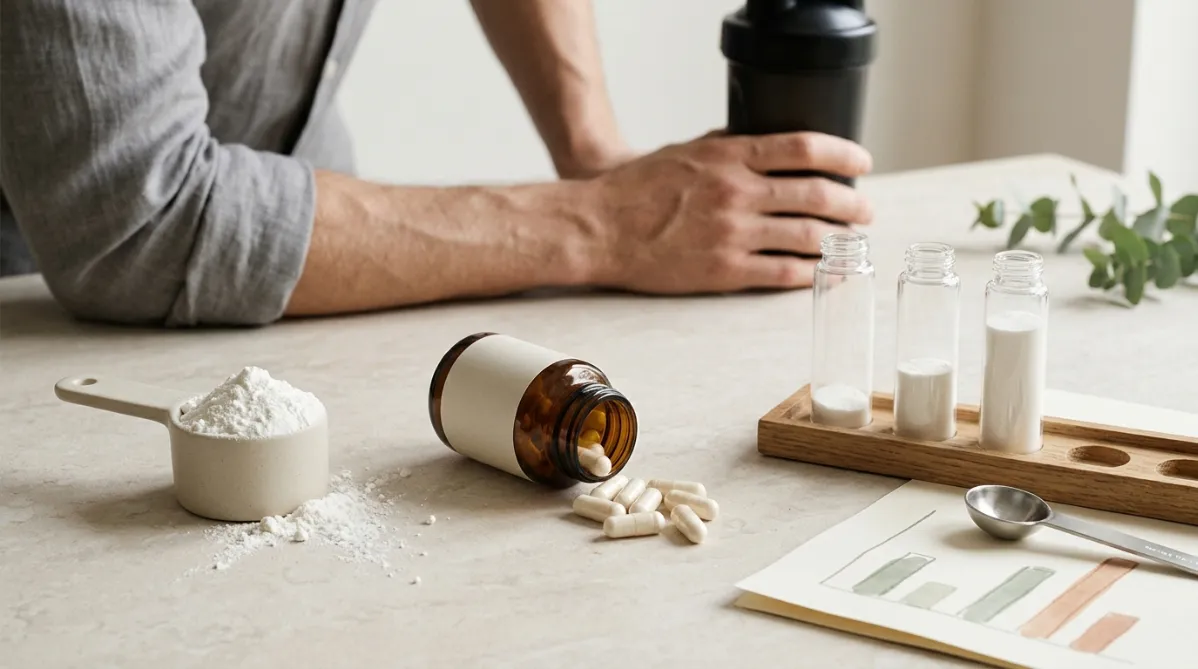
A modern editorial still life photographed from a slightly elevated angle on a pale, matte stone surface in soft natural window light. On the left, a heaping mound of fine white creatine monohydrate powder spills from a matte ceramic scoop, with a few crisp grains scattered across the surface. In the center, a small, minimalist amber glass capsule bottle sits tipped on its side, with a handful of off-white capsules spilling out. The label is blank and clean. On the right, a neat row of three clear glass lab-style vials rests on a slim oak tray. The vials hold different amounts of white powder: the first nearly empty, the second slightly fuller, the third filled almost to the brim. This quietly suggests the difference in dose and result. Beside the tray lies a simple stainless steel measuring spoon and a folded sheet of cream paper with soft, abstract bar-chart lines in muted sage green and terracotta. The lines are hand-drawn and unlabeled.

Behind the objects, slightly out of focus, a lean athletic forearm in a gray linen sleeve rests on the edge of the surface, one hand loosely holding a matte shaker bottle. This hints at a training context without showing a face. A single sprig of eucalyptus in the corner adds a soft organic touch.

The palette is warm neutral: bone white, oatmeal, soft sage, muted terracotta, and touches of amber. Shadows are gentle and long, with a shallow depth of field that gives creamy bokeh in the background. The mood is calm, clean, and trustworthy, like a premium health and science journal's feature spread, with generous negative space at the top and right for headline overlay. The composition is wide, balanced, and uncluttered, with subtle film-like grain and a natural, true-to-life color grade. No text, no logos, no futuristic elements.
nutrition

La dose indiquée de Kre‑Alkalyn n’augmente pas la créatine musculaire, le montrent les biopsies

BY DR. GYMBRO ·

La créatine tamponnée, telle que le Kre‑Alkalyn, promet une meilleure absorption, une dose plus faible et moins de ballonnements. Un essai double‑aveugle réalisé à Texas A&M a mis ces affirmations à l’épreuve en prélevant des biopsies musculaires chez 36 haltérophiles entraînés pendant 28 jours. À la dose recommandée de 1,5 g/jour, la teneur en créatine du muscle n’a pratiquement pas changé, alors que la créatine monohydrate l’a clairement augmentée. La force, la composition corporelle et les effets indésirables n’ont montré aucun avantage pour le produit tamponné.

This page is available in