Dr. Gymbro
←

#prediabetes

1 article
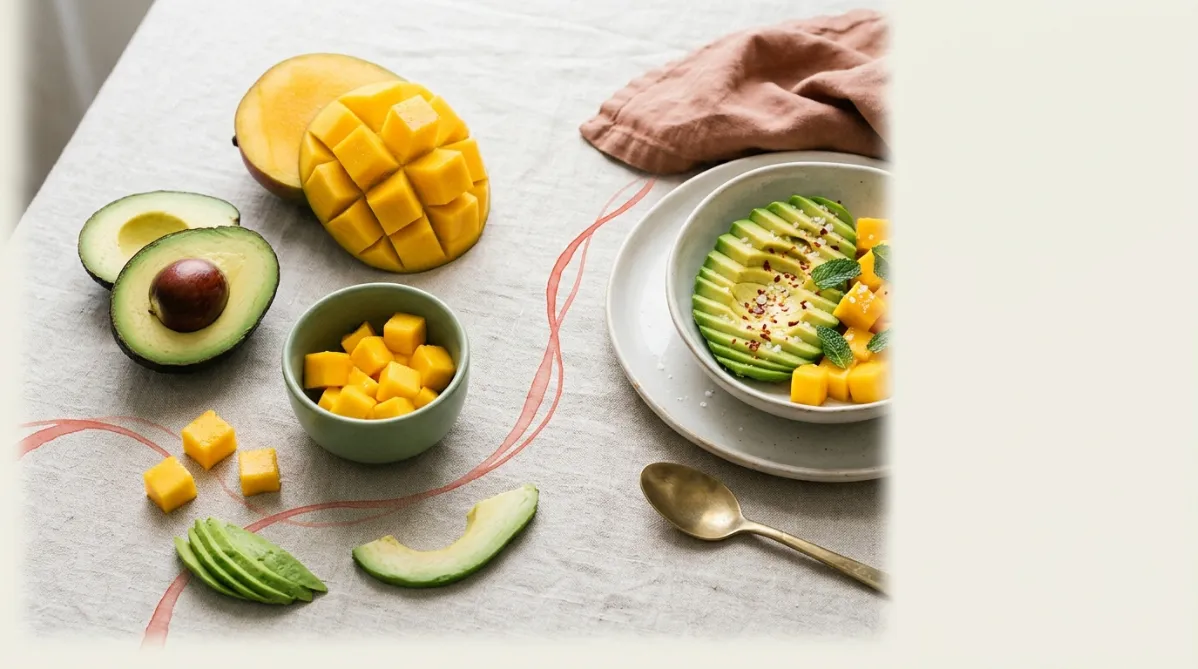
A wide, softly lit editorial still life photographed from slightly above on a pale oat-colored linen surface. On the left, a halved ripe Hass avocado with its glossy pit still nestled in one half, the flesh a buttery gradient from deep green at the skin to creamy yellow at the center. Beside it, a ripe mango is sliced into thick cheeks with a neat crosshatch pattern, the golden-orange flesh catching the light. A small ceramic bowl in matte sage green holds a cup of diced mango cubes. A few scattered mango cubes and a thin avocado slice fan out across the surface.

On the right, a minimalist ceramic plate holds a simple composed bowl: sliced avocado fanned over mango, with a sprinkle of flaky sea salt, a pinch of chili flakes, and a few torn mint leaves. A linen napkin in muted terracotta is draped casually at the edge of the frame. A single brushed-brass spoon rests nearby.

A subtle graphic touch ties in the artery theme: a thin, elegant line of warm coral red, like a hand-drawn ribbon or gentle wave, curves through the negative space on the surface, suggesting a blood vessel and flow without looking clinical. It passes softly beneath the fruit as if painted on the table in watercolor.

Natural morning window light enters from the upper left, creating soft long shadows and gentle highlights on the fruit's surface. The palette is warm and fresh: avocado greens, mango golds and oranges, cream, sage, and a hint of coral. Shallow depth of field blurs the background edges into creamy neutrals, leaving generous clean empty space on the right third for title text. Modern wellness magazine aesthetic, crisp but organic, high-end food photography, with a subtle film-like grain and calm, balanced composition.
nutrition

Avocat + mangue au quotidien : ce qui a changé dans les artères (et ce qui n’a pas changé)

BY DR. GYMBRO ·

Huit semaines de consommation quotidienne d’un avocat et d’une tasse de mangue ont modifié la fonction artérielle chez des adultes prédiabétiques, sans toucher à la glycémie. Dans un essai randomisé mené sur 82 participants, la dilatation dépendante du flux (FMD) a progressé d’environ 1 % avec le régime fruité, alors qu’elle a reculé avec le régime contrôle pauvre en fibres, soit une différence d’environ 2,1 % (P = 0,008). La pression artérielle diastolique s’est surtout améliorée chez les hommes, tandis que la plupart des autres biomarqueurs sont restés inchangés. L’étude, partiellement financée par le Hass Avocado Board et le National Mango Board, montre ce que le combo avocat‑mangue peut réellement apporter et ce qu’il ne prouve pas, ainsi que des pistes pour l’intégrer dans un régime de coupe ou d’entretien.

This page is available in