Dr. Gymbro
←

#turkesterone

1 article
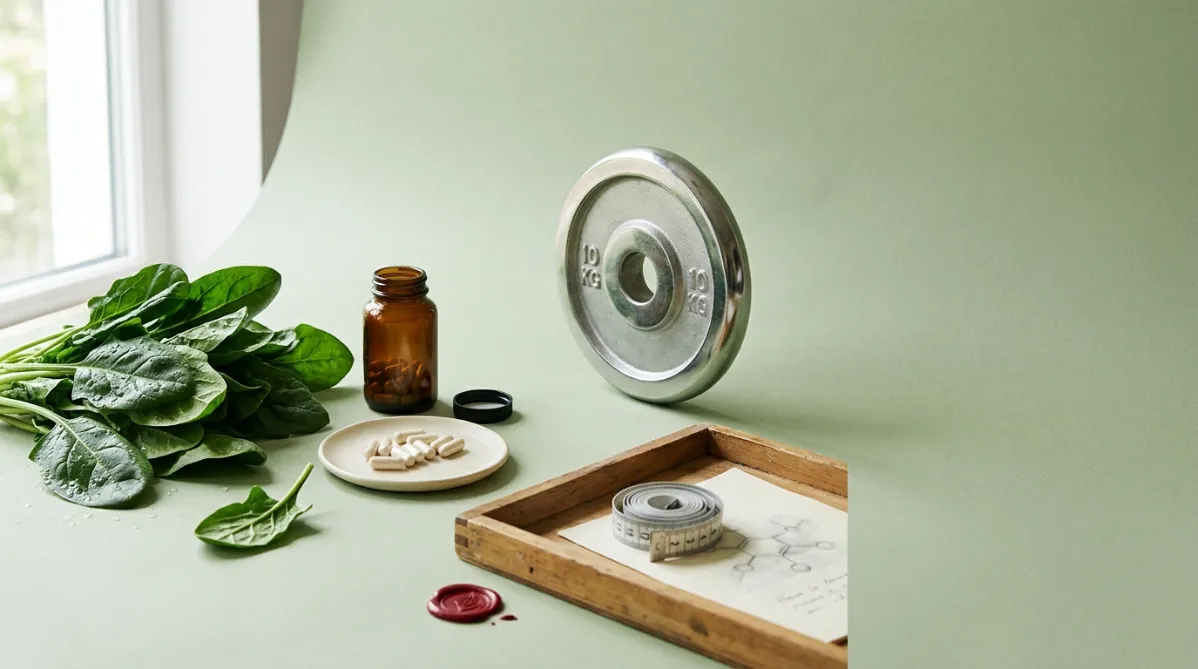
A wide editorial still life on a pale sage-green seamless backdrop, shot from a slightly elevated angle in soft, diffused natural window light. On the left, a loose heap of fresh spinach leaves with deep emerald color and visible veining, a few leaves curling toward the camera with tiny droplets of water catching the light. Beside the leaves sits a minimalist amber glass supplement bottle with a plain cream label, its cap off, and a small scatter of off-white capsules spilling onto a matte ceramic plate. At the center-right of the frame, a polished steel barbell plate stands on its edge, partly in soft focus, suggesting strength training without cluttering the scene. In the foreground, a clean, slightly weathered wooden lab-style tray holds a slim stainless steel measuring tape coiled loosely and a folded paper with a faint abstract molecular line drawing, kept subtle and out of focus. A single red wax-style seal stamp lies near the edge of the arrangement, hinting at "ban" and regulation, with a small imprint half visible on the backdrop. The palette is restrained and modern: sage green, warm cream, soft amber, brushed steel gray, and one small accent of deep red. Shadows are gentle and elongated, falling to the right. Shallow depth of field, crisp focus on the spinach and capsules, a subtle film-like grain, and generous negative space on the right third of the frame for headline overlay. The overall feel is a contemporary health and science magazine cover: clean, tactile, quietly tense, and sophisticated, with no people, no text, and no futuristic elements.
nutrition

Écdystérone anabolique des épinards : 46 hommes, 10 semaines, interdiction recommandée

BY DR. GYMBRO ·

Un « anabolique naturel » présent dans les épinards vient de recevoir le sceau d’efficacité, financé par le WADA, ainsi qu’une recommandation d’interdiction. Lors d’un essai de 10 semaines mené sur 46 jeunes hommes, la supplémentation en écdystérone a été liée à des gains nettement supérieurs de masse musculaire et de force au développé couché (1RM), sans élévation des marqueurs de toxicité hépatique ou rénale. Le mécanisme proposé passe par la liaison aux récepteurs aux œstrogènes, et non aux récepteurs androgènes. Quiconque s’intéresse à la turkéstérone doit comprendre ce que cette petite étude démontre (et ne démontre pas) et pourquoi les athlètes soumis à contrôle doivent rester vigilants.

This page is available in