Dr. Gymbro
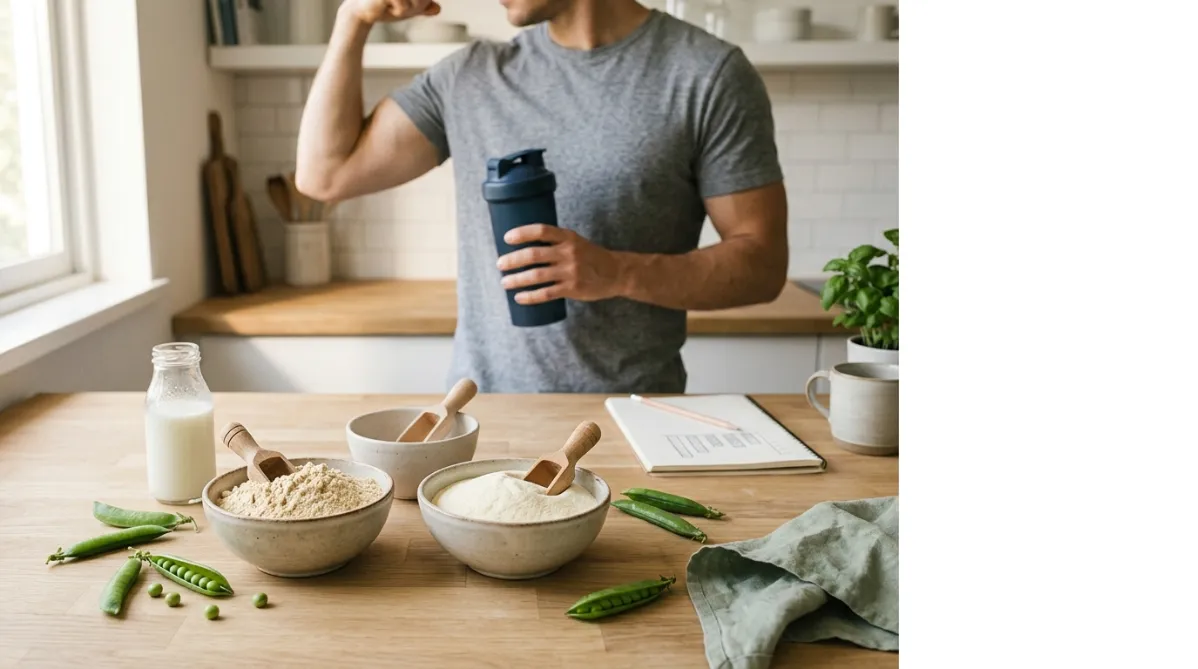
A bright, airy, minimalist kitchen counter in soft morning light, shot from a slightly elevated three-quarter angle in a wide landscape composition. Two matching ceramic bowls sit side by side on a pale oak butcher-block surface. The left bowl holds fine, creamy-beige pea protein powder with a small wooden scoop resting in it. The right bowl holds smooth, ivory-white whey powder with an identical scoop. Between and slightly behind them sits a third, smaller empty bowl with a plain scoop, hinting at the placebo. Scattered around the bowls are fresh green pea pods, some split open to reveal bright, round peas, and a small glass bottle of milk with delicate condensation. A sage-green linen napkin is folded loosely at the edge of the frame.

In the soft-focus background, a young man in a fitted heather-gray t-shirt is seen from the shoulders down, casually flexing one arm while holding a matte shaker bottle, the biceps subtly defined and the pose relaxed and natural. A minimalist notebook with a pencil and a simple hand-drawn bar chart lies open on the counter, suggesting analysis without legible text. A small potted herb plant and a ceramic mug add warmth.

The color palette is muted and editorial: warm cream, sage green, soft terracotta, pale wood, and touches of charcoal. Light streams in from a window on the left, casting gentle long shadows and a subtle golden glow across the powders so their textures look fine and tactile. Shallow depth of field keeps the bowls crisp while the background melts into a creamy blur. The look is modern lifestyle-magazine photography, clean and uncluttered, with generous negative space on the right third of the frame for headline overlay. It is natural, appetizing, and trustworthy, in the style of a contemporary wellness and nutrition journal.
Nutrition

Proteine di pisello vs siero: il risultato sorprendente per i principianti

Dr. Gymbro · · 4 min read

Se sei vegano, intollerante al lattosio o semplicemente stufo del gonfiore provocato dai latticini, probabilmente ti sei chiesto se le proteine vegetali possano davvero far crescere i muscoli. Un trial doppio cieco di 12 settimane su 161 uomini ha messo a confronto la proteina di pisello con il siero e un placebo. Il risultato principale è sorprendente, ma i dettagli sono altrettanto importanti.

Cosa hanno davvero testato

Lo studio, pubblicato nel Journal of the International Society of Sports Nutrition nel 2015 da Babault e collaboratori, era un trial randomizzato, doppio cieco e controllato con placebo. Ha coinvolto 161 uomini tra i 18 e i 35 anni, suddivisi in tre gruppi:

  • Proteina di pisello (marca NUTRALYS), n = 53
  • Proteina di siero, n = 54
  • Placebo, n = 54

Tutti hanno seguito 12 settimane di allenamento di resistenza focalizzato sulla parte superiore del corpo. Ogni partecipante ha assunto 25 g di proteina o placebo due volte al giorno, per un totale di circa 50 g al giorno. I ricercatori hanno misurato lo spessore del muscolo bicipite brachiale con ecografia e la forza con un dinamometro isocinético al basale, al giorno 42 e al giorno 84.

I risultati: tutti sono cresciuti, ma i gruppi si sono differenziati poco

In tutti i partecipanti lo spessore del bicipite è passato da 24,9 mm a 26,9 mm a metà percorso e a 27,3 mm alla fine. Questo effetto temporale era altamente significativo (P < 0,0001), quindi l’allenamento ha funzionato.

La differenza tra i gruppi era solo una tendenza (P = 0,09), quindi non raggiunge la significatività statistica. Anche la forza è migliorata col tempo, senza differenze significative tra pisello, siero e placebo.

Quindi, nell’intero campione non si può affermare che il pisello abbia superato il siero o il placebo. È un inizio modesto per un titolo sensazionale, ed ecco perché la parte successiva conta.

Il colpo di scena per i principianti

I ricercatori hanno poi eseguito un’analisi di sensibilità sui partecipanti più deboli, definita in base alla forza iniziale. Questo è un proxy ragionevole per chi è nuovo al sollevamento o ritorna dopo una pausa. In questo sottogruppo i gruppi si sono differenziati (P < 0,05):

  • Proteina di pisello: +20,2 % di spessore del bicipite
  • Proteina di siero: +15,6 %
  • Placebo: +8,6 %

Il guadagno del pisello era significativamente maggiore rispetto al placebo. Il siero si colloca a metà strada e non differisce statisticamente né dal pisello né dal placebo. Il pisello non ha superato il siero; entrambi i gruppi proteici hanno semplicemente mostrato una crescita, con il pisello che ha superato la soglia statistica rispetto al placebo.

Gli autori hanno concluso che la proteina di pisello ha promosso guadagni di spessore maggiori rispetto al placebo, specialmente in persone che iniziano o riprendono l’allenamento di forza. Poiché i due tipi di proteina non differivano, hanno proposto il pisello come alternativa ai prodotti a base di siero.

Le piccole note da non trascurare

Ecco dove un titolo accattivante ha bisogno di oneste precisazioni:

  • Il confronto principale è una tendenza. La differenza globale (P = 0,09) non è significativa.
  • Il risultato positivo proviene da un sottogruppo. Le analisi di sensibilità possono generare ipotesi utili, ma sono più vulnerabili al caso rispetto a un risultato primario.
  • Legami con l’industria. Alcuni autori sono affiliati a Roquette, la società che produce NUTRALYS. Questo non invalida lo studio, ed è stato registrato (NCT02128516), ma è un contesto da considerare.
  • Popolazione ristretta. I partecipanti erano giovani uomini, e l’allenamento ha riguardato solo la parte superiore del corpo, in particolare i bicipiti. I risultati non si estendono automaticamente a donne, adulti più anziani o allenamenti delle gambe.
  • Nessuna vittoria netta per il siero. Il guadagno del siero del 15,6 % non è stato statisticamente diverso da quello del pisello o del placebo; quindi questo trial non può classificare una proteina come superiore all’altra.

La lettura equilibrata è che la proteina di pisello sembra una scelta valida quando l’allenamento è sufficientemente intenso e l’apporto totale di proteine è adeguato. Non è una prova che il pisello sia superiore, né che sia completamente equivalente in ogni contesto.

Consigli pratici

Dosaggio. Lo studio ha usato 25 g due volte al giorno, cioè circa 50 g di proteina supplementare al giorno. È un obiettivo realistico per molti sollevatori, anche se il totale giornaliero di proteine provenienti dal cibo conta altrettanto.

Tempistica. Lo studio non ha testato la tempistica come variabile. Suddividere la proteina in due dosi, con una intorno all’allenamento, è un modo pratico per replicare lo studio. La costanza nelle 12 settimane probabilmente ha avuto più importanza del minuto esatto.

Per chi è indicata. La proteina di pisello è una scelta sensata per vegani, persone intolleranti al lattosio o sensibili ai latticini, e per chiunque preferisca prodotti a base vegetale. Il segnale più forte riguarda i sollevatori più recenti o di ritorno, che tendono a rispondere rapidamente a qualsiasi buona dose di proteine accompagnata dallo stimolo dell’allenamento.

Come scegliere una proteina di pisello.

  • Cerca un’etichetta che indichi chiaramente la quantità di proteina per porzione, idealmente 20‑25 g.
  • Prediligi prodotti con liste di ingredienti brevi e pochi riempitivi.
  • Verifica la presenza di test di terze parti, come NSF o Informed‑Choice, per qualità e contaminanti.
  • Ricorda che lo studio ha utilizzato un isolato di marca specifica; altri prodotti possono differire per processo e profilo amminoacidico.
  • Confronta il costo per grammo di proteina, non solo il prezzo del contenitore.

Conclusione

La questione “proteina di pisello vs siero” non riceve qui una risposta definitiva. In 161 uomini la proteina di pisello ha supportato la crescita muscolare insieme all’allenamento e, nei partecipanti più deboli, ha prodotto un aumento del 20,2 % dello spessore del bicipite rispetto all'8,6 % del placebo. Il siero ha mostrato prestazioni simili e i dati non dimostrano che uno riesca a battere l’altro. Se eviti i latticini, questo trial ti offre una ragione ragionevole, supportata da evidenze, per utilizzare la proteina di pisello, a patto di mantenere aspettative realistiche e un allenamento costante.
Original study

Read the original research on pubmed.ncbi.nlm.nih.gov →

This article summarizes published research for general information. It is not medical advice.

DG

Written by

Dr. Gymbro

Dr. Gymbro writes for Dr. Gymbro: science-backed fitness, nutrition & performance.

Related Articles

A bright, minimalist editorial still life on a pale oak table, shot from a slightly elevated three-quarter angle in soft natural window light. On the left sits a rustic ceramic bowl of uncooked short-grain white rice, with a few grains scattered across the wood. Beside it is a matte cream-colored shaker bottle. On the right is a small glass bowl of fine ivory whey powder with a wooden scoop resting in it, and a small pitcher of milk behind it. Two identical tall glasses of creamy, lightly frothed shake stand side by side in the center, one a touch warmer beige and the other a soft white. They suggest equal outcomes without any text or labels. A pair of worn black neoprene-coated dumbbells and a folded sage-green gym towel sit slightly out of focus in the background. A sprig of green rice stalks in a slim vase adds a fresh, natural accent.

The palette is warm neutrals: cream, oatmeal, soft sage, and muted terracotta, with gentle shadows and a shallow depth of field. The surface has subtle grain, and fine powder dust is caught in the light. The composition is clean and balanced, with generous negative space on the upper right for a headline overlay. The mood is calm, modern, and health-forward, like a contemporary nutrition magazine or wellness journal. Photorealistic, crisp detail, creamy bokeh, and a gentle matte film-like finish.
nutrition

48 g di Proteine di Riso e Whey per Muscolo e Forza in 8 Settimane

BY DR. GYMBRO ·

Molti credono che le proteine vegetali siano inferiori al siero di latte, ma uno studio del 2013 su uomini allenati ha dimostrato il contrario quando si assume una dose molto elevata. In 24 soggetti allenati alla resistenza, 48 g di isolato di proteine di riso assunti dopo l’allenamento hanno prodotto gli stessi guadagni in massa magra, spessore muscolare, forza e potenza di 48 g di isolato di whey in otto settimane. Perché il riso è riuscito a stare al pari? Probabilmente la grande dose ha colmato il divario di leucina. Di seguito trovi i risultati, i limiti dello studio e come gli sportivi vegani o intolleranti al lattosio possano sfruttarlo.

A wide, editorial flat-lay photograph shot from directly above on a pale warm-gray stone countertop, lit by soft natural morning window light with gentle diagonal shadows. On the left, a neatly arranged cluster of whole-food protein sources: two seared chicken breast slices with a golden crust, a small ceramic bowl of creamy Greek yogurt topped with blueberries, three halved soft-boiled eggs with jammy orange yolks, a handful of raw almonds, and a small pile of dried lentils scattered on a linen napkin. At the center, a matte white shaker bottle and a wooden scoop resting in a pile of fine vanilla-colored protein powder, a few grains dusted artfully across the surface. On the right, a minimalist kitchen scale in matte black displaying a portion of food, next to an open notebook with a hand-drawn curve that rises steeply and then flattens into a plateau, drawn in a deep terracotta ink pen, with a small dot marking the bend. A brass pen lies beside the notebook. A single dumbbell with a brushed steel finish sits partially in frame at the upper right corner, grounding the fitness theme without feeling gym-like. Color palette: warm cream, sage green, terracotta, soft charcoal, and butter yellow accents, with generous negative space along the top edge for title overlay. Shallow depth of field, crisp textures, subtle film grain, modern lifestyle magazine aesthetic, clean and calm composition, 16:9 landscape.
nutrition

Quanta proteina massimizza realmente i muscoli? Il plateau di 1,6 g/kg spiegato

BY DR. GYMBRO ·

Pensavi di aver bisogno di più di 2 g di proteina per libbra per crescere? Una meta‑analisi su 49 studi e 1.863 adulti ha mostrato che i benefici per l’aumento muscolare si stabilizzano intorno a 1,6 g/kg al giorno. Il limite superiore dell’intervallo di confidenza arriva a circa 2,2 g/kg, offrendo ai sollevatori una gamma pratica invece di una dose arbitrariamente enorme. Gli atleti già allenati traggono il massimo dal supplemento, mentre il beneficio diminuisce con l’età. Ecco cosa significano i numeri per il tuo piatto, il tuo shaker e il tuo portafoglio.

A wide, softly lit editorial still life on a pale warm-gray concrete surface, shot from a slightly elevated three-quarter angle. In the center-left, two matte ceramic scoops sit side by side. One holds fine ivory whey powder, the other holds slightly coarser, pale golden collagen peptide powder. A small, elegant dusting of both powders spills between them and blends into a soft swirl. Behind them, three minimalist cream and sage-green supplement tubs with no legible text stand in a staggered row, with a frosted glass shaker bottle of creamy liquid beside them.

On the right, a brushed-steel barbell plate and a compact chalk-dusted kettlebell rest slightly out of focus, suggesting resistance training. Pale wisps of chalk hang in the air. A folded charcoal gym towel and a pair of worn leather lifting straps lie in the foreground. A single cross-section of a clean white bone model, a stylized vertebra, rests on a small oak block at the far right. It subtly signals the bone-density theme without looking clinical.

Natural window light enters from the left, casting long, gentle shadows and a warm highlight on the powders. The palette is muted and modern: oatmeal, bone white, sage green, soft charcoal, and touches of warm amber. Shallow depth of field keeps the scoops tack-sharp and melts the background into creamy blur. Leave generous negative space in the upper right for headline overlay. The overall feel is a premium health and science journal cover: clean, tactile, minimalist, with fine film-like grain and a calm, editorial mood.
nutrition

Whey + Collagene batte sia il whey che il collagene da soli nei sollevatori — ma con dei rischi

BY DR. GYMBRO ·

Mescolare 30 g di whey con 10 g di collagene ha superato whey da solo, collagene da solo e placebo in tutti i parametri in una nuova prova otto‑settimane su uomini allenati alla resistenza. Lo stack ha aggiunto 2,66 kg di massa muscolare (misurata con BIA), ha aumentato la densità minerale ossea della colonna lombare e ha migliorato squat, panca e i marcatori di turnover osseo. Il collagene da solo ha influenzato l'osso, mentre il whey ha spinto il muscolo. Con solo 40 partecipanti, apporto proteico non equilibrato e un inaspettato balzo della BMD, c'è però un margine di incertezza. Ecco cosa ha vinto lo stack, a chi può interessare e a chi conviene evitarlo.

A wide, softly lit bedroom scene at dusk, styled like a modern editorial photograph. In the foreground, a rumpled bed with textured oatmeal linen sheets and a single dented pillow sits beside a light oak nightstand. On the nightstand is a tall glass of creamy, milky white protein shake, a small wooden scoop and a matte ceramic tub with no readable label, beside a minimalist analog alarm clock. The clock's hands show a late hour, and it casts a faint shadow on the wall. A pair of clean white running shoes rests on the floor by the bed. A folded gray athletic hoodie lies at the foot of the bed, suggesting an athlete's lifestyle.

Warm amber light from a bedside lamp mixes with cool blue-gray twilight from a tall window with sheer curtains. The glow lands on the glass and gives the milky surface a soft sheen. Through the window, a muted city skyline fades into evening haze.

The palette is calm and sophisticated: warm cream, soft sage green, dusty blue, and a touch of terracotta from a small ceramic vase holding dried pampas grass. The composition follows the rule of thirds, with the glass and clock in the right third and open negative space on the left for headline text. Shallow depth of field keeps the glass and clock crisp while the background blurs gently.

The mood is quiet, slightly restless, and thoughtful, hinting at a night that does not go as planned. A subtle detail, a half-drawn curtain letting in a thin stripe of light across the rumpled sheets, suggests interrupted sleep. The look is clean, contemporary, and magazine-quality, with fine film grain, natural tones, and soft shadows, like a lifestyle wellness journal cover. No people, no text, no futuristic elements.
recovery

La “proteina del sonno” che ha aumentato i risvegli nei soggetti con disturbi del sonno

BY DR. GYMBRO ·

L’alfa‑lattalbumina è commercializzata come la “proteina del sonno” e, sulla base di studi acuti, si pensava potesse migliorare il sonno e le performance atletiche. Un nuovo studio randomizzato crossover ha valutato l’effetto su 24 atleti con reali problemi di sonno. Dopo una settimana di integrazione con 40 g di prodotto assunti due ore prima di coricarsi, non si è riscontrato alcun beneficio sul sonno; anzi, il numero di risvegli è aumentato leggermente (11,01 vs 10,25) e l’altezza del salto è diminuita (27,68 vs 28,58 cm). L’unico aspetto positivo è stata la riduzione dell’umore negativo serale. Scopri cosa è stato testato, cosa mostrano i dati e a chi conviene evitare questo integratore.

This page is available in