Dr. Gymbro
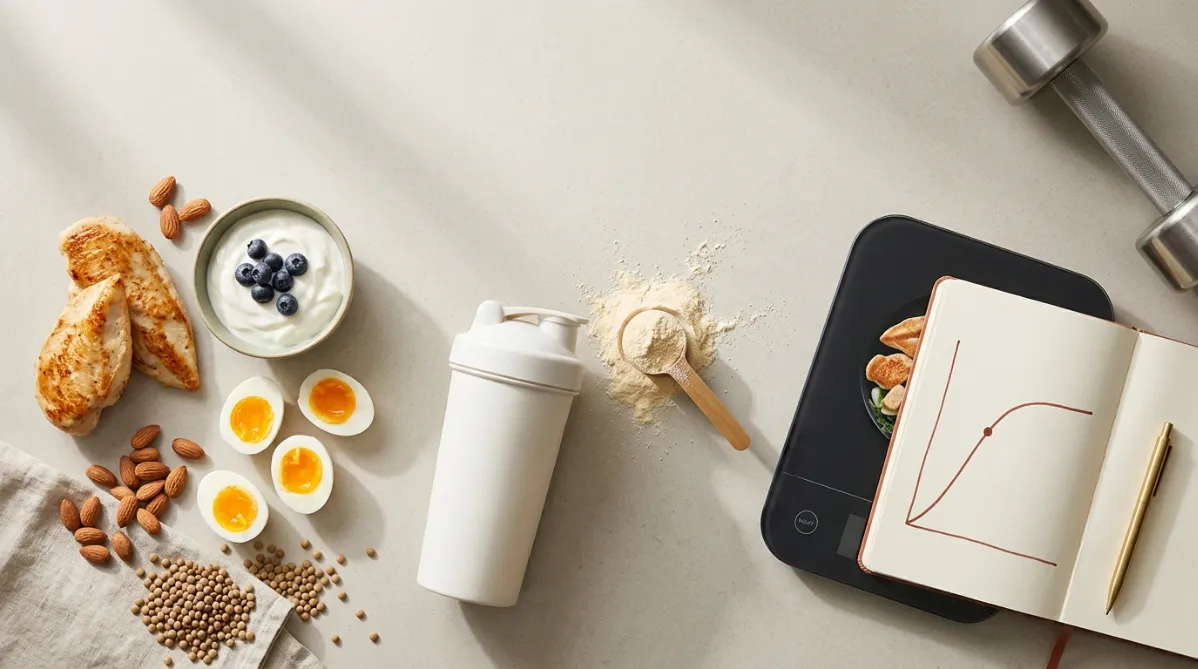
A wide, editorial flat-lay photograph shot from directly above on a pale warm-gray stone countertop, lit by soft natural morning window light with gentle diagonal shadows. On the left, a neatly arranged cluster of whole-food protein sources: two seared chicken breast slices with a golden crust, a small ceramic bowl of creamy Greek yogurt topped with blueberries, three halved soft-boiled eggs with jammy orange yolks, a handful of raw almonds, and a small pile of dried lentils scattered on a linen napkin. At the center, a matte white shaker bottle and a wooden scoop resting in a pile of fine vanilla-colored protein powder, a few grains dusted artfully across the surface. On the right, a minimalist kitchen scale in matte black displaying a portion of food, next to an open notebook with a hand-drawn curve that rises steeply and then flattens into a plateau, drawn in a deep terracotta ink pen, with a small dot marking the bend. A brass pen lies beside the notebook. A single dumbbell with a brushed steel finish sits partially in frame at the upper right corner, grounding the fitness theme without feeling gym-like. Color palette: warm cream, sage green, terracotta, soft charcoal, and butter yellow accents, with generous negative space along the top edge for title overlay. Shallow depth of field, crisp textures, subtle film grain, modern lifestyle magazine aesthetic, clean and calm composition, 16:9 landscape.
Nutrition

Quanta proteina massimizza realmente i muscoli? Il plateau di 1,6 g/kg spiegato

Dr. Gymbro · · 4 min read

La risposta breve: ~1,6 g/kg al giorno

Se ti alleni per aumentare la massa muscolare, una vasta meta‑analisi suggerisce che il tuo obiettivo proteico giornaliero è più basso rispetto ai miti diffusi in palestra. Lo studio, pubblicato sul British Journal of Sports Medicine, ha aggregato 49 trial randomizzati controllati e 1.863 adulti sani. L’analisi del punto di rottura ha individuato il plateau a circa 1,62 g di proteina per kg di peso corporeo al giorno. Oltre questa soglia, ulteriori proteine non hanno prodotto ulteriori guadagni di massa magra indotta dall’allenamento con i pesi (FFM).

Il limite superiore dell’intervallo di confidenza al 95 % si aggira intorno a 2,2 g/kg/giorno. Questo ti fornisce una fascia pratica: 1,6 g/kg è il punto medio in cui, in media, i benefici si appiattiscono, mentre 2,2 g/kg rappresenta un tetto ragionevole se vuoi aggiungere un margine di sicurezza.

Come appare su un piatto

Il calcolo è semplice:

  • 70 kg (154 lb): circa 112 g al giorno a 1,6 g/kg, fino a circa 154 g a 2,2 g/kg
  • 80 kg (176 lb): circa 128 g al giorno, fino a circa 176 g
  • 90 kg (198 lb): circa 144 g al giorno, fino a circa 198 g

Queste cifre rappresentano il totale giornaliero di proteine provenienti da cibo e integratori combinati. Non sono un extra da aggiungere a quello che già mangi. Molte persone con una dieta equilibrata arrivano già quasi a questi valori.

Cosa hanno mostrato i trial

I ricercatori hanno incluso solo studi randomizzati controllati con almeno sei settimane di allenamento di resistenza e che prevedevano anche la supplementazione proteica. Confrontata con l’allenamento solo, la supplementazione ha prodotto i seguenti miglioramenti medi:

  • Forza (1RM): +2,49 kg
  • Massa magra: +0,30 kg
  • Area trasversale delle fibre muscolari: +310 µm²
  • Area trasversale del femore medio: +7,2 mm²

Tutti questi risultati erano statisticamente significativi. I guadagni sono reali ma modesti. La supplementazione proteica è un potenziatore, non un sostituto del sovraccarico progressivo, di un apporto calorico adeguato e della costanza nell’allenamento.

Chi ne trae più beneficio?

Due moderatori sono emersi dall’analisi.

Atleti allenati. La supplementazione è risultata più efficace in individui già allenati, i quali hanno guadagnato ulteriori 0,75 kg di massa magra rispetto a persone meno allenate. Una possibile spiegazione è che gli atleti esperti hanno meno spazio per i tipici “guadagni da principiante”, quindi i dettagli nutrizionali contano di più. Si tratta di un’interpretazione, non di una dimostrazione definitiva.

Età. L’effetto della supplementazione sulla massa magra diminuisce con l’età, di circa 0,01 kg per anno. Gli adulti più anziani non sono esentati, però. L’invecchiamento è associato a una risposta muscolare attenuata alle proteine, e lo studio non suggerisce che gli atleti più vecchi debbano mangiare meno. Semplicemente, nei trial analizzati, l’incremento dovuto alla supplementazione è stato minore con l’avanzare dell’età. Gli atleti più anziani dovrebbero comunque puntare a un apporto proteico totale adeguato e non interpretare il plateau come un limite da non superare.

Whey, frullati e cibo reale

La maggior parte dei trial di supplementazione utilizza prodotti pratici e ricchi di proteine, come le polveri di whey e gli shake pronti da bere. Uno shake è un modo comodo per colmare un gap: una tipica dose fornisce circa 20‑25 g di proteine con poco lavoro di preparazione. Il risultato della revisione riguarda l’apporto proteico totale, non un prodotto “magico”. Se raggiungi circa 1,6 g/kg con pollo, uova, latticini, legumi e tofu, la logica del plateau rimane valida.

Un approccio semplice:

  1. Calcola il tuo obiettivo (peso corporeo in kg × 1,6).
  2. Distribuiscilo su tre‑cinque pasti o snack.
  3. Usa uno shake solo per colmare il divario tra quello che mangi e il tuo target.
  4. Smetti di rincorrere grammi extra una volta che sei nella zona 1,6‑2,2 g/kg.

Avvertenze da tenere a mente

Il valore di 1,6 g/kg è un punto medio di rottura, non un limite biologico rigido. L’intervallo di confidenza copre una gamma ampia, perciò le esigenze individuali variano. L’analisi ha misurato la massa magra, un proxy della muscolatura che include acqua, organi e altri tessuti non grassi.

Gli autori hanno dichiarato un potenziale conflitto di interesse: lo studioso senior Stuart Phillips ha ricevuto finanziamenti e onorari dal US National Dairy Council, che ha supportato alcuni dei trial analizzati. Questo non invalida i risultati, ma è un contesto da considerare per i lettori.

La revisione ha incluso solo adulti sani. Non si applica a persone con malattie renali o altre condizioni mediche, le quali dovrebbero consultare un professionista sanitario per definire i target proteici.

In sintesi

Per la maggior parte delle persone che sollevano pesi per guadagnare muscolo, circa 1,6 g/kg al giorno è il punto di ritorni decrescenti, e 2,2 g/kg è un limite superiore sensato. Consumare molto oltre tale quantità è improbabile che acceleri la crescita muscolare. Concentrati sulla qualità dell’allenamento, sul sonno, sulle calorie totali e sulla costanza, e usa gli shake proteici solo quando ti aiutano a raggiungere più facilmente i tuoi numeri.

Original study

Read the original research on pubmed.ncbi.nlm.nih.gov →

This article summarizes published research for general information. It is not medical advice.

DG

Written by

Dr. Gymbro

Dr. Gymbro writes for Dr. Gymbro: science-backed fitness, nutrition & performance.

Related Articles

A wide, editorial-style flat lay photographed from slightly above on a pale oak gym bench with a soft matte finish. On the left, a small white ceramic cup of black coffee sits on a matching saucer, with a thin curl of steam rising and catching warm window light. Beside it is a second, slightly larger handleless stoneware mug in muted sage green, also filled with coffee, so the pair suggests one to two cups. In the center-right foreground rests a sleek matte-black steel barbell plate, partly overlapping a brushed-steel dumbbell with fine knurling. A folded charcoal gym towel and a clean white chalk-dusted wrist strap lie casually to one side. A small scatter of whole roasted coffee beans spills across the bench in front of the cups, glossy and deep brown. Near the bottom edge, a minimalist analog kitchen scale in soft cream with a thin black needle hints at precise dosing, without any readable numbers or text.

Soft morning sunlight streams in from the upper left, creating long, gentle shadows and a warm golden glow against cool neutral tones. The background is a softly blurred, airy home gym or boutique training studio with out-of-focus squat rack uprights, pale concrete walls, and a leafy green plant in a terracotta pot adding a touch of organic color. The palette is restrained and modern: warm cream, espresso brown, charcoal, sage green, and hints of brushed silver. Shallow depth of field keeps the cups and beans tack sharp while the background melts into creamy bokeh. The composition leaves generous negative space on the right third for a title overlay, with a balanced, calm, premium magazine feel, like a contemporary wellness and sports science journal. High-resolution, natural color grading, subtle film grain, realistic textures on ceramic, steel, and coffee crema.
nutrition

Quanta caffeina prima di allenarsi? Una meta‑analisi mostra che 1‑2 mg/kg sono sufficienti

BY DR. GYMBRO ·

Il consiglio più diffuso è di assumere 3–6 mg/kg di caffeina circa un’ora prima dell’allenamento, corrispondente a diverse tazzine di caffè o a una generosa dose di pre‑workout. Una meta‑analisi del 2022, basata su 12 studi, ha dimostrato che dosi comprese tra 0,9 e 2 mg/kg migliorano comunque la forza muscolare (d≈0,17), la resistenza (d≈0,21) e la velocità media della barra (d≈0,56). Per la maggior parte degli appassionati ciò equivale a una‑o‑due tazze di caffè. Gli effetti sono modesti e derivano da studi acuti a sessione singola, ma i risultati suggeriscono che un beneficio simile possa essere ottenuto con meno caffeina.

A wide, editorial-style still life photographed in soft natural window light on a pale oak gym bench. In the foreground, a small rustic ceramic bowl in warm sand tones holds a mound of fine golden-beige ashwagandha root powder, with a few dried gnarled ashwagandha roots and a sprig of green leaves with tiny orange-red berries resting beside it. A wooden scoop dusted with powder lies at an angle. Just behind, a matte black barbell with a single chalk-dusted steel plate sits slightly out of focus, a light haze of white chalk hanging in the air and catching the sunlight.

On the left side, a neat stack of printed research papers with a sharp black pen and a few muted sage-green sticky tabs. One page shows a simple, abstract forest-plot-style line graph with small squares and horizontal lines, subtly out of focus, hinting at statistics without legible text. A pair of minimal round reading glasses rests on the pages. A small linen gym towel is folded near the edge of the bench.

The palette is restrained and modern: warm cream, soft sage green, muted terracotta, charcoal black, and brushed steel highlights. The background is a softly blurred minimalist studio space with a pale plaster wall and a long soft shadow cast by a window frame, giving a calm, contemplative mood. Shallow depth of field, crisp detail on the powder and roots, gentle film-like grain, and generous negative space on the right third of the frame for a headline overlay. The overall look is a clean, trendy health-and-science journal cover, thoughtful and skeptical rather than promotional, balancing the natural herbal element against the discipline of strength training.
nutrition

Ashwagandha per i sollevatori: potenziamento della forza o miraggio statistico?

BY DR. GYMBRO ·

L'ashwagandha è commercializzata ai sollevatori come potenziatore di forza e massa; una recente meta‑analisi di RCT sull'allenamento con i pesi ha mostrato incrementi del 1RM su panca e squat che, sulla carta, sembrano impressionanti. Tuttavia, solo tre studi, per un totale di 161 partecipanti, sono stati aggregati. I risultati sulla forza hanno perso la significatività con il test HKSJ, più rigoroso, e dipendevano tutti da un singolo studio influente. GRADE ha valutato la qualità delle prove come bassa o molto bassa, e non è emerso alcun effetto affidabile sul grasso corporeo.

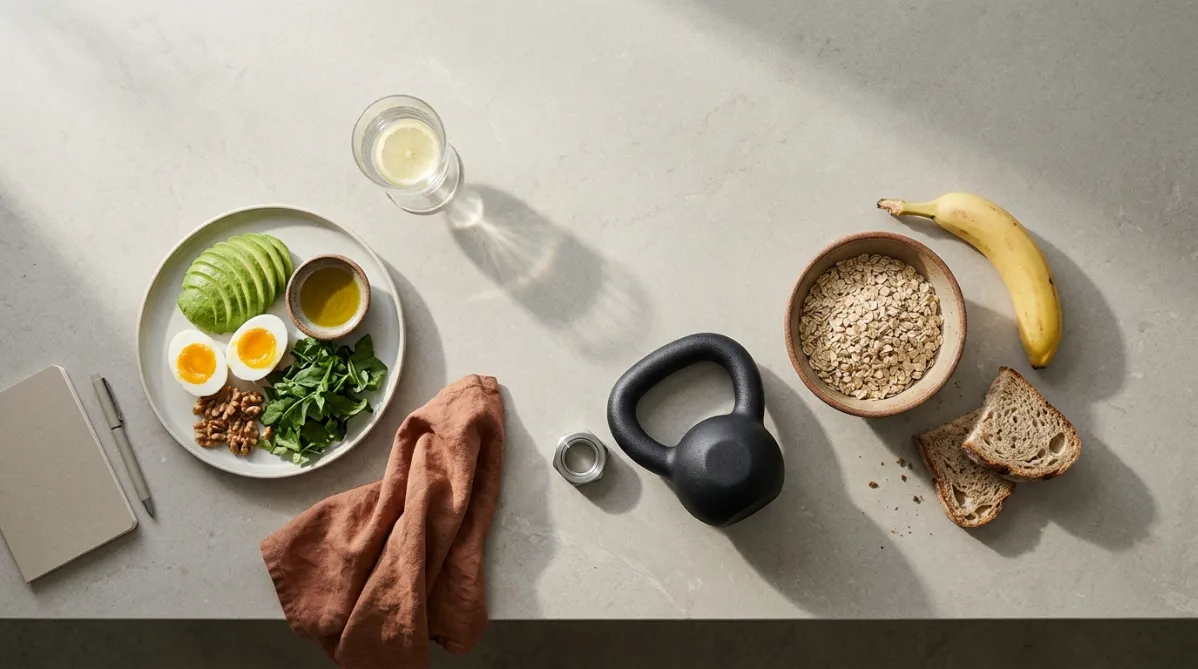
A wide, editorial-style flat lay photographed from above on a pale warm-gray stone countertop, bathed in soft natural window light with gentle long shadows. On the left half, a minimalist keto plate: sliced avocado fanned out in creamy green, two soft-boiled eggs halved to reveal golden yolks, a small pile of dark leafy greens, a few walnuts, and a glossy drizzle of olive oil in a small ceramic dish. On the right half, a contrasting arrangement of carbohydrates: a rustic bowl of oats, a ripe banana, and a few slices of sourdough, arranged with equal visual weight. Between the two sides, a matte black kettlebell sits at the center, and a slim brushed-steel barbell collar rests nearby, suggesting resistance training without a gym setting. A simple, elegant glass of water with a lemon slice catches the light and casts a delicate refracted glow, hinting at water weight and glycogen. A linen napkin and a small, neutral-toned notebook with a pen add a journal-like touch. The palette is muted and modern: sage green, cream, terracotta, charcoal, and soft butter yellow. The composition is clean and balanced with generous negative space across the top and bottom edges, suitable for headline overlay. The mood is calm, thoughtful, and science-informed, like a contemporary health and wellness magazine cover. Shallow depth of field, crisp textures on the food, subtle film-like grain, and high-end, trendy food photography styling.
nutrition

Keto per i sollevatori: il grasso diminuisce, ma la massa magra è inferiore di 1,4 kg

BY DR. GYMBRO ·

Una revisione basata su 50 studi ha dimostrato che le diete chetogeniche riducono il grasso e, in generale, mantengono la forza. Tuttavia, negli adulti allenati alla resistenza la massa magra risulta circa 1,37 kg più bassa rispetto a diete non chetogeniche. Gli autori valutano questa evidenza con bassa certezza e sottolineano che non indica una perdita di muscolo, poiché glicogeno e acqua possono spiegare gran parte del risultato. Le prestazioni ad alta intensità sono state più spesso invariate o compromesse. Scopri a chi può andare bene il keto per il cutting, chi dovrebbe evitarlo e come tutelare la massa magra.

A bright, minimalist editorial still life on a pale oat-colored linen surface, shot from a slightly elevated three-quarter angle in soft natural window light. On the left, a matte ceramic bowl of fine white collagen powder with a wooden scoop resting beside it, a light dusting of powder spilling across the linen. On the right, a matching bowl of creamy off-white whey powder with a brushed-steel scoop. Between them sits a small, neatly balanced stack of simple geometric wooden blocks and a single smooth gray stone, hinting at a scale or comparison without showing a literal scale. Behind them, a lightly blurred row of three clean amber glass supplement jars with plain cream labels, unbranded. A single rolled yoga towel and a pair of small chrome dumbbells sit softly out of focus in the background on a pale plaster shelf. Accents of muted sage green and warm terracotta appear in a ceramic cup and a folded napkin, giving the palette a calm, contemporary wellness-magazine feel. A thin, elegant sprig of dried eucalyptus lies at the edge of the frame. Shadows are long, gentle, and slightly cool, with a creamy shallow depth of field and fine grain. The composition leaves generous negative space across the upper third for title overlay, with a subtle gradient from warm ivory to pale gray-blue in the background wall. The styling is clean and modern like a trendy health journal website, with a refined, tactile, editorial photography look, balanced symmetry, and no text, no people, no futuristic or laboratory elements.
nutrition

Collagene supera il siero nel muscolo in un'analisi di 78 studi?

BY DR. GYMBRO ·

Una meta‑analisi di rete del 2026 su 78 studi randomizzati con 4.755 partecipanti ha classificato il collagene al primo posto per guadagni di forza e massa magra, davanti al siero. Sorprendentemente, nessun altro integratore proteico ha superato il placebo. Il collagene è però una proteina incompleta e povera di leucina, con intervalli di confidenza ampi. Ecco cosa mostrano davvero i numeri, perché il risultato necessita di conferma diretta e cosa fare con il tuo stack di integratori nel frattempo.

This page is available in