Dr. Gymbro
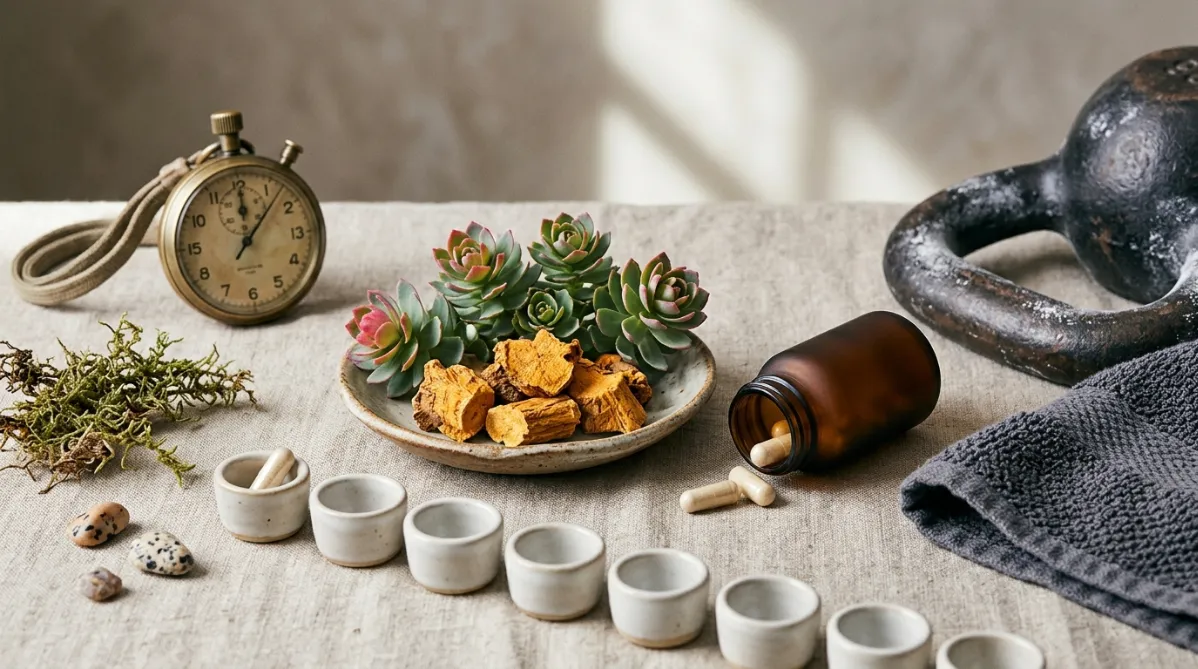
A wide, editorial still life photographed in soft natural window light on a pale oatmeal-colored linen surface. At the center sits a small, rustic ceramic dish holding a handful of dried golden-orange Rhodiola rosea root pieces and a few fresh, fleshy green-gray succulent rosettes with rosy-pink tips. Beside it, a single matte amber glass capsule bottle lies on its side, with two cream-colored capsules spilling out. On the left, a minimalist analog stopwatch with a brushed brass case rests slightly out of focus, its hands suggesting a duration just past the quarter-hour mark. On the right, a worn, chalk-dusted steel kettlebell handle and a folded charcoal gym towel fill the negative space, hinting at lifting without showing a full gym scene.

In the foreground, a neat row of seven tiny ceramic pill cups arranged in a gentle diagonal line, the first cup holding one capsule and the rest sitting empty, as a quiet visual metaphor for a single dose versus daily dosing. A sprig of dried alpine moss and a few small speckled pebbles add organic texture. The background is a softly blurred warm-gray plaster wall with a gentle gradient shadow cast by a window frame, creating diagonal light stripes across the scene.

The palette is muted and earthy: sage green, terracotta, warm cream, brushed brass, and soft charcoal, with one subtle pop of coral from the Rhodiola tips. Shallow depth of field, crisp focus on the root and capsules, and fine film-like grain. The composition leaves generous clean negative space in the upper left for a headline overlay. The overall feel is a modern wellness and science journal: calm, tactile, minimal, and sophisticated, with a slightly moody, high-end magazine look. There is no text, no people, and no futuristic elements.
Nutrition

200 mg Rhodiola gaf sporters 24 extra seconden. Vier weken dagelijks innemen leverde niets op

Dr. Gymbro · · 4 min read

De Rhodiola‑wending die niemand op het etiket zet

Rhodiola rosea wordt vaak gepresenteerd als een adaptogeen dat vermeend vermoeidheid bestrijdt, de focus scherpt en het uithoudingsvermogen vergroot. De meeste claims gaan ervan uit dat de voordelen toenemen naarmate je het supplement langer gebruikt. Eén gerandomiseerde, dubbelblinde studie, gepubliceerd in het International Journal of Sport Nutrition and Exercise Metabolism, liet echter iets anders zien: een enkele dosis van 200 mg leverde een bescheiden verbetering in de uithoudingsprestaties, maar vier weken dagelijks gebruik bracht geen extra winst.

Wat de onderzoekers precies gaven

Het onderzoeksteam, onder leiding van Katrien De Bock en Peter Hespel, testte een gestandaardiseerd extract van 200 mg Rhodiola rosea met 3 % rosavine en 1 % salidroside, gemengd met 500 mg zetmeel. Het placebomeiddel bestond uit 700 mg zuiver zetmeel. De deelnemers slikten hun capsule een uur vóór de test.

Fase I was een placebogecontroleerde cross‑overstudie met 24 jonge, gezonde vrijwilligers. Elke deelnemer onderging twee sessies – één met rhodiola, één met placebo – gescheiden door een wash‑out van vijf dagen en een omgekeerde volgorde. Iedere sessie bestond uit twee dagen:

  • Dag 1: snelheid van ledembeweging (plaatkloppen), auditieve en visuele reactietijd, en aanhoudende aandacht (de Fepsy Vigilance‑test).
  • Dag 2: maximale isometrische knie‑extensie‑kracht en een test voor uithoudingsvermogen.

Fase I: De cijfers

In vergelijking met placebo verhoogde de enkele dosis de uitputtingstijd van 16,8 ± 0,7 naar 17,2 ± 0,8 minuten (p < 0,05). Dat is een verschil van ongeveer 0,4 minuut, oftewel ruwweg 24 seconden – een winst van circa 2,4 %.

De gasuitwisselingsgegevens bewogen in dezelfde richting:

  • VO₂‑peak: 50,9 → 52,9 ml·min⁻¹·kg⁻¹ (p < 0,05)
  • VCO₂‑peak: 60,0 → 63,5 ml·min⁻¹·kg⁻¹ (p < 0,05)
  • Pulmonale ventilatie: 115,9 → 124,8 L/min, een trend die net niet significant werd (p = 0,07)

Kortom, de deelnemers hielden iets langer vol en bereikten een iets hogere maximale zuurstofopname. De publicatie verduidelijkt het onderliggende mechanisme niet, dus elke verklaring over waarom blijft speculatief.

Alle andere variabelen bleven gelijk. Isometrische knie‑extensie‑kracht, snelheid van ledembeweging, reactietijden en aanhoudende aandacht vertoonden geen verandering. Als je hoopte dat rhodiola je reflexen scherper zou maken of je sterker zou maken, ondersteunt deze studie dat niet.

Fase II: De wending

In fase II doorliepen 12 vrijwilligers dezelfde testreeksen, maar nu na vier weken dagelijks innemen van 200 mg rhodiola of placebo. De vraag was of chronisch gebruik extra voordelen zou opleveren of de acute respons zou beïnvloeden.

Dat was niet het geval. De auteurs meldden dat vier weken rhodiola geen enkele gemeten variabele veranderde, en dat de acute respons niet werd beïnvloed door de voorgaande maand dagelijks gebruik. Chronisch gebruik leverde geen extra boost op in uithoudingsvermogen, kracht, reactietijd of aandacht.

De conclusie is beperkt maar duidelijk: een acute dosis rhodiola kan de uithoudingscapaciteit verbeteren bij jonge, gezonde vrijwilligers, maar een vier‑weekse dagelijkse inname levert geen meetbare extra winst op.

Praktische conclusies

Voor wie is een acute dosis interessant?

Recreatieve duursporters die graag experimenteren, kunnen een gestandaardiseerde dosis van 200 mg ongeveer een uur voor een zware training of tijdrit proberen. Dit is het protocol dat het effect opleverde, dus dit is het protocol om te volgen. Controleer daarbij het etiket op hetzelfde extractprofiel (≈ 3 % rosavine en 1 % salidroside), want rhodiola‑producten variëren sterk.

Wat je niet mag verwachten:

  • Een enorme sprong. Een winst van 0,4 minuut op een test van ongeveer 17 minuten is bescheiden. Voor een atleet die jacht op marginale winst kan het relevant zijn, maar het zal je training niet fundamenteel veranderen.
  • Cumulatieve voordelen. Volgens dit onderzoek levert dagelijks innemen gedurende een maand geen extra verbetering in uithoudingsvermogen boven het acute effect.
  • Kracht‑ of cognitieve winst. Kracht, reactietijd en aandacht bleven onveranderd.

Als je rhodiola dagelijks neemt in de hoop een “opgeruimd” prestatievoordeel te behalen, biedt deze studie geen bevestiging. Gebruik je het al, dan sluit een ‘bij‑behoefte‑’ aanpak beter aan bij het beschikbare bewijs en bespaar je bovendien geld.

Beperkingen die je moet kennen

Dit is een waardevolle studie, maar geen definitief oordeel.

  • Kleine steekproeven. Fase I had 24 deelnemers en fase II slechts 12, waardoor fase II mogelijk onvoldoende power had om kleine chronische effecten te detecteren. Een nul‑resultaat in een kleine groep bewijst niet dat er geen effect is.
  • Bescheiden effectgrootte. De winst was statistisch significant maar praktisch klein, en geen enkele bevinding toont aan dat dit zich vertaalt naar race‑resultaten.
  • Alleen jonge, gezonde vrijwilligers. De resultaten zijn mogelijk niet toepasbaar op oudere volwassenen, topsporters, of mensen die slaapgebrek, stress of ziekte ervaren – precies de groepen waarin rhodiola vaak wordt gepresenteerd.
  • Één dosis, één extract. Alleen 200 mg van één gestandaardiseerd extract werd getest, dus we kunnen niet concluderen of andere doseringen of producten hetzelfde gedrag vertonen.
  • Enkele studie. Eén onderzoek uit 2004 moet nog gerepliceerd worden voordat men het als definitief beschouwt.

Conclusie

Het rhodiola‑verhaal is minder glanzend dan de marketing doet vermoeden. Een enkele dosis van 200 mg, een uur vóór de training, verbetert bescheiden de uitputtingstijd en de maximale zuurstofopname bij jonge, gezonde vrijwilligers. Vier weken dagelijks innemen levert daar geen extra winst op. Beschouw rhodiola als een optioneel, klein‑voorsprong‑hulpmiddel, acuut toegepast, in plaats van een supplement dat je een maand moet “laden”.
Original study

Read the original research on pubmed.ncbi.nlm.nih.gov →

This article summarizes published research for general information. It is not medical advice.

DG

Written by

Dr. Gymbro

Dr. Gymbro writes for Dr. Gymbro: science-backed fitness, nutrition & performance.

Related Articles

A landscape editorial photograph of a lone runner's hands resting on a weathered wooden table beside a small white ceramic dish of fine white powder and a clear glass of water, shot in soft morning light. A slim matte aluminum energy drink can, unbranded with a minimalist pale sage-green label, stands slightly out of focus in the background, with a single scoop of powder dusted lightly on the tabletop. A pair of worn running shoes and a folded gray towel sit at the edge of the frame. Through a large window behind them, a blurred misty trail winds through green trees at sunrise, with warm golden light spilling across the scene.

The color palette is calm and modern: creamy off-white, sage green, warm honey gold, and soft charcoal. The composition follows the rule of thirds, with the dish and glass in the lower left third and generous negative space on the right for a title overlay. The depth of field is shallow, with a crisp focus on the powder's delicate texture and tiny glints of light on the glass rim. The mood is clean, thoughtful, and quietly energetic, like a contemporary health and science magazine feature. Natural grain, subtle film-like softness, and gentle shadows give it an authentic lifestyle-editorial look. There are no text, logos, or futuristic elements, only tactile, real-world materials like wood, ceramic, glass, cotton, and metal.
nutrition

Het energiedrank‑ingrediënt dat de uithouding alleen verbetert

BY DR. GYMBRO ·

Iedereen praat over cafeïne, maar het tweede bestanddeel van energiedrankjes kan stilletjes zijn eigen werk doen. Een meta‑analyse uit 2018 van tien onderzoeken liet zien dat geïsoleerde taurine de uithoudingsprestaties verbetert (Hedges’ g = 0,40) en dat één enkele dosis al voldoende lijkt. Noch de hoeveelheid (1‑6 g) noch de duur van inname beïnvloedde het effect merkbaar. Het bewijs blijft beperkt en de betrouwbaarheidsintervallen breed – een veelbelovende aanwijzing, geen garantie. Hieronder vind je wat de studie aantoonde en hoe je taurine verstandig kunt uitproberen.

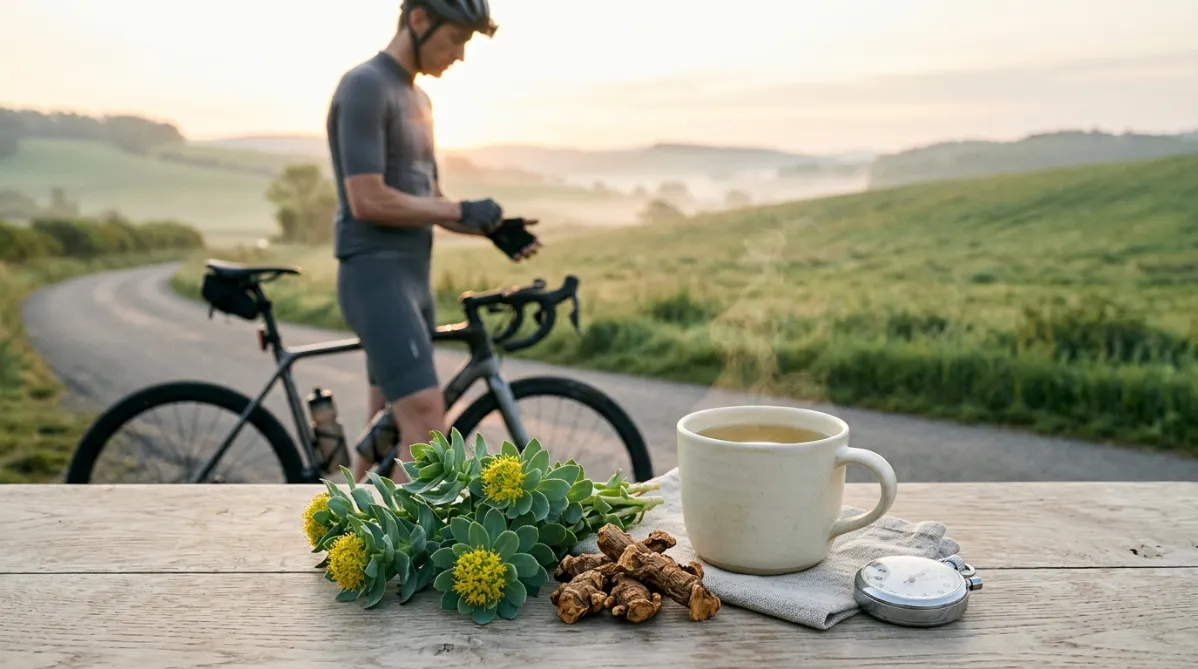
A landscape editorial photograph in soft natural morning light. In the foreground on a rustic light oak table, a small cluster of fresh Rhodiola rosea plants with thick succulent blue-green leaves and tiny golden-yellow flower clusters rests beside a few dried, knobby amber-brown rhizome pieces. A matte ceramic cup of pale golden herbal tea sits beside them, with a thin curl of steam and a small linen cloth. The plants and roots are sharp, with fine texture and dewy highlights.

In the softly blurred background, a lean cyclist in a fitted charcoal jersey stands beside a road bike on a quiet country lane at sunrise. Rolling green hills fade into pale mist behind them, and warm light rims the rider's shoulders. The cyclist tightens a glove, calm and focused, in a pre-ride moment of preparation. A water bottle is mounted on the bike frame, and a simple analog stopwatch with a brushed metal casing lies on the table near the herbs, hinting at timed effort.

The palette is muted and modern: sage green, warm cream, soft gold, and slate gray, with gentle peach tones from the sunrise. Shallow depth of field, a clean, airy composition with generous negative space on the right third for headline text, and subtle film grain. The mood is calm, health-conscious, and quietly athletic, like a premium wellness and sports science magazine cover. No text, no logos, no futuristic elements.
science research

Rhodiola Rosea: Een cafeïnevrij pre‑workout voor harde cardio?

BY DR. GYMBRO ·

Een crossover‑studie uit 2013 liet zien dat een enkele dosis van 3 mg/kg Rhodiola rosea, ingenomen een uur voor een 6‑mijl fietstijdrit, de eindtijd verkortte van 25,8 naar 25,4 minuten. De hartslag tijdens de warming‑up daalde van 140 naar 136 bpm en de subjectieve inspanning ging van 6,6 naar 6,0. De winst is bescheiden – ongeveer 1,5 % – en gebaseerd op slechts 18 deelnemers, dus geen wondermiddel. Toch is het effect op de waargenomen inspanning een intrigerend, cafeïnevrij alternatief voor duursporters. Hieronder vind je wat de data laten zien en hoe je het op een verstandige manier kunt uitproberen.

A wide, editorial-style flat lay photographed from above on a pale warm-gray linen surface in soft natural window light. At the center, a small open amber glass jar tips gently onto its side, spilling a few cream-colored capsules across the fabric. Next to the jar sits a loose arrangement of fresh mushrooms: a cluster of golden-tan reishi with glossy, lacquered caps, a few slender white enoki stems, a halved shiitake showing its pale gills, and a curl of turkey tail with concentric bands of rust, cream, and charcoal. A small wooden scoop holds a pile of fine beige mushroom powder.

On the left third of the frame, a matte black sports watch with a minimal face lies beside a folded sage-green running shirt and a pair of lightweight off-white running shoes, hinting at athletic training without showing a person. A slim white notebook with a single pencil rests nearby, open to a blank page with a faint hand-drawn line graph trending upward, in thin graphite strokes.

On the right side, a pair of clear glass beakers and a single small petri dish with a soft amber-tinted liquid add a subtle laboratory note, kept calm and organic. A single sprig of dried herbs and a few scattered oat-colored grains add texture.

The palette is earthy and refined: oatmeal, soft sage, terracotta, warm amber, and charcoal accents against the muted neutral background. Shadows are soft and diffused, with a gentle highlight on the glass and the glossy reishi cap. The composition leaves generous negative space in the upper right for a headline overlay. Shallow depth of field blurs the edges slightly, while the central mushrooms and capsules stay crisp. The overall feel is modern, clean, and trendy, like a wellness and science magazine cover, with tactile natural textures, minimal styling, and a quiet sense of curiosity and skepticism.
science research

Een paddencapsule verhoogde VO₂max met 14,8 % — maar er zit een grote valstrik

BY DR. GYMBRO ·

Een paddencapsule, 40 dagen gebruik en een stijging van 14,8 % in VO₂max klinkt bijna te mooi om waar te zijn. In een recent *Antioxidants*-artikel namen 50 jonge mannelijke sporters 320 mg per dag van een beta‑glucaan‑rijk multi‑paddencapextract en zagen hun VO₂max van 46,26 naar 53,12 mL·kg⁻¹·min⁻¹ stijgen. Het grote addertje onder het gras: er was geen placebogroep, geen randomisatie, geen blindering en de atleten bleven gedurende de studie trainen. In‑vitro‑experimenten met rattehartcellen leverden een hypoxiegerelateerde hint, maar er werden alleen losse verbindingen getest, niet de capsule zelf. Hieronder lees je wat de studie aantoonde, wat ze niet kan bewijzen en voor wie de resultaten een tweede gedachte waard zijn.

A landscape editorial photograph with a modern, clean magazine feel, shot on a pale warm-gray concrete surface in soft natural window light from the left. In the foreground, two matte white ceramic espresso cups sit side by side. The left cup holds a small amount of dark espresso with golden crema. The right cup is filled twice as high. Beside them, two small stainless steel scoops hold fine coffee-colored powder, one half full and one heaped, suggesting a dose comparison without any text or labels. A pair of worn red leather boxing gloves rests slightly out of focus behind the cups, laces loosely draped, with a white hand wrap rolled neatly beside them. A minimalist digital kitchen scale in matte black sits at the edge of the frame, with a few roasted coffee beans scattered across the surface. In the soft-focus background, a boxing gym corner appears: a hanging heavy bag in muted charcoal, pale wood plank flooring, and a tall window with diffused morning light. The palette is warm cream, espresso brown, brick red, and soft slate gray, with gentle shadows and a shallow depth of field. The composition follows the rule of thirds, with the cups and scoops in the lower left third and open negative space on the right for headline overlay. The look is tactile and refined, like a high-end health and performance journal. It has natural grain, subtle contrast, and a calm, confident mood. There are no people, no text, no logos, and no futuristic elements.
nutrition

Dubbel zo veel cafeïne hielp boksers nauwelijks — dit werkte wel

BY DR. GYMBRO ·

Denk je dat een dubbele schep pre‑workout je prestaties automatisch verdubbelt? Een nieuwe crossover‑studie met 15 competitieve boksers vergeleek 3 mg/kg met 6 mg/kg cafeïne en toonde aan dat de hogere dosis niet consequent beter was. Beide dosissen verhoogden de spronghoogte en kracht na 60 minuten, maar 6 mg/kg leverde alleen bij enkele uitkomsten – zoals de ballistic push‑up en knie‑torque – een extra voorsprong. Hieronder vind je een mg‑per‑kg‑omrekening voor veelvoorkomende lichaamsgewichten, de door de data ondersteunde timing, en enkele kanttekeningen, onder meer dat er geen effect op daadwerkelijke stoten is getest.

This page is available in