Dr. Gymbro
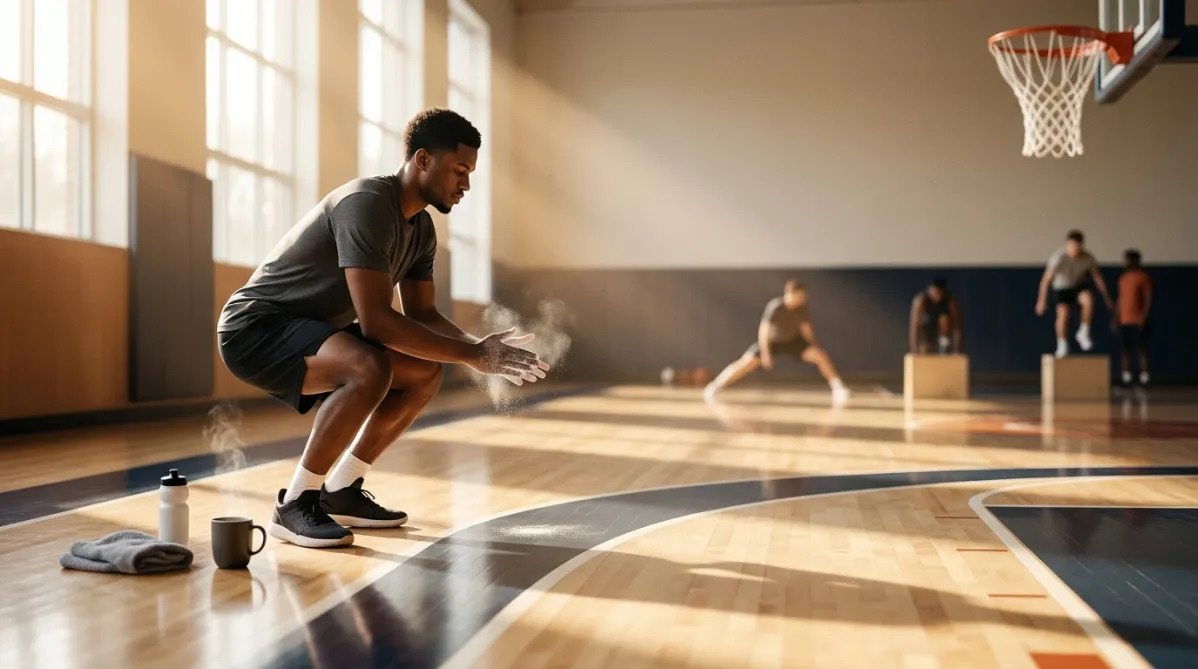
A wide, editorial-style photograph of an indoor basketball court at early morning, shot from a low angle near the baseline. In the foreground, a male collegiate basketball player in a charcoal athletic tee and black shorts is captured mid-crouch, just before a plyometric jump, with chalk dust lifting off his hands and fingers. His expression is focused and calm. Beside him on the polished maple floor sits a matte ceramic cup of black coffee with a thin curl of steam, next to a small white water bottle and a folded gray towel, placed slightly out of focus as a quiet visual hint at the caffeine theme.

Soft golden sunlight pours through tall high windows on the left, casting long, warm diagonal beams across the hardwood and creating subtle reflections on the glossy surface. The painted court lines in deep navy and cream curve gracefully through the frame, leading the eye toward the background, where a few teammates blur softly, stretching and doing box jumps over low plyometric boxes. A basketball hoop with a clean white net is visible in the upper right, gently out of focus.

The color palette is warm and refined: honey-toned wood, espresso brown, cream, muted navy, and touches of terracotta orange. Use shallow depth of field with a creamy bokeh, fine film-like grain, and gentle contrast, giving the image the feel of a modern lifestyle and science journal cover, like a contemporary wellness or sports magazine. Composition follows the rule of thirds, with the athlete on the left third and generous negative space on the right, filled with soft light and blurred court, which is ideal for overlaid headline text. No text, logos, or graphics appear in the image. The mood is energized, intentional, and quietly scientific, evoking preparation, rhythm, and peak performance, with natural realism and no futuristic elements.
Science & Research

Cafeïne + deze opwarmtruc verhoogt Wingate‑vermogen bij basketbalspelers

Dr. Gymbro · · 4 min read

De meeste sporters zien cafeïne en opwarming als twee losse vakjes die afgevinkt moeten worden. Een nieuwe crossover‑studie suggereert dat je daardoor mogelijk vermogen op tafel laat liggen. Onderzoekers in China onderzochten wat er gebeurt als je 5 mg/kg cafeïne toevoegt aan een post‑activation potentiation enhancement (PAPE)‑opwarming, en de resultaten overtroffen zowel een standaardopwarming als PAPE alleen.

Het nadeel? Het betrof een kleine studie in een zeer specifieke populatie. Hieronder vind je wat er werd ontdekt, wat het betekent en hoe je het veilig kunt toepassen.

De korte versie: wat de studie vond

Gepubliceerd in het Journal of the International Society of Sports Nutrition (2026), rekruteerde de studie 24 mannelijke universiteitsbasketballers (gemiddelde leeftijd ≈ 20 jaar). Er werd een gerandomiseerd crossover‑design gebruikt, zodat elke deelnemer alle drie de condities doorliep:

  • CON: standaardopwarming
  • PAPE+PLA: PAPE‑opwarming + placebo
  • PAPE+CAF: PAPE‑opwarming + 5 mg/kg cafeïne

De prestatie werd gemeten met de Wingate‑anaerobe test, een 30‑seconden all‑out fietssprint. Onderzoekers registreerden piekvermogen, gemiddeld vermogen, totale arbeid, vermoeidheidsindex en de rating of perceived exertion (RPE).

PAPE met placebo overtrof de standaardopwarming aanzienlijk voor piekvermogen, gemiddeld vermogen en totale arbeid (alle p < 0,001). Het toevoegen van cafeïne verhoogde deze waarden nogmaals ten opzichte van PAPE + placebo (p < 0,001). De auteurs spraken van een duidelijk synergistisch effect.

Wat is PAPE en waarom is het belangrijk?

PAPE (post‑activation potentiation enhancement) is het idee dat een korte, intensieve spierinspanning de prestaties van de daaropvolgende inspanning tijdelijk kan verbeteren. Het verschilt van klassieke post‑activation potentiation, die vooral twitch‑niveau veranderingen betreft. PAPE is wat sporters ervaren als “geprimed”, springerig en klaar voor actie.

In deze studie bestond de activatieset uit een complexe plyometrische reeks: squat‑jumps, split‑jumps en een sprint van 20 m. Het is geen exotisch laboratoriumprotocol; elke basketbal‑ of veldsportatleet kan iets dergelijks uitvoeren in de gym of op de baan zonder speciale apparatuur.

De conclusie is dat een goed ontworpen, explosieve opwarming meer doet dan alleen de lichaamstemperatuur verhogen; hij verbetert meetbaar de anaerobe output ten opzichte van een standaardopwarming.

De cafeïne‑laag

Cafeïne behoort tot de best onderzochte prestatie‑hulpmiddelen, en de gebruikte dosering van 5 mg/kg ligt in het matige‑tot‑hoge bereik van gangbare onderzoeksprotocollen. Voor een atleet van 80 kg betekent dit 400 mg, ongeveer vier kleine kopjes gezette koffie of een paar sterke pre‑workout‑porties.

Het interessante is dat cafeïne niet alleen een klein extraatje leverde. Het verhoogde piekvermogen, gemiddeld vermogen en totale arbeid boven wat de PAPE‑opwarming al opleverde. Bovendien verminderde het de RPE (p < 0,001), wat betekent dat dezelfde maximale inspanning gemakkelijker aanvoelde.

Één factor bleef onveranderd: de vermoeidheidsindex veranderde niet significant bij beide interventies (p = 0,06). De atleten produceerden dus meer vermogen, maar de snelheid waarmee de output binnen de 30 seconden afnam, verbeterde niet duidelijk.

Hoe pas je het toe: dosering, timing en protocol

De abstract bevestigt de dosering (5 mg/kg) en de opwarmstructuur. De exacte timing werd niet vermeld in de beschikbare tekst, dus raadpleeg de volledige paper voordat je het protocol letterlijk overneemt. In de meeste cafeïne‑studies wordt de inname 45 tot 60 minuten vóór de inspanning aanbevolen; beschouw dit echter als een algemene richtlijn, niet als een bevinding uit deze trial.

Een praktische manier om het idee toe te passen:

  1. Test cafeïne eerst in de training. Gebruik nooit 5 mg/kg op wedstrijddag zonder voorafgaand experiment.
  2. Bereken je dosis op basis van lichaamsgewicht. Begin lager, rond de 3 mg/kg, als je gevoelig bent.
  3. Voeg een korte explosieve blok toe aan je normale opwarming: squat‑jumps, split‑jumps en een sprint van 20 m.
  4. Voorzie voldoende herstel tussen de activatieset en de hoofd‑inspanning. De abstract geeft de rustperiode niet, dus experimenteer voorzichtig.

Wie zou het moeten proberen (en wie moet het vermijden)

Goede kandidaten:

  • Sporters in explosieve veld‑ of baansporten die al gewend zijn aan cafeïne
  • Gewichtheffers, sprinters of basketbalspelers die een pre‑competitie‑primingsroutine zoeken
  • Atleten die zich vlak voelen tijdens korte, hoge‑intensiteit‑inspanningen

Wie moet het overslaan of voorzichtig zijn:

  • Personen met angst, hartritmestoornissen, hoge bloeddruk of een bekende cafeïnesensitiviteit
  • Iedereen die zwanger is of door een arts is geadviseerd cafeïne te beperken
  • Sporters die laat in de avond presteren en hun slaap willen beschermen
  • Adolescenten, aangezien de studie alleen volwassen (≈ 20 jaar) mannen betrof

Beperkingen die je moet kennen

  • Kleine steekproef: 24 deelnemers, allemaal mannelijke universiteitsbasketballers. De resultaten zijn mogelijk niet overdraagbaar naar vrouwen, andere sporten of elite‑professionals.
  • Wingate is geen wedstrijd. Het is een fietstest; echt basketbal omvat springen, snijden en technische vaardigheden die hier niet werden gemeten.
  • Vermoeidheidsindex bleef ongewijzigd, dus herhaalde‑sprintuithoudingsvermogen verbetert mogelijk niet.
  • Alleen acute effecten. De studie geeft geen informatie over langetermijnadaptatie.
  • Individuele respons varieert. Cafeïnetolerantie, genetica en gewoonlijk gebruik beïnvloeden de uitkomsten.

Conclusie

Deze trial ondersteunt een simpel idee: een explosieve PAPE‑opwarming verbetert het anaerobe vermogen, en een matige cafeïnedosis kan hieraan toevoegen terwijl de inspanning makkelijker aanvoelt. Het is veelbelovend, praktisch en goedkoop, maar blijft één kleine studie. Beschouw het als een slimme experiment in de training, niet als een gegarandeerde prestatie‑truc.
Original study

Read the original research on pubmed.ncbi.nlm.nih.gov →

This article summarizes published research for general information. It is not medical advice.

DG

Written by

Dr. Gymbro

Dr. Gymbro writes for Dr. Gymbro: science-backed fitness, nutrition & performance.

Related Articles

A wide, editorial-style photograph of a basketball player mid-air at the top of a vertical jump inside a sunlit indoor court, shot from a low angle so the athlete's silhouette rises against tall frosted windows glowing with soft morning light. The player wears a plain charcoal tank and white sneakers, with chalk dust drifting off their hands and catching the light. The polished honey-toned hardwood floor reflects the figure faintly, with crisp painted court lines leading the eye across the frame.

In the foreground at the lower left, slightly out of focus, a small wooden plyometric box sits on the floor beside a matte ceramic cup of black coffee and a plain white paper cup, placed neatly on a folded gray towel. Thin steam curls from the ceramic cup. They stand for the question of caffeine versus warm-up without any text or labels.

The color palette is calm and modern: warm amber wood, soft cream, muted slate blue shadows, and a touch of burnt orange from a basketball resting near the box. Light is natural and diffused, with gentle rim lighting on the athlete's shoulders and a shallow depth of field that blurs the background bleachers into creamy shapes. The composition has generous negative space on the right third, suited to a headline overlay, in a clean, contemporary magazine style with fine film grain, subtle contrast, and a quiet, focused mood. No text, no logos, no futuristic elements.
science research

Cafeïne vóór sprongen brengt niets extra's. De opwarming doet het werk

BY DR. GYMBRO ·

Cafeïne gecombineerd met een drop‑jump‑opwarming klinkt als een recept voor hogere sprongen, maar een nieuwe studie bij elitebasketballers toonde dat de koffie niets extra’s bijdroeg. De geïndividualiseerde drop‑jump‑routine leverde op zichzelf een duidelijk, kortstondig sprongverbetering op. Cafeïne van 3 mg/kg veranderde de piekhoogte, timing of de totale PAPE niet ten opzichte van placebo. Individuele reacties varieerden sterk, waardoor sommige sporters nog steeds anders kunnen reageren. Hieronder lees je wat de studie wel en niet aantoont en hoe je je eigen sprongprimer opstelt.

A wide, editorial-style still life photographed on a pale, matte stone countertop in soft morning window light. On the left, a small ceramic cup of black coffee sits beside a scattering of whole roasted coffee beans, with a thin wisp of steam rising. At the center, a shallow wooden bowl holds dried Rhodiola rosea root pieces, rust-orange and tan, with a few fresh succulent-like Rhodiola rosette stems with blue-green leaves and yellow-gold flowers laid across the surface. On the right, a minimalist matte white scoop and two small glass vials of fine powder, one dark brown and one soft amber, are lined up neatly like a measured dose. Behind them, softly out of focus, a blurred athletic setting suggests a training space: a muted sage-green wall, a folded gray towel, and a worn soccer ball resting on a low bench. A stopwatch with a clean white face lies in the foreground, slightly angled, hinting at timing and performance. The palette is warm and earthy: cream, terracotta, deep espresso brown, moss green, and a touch of marigold yellow. Shadows are long and gentle, with a shallow depth of field and fine natural texture in the stone, wood, and plant material. The composition is balanced and uncluttered, with generous negative space on the upper left for headline text. The overall look is modern, calm, and trendy, like a contemporary wellness and science journal cover, with crisp detail, subtle film grain, and a natural, tactile feel.
supplements

Rhodiola + Cafeïne: De combinatie die placebo verslaat in Wingate‑vermogen

BY DR. GYMBRO ·

Cafeïne is de onbetwiste koning van pre‑workouts, maar een nieuwe crossover‑studie suggereert dat een combinatie met Rhodiola rosea extra voordelen kan bieden. Bij getrainde voetballers was de mix (3 mg/kg van elk, 60 min voor de test) de enige conditie die placebo overtrof in maximale Wingate‑vermogen. Cortisol, α‑amylase en IgA in speeksel vertoonden elk een eigen patroon. Met slechts 10 deelnemers en één enkele acute dosis is dit echter een aanwijzing, geen definitief oordeel. Hieronder lees je wat de studie werkelijk liet zien, voor wie hij relevant is en wat je er niet uit moet opmaken.

A landscape editorial photograph in a bright, modern gym studio with soft natural light pouring through tall windows. In the foreground, a matte ceramic cup and a small glass jar of plain white powder sit on a light oak bench, with a wooden scoop resting beside them and a few loose grains dusted across the wood. The jar has no label, which hints at mystery without being heavy-handed. Slightly out of focus behind them, a female athlete in a sage green athletic set stands at a barbell, chalked hands gripping the bar, her expression calm and focused. A male cyclist on a stationary bike is blurred in the far background. The palette is warm neutrals: cream, soft sand, pale oak, muted sage, and a touch of terracotta, with gentle golden-hour highlights and soft shadows. The composition follows the rule of thirds, with the cup and jar in the lower left, the athlete on the right, and open negative space in the upper area for headline text. The depth of field is shallow, with a creamy bokeh background. The mood is contemplative, curious, and trendy, like a contemporary health and science magazine cover. Fine film grain, subtle matte finish, clean minimalist styling, and no text or logos.
science research

Valse cafeïne maakte atleten nog harder en sneller

BY DR. GYMBRO ·

Wat als een deel van je pre‑workout boost eigenlijk uit je hoofd komt en niet uit de schep? Een meta‑analyse uit 2026 van 17 onderzoeken toont aan dat een placebo waarvan atleten dachten dat het cafeïne was, toch de sportprestaties verbetert (d = 0.49) bij bankdrukken, fietstijdritten en herhaalde sprints. De effecten waren groter in studies waarin de onderzoekers geblinderd waren en waarin relatief meer vrouwen deelnamen, hoewel het bewijs een lage zekerheid heeft en een hoog risico op bias vertoont. Dit is geen reden om echte cafeïne (3‑6 mg/kg) over te slaan, maar wel een herinnering dat verwachting een prestatievariabele is.

A wide, editorial-style photograph of a single slim silver and blue energy drink can standing upright at center on a polished light-oak gym bench, shot in soft natural window light. The can is unbranded, with a clean, minimal design and a few beads of condensation. Behind it, the softly blurred interior of a bright modern indoor volleyball court stretches into the background, with a pale hardwood floor, a net, and a few volleyballs resting in a mesh cart. Warm morning sunlight enters through tall windows on the left and casts long, gentle shadows across the bench. Beside the can sit a small white towel folded neatly, a simple stopwatch, and a pair of white wireless earbuds. On the right, a small paper cup of white powder and a wooden scoop hint at measured dosing. They are placed deliberately, like a styled still life.

At the very edge of the frame, a pair of delicate white paper wings, origami-like and slightly crumpled, lie flat and unused on the bench, a subtle visual joke about the "wings" slogan. The wings are understated and tactile, not magical or glowing.

The color palette is muted and fresh: warm honey wood, soft cream, pale sky blue, and touches of silver, with a single accent of coral red from a volleyball panel in the background. The depth of field is shallow, with crisp focus on the can and the paper wings and a creamy bokeh background. The composition follows the rule of thirds, with the can slightly left of center and generous negative space on the right for a headline overlay. The mood is calm, clean, and contemporary, like a lifestyle and science magazine cover, with fine film grain and natural contrast. The camera angle is slightly low, at bench level, with a 50mm lens look.
nutrition

Geeft Red Bull je vleugels? 13 sporttesten vonden niets

BY DR. GYMBRO ·

Red Bull’s slogan belooft vleugels, maar een nieuwe crossover‑studie bij vrouwelijke volleybalsters vond geen effect. Eén standaardblik leverde geen verbetering op in dertien tests voor Wingate, sprong en handgreep, vergeleken met een placeboboost. Acht van de 15 sporters meldden milde misselijkheid. De cafeïnedosis bedroeg slechts circa 1,1 mg per kilogram lichaamsgewicht, veel lager dan de 3‑6 mg/kg die doorgaans als effectief wordt beschouwd.

This page is available in