Dr. Gymbro
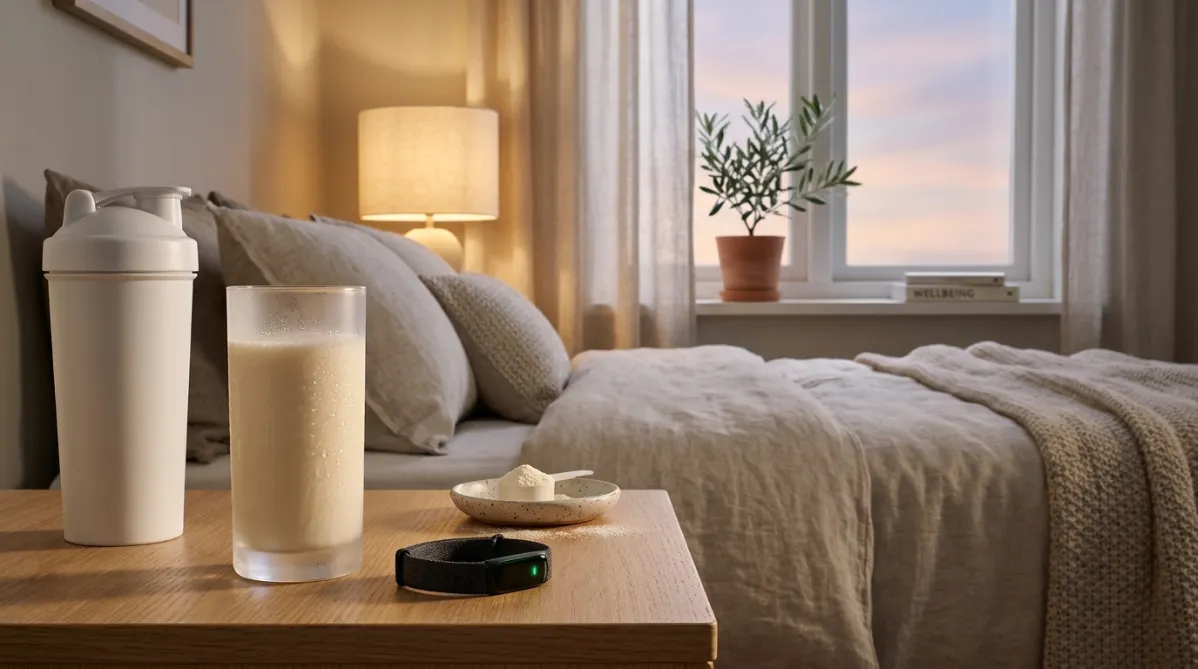
A softly lit bedside table in a calm, modern bedroom at dusk, photographed in wide landscape format with shallow depth of field. In the foreground, a matte white shaker bottle sits beside a tall frosted glass of creamy, pale vanilla-colored protein shake, with a few condensation droplets catching warm light. Next to the glass rests a slim fitness band on a dark charcoal fabric strap, its small LED glowing a gentle green, lying casually on a light oak wooden surface. A small scoop of fine white protein powder rests on a ceramic dish nearby, with a light dusting of powder on the wood.

In the soft-focus background, a neatly made bed with oatmeal-colored linen bedding and a textured knit throw blanket. A sheer curtain filters the last peach and lavender light of evening from a large window. A small potted olive branch in a terracotta vase and a closed paperback book add a quiet editorial touch. A bedside lamp with a warm, cream-colored shade casts a golden glow across the scene and creates gentle highlights on the glass.

The palette is muted and harmonious: warm cream, soft sand, oatmeal beige, faint sage green accents, and touches of dusty lavender in the window light. The mood is peaceful, reassuring, and clean, like a contemporary wellness magazine or a trendy health journal feature. Lighting is natural and cinematic, with soft shadows and a subtle film-like grain. The composition follows the rule of thirds, with the shake and band on the left third and open negative space on the right for headline overlay. Minimalist, Scandinavian-inspired styling, high-end lifestyle photography, crisp details, and a tranquil, premium editorial feel.
Recovery

Caseïne voor het slapengaan maakt je slaap niet kapot: WHOOP‑gegevens tonen

Dr. Gymbro · · 4 min read

Je hebt vast wel het advies gehoord: een zware eiwitshake vlak voor het slapengaan houdt je wakker en helpt je herstel niet. Een nieuwe, gerandomiseerde studie onder elite‑atleetinnen heeft die gedachte op de proef gesteld met behulp van WHOOP‑wearables. Het resultaat is interessanter dan een simpel ja of nee: de shake verwoestte de slaap niet, maar verbeterde die ook niet.

De mythe onder de microscoop

Voeding voor het slapengaan is een populaire hersteltactiek geworden. Langzaam verteerende eiwitten zoals caseïne worden vaak gekozen, omdat ze ’s nachts een gestage afgifte van aminozuren kunnen bieden. De zorg is dat laat‑avondcalorieën de slaap kunnen verstoren, de hartslag kunnen verhogen of het herstel kunnen verminderen.

Onderzoekers van Florida State University, in samenwerking met South Dakota State University, gingen deze zorgen onderzoeken. Hun artikel, gepubliceerd in Journal of the International Society of Sports Nutrition (Paterson et al., 2026), benadrukt dat er weinig gerandomiseerde, dubbelblinde crossover‑studies bestaan die pre‑sleep macronutriënten bij elite‑vrouwen onderzoeken.

Hoe de studie werd uitgevoerd

Vijfentwintig NCAA Division I‑atleetinnen (18–25 jaar) werden gerekruteerd, en 21 voltooiden de proef. Elke atleet doorliep vier condities in een gerandomiseerd, dubbelblind, placebogecontroleerd crossover‑ontwerp:

  • 40 g caseïne (160 kcal)
  • 40 g alpha‑lactalbumine, een wei‑afkomstig melkeiwit (160 kcal)
  • 40 g koolhydraat (160 kcal)
  • 40 g placebo (≈ 5 kcal)

Elke conditie duurde drie opeenvolgende nachten, met minimaal drie dagen wash‑outperiode ertussen. Het volledige protocol liep 4 tot 8 weken. De atleetinnen namen het supplement ongeveer twee uur na hun laatste maaltijd in, circa 30 minuten vóór het slapengaan – hun laatste calorie‑inname van de dag.

Wat werd gemeten

Objectieve data werden verkregen via een WHOOP 4.0‑band: totale slaaptijd, slaaplatentie, slaap‑efficiëntie, rusthartslag en hartslagvariabiliteit (HRV). Elke ochtend vulden de deelnemers ook vragenlijsten in over subjectieve slaapkwaliteit, in slaap vallen en herstelgevoel. In een kleine subgroep van zes atleetinnen werden continue glucosemonitoren (CGM) gebruikt om de nachtelijke glucosespiegel te volgen.

De cijfers: eigenlijk geen verschil

Er werden geen significante behandelingseffecten gevonden voor enige objectieve slaap‑ of herstelparameter (alle p > 0,05). Over de vier condities heen:

  • Totale slaaptijd: 7,47–7,62 uur
  • Slaap‑efficiëntie: 91,5 %–92,0 %
  • Rusthartslag: 53,5–54,1 bpm
  • HRV: 98,2–103,9 ms

De subjectieve data vertelden hetzelfde verhaal. Slaapkwaliteitsscores varieerden van 69 % tot 75 %, de zelfgerapporteerde tijd om in slaap te vallen lag tussen 16 en 20 minuten en de waargenomen herstelscore tussen 61 % en 66 %. Geen van deze verschillen was statistisch significant.

In de glucose‑subanalyse veranderde de nachtelijke glucose over tijd (p = 0,008), zoals verwacht. Er was echter geen verschil tussen de behandelingen (p = 0,187) en geen interactie tussen behandeling en tijd (p = 0,550).

De auteurs concludeerden dat drie nachten caseïne, alpha‑lactalbumine of koolhydraat voor het slapengaan de objectieve of subjectieve slaap‑ en herstelparameters niet verslechterden ten opzichte van placebo.

De plotwending: het hielp de slaap niet

Dit is geen “eiwit voor het slapengaan verbetert slaap”‑verhaal. Geen van de actieve condities overtrof placebo op een enkele slaapmaatregel. Als je caseïne wilt gebruiken voor spierproteïnesynthese, om je dagelijkse eiwitdoelen te halen of gewoon omdat je de smaak prettig vindt, laat deze studie zien dat je je geen zorgen hoeft te maken over je slaap. Als je echter hoopte dat het als slaapmiddel zou fungeren, wordt dat niet ondersteund.

De studie meette bovendien geen spier‑, prestatie‑ of lichaamssamenstellingsuitkomsten. Ze kan dus niet bevestigen of pre‑sleep eiwit het herstel op spierniveau bevordert.

Beperkingen die je moet kennen

  • Korte blootstelling: Elke conditie duurde slechts drie nachten. Langetermijneffecten blijven onbekend.
  • Wearable‑gebaseerde slaapdata: WHOOP is praktisch en gebruiksvriendelijk, maar geen polysomnografie – de laboratorium‑goudstandaard voor slaapstadiëring.
  • Beperkte populatie: Alle deelnemers waren jonge, elite‑vrouwelijke universiteitsatleetinnen die al goed sliepen (≈ 7,5 uur met > 91 % efficiëntie). De resultaten zijn mogelijk niet generaliseerbaar naar slechte slapers, ouderen, mannen of niet‑sporters.
  • Kleine CGM‑subgroep: Slechts zes atleetinnen kregen glucosemonitoring; deze bevindingen zijn daarom voorlopig.
  • Steekproefgrootte: 21 voltooiers is bescheiden om kleine effecten te detecteren.
  • Openbaarmaking: Eén auteur is onbetaald lid van de International Protein Board.

Praktische lessen

Dosering: De studie gebruikte 40 g eiwit of koolhydraat (160 kcal). Dat is de hoeveelheid met wetenschappelijke onderbouwing.

Timing: Atleetinnen namen het ongeveer 30 minuten voor het slapengaan in, ruwweg twee uur na hun laatste maaltijd – hun laatste calorieën van de dag.

Voor wie: Atleten en actieve mensen die pre‑sleep voeding willen gebruiken om aan eiwit‑ of energiebehoeften te voldoen. Bij deze groep jonge, goed slapende vrouwelijke atleetinnen had het geen negatieve invloed op slaap, HRV of rusthartslag.

Wie moet het vermijden of voorzichtig zijn:

  • Personen met een melkeiwitallergie of die zuivel niet tolereren, want beide geteste eiwitten zijn melkeiwitten.
  • Iedereen die merkt dat laat eten hun slaap verstoort. De resultaten gelden voor groepen; individuele reacties kunnen afwijken.
  • Mensen die de extra calorieën of eiwitten niet nodig hebben. De studie vond geen slaapvoordeel, dus er is geen reden om het uitsluitend voor een betere slaap te gebruiken.

Conclusie: De bewering dat een “eiwitshake voor het slapengaan je slaap verpest” houdt geen stand in deze trial. Beschouw een pre‑bedtijdshake als een nutritioneel hulpmiddel, niet als een slaap‑hack, en controleer je eigen WHOOP‑ of slaapdata als je wilt weten hoe jij reageert.
Original study

Read the original research on pubmed.ncbi.nlm.nih.gov →

This article summarizes published research for general information. It is not medical advice.

DG

Written by

Dr. Gymbro

Dr. Gymbro writes for Dr. Gymbro: science-backed fitness, nutrition & performance.

Related Articles

A landscape editorial still life shot from slightly above on a pale oat-colored linen surface, lit by soft morning window light with gentle long shadows. On the left, in warm golden sunlight, sits a small ceramic bowl of dried ashwagandha root pieces and a scatter of fine tan powder. Beside it are a few rough, rosy-gold slices of Rhodiola rosea root and a sprig of tiny succulent-like green leaves with yellow blossoms. A matte sand-colored stoneware mug of steaming tea and a simple glass of water stand nearby. A small amber glass bottle with a minimal unbranded label tips out two capsules.

The right side of the frame is cooler and bluer, as if dusk is arriving. It holds a muted indigo ceramic dish with a few pale capsules, a small bundle of dried chamomile flowers (the source of apigenin), and a few green tea leaves. A slim, unlit beeswax candle and a folded charcoal wool blanket suggest evening. The warm and cool halves meet softly in the center, where a rumpled white cotton napkin sits beneath a small brass spoon.

In the background, out of focus, a wooden shelf holds a worn paperback, a small potted plant, and the edge of a kettlebell in matte black, hinting at an active lifestyle. Subtle film grain, shallow depth of field, and a muted palette of cream, terracotta, sage green, and deep indigo give it a clean, modern wellness-magazine feel. Leave generous negative space in the upper third for a headline overlay. No text, no logos, no people.
recovery

Ashwagandha + Rhodiola werkt; de avond‑slaapstack niet

BY DR. GYMBRO ·

Een nieuwe vierarmige studie geeft een onverwachte wending aan supplement‑liefhebbers. Bij 103 gezonde, actieve volwassenen liet een ochtendcombinatie van 600 mg ashwagandha en 300 mg Rhodiola rosea een lager stressniveau, betere slaapkwaliteit en een opgewekter humeur zien. De populaire avondstack met magnesium‑L‑threonaat, L‑theanine en apigenine leverde geen extra effect op; het combineren van beide stapels was zelfs minder gunstig voor het positieve affect. Hieronder lees je wat de studie aantoonde, welke kanttekeningen er zijn (korte duur, kleine groepen) en hoe sporters hier praktisch mee om kunnen gaan.

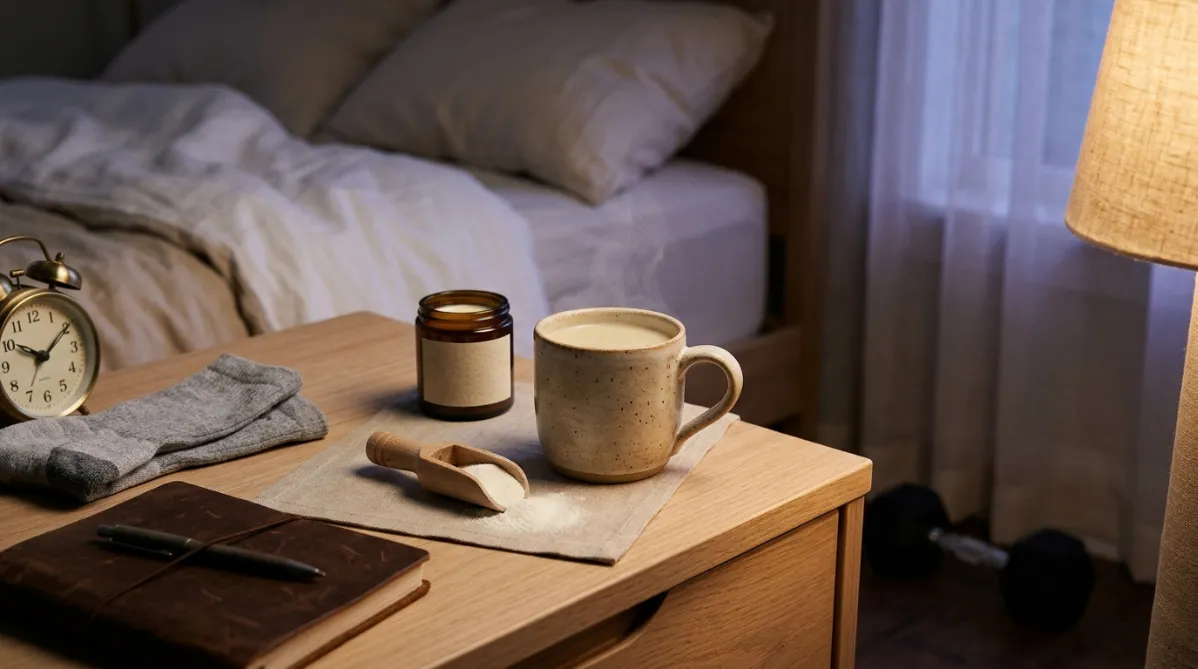
A softly lit bedroom nightstand scene in landscape format, photographed in a modern editorial lifestyle style. In the center of the frame sits a handmade ceramic mug in warm oatmeal tones, filled with a pale creamy drink. A thin wisp of steam rises from it. Beside the mug, a small wooden scoop rests on a matte linen-textured surface with a fine dusting of white collagen powder. A minimal amber glass jar with a cream label stands just behind, with no readable text. The nightstand is pale oak with subtle grain.

To the left, a neatly folded pair of gray cotton athletic socks and a worn leather-bound training journal with a pen on top hint at a lifter's routine. A small brass alarm clock reads about 9:30 and is slightly out of focus. On the right side, a sheer curtain filters the last blue-violet twilight from a window, while a warm bedside lamp with a linen shade casts a honey-colored glow across the scene. The glow contrasts gently with the cool dusk tones.

Behind the nightstand, the edge of a rumpled bed with soft white and sand-colored bedding is visible, with a dumbbell resting quietly on the floor in the soft-focus background to suggest recovery after training. The depth of field is shallow, with the mug and scoop in crisp focus and the background dissolving into creamy bokeh.

The palette is calm and earthy: warm beige, soft cream, muted terracotta, and dusk blue accents. The lighting is cinematic and low-key, with gentle highlights on the ceramic rim and a subtle rim light on the steam. The composition follows the rule of thirds, with the mug placed on the left third and generous negative space on the right for title overlay. The mood is serene, restorative, and quietly scientific without any clinical elements. The finish is clean, high-end, and magazine-worthy, with fine film grain and natural color grading, like a wellness feature in a contemporary online journal.
recovery

De 15 g collageen‑truc voor het slapengaan die nachtelijk ontwaken met 27 % vermindert

BY DR. GYMBRO ·

Herhaaldelijk wakker worden gedurende de nacht kan je herstel stilletjes saboteren, zelfs als training en voeding op orde zijn. Een kleine proef toonde aan dat 15 g collageenpeptiden een uur voor het slapengaan het aantal ontwakingen, gemeten met polysomnografie, van 29,3 naar 21,3 verminderde – ongeveer 27 % minder. De deelnemers scoorden ook beter op een Stroop‑test in de ochtend. Wel bleven totale slaapduur, slaaplatentie en slaapefficiëntie ongewijzigd, en de studie betrof slechts 13 mannen over zeven nachten met een product geleverd door de industrie.

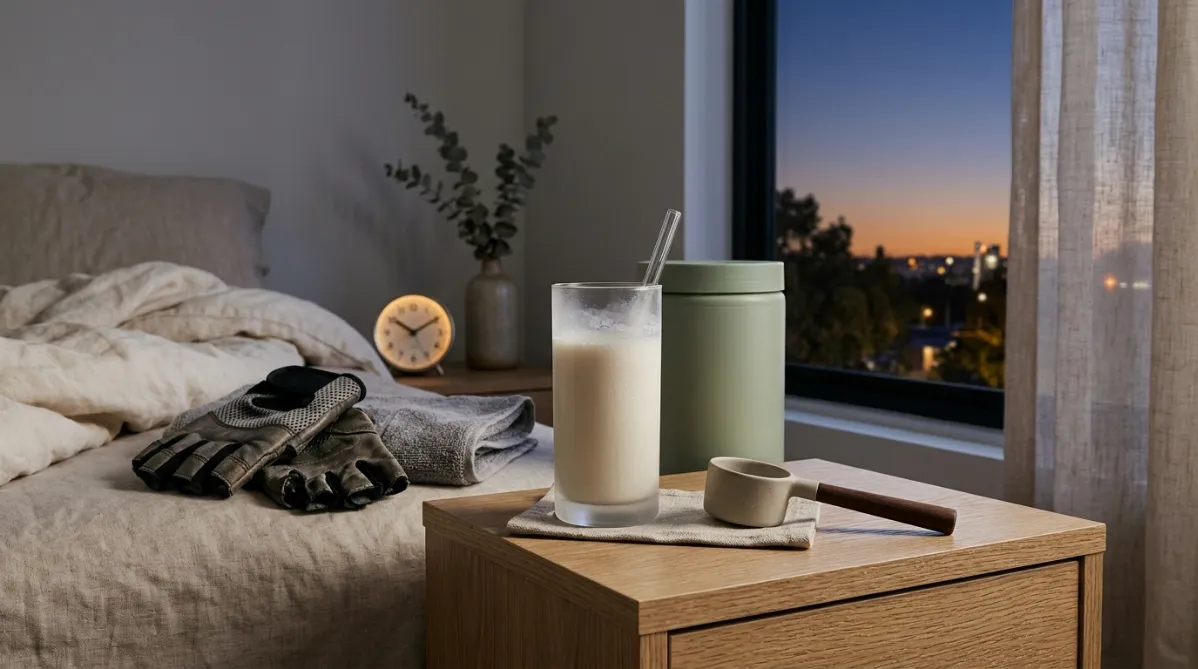
A quiet bedside scene at dusk, shot in soft natural light with a shallow depth of field. A tall frosted glass of creamy, pale-white shake sits on a light oak nightstand, with a thin film of condensation on the glass and a faint milky residue near the rim. Beside it, a matte ceramic scoop rests on a small linen coaster. A minimalist tub of unbranded protein powder in muted sage green sits slightly out of focus in the background.

To the left, a neatly made bed with oatmeal-colored linen sheets and a rumpled cream duvet. A pair of worn lifting gloves and a folded gray gym towel sit on the edge of the bed, suggesting an evening workout just finished. A small analog alarm clock reads about 10:30 PM, its soft face glowing faintly. A sprig of dried eucalyptus in a small stoneware bud vase adds an organic touch.

Through a large window on the right, deep indigo twilight fades into a warm amber horizon, and the last light spills across the wall in long, gentle gradients. A sheer curtain moves slightly. The palette is warm neutrals (cream, oak, sand, soft terracotta) with a few muted blue-violet accents from the evening sky.

The composition uses the rule of thirds, with the glass at the left-center foreground and generous negative space on the right, where headline text could sit. The mood is calm, restorative, and editorial, like a modern wellness and nutrition journal. The lighting is gentle and diffused, with subtle film grain and slightly lifted shadows. The textures of linen, wood, glass, and ceramic are crisp. The image is clean and uncluttered, with no text, logos, or people, and no futuristic or sci-fi elements.
nutrition

De 40 g bedtijdransshake: wat pre‑slaapcaseïne ’s nachts doet

BY DR. GYMBRO ·

Krachttraining in de avond roept de vraag op wat er met het herstel gebeurt tijdens de circa acht uur dat je niets eet. Een studie uit 2012 gaf zestien jonge mannen 40 g caseïne 30 minuten voor het slapengaan en volgde hun nacht. Het eiwit werd tijdens de slaap verteerd en opgenomen; de algehele eiwitsynthese steeg en de netto‑eiwitbalans veranderde van negatief naar positief. De spier‑eiwitsynthese was ongeveer 22 % hoger, hoewel dit slechts grenzend aan statistische significantie lag. Hieronder worden de implicaties, beperkingen en praktische toepassingen besproken.

A sunlit, minimalist home gym corner photographed in soft golden morning light, with a young athletic man seated on a wooden bench, leaning forward with his elbows resting on his knees, catching his breath after a hard leg session. He wears a muted sage-green t-shirt and charcoal shorts, his face turned slightly away from the camera, calm and focused. A matte ceramic dish in the foreground holds a few small, translucent golden softgel capsules, with a glass of water beside it catching the light and casting a soft caustic shadow across a pale oak floor. Behind him, a loaded barbell rests on a squat rack, slightly out of focus, and a tall window pours warm sunlight diagonally across the scene, creating long gentle shadows and a hazy glow. A small potted green plant sits on a shelf at the edge of the frame. The color palette is warm and editorial: cream, soft gold, sage green, pale wood, and charcoal accents. Shallow depth of field, with crisp focus on the capsules and glass in the lower third and a creamy bokeh background. The composition leaves generous negative space on the right side for a headline overlay. The mood is clean, modern, and aspirational, like a high-end wellness magazine or a trendy health journal feature. Shot on a 50mm lens, natural light, fine film grain, subtle matte finish, landscape 16:9 framing.
recovery

Vitamine D versnelt krachtherstel bij mannen met voldoende vitamine‑D‑status

BY DR. GYMBRO ·

Mannen met volledig normale vitamine‑D‑waarden herstelden hun kracht sneller na een zware beentraining toen ze dagelijks 4.000 IU innamen. In deze gerandomiseerde, placebogecontroleerde proef met 28 actieve mannen was de piek‑isometrische kracht na 24 uur gemiddeld 8 % hoger. Markers voor spierschade, ALT en AST, stegen eveneens minder. Spierpijn bleef echter onaangedaan.

This page is available in