Dr. Gymbro
A cinematic, editorial-style photograph of a judoka's hands adjusting a worn white judo gi belt on a tatami mat, shot in soft late-afternoon light streaming through tall dojo windows. In the foreground on the mat sits a small matte white supplement tub with a wooden scoop resting beside it. A single level scoop of fine white powder is spilled in a gentle arc across the straw-colored tatami texture. Beside it is a clear glass of water catching warm golden highlights, with delicate condensation on the surface.

In the softly blurred background, a second athlete in a crisp white gi sits cross-legged, towel draped over the shoulders, head slightly bowed in post-training stillness. Warm wood paneling and a pale plaster wall create a calm, minimalist backdrop. A subtle muted sage-green and cream color palette dominates, with accents of warm amber from the light and a soft terracotta tone from a folded towel.

Composition follows the rule of thirds, with the supplement and spilled powder at lower left and negative space on the right for a title overlay. Shallow depth of field, 50mm lens look, gentle film grain, natural color grading reminiscent of a modern wellness or sports-science magazine. Clean, tactile, understated, and contemplative. Dust motes float in the sunbeams. There is no text, no logos, and no digital effects, just authentic materials: cotton, wood, straw, glass, and powder.
Recovery

Een HMB-dosis na judowedstrijden verhoogde antioxidatieve enzymen – niet CK

Dr. Gymbro · · 4 min read

Denk je dat HMB een magische herstelpil is? Een nieuwe pilotstudie bij elite‑judoka zegt: nog niet zo snel. De verwachting was dat spierbeschadiging zou afnemen, maar die bleef ongewijzigd. Wel liet de stof iets anders zien.

De studie, gepubliceerd in het Journal of the International Society of Sports Nutrition, gaf elite‑judoka een enkele dosis HMB free acid (HMB‑FA) na een heftige reeks gesimuleerde Olympische gevechten. De marker die de meeste mensen associëren met spierbeschadiging, creatinekinase (CK), vertoonde geen verschil tussen de groepen. Drie antioxidatieve enzymen stegen echter aanzienlijk meer in de HMB‑groep.

Wat de onderzoekers precies deden

Tayebi, Mirzaei en Stout voerden een gerandomiseerde, dubbelblinde, placebogecontroleerde pilotstudie uit. Tweeën twintig mannelijke elite‑judoka werden verdeeld over twee groepen: de één kreeg 1,0 g HMB‑FA (merk BetaTOR®), de ander een placebo. Het supplement werd na vier gesimuleerde Olympische judowedstrijden ingenomen, niet ervoor.

Er werd op drie tijdstippen bloed afgenomen: vóór de inspanning, direct na de vierde wedstrijd en twee uur daarna. Het team mat CK en lactaatdehydrogenase (LDH) als markers voor spierbeschadiging. Daarnaast werden catalase (CAT), glutathionperoxidase (GPX), superoxide‑dismutase (SOD), malondialdehyde (MDA, een oxidatieve‑stress‑marker) en totale antioxiderende capaciteit (TAC) gemeten. Eén placebo‑atleet viel af door een blessure, waardoor er 21 deelnemers overbleven.

De verrassing: spierbeschadiging bleef onveranderd

Als je HMB koopt om spierpijn en afbraak te verminderen, is dit het sobere feit. Er waren geen groepsverschillen in CK, en ook geen in MDA of TAC (alle p > 0,05). Op basis van deze markers verminderde een enkele post‑wedstrijddosis HMB‑FA de spierbeschadiging of oxidatieve stress niet meetbaar.

Het LDH‑resultaat levert ook geen winst op voor HMB. LDH daalde in beide groepen, maar meer in de placebogroep (‑29,9 %) dan in de HMB‑FA‑groep (‑18,6 %), met een significante interactie (p = 0,001). De auteurs concluderen dat acute HMB‑FA de spierbeschadigingsmarkers niet significant beïnvloedde. Het is lastig om dit LDH‑patroon als een voordeel te interpreteren.

De wending: antioxidatieve enzymen stegen

Dit is de bevinding die de studie interessant maakt. Significante groeps‑×‑tijd‑interacties werden aangetoond voor drie antioxidatieve enzymen:

  • Catalase (CAT): +54 % met HMB‑FA (p < 0.001)
  • Glutathionperoxidase (GPX): +38 % (p = 0.031)
  • Superoxide‑dismutase (SOD): +16 % (p = 0.025)

In de placebogroep bedroeg de toename slechts ongeveer 7–14 %. Dus HMB‑FA werd geassocieerd met een grotere stijging van de eigen antioxiderende afweer. De auteurs omschrijven het effect als tijdelijk en enzym‑specifiek.

Dit betreft echter veranderingen in enzymactiviteit. Totale antioxiderende capaciteit en MDA verschilden niet tussen de groepen, waardoor de grotere enzymstijging niet vertaalde naar een meetbaar verschil in de algehele antioxiderende status of oxidatieve schade. De auteurs roepen op tot preciezere oxidatieve‑stress‑markers en cellulaire assays.

Waarom je voorzichtig moet zijn

Dit is een kleine pilotstudie: 22 gerandomiseerd, 21 geanalyseerd, allemaal mannelijke elite‑judoka. Er werd één dosis, één keer ingenomen getest. Dat zegt niets over wat er gebeurt wanneer HMB dagelijks gedurende weken wordt ingenomen, zoals bij normaal gebruik.

De auteurs wijzen ook op beperkingen in de gevoeligheid van de assays en de timing van de metingen. Bloed werd slechts tot twee uur na de wedstrijden afgenomen, dus we weten niet of de enzymveranderingen effect hadden op spierpijn de volgende dag, op prestatie, of op de training de dag daarna. Die uitkomsten werden niet gemeten. Er werden geen belangenconflicten gemeld, wat geruststellend is, maar een pilot is bedoeld om hypothesen te genereren, niet om ze definitief te bevestigen.

Praktische conclusies: dosis, timing en voor wie

  • Geteste dosis: 1,0 g HMB‑FA, één keer. De studie kan niet bepalen of meer of minder beter werkt.
  • Geteste timing: direct na de vierde wedstrijd van een gesimuleerde competitiesessie, niet vóór of gedurende dagen daarna.
  • Populatie: mannelijke elite‑judoka. De resultaten zijn mogelijk niet overdraagbaar naar recreatieve krachtsporters, vrouwen of andere sporten.
  • Wat het deed: verhoogde de activiteit van CAT, GPX en SOD meer dan placebo.
  • Wat het niet deed: veranderde CK, MDA of TAC niet ten opzichte van placebo.

Het eerlijke oordeel: is HMB de aanschaf waard voor herstel?

Gebaseerd op dit onderzoek alleen, nee, niet als een bewezen hersteloplossing. De marker die het sterkst met spierbeschadiging wordt geassocieerd, verbeterde niet; LDH bewoog zelfs in een minder gunstige richting, en er is geen bewijs van betere prestatie of minder spierpijn. Het resultaat van de antioxidatieve enzymen is intrigerend en de moeite waard om verder te onderzoeken, maar een stijging van enzymactiviteit is geen garantie voor sneller herstel.

Als je HMB al om andere redenen gebruikt, wijst dit onderzoek niet op problemen, maar het rechtvaardigt niet om geld uit te geven aan een enkele post‑workout dosis voor herstel. Voor vechtsport‑atleten in toernooicondities is het een veelbelovende aanwijzing, geen aanbeveling. De volgende stap zijn grotere studies met herhaalde dosering, scherpere oxidatieve‑stress‑metingen en echte hersteluitkomsten zoals spierpijn en prestaties de volgende dag.

Tot die tijd kun je HMB beschouwen als een "misschien" met een fascinerende biochemische kanttekening, niet als een herstel‑shortcut.
Original study

Read the original research on pubmed.ncbi.nlm.nih.gov →

This article summarizes published research for general information. It is not medical advice.

DG

Written by

Dr. Gymbro

Dr. Gymbro writes for Dr. Gymbro: science-backed fitness, nutrition & performance.

Related Articles

A sunlit, minimalist home gym corner photographed in soft golden morning light, with a young athletic man seated on a wooden bench, leaning forward with his elbows resting on his knees, catching his breath after a hard leg session. He wears a muted sage-green t-shirt and charcoal shorts, his face turned slightly away from the camera, calm and focused. A matte ceramic dish in the foreground holds a few small, translucent golden softgel capsules, with a glass of water beside it catching the light and casting a soft caustic shadow across a pale oak floor. Behind him, a loaded barbell rests on a squat rack, slightly out of focus, and a tall window pours warm sunlight diagonally across the scene, creating long gentle shadows and a hazy glow. A small potted green plant sits on a shelf at the edge of the frame. The color palette is warm and editorial: cream, soft gold, sage green, pale wood, and charcoal accents. Shallow depth of field, with crisp focus on the capsules and glass in the lower third and a creamy bokeh background. The composition leaves generous negative space on the right side for a headline overlay. The mood is clean, modern, and aspirational, like a high-end wellness magazine or a trendy health journal feature. Shot on a 50mm lens, natural light, fine film grain, subtle matte finish, landscape 16:9 framing.
recovery

Vitamine D versnelt krachtherstel bij mannen met voldoende vitamine‑D‑status

BY DR. GYMBRO ·

Mannen met volledig normale vitamine‑D‑waarden herstelden hun kracht sneller na een zware beentraining toen ze dagelijks 4.000 IU innamen. In deze gerandomiseerde, placebogecontroleerde proef met 28 actieve mannen was de piek‑isometrische kracht na 24 uur gemiddeld 8 % hoger. Markers voor spierschade, ALT en AST, stegen eveneens minder. Spierpijn bleef echter onaangedaan.

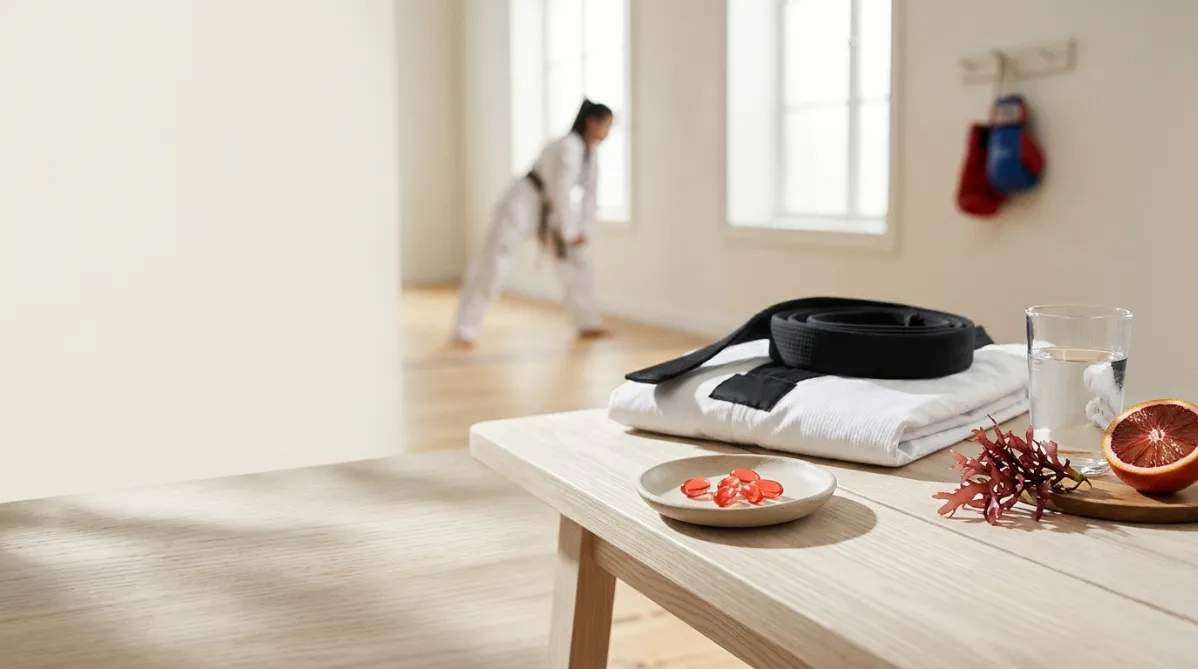
A wide editorial still life shot from a slightly elevated angle on a pale ash-wood bench in a bright, airy training hall. In the center sits a small matte ceramic dish holding a few translucent coral-red softgel capsules, their glossy surfaces catching soft window light. Beside the dish rests a folded white taekwondo dobok with a black belt loosely coiled on top. A sprig of fresh red microalgae-toned seaweed and a halved blood orange add natural color accents. A clean glass of water with subtle condensation stands to one side.

In the softly blurred background, the silhouette of a martial artist in a white uniform stretches near tall windows, with diffused morning light streaming across a sprung wooden floor. A pair of red and blue sparring gloves hangs on a minimal wall hook. Thin, elegant shadows stretch across the bench.

The palette is restrained and modern: warm off-white, soft sand, muted charcoal, with a vivid coral-red accent pulled from the capsules. Shallow depth of field, crisp focus on the capsules and dish, creamy bokeh behind. Natural, gentle lighting with a subtle film-like grain, reminiscent of a contemporary wellness and science magazine cover. Generous negative space on the left third of the frame for headline text. Calm, precise, and quietly athletic in mood, with no text, logos, or futuristic elements.
science research

12 mg astaxanthine voor 28 dagen: spierbeschadiging en burn‑out bij vechters

BY DR. GYMBRO ·

Een nieuwe gerandomiseerde studie onderzocht de effecten van 12 mg astaxanthine per dag bij jonge mannelijke taekwondo‑atleten. Na 28 dagen vertoonde de supplementgroep een opvallend andere creatine‑kinase‑curve dan de placebogroep, daarnaast hogere SOD‑waarden en verkennende aanwijzingen voor lagere MDA en minder emotionele en fysieke uitputting. De uitkomsten rondom burn‑out waren echter slechts exploratief, zonder significante groep‑×‑tijd‑interactie op een enkele subschaal. De trial was klein en meette alleen biomarkers, niet de sportprestaties. Hieronder lees je wat de data laten zien, wat ze niet laten zien, en voor wie de bevindingen relevant kunnen zijn.

A wide, softly lit editorial still life on a warm off-white linen surface. At the center-left, a matte ceramic bowl holds a small mound of fine golden-yellow quercetin powder, with a few scattered capsules beside it. Next to the bowl sit fresh red onions (one halved to show its translucent purple layers), a few capers, and a small cluster of ripe apples with the skin on, all natural quercetin sources. On the right side of the frame, a sleek matte-black dumbbell rests at an angle beside a folded slate-gray gym towel. A minimalist glass beaker of water with a thin lemon slice sits just behind it.

Soft diffused morning window light enters from the upper left, casting gentle long shadows and subtle highlights on the powder and glossy onion skin. The color palette is muted and sophisticated: butter yellow, deep plum, warm cream, charcoal, with small touches of sage green from a single eucalyptus sprig. A subtle, out-of-focus background of pale plaster wall and a wooden shelf adds depth.

Shallow depth of field, shot from a slightly elevated three-quarter angle with a 50mm lens feel. Generous negative space in the upper right for a title overlay. The mood is clean, calm, and modern, like a premium wellness and science journal feature: tactile textures, natural materials, restrained composition, high-end editorial photography, and no text or logos.
science research

1 g/dag quercetine voor excentrische curls: de IGF‑wending

BY DR. GYMBRO ·

Wat gebeurt er als je twee weken vóór een zware excentrische biceps‑training 1 g/dag quercetine inneemt? In een kleine, placebogecontroleerde crossover‑studie daalden schade‑markers als CK, LDH en myoglobine, evenals IL‑6. Nog opvallender: de IGF‑I‑respons werd sterker en de IGF‑II‑piek trad eerder op dan normaal. Met slechts twaalf deelnemers en zonder hypertrofie‑data is dit een veelbelovend herstel‑signaal, geen garantie voor spiergroei. Hieronder lees je wat de studie aantoonde en hoe je het verstandig kunt toepassen.

A wide, softly lit editorial still life on a pale oatmeal linen surface. In the center sits a tall, clear glass filled with deep garnet-red tart cherry juice, with condensation beading on the outside and a faint ruby glow where light passes through it. Around it are a scattering of fresh Montmorency cherries, some with stems and some halved to show pale amber flesh and a single pit. A few drops of juice have splashed onto the linen, leaving small crimson stains. To the right, slightly out of focus, lies a folded charcoal-gray running shirt, a pair of minimalist off-white running shoes, and a small brushed-steel kettlebell, suggesting both endurance and strength training without a gym in view. On the left, a ceramic pitcher in matte sage green holds more juice, and a sprig of fresh mint adds a small contrast.

Window light comes from the upper left, casting long, gentle shadows and creating a warm morning feel. The palette is restrained and modern: deep burgundy, cream, sage, and soft slate, with plenty of negative space in the upper right for headline text. The camera angle is a shallow three-quarter view from slightly above, with a shallow depth of field. The foreground cherries are razor sharp and the background melts into a creamy blur. Subtle film grain, natural color grading, and a clean, minimalist composition give it the polished feel of a contemporary health and science magazine. No text, no logos, no people, and no futuristic elements. The overall mood is calm, fresh, and restorative, hinting at recovery and balance.
recovery

Tart cherry‑juice truc: sneller krachtherstel, lager IL‑6

BY DR. GYMBRO ·

Marathonlopers en krachtsporters zweren op kersensap voor herstel; een placebogecontroleerde studie heeft deze praktijk onder de loep genomen. Bij twintig deelnemers kwam de isometrische kracht aanzienlijk sneller terug (P = 0,024), terwijl IL‑6, CRP en urinezuur daalden en de antioxidante status ongeveer 10 % hoger lag. Creatine‑kinase, LDH en spierpijn vertoonden echter geen significante verschillen, waardoor het plaatje genuanceerder is dan de hype. Hieronder lees je wat de studie deed, wat ze ontdekte en voor wie de bevindingen relevant zijn.

This page is available in