Dr. Gymbro
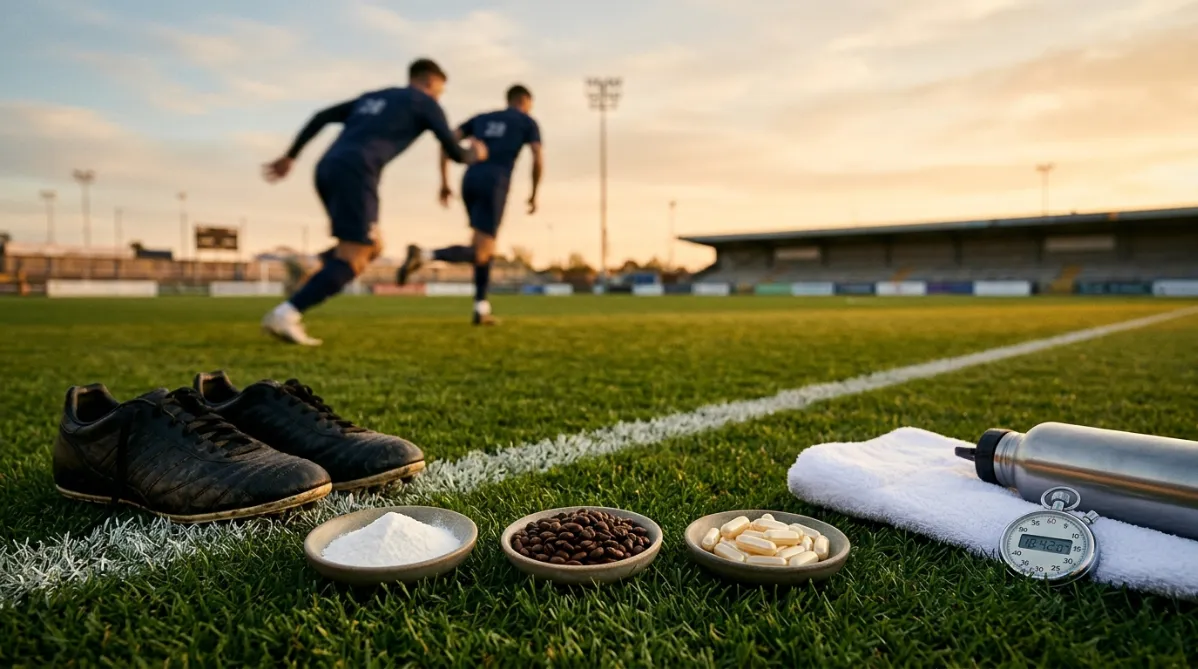
A wide, editorial-style photograph of a professional soccer pitch at golden hour, shot from a low angle at the edge of the grass. In the foreground, slightly off-center to the left, a pair of worn leather cleats sits beside a scatter of three small matte ceramic dishes. One holds fine white taurine powder, one holds dark roasted coffee beans, and one holds pale cream-colored softgel capsules. Soft warm light catches the textures: the grain of the beans, the powder's fine crystalline sheen, the glossy curve of the capsules. A clean white sports towel and a brushed-steel water bottle rest nearby, with a small stopwatch lying on the turf, its face softly glowing.

Behind them, the field stretches into a gentle blur. A lone player in a muted navy training kit mid-sprint leaves a faint streak of motion across the frame, with painterly bokeh from stadium floodlights and distant stands. The grass is a rich, deep green with crisp white line markings curving across the midground and leading the eye toward the athlete. Long amber shadows stretch across the pitch, and a hazy peach and pale blue sky fills the upper right, leaving open negative space for a title overlay.

The palette is restrained and modern: deep green, warm cream, soft amber, charcoal, and a touch of muted coral. The depth of field is shallow, with sharp detail on the supplements and cleats. The mood is calm, premium, and scientific without feeling clinical, like a contemporary sports-science magazine or wellness journal cover. The lighting is natural and cinematic, with gentle film grain and a subtle vignette. The composition follows the rule of thirds, with clean lines and no text, logos, or clutter.
Nutrition

Taurine, cafeïne + PS‑stack gaf profvoetballers een voorsprong: de addertjes onder het gras

Dr. Gymbro · · 4 min read

Het kopresultaat en de kleine lettertjes die ertoe doen

Professionele voetballers die gedurende twee weken een stack van taurine, cafeïne en fosfatidylserine (PS) innamen, sprintten 30 m sneller dan de placebogroep. Ze scoorden bovendien beter op diverse reactietijd‑ en mentale‑vermoeidheidsmetingen. De twist is dat de onderzoekers zelf aangeven dat de studie niet aantoont dat de stack de spelers vermoeidheidsresistenter maakt. Evenmin kan worden vastgesteld of PS zelf effect heeft.

Die spanning maakt deze nieuwe gerandomiseerde proef in Nutrients een lezing die de moeite waard is.

Wat de onderzoekers echt hebben gedaan

De studie rekruteerde 97 professionele mannelijke voetballers in een gerandomiseerde, drievoudig geblindeerde, placebogecontroleerde, parallel‑group opzet. Spelers werden voor 14 dagen verdeeld over vier groepen:

  • Placebo (PLA): n = 24
  • Taurine + cafeïne (TC): n = 24
  • Taurine + cafeïne + 300 mg/dag PS (TCP‑300): n = 24
  • Taurine + cafeïne + 600 mg/dag PS (TCP‑600): n = 25

De taurine‑dosering was 1 500 mg/dag en de cafeïne‑dosering 200 mg/dag in alle actieve groepen. Vervolgens voltooiden de spelers een gestandaardiseerd voetbal‑specifiek oefenprotocol. Het team matte 30 m sprinttijd, visuele en auditieve reactietijd, Stroop‑taakprestaties, waargenomen mentale vermoeidheid en GPS‑afgeleide locomotie‑variabelen.

De successen: sprint, reactietijd en mentale vermoeidheid

Na correctie voor de baselines vond de analyse een significant effect van de behandelingsgroep op de post‑interventie 30‑meter sprinttijd. Na Holm‑Bonferroni‑correctie voor multiple comparisons bleven significante behandeling‑gerelateerde effecten bestaan voor drie cognitieve en psychomotorische uitkomsten:

  • Stroop‑reactietijd
  • Visuele reactietijd
  • Waargenomen mentale vermoeidheid

Auditieve reactietijd viel buiten de cut‑off (p = 0.074; Holm‑gecorrigeerd p = 0.096), dus geen statistisch significant effect.

De GPS‑afgeleide locomotie‑uitkomsten tijdens het voetbal‑specifieke protocol verschilden ook significant tussen de groepen na baseline‑aanpassing. Over het geheel genomen waren de actieve stacks geassocieerd met gunstigere geselecteerde uitkomsten dan placebo.

300 mg vs 600 mg PS: nauwelijks een verschil

Het is verleidelijk te denken dat het verdubbelen van de PS‑dosering het voordeel verdubbelt. De data ondersteunen dat niet. Enkele uitkomsten waren numeriek gunstiger in de 600 mg‑groep, en de kleinste prestatie‑verliezen van eerste naar tweede helft werden over het algemeen gezien in TCP‑600. Maar de auteurs stellen dat de verschillen tussen TCP‑300 en TCP‑600 bescheiden en niet consistent statistisch significant waren. De studie was bovendien niet powered om een dose‑response‑relatie vast te stellen.

In gewone taal: 600 mg zag er op papier iets beter uit, maar dit onderzoek kan niet aantonen dat de extra capsules ten opzichte van 300 mg de moeite waard zijn.

Het grote voorbehoud: dit is geen bewijs van vermoeidheidsresistentie

De proef meette ook indexen van prestatie‑verlies van eerste naar tweede helft, die aangeven hoeveel output er tijdens het protocol afnam. De groepen verschilden hierin na de interventie. Dat klinkt als een winst in vermoeidheidsresistentie, maar de auteurs waarschuwen expliciet tegen die interpretatie. Vergelijkbare afname‑indexen waren niet beschikbaar bij baseline, dus er is geen manier om aan te tonen dat de stack veranderd heeft hoe spelers afnemen. De post‑interventie verschillen kunnen niet worden gekaderd als een interventie‑gerelateerde verbetering in vermoeidheidsresistentie.

Een tweede beperking is net zo belangrijk. PS werd nooit afzonderlijk getest. Elke actieve groep kreeg zowel taurine als cafeïne, en het ontwerp isoleerde PS niet. De bevindingen weerspiegelen de gecombineerde multi‑ingredient protocollen, niet PS alleen. Cafeïne is een bekend stimulerend middel, dus het zou een aanzienlijk deel van de sprint‑ en reactietijd‑effecten kunnen verklaren. Deze studie kan dat niet uitsplitsen.

Praktische conclusies: de stack zoals getest

Hieronder staat wat in de proef werd gebruikt, zodat je het kunt vergelijken met je eigen plannen:

  • Taurine: 1 500 mg/dag
  • Cafeïne: 200 mg/dag
  • Fosfatidylserine: 300 of 600 mg/dag, met slechts bescheiden verschillen tussen beide
  • Duur: 14 dagen

Het abstract vermeldt niet hoe de dagelijkse dosis werd getimed ten opzichte van training of wedstrijden, dus er is geen op bewijs gebaseerde timingregel. Raadpleeg het volledige artikel voor die details voordat je een protocol kopieert.

Voor wie is dit?

Het bewijs geldt voor professionele mannelijke voetballers onder de voorwaarden van een 14‑daagse proef. Het spreekt niet direct amateur‑atleten, vrouwelijke spelers, andere sporten of langdurig gebruik aan. Als je een competitieve speler bent die nieuwsgierig is naar cognitieve scherpte in de late fase van wedstrijden, is dit een interessante aanwijzing, geen recept. Iedereen die gevoelig is voor cafeïne, medicijnen gebruikt of een gezondheidsconditie heeft, moet eerst met een sportdiëtist of arts overleggen. Teams moeten bovendien zorgen dat elk supplement batch‑geïnspecteerd is op verboden stoffen.

Conclusie

Deze proef draagt bij aan de case dat multi‑ingredient stacks reactietijd kunnen verscherpen, waargenomen mentale vermoeidheid kunnen verminderen en sprintresultaten kunnen verbeteren bij elite‑voetballers. De kop‑caveats zijn echter reëel. PS werd niet geïsoleerd, het verschil tussen 300 mg en 600 mg was bescheiden, en de vraag naar vermoeidheidsresistentie blijft open. Beschouw het als een veelbelovende hint voor toekomstig onderzoek met PS‑enkele armen en baseline‑vermoeidheidsmetingen, niet als bewijs dat een drie‑ingredienten stack een wondermiddel voor wedstrijddag is.
Original study

Read the original research on pubmed.ncbi.nlm.nih.gov →

This article summarizes published research for general information. It is not medical advice.

DG

Written by

Dr. Gymbro

Dr. Gymbro writes for Dr. Gymbro: science-backed fitness, nutrition & performance.

Related Articles

nutrition

Cafeïne maakt voetballers sneller, maar niet beter in reageren

BY DR. GYMBRO ·

Veel mensen gaan ervan uit dat cafeïne sporters overal scherper maakt, maar een recent dubbelblinde onderzoek met amateurvoetballers laat een genuanceerder beeld zien. Een dosis van 300 mg (ongeveer 3,7 mg per kg lichaamsgewicht) verbetert de geplande wendbaarheid (effectgrootte 0,62) en de sprongprestaties, maar bij reactieve taken – reageren op een lichtsignaal of een menselijke tegenstander – zijn de voordelen klein of zelfs niet‑significant. Hieronder vind je de belangrijkste bevindingen, hoe je de resultaten moet interpreteren en voor wie ze echt van waarde kunnen zijn.

A wide, editorial-style photograph of a soccer pitch at golden hour, shot from a low angle at the edge of the touchline. In the foreground, a pair of worn leather cleats sits beside a small, matte white scoop and a minimalist ceramic jar of fine white powder resting on the dewy grass. A few loose grains of powder dust the blades of grass and catch the warm light. The jar is unbranded, with a clean, modern look.

In the midground, slightly out of focus, a lone player in a plain charcoal training kit stands mid-stride on the pitch, caught in a sprint. The motion blur in the legs suggests speed, and long shadows stretch across the freshly mowed stripes of the turf. A soccer ball rests a few meters ahead of the player.

Behind them, the stadium stands curve softly into the distance, rendered in a hazy, muted gradient of peach, soft amber, and pale blue sky. The mowing pattern on the grass forms clean diagonal lines that lead the eye toward the horizon. A thin white chalk line cuts across the frame, adding a subtle graphic element.

The palette is warm and restrained: sage and deep green grass, cream white, soft apricot light, and touches of charcoal. The mood is calm, thoughtful, and slightly skeptical rather than hyped, like a magazine feature on sports science. Shallow depth of field with a creamy bokeh background, fine film grain, and gentle natural contrast. The composition follows the rule of thirds, with the jar and cleats in the lower left and open negative space in the upper right, which leaves room for a headline overlay. The look is contemporary and clean, like a premium health and performance journal.
nutrition

Creatine voor Voetbal: 41 Studies, één ongemakkelijke waarheid over sprints

BY DR. GYMBRO ·

Creatine is overal verkrijgbaar en de sprint‑intensieve eisen van voetbal lijken een perfecte match. Een nieuwe systematische review van 41 studies testte dit idee en leverde een voorzichtiger oordeel op dan de marketing suggereert. Sommige onderzoeken toonden voordelen voor herhaalde sprints, anaerobe kracht en spierkracht, maar het bewijs was wisselvallig en van zeer lage zekerheid. Claims over herstel kregen weinig steun, en het lichaamsgewicht steeg vaak zonder duidelijke toename in spiermassa. Hier lees je wat je eruit kunt halen, wie er baat bij kan hebben en wie beter twee keer nadenkt.

A wide, editorial-style still life photographed on a pale, matte stone countertop in soft morning window light. On the left, a small ceramic cup of black coffee sits beside a scattering of whole roasted coffee beans, with a thin wisp of steam rising. At the center, a shallow wooden bowl holds dried Rhodiola rosea root pieces, rust-orange and tan, with a few fresh succulent-like Rhodiola rosette stems with blue-green leaves and yellow-gold flowers laid across the surface. On the right, a minimalist matte white scoop and two small glass vials of fine powder, one dark brown and one soft amber, are lined up neatly like a measured dose. Behind them, softly out of focus, a blurred athletic setting suggests a training space: a muted sage-green wall, a folded gray towel, and a worn soccer ball resting on a low bench. A stopwatch with a clean white face lies in the foreground, slightly angled, hinting at timing and performance. The palette is warm and earthy: cream, terracotta, deep espresso brown, moss green, and a touch of marigold yellow. Shadows are long and gentle, with a shallow depth of field and fine natural texture in the stone, wood, and plant material. The composition is balanced and uncluttered, with generous negative space on the upper left for headline text. The overall look is modern, calm, and trendy, like a contemporary wellness and science journal cover, with crisp detail, subtle film grain, and a natural, tactile feel.
supplements

Rhodiola + Cafeïne: De combinatie die placebo verslaat in Wingate‑vermogen

BY DR. GYMBRO ·

Cafeïne is de onbetwiste koning van pre‑workouts, maar een nieuwe crossover‑studie suggereert dat een combinatie met Rhodiola rosea extra voordelen kan bieden. Bij getrainde voetballers was de mix (3 mg/kg van elk, 60 min voor de test) de enige conditie die placebo overtrof in maximale Wingate‑vermogen. Cortisol, α‑amylase en IgA in speeksel vertoonden elk een eigen patroon. Met slechts 10 deelnemers en één enkele acute dosis is dit echter een aanwijzing, geen definitief oordeel. Hieronder lees je wat de studie werkelijk liet zien, voor wie hij relevant is en wat je er niet uit moet opmaken.

A lone trail runner pauses on a high alpine ridge at dawn, holding a small enamel camp mug of steaming coffee, with thin ribbons of steam curling into crisp, cold air. She wears a fitted charcoal running vest and a muted sage windbreaker, and her breath is faintly visible. Behind her, layered mountain ranges fade into soft blue and lavender haze, and a sea of low clouds fills the valley below. Warm golden sunlight skims the ridgeline and rim-lights her profile, shoulders, and the rising steam. In the foreground, a scattering of dried alpine grasses and lichen-covered stones is in sharp focus, with a worn trail snaking toward the summit. Near the mug sits a small pair of trail running shoes with dusty soles and a simple analog wristwatch resting on a flat rock.

The composition follows a wide 16:9 editorial layout. The subject sits slightly right of center on the rule of thirds, leaving generous negative space in the pale peach-and-powder-blue sky on the left, where headline text could sit. The palette is restrained and modern: warm amber, soft cream, dusty sage, slate blue, and a touch of terracotta. The look is cinematic but natural, with shallow depth of field on the foreground details, gentle film grain, and a slightly matte finish. It evokes a high-end outdoor lifestyle magazine or a contemporary wellness journal. The mood is calm, focused, and quietly determined, capturing the contrast between thin, cold altitude air and the warmth of a coffee ritual. The image has no text, logos, or futuristic elements, and no gym equipment, only natural light, texture, and atmosphere.
nutrition

Cafeïne in dunne lucht: de uithoudingsboost die hypoxie niet kan neutraliseren

BY DR. GYMBRO ·

Dunne lucht vermindert je uithoudingsvermogen, maar een nieuwe meta‑analyse suggereert dat cafeïne een deel van dit verlies kan compenseren. In negen placebogecontroleerde crossover‑studies met 117 deelnemers werd een matig‑tot‑groot prestatievoordeel gevonden onder hypoxische omstandigheden (g = 0,76). Verrassend genoeg veranderden de zuurstofsaturatie en de waargenomen inspanning niet, terwijl hartslag, lactaat en ventilatie wel stegen. Het bewijs heeft echter een lage zekerheid en slechts 19 van de deelnemers waren vrouwen, waardoor de bevindingen veelbelovend maar nog niet overtuigend blijven.

This page is available in
