Dr. Gymbro
←

#phosphatidylserine

1 article
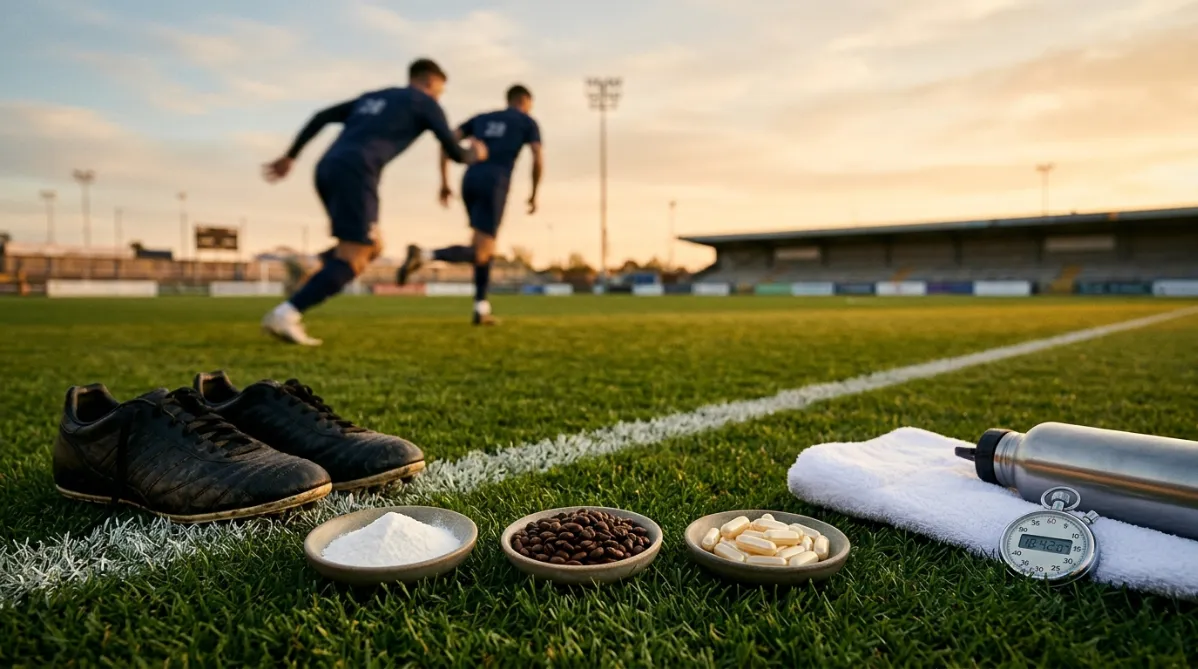
A wide, editorial-style photograph of a professional soccer pitch at golden hour, shot from a low angle at the edge of the grass. In the foreground, slightly off-center to the left, a pair of worn leather cleats sits beside a scatter of three small matte ceramic dishes. One holds fine white taurine powder, one holds dark roasted coffee beans, and one holds pale cream-colored softgel capsules. Soft warm light catches the textures: the grain of the beans, the powder's fine crystalline sheen, the glossy curve of the capsules. A clean white sports towel and a brushed-steel water bottle rest nearby, with a small stopwatch lying on the turf, its face softly glowing.

Behind them, the field stretches into a gentle blur. A lone player in a muted navy training kit mid-sprint leaves a faint streak of motion across the frame, with painterly bokeh from stadium floodlights and distant stands. The grass is a rich, deep green with crisp white line markings curving across the midground and leading the eye toward the athlete. Long amber shadows stretch across the pitch, and a hazy peach and pale blue sky fills the upper right, leaving open negative space for a title overlay.

The palette is restrained and modern: deep green, warm cream, soft amber, charcoal, and a touch of muted coral. The depth of field is shallow, with sharp detail on the supplements and cleats. The mood is calm, premium, and scientific without feeling clinical, like a contemporary sports-science magazine or wellness journal cover. The lighting is natural and cinematic, with gentle film grain and a subtle vignette. The composition follows the rule of thirds, with clean lines and no text, logos, or clutter.
nutrition

Tauryna, kofeina + PS dały piłkarzom przewagę. Co w tym jest podchwyt?

BY DR. GYMBRO ·

Zawodowi piłkarze, którzy przez 14 dni przyjmowali taurynę, kofeinę i fosfatydyloserynę, uzyskali lepsze wyniki w 30‑metrowym sprincie, krótsze czasy reakcji oraz niższy poziom zmęczenia psychicznego niż grupa placebo w randomizowanym badaniu z 97 uczestnikami. Jednak podwojenie dawki PS z 300 do 600 mg przyniosło jedynie niewielką i niekonsekwentną różnicę. Autorzy podkreślają, że dane nie dowodzą zwiększonej odporności na zmęczenie, a PS nigdy nie testowano samodzielnie. Poniżej opisujemy, co zawierał ten zestaw, jakie przyniósł efekty i czego nie może nam on powiedzieć.

This page is available in