Dr. Gymbro
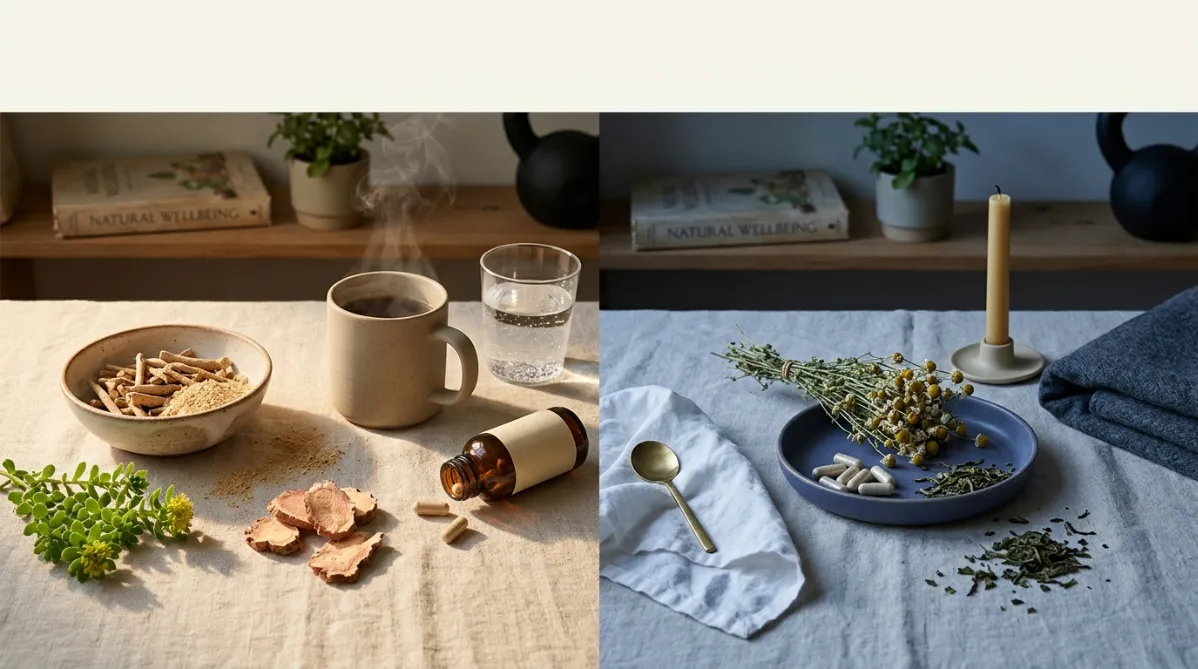
A landscape editorial still life shot from slightly above on a pale oat-colored linen surface, lit by soft morning window light with gentle long shadows. On the left, in warm golden sunlight, sits a small ceramic bowl of dried ashwagandha root pieces and a scatter of fine tan powder. Beside it are a few rough, rosy-gold slices of Rhodiola rosea root and a sprig of tiny succulent-like green leaves with yellow blossoms. A matte sand-colored stoneware mug of steaming tea and a simple glass of water stand nearby. A small amber glass bottle with a minimal unbranded label tips out two capsules.

The right side of the frame is cooler and bluer, as if dusk is arriving. It holds a muted indigo ceramic dish with a few pale capsules, a small bundle of dried chamomile flowers (the source of apigenin), and a few green tea leaves. A slim, unlit beeswax candle and a folded charcoal wool blanket suggest evening. The warm and cool halves meet softly in the center, where a rumpled white cotton napkin sits beneath a small brass spoon.

In the background, out of focus, a wooden shelf holds a worn paperback, a small potted plant, and the edge of a kettlebell in matte black, hinting at an active lifestyle. Subtle film grain, shallow depth of field, and a muted palette of cream, terracotta, sage green, and deep indigo give it a clean, modern wellness-magazine feel. Leave generous negative space in the upper third for a headline overlay. No text, no logos, no people.
Recovery

Ashwagandha + Rhodiola funcionou. O combo noturno de sono não.

Dr. Gymbro · · 4 min read

Ashwagandha + Rhodiola funcionou. O combo noturno de sono não.

Uma reviravolta inesperada

Aqui vai a reviravolta que ninguém esperava: em um novo ensaio de quatro braços, o suplemento que realmente fez a diferença no estresse e no sono foi o da manhã. Ashwagandha mais Rhodiola rosea ajudaram. O famoso combo noturno de magnésio L‑trionato, L‑teanina e apigenina não acrescentou nenhum ganho. Tomar ambos, na verdade, pareceu piorar um dos indicadores de humor.

Se você levanta pesos, corre ou, de alguma forma, se dedica a treinos intensos enquanto lida com o estresse do trabalho e noites de sono irregulares, este estudo merece uma análise mais cuidadosa.

O que o estudo fez

Pesquisadores da University of South Carolina e colaboradores publicaram um ensaio randomizado, duplo‑cego, controlado por placebo no Journal of the International Society of Sports Nutrition (2026). Eles recrutaram 103 adultos saudáveis e fisicamente ativos (53 mulheres, idade média 34,8 anos) e os dividiram em quatro grupos:

  • Somente manhã (n = 26): 600 mg de ashwagandha + 300 mg de Rhodiola rosea pela manhã, placebo à noite.
  • Somente noite (n = 25): placebo pela manhã, depois 2 g de magnésio L‑trionato (equivalente a 145 mg de magnésio), 200 mg de L‑teanina e 50 mg de apigenina à noite.
  • Manhã + noite (n = 25): ambos os protocolos ativos.
  • Placebo (n = 27): placebo nas duas ocasiões.

O estudo totalizou quatro semanas: uma semana de linha de base, apenas duas semanas de suplementação e uma semana de washout. Os participantes preencheram questionários diários de estresse e avaliações PROMIS semanais que mensuram estresse percebido, afeto e sono. Também completaram o Pittsburgh Sleep Quality Index (PSQI) na linha de base e após o washout. Um dispositivo vestível registrou o sono de forma objetiva todas as noites.

O que o estudo encontrou

O grupo que recebeu os adaptógenos pela manhã foi o destaque. Eis os principais achados relatados no artigo:

  • O estresse percebido semanal diminuiu no grupo da manhã (p = 0,034; η² = 0,020). O estresse diário não mostrou diferenças significativas.
  • A deterioração relacionada ao sono reduziu no grupo da manhã (p = 0,032; d = 2,74).
  • O tempo acordado após o início do sono diminuiu no grupo da manhã (p = 0,047; η² = 0,020), conforme os dados do dispositivo vestível.
  • A qualidade do sono no PSQI melhorou no grupo da manhã em comparação ao grupo manhã + noite (diferença média = 0,66 AU, p < 0,001, d = 1,45).
  • O afeto positivo aumentou no grupo da manhã ao final do período de cessação (p = 0,003; d = 1,68) e continuou subindo. O grupo manhã + noite seguiu a direção oposta, apresentando queda (p = 0,009; d = 0,16).

Os autores concluíram que a combinação matinal de ashwagandha e Rhodiola esteve associada a melhorias no estresse subjetivo, na qualidade do sono e no afeto positivo após 14 dias, em comparação ao placebo.

O protocolo noturno de sono, sozinho ou somado ao da manhã, não trouxe benefício nos desfechos principais. Para quem já investiu em um ritual caro de suplementos noturnos, o resultado pode ser frustrante.

Por que a combinação pode não ter potencializado

O resumo do artigo não oferece um mecanismo para explicar a falta de efeito adicional do protocolo noturno; portanto, qualquer explicação aqui é especulativa. Algumas hipóteses:

  • Ponto de saturação: participantes saudáveis e ativos podem ter pouco espaço para melhorar esses marcadores.
  • Mais não significa melhor: a adição de mais ingredientes não garante benefício adicional.
  • Interação negativa: os dados sugerem que a estratégia de "empilhar tudo" não superou os adaptógenos matinais e, no afeto positivo, pareceu piorar.

A pegadinha

Antes de reorganizar sua prateleira de suplementos, considere as limitações do estudo:

  • Duração curta: a suplementação durou apenas duas semanas.
  • Amostra saudável: adultos fisicamente ativos sem diagnóstico de transtorno de estresse ou sono.
  • Grupos pequenos: cada braço contou com cerca de 25 participantes, e muitas variáveis foram analisadas.
  • Efeitos modestos: vários p‑values ficaram logo abaixo de 0,05 (0,032; 0,034; 0,047) e os η² = 0,020 são pequenos.
  • Tamanhos de efeito heterogêneos: valores de d variaram de 0,16 a 2,74; os maiores são incomuns em pesquisas de suplementos e devem ser interpretados com cautela.
  • Afeto positivo paradoxal: o aumento foi significativo apenas ao final do washout, não durante a fase de suplementação.

Os próprios autores pedem intervenções mais longas e populações com maior estresse basal e perturbações de sono.

Como usar isso (na prática)

Dose: 600 mg de ashwagandha e 300 mg de Rhodiola rosea por dia.

Horário: manhã – foi esse o horário que produziu os benefícios.

Duração: o ensaio durou 14 dias; não há evidência sobre efeitos de uso prolongado.

Forma: o artigo não especifica o tipo de extrato nem a padronização. Prefira produtos que informem o tipo de extrato, a padronização dos princípios ativos e que correspondam às doses acima.

Indicação: adultos saudáveis e fisicamente ativos que sentem o peso do estresse e desejam melhorar a qualidade do sono e o humor – exatamente a população estudada.

Contra‑indicações / precauções: gestantes, lactantes, pessoas com problemas de tireoide, fígado ou doenças autoimunes, que usam sedativos, antidepressivos ou outros medicamentos prescritos, ou que tenham diagnóstico de distúrbio do sono, devem consultar um profissional de saúde antes de iniciar.

Conclusão para quem treina

Este ensaio não prova que a combinação matinal seja um milagre, nem que magnésio L‑trionato, L‑teanina ou apigenina sejam inúteis. Ele demonstra que, em 103 adultos saudáveis e ativos ao longo de duas semanas, um protocolo simples de ashwagandha + Rhodiola pela manhã gerou os sinais mais consistentes, enquanto acrescentar o combo noturno de sono não trouxe ganho adicional. Se você está tentado a comprar mais suplementos, os dados sugerem que uma abordagem mais enxuta pode ser tão eficaz. Higiene do sono, carga de treino e estratégias de recuperação ainda são os verdadeiros responsáveis pelos resultados.
Original study

Read the original research on pubmed.ncbi.nlm.nih.gov →

This article summarizes published research for general information. It is not medical advice.

DG

Written by

Dr. Gymbro

Dr. Gymbro writes for Dr. Gymbro: science-backed fitness, nutrition & performance.

Related Articles

A softly lit bedroom nightstand scene in landscape format, photographed in a modern editorial lifestyle style. In the center of the frame sits a handmade ceramic mug in warm oatmeal tones, filled with a pale creamy drink. A thin wisp of steam rises from it. Beside the mug, a small wooden scoop rests on a matte linen-textured surface with a fine dusting of white collagen powder. A minimal amber glass jar with a cream label stands just behind, with no readable text. The nightstand is pale oak with subtle grain.

To the left, a neatly folded pair of gray cotton athletic socks and a worn leather-bound training journal with a pen on top hint at a lifter's routine. A small brass alarm clock reads about 9:30 and is slightly out of focus. On the right side, a sheer curtain filters the last blue-violet twilight from a window, while a warm bedside lamp with a linen shade casts a honey-colored glow across the scene. The glow contrasts gently with the cool dusk tones.

Behind the nightstand, the edge of a rumpled bed with soft white and sand-colored bedding is visible, with a dumbbell resting quietly on the floor in the soft-focus background to suggest recovery after training. The depth of field is shallow, with the mug and scoop in crisp focus and the background dissolving into creamy bokeh.

The palette is calm and earthy: warm beige, soft cream, muted terracotta, and dusk blue accents. The lighting is cinematic and low-key, with gentle highlights on the ceramic rim and a subtle rim light on the steam. The composition follows the rule of thirds, with the mug placed on the left third and generous negative space on the right for title overlay. The mood is serene, restorative, and quietly scientific without any clinical elements. The finish is clean, high-end, and magazine-worthy, with fine film grain and natural color grading, like a wellness feature in a contemporary online journal.
recovery

O truque do colágeno de 15 g antes de dormir que reduziu os despertares noturnos em 27 %

BY DR. GYMBRO ·

Acordar repetidamente durante a noite pode sabotar silenciosamente sua recuperação, mesmo quando treino e nutrição estão alinhados. Um pequeno ensaio revelou que 15 g de peptídeos de colágeno consumidos uma hora antes de deitar reduziram os despertares registrados por polisomnografia de 29,3 para 21,3, cerca de 27 % a menos. Os participantes também tiveram desempenho melhor no teste Stroop matinal. Contudo, o tempo total de sono, a latência e a eficiência do sono não mudaram, e o estudo contou apenas com 13 homens durante 7 noites, usando um produto fornecido pela indústria. Veja o que os dados realmente mostram e como os praticantes de musculação podem testá‑lo com segurança.

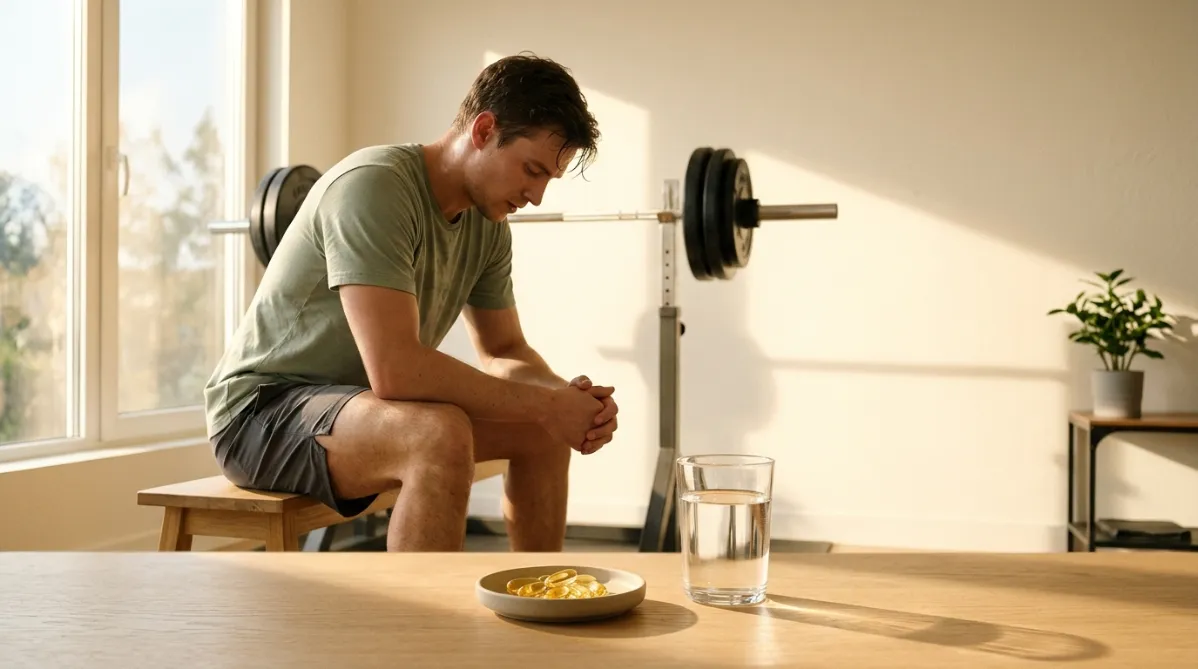
A sunlit, minimalist home gym corner photographed in soft golden morning light, with a young athletic man seated on a wooden bench, leaning forward with his elbows resting on his knees, catching his breath after a hard leg session. He wears a muted sage-green t-shirt and charcoal shorts, his face turned slightly away from the camera, calm and focused. A matte ceramic dish in the foreground holds a few small, translucent golden softgel capsules, with a glass of water beside it catching the light and casting a soft caustic shadow across a pale oak floor. Behind him, a loaded barbell rests on a squat rack, slightly out of focus, and a tall window pours warm sunlight diagonally across the scene, creating long gentle shadows and a hazy glow. A small potted green plant sits on a shelf at the edge of the frame. The color palette is warm and editorial: cream, soft gold, sage green, pale wood, and charcoal accents. Shallow depth of field, with crisp focus on the capsules and glass in the lower third and a creamy bokeh background. The composition leaves generous negative space on the right side for a headline overlay. The mood is clean, modern, and aspirational, like a high-end wellness magazine or a trendy health journal feature. Shot on a 50mm lens, natural light, fine film grain, subtle matte finish, landscape 16:9 framing.
recovery

Vitamina D acelera a recuperação de força em homens que não eram deficientes

BY DR. GYMBRO ·

Homens com níveis perfeitamente normais de vitamina D ainda recuperaram a força mais rapidamente após um treino de pernas intenso ao tomarem 4.000 UI por dia. Em um ensaio randomizado, controlado por placebo, com 28 homens ativos, a força isométrica máxima retornou cerca de 8 % melhor em 24 h. Os marcadores de dano muscular ALT e AST também aumentaram menos. Contudo, a dor muscular não melhorou. Veja o que o estudo encontrou, suas limitações e quem realmente pode se interessar.

A softly lit bedside table in a calm, modern bedroom at dusk, photographed in wide landscape format with shallow depth of field. In the foreground, a matte white shaker bottle sits beside a tall frosted glass of creamy, pale vanilla-colored protein shake, with a few condensation droplets catching warm light. Next to the glass rests a slim fitness band on a dark charcoal fabric strap, its small LED glowing a gentle green, lying casually on a light oak wooden surface. A small scoop of fine white protein powder rests on a ceramic dish nearby, with a light dusting of powder on the wood.

In the soft-focus background, a neatly made bed with oatmeal-colored linen bedding and a textured knit throw blanket. A sheer curtain filters the last peach and lavender light of evening from a large window. A small potted olive branch in a terracotta vase and a closed paperback book add a quiet editorial touch. A bedside lamp with a warm, cream-colored shade casts a golden glow across the scene and creates gentle highlights on the glass.

The palette is muted and harmonious: warm cream, soft sand, oatmeal beige, faint sage green accents, and touches of dusty lavender in the window light. The mood is peaceful, reassuring, and clean, like a contemporary wellness magazine or a trendy health journal feature. Lighting is natural and cinematic, with soft shadows and a subtle film-like grain. The composition follows the rule of thirds, with the shake and band on the left third and open negative space on the right for headline overlay. Minimalist, Scandinavian-inspired styling, high-end lifestyle photography, crisp details, and a tranquil, premium editorial feel.
recovery

Caseína antes de dormir não prejudica o sono, dados da WHOOP mostram

BY DR. GYMBRO ·

Já ouviu dizer que um shake de proteína pesado antes de deitar atrapalha o sono e impede a recuperação? Um estudo randomizado com 21 atletas universitárias de alto nível, monitoradas por pulseiras WHOOP 4.0, não encontrou efeitos negativos na duração, eficiência, frequência cardíaca de repouso ou HRV. Alfa‑lactalbumina e carboidrato apresentaram resultados equivalentes, mas nenhum dos suplementos melhorou o sono. Confira o que os dados revelam, as limitações do estudo e quem ainda deve evitar o shake noturno.

A wide, editorial-style still life shot from a slightly elevated angle on a pale oatmeal-colored linen surface in soft, diffused morning light. At the center, a shallow matte ceramic bowl in warm terracotta holds a small mound of fine, golden-tan ashwagandha root powder. Beside it lie a few gnarled, dried ashwagandha roots and a sprig of green leaves with tiny orange-red berries in their papery husks. To the left, a minimalist amber glass supplement bottle sits with a few capsules spilled beside it, label blank and clean. A wooden scoop rests on the surface, dusted with powder.

On the right side of the frame, a pair of sleek, muted sage-green running shoes sits slightly off-center. A folded cream towel and a stainless steel water bottle sit just behind them, with a single brushed-steel kettlebell partly out of focus in the background to hint at strength training without dominating the scene. The running shoes and the botanical elements share equal visual weight, suggesting the endurance theme.

A thin, curved line of scattered powder sweeps across the linen from the bowl toward the shoes, like a gentle path or track. Soft shadows fall to the left, and a warm sunbeam crosses the surface and picks out the texture of the powder and the roots.

The palette is restrained and modern: warm terracotta, sage green, cream, soft gold, and touches of charcoal. The background is a blurred pale plaster wall with a hint of a window shadow. Shallow depth of field, crisp focus on the bowl and roots, and generous negative space in the upper left for a headline. Contemporary wellness magazine aesthetic, calm, natural, tactile, high-end lifestyle photography, no text, no people, no futuristic elements.
science research

Surpresa da Ashwagandha: ela ajuda mais na resistência do que na força

BY DR. GYMBRO ·

A ashwagandha costuma ser vendida como potenciadora de força e ganho muscular, mas uma nova meta‑análise aponta para outro benefício principal: a resistência aeróbica. Analisando 13 ensaios randomizados com 599 participantes, os pesquisadores encontraram um efeito médio de g = 0,54 para o desempenho aeróbico. Os ganhos de força foram positivos, porém incertos, e os dados sobre potência ainda são escassos. A dose aparentemente ideal seria 500‑600 mg/dia de extrato, mas há importantes ressalvas a considerar.

This page is available in