Dr. Gymbro
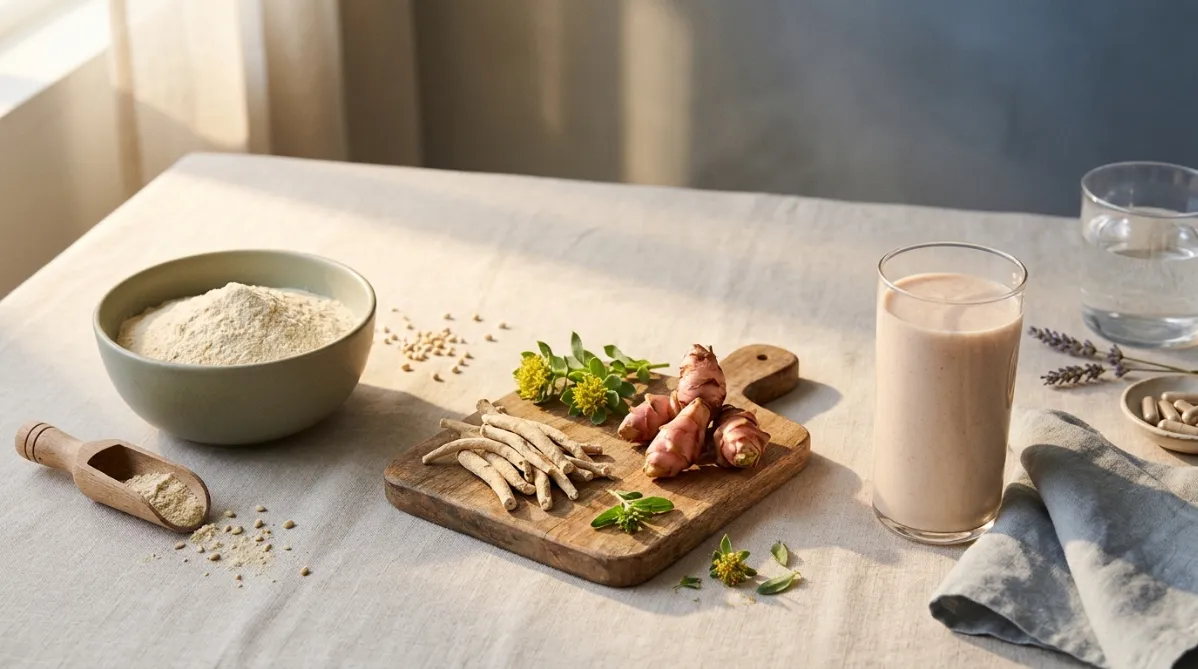
A calm, softly lit flat-lay on a pale oat-colored linen surface, shot from slightly above in a wide landscape composition. On the left, a matte ceramic bowl holds fine cream-colored plant protein powder, with a wooden scoop resting beside it and a few loose dusty-beige grains scattered across the linen. In the center, a small rustic wooden board displays dried ashwagandha roots, pale tan and gnarled, next to a few fresh rhodiola rhizomes with rosy-pink and coppery tones, and a few small sprigs of green leaves and tiny yellow-gold rhodiola flowers. On the right, a tall glass of creamy pale-blush smoothie sits next to a folded soft gray-blue cotton napkin, with a tumbler of water in the background. A delicate sprig of dried lavender and a small ceramic dish of capsules add subtle texture. Morning window light enters from the upper left, casting long, gentle shadows and a warm golden glow across the scene, with a faint hint of dusk-blue in the shadows to suggest restful sleep. The palette is muted and earthy: sage green, warm cream, dusty rose, soft terracotta, and touches of slate blue. The background is softly blurred with shallow depth of field, leaving generous negative space in the upper right for headline text. The style is editorial wellness photography, like a modern lifestyle journal, minimal, organic, tactile, and refined, with natural textures, subtle film grain, and a serene, restorative mood. No text, no people, no futuristic elements.
Recovery

Ashwagandha + Rhodiola: combinação de proteína vegetal reduz problemas de sono em 56%

Dr. Gymbro · · 4 min read

O sono é a ferramenta de recuperação mais barata que existe na bolsa de um praticante de academia, e a maioria de nós não sabe aproveitá‑lo direito. Um ensaio clínico randomizado investigou se uma proteína vegetal associada a dois adaptógenos populares poderia melhorar esse aspecto em 30 dias. No grupo que recebeu a combinação, a dificuldade para dormir caiu 56 %, a sonolência diurna reduziu 60 % e a pontuação total de sono aumentou 58 %. O porém: o estudo testou o conjunto de ingredientes, portanto nenhum deles pode ser apontado isoladamente como responsável pelos benefícios. A seguir, os principais resultados e as limitações do estudo.

Resultado principal: vantagem de 3,7 vezes sobre o placebo

O artigo, publicado na Plant Foods for Human Nutrition, descreve um ensaio randomizado, duplo‑cego e controlado por placebo. Foram incluídos 100 adultos entre 35 e 70 anos, divididos em partes iguais entre o grupo VERUM (ativo) e o grupo PLACEBO. Trata‑se de pesquisa em seres humanos, não em ratos ou culturas celulares.

No grupo VERUM, os autores observaram:

  • Dificuldade para dormir: redução de 56 % (p < 0.001, d de Cohen = 0,91)
  • Sonolência diurna: queda de 60 % (p < 0.001, d = 0,85)
  • Pontuação total de sono: aumento de 58 % (p < 0.001, d = 0,96)

A melhoria da pontuação total foi 3,7 vezes maior que a observada no placebo. Valores de d próximos a 0,9 são, convencionalmente, considerados grandes, o que justifica a classificação das mudanças como clinicamente relevantes. Nenhum evento adverso foi registrado.

O que realmente compôs a pilha

O grupo ativo consumiu, diariamente, durante 30 dias:

  • Proteína vegetal – 27 g/dia, proveniente de isolados de ervilha, arroz e cânhamo;
  • Tabletes de adaptógenos: Rhodiola rosea 300 mg + extrato padronizado de Withania somnifera (ashwagandha) KSM‑66® 500 mg.

O sono foi avaliado com o Sleep Quality Questionnaire (SQQ), um questionário validado que os participantes preencheram diariamente. Os dados foram analisados por modelos mistos longitudinais e testes não paramétricos.

Principais ressalvas: não se pode atribuir o efeito a um único ingrediente

Trata‑se de um produto combinado. O estudo não comparou a proteína isoladamente, nem a ashwagandha isolada, nem a rhodiola isolada. Assim, não é possível afirmar qual dos componentes foi o responsável pelos benefícios percebidos.

Os autores reconhecem que cada ingrediente tem evidências individuais de efeito, mas o impacto da combinação ainda era pouco conhecido. Portanto, o estudo fornece evidência apenas para a combinação como um todo, não para cada suplemento separadamente.

Ângulo de fase, explicado de forma simples

Os pesquisadores também mensuraram o ângulo de fase por bioimpedância. O aparelho envia uma corrente elétrica mínima através do corpo e registra como os tecidos resistem e atrasam essa corrente. Membranas celulares saudáveis comportam‑se como pequenas baterias que armazenam carga, gerando um deslocamento de fase. Quanto maior esse ângulo, mais saudável costuma ser o estado celular.

Nesse ensaio, as variações no ângulo de fase foram insignificantes em ambos os grupos. Ou seja, o benefício observou‑se apenas nos questionários de sono, não em marcadores de saúde celular. Trinta dias podem ser um período curto demais para que mudanças celulares se tornem detectáveis.

Leia a letra miúda

Algumas limitações devem ser consideradas antes de correr para a prateleira dos suplementos:

  • Desistências: 77 participantes completaram a bioimpedância (38 VERUM, 39 PLACEBO). Apenas 61 concluíram as avaliações de sono (32 VERUM, 29 PLACEBO), representando perda significativa em relação aos 100 iniciais.
  • Sono autorrelatado: O SQQ é um questionário, não um estudo de polisomnografia ou um monitor vestível. Avaliações subjetivas podem ser influenciadas por expectativas, embora o controle de placebo e o cegamento ajudem a mitigar esse viés.
  • Duração curta: O período de intervenção foi de 30 dias; efeitos a longo prazo permanecem desconhecidos.
  • Amostra não esportiva: A média de idade foi de 47,8 ± 8,2 anos, sem descrição de prática esportiva ou de academia dos participantes.
  • Conflitos de interesse: Um dos autores possui vínculo com a empresa Unifarco SPA. Os autores declaram não ter interesses conflitantes e o protocolo foi aprovado por um comitê de ética hospitalar em Sevilha.

Implicações práticas

Doses empregadas: 27 g/dia de proteína vegetal (ervilha, arroz, cânhamo), 300 mg de Rhodiola rosea e 500 mg de ashwagandha KSM‑66®, todos administrados diariamente por 30 dias.

Horário de ingestão: O resumo não especifica o momento do dia em que a proteína ou os adaptógenos foram consumidos. Qualquer recomendação de “tomar 30 minutos antes de dormir” seria mera suposição. Se decidir experimentar, a única orientação respaldada pelo estudo é a constância ao longo dos 30 dias.

Para quem pode ser útil: Evidência válida para adultos de meia‑idade (35 a 70 anos) com queixas de sono. Atletas ou praticantes de musculação estressados podem se interessar, mas o estudo não avaliou esse subgrupo nem mediu níveis de estresse ou carga de treino.

Quem deve ter cautela: O artigo não aborda interações medicamentosas ou populações especiais. Gestantes, pessoas que utilizam sedativos, medicações para tireoide, pressão arterial ou imunossupressoras, ou que tenham condições clínicas pré‑existentes, devem consultar um profissional de saúde antes de iniciar o uso de adaptógenos.

Conclusão

Em um ensaio clínico duplo‑cego, controlado por placebo, envolvendo 100 participantes, uma combinação de proteína vegetal, rhodiola e ashwagandha melhorou substancialmente a qualidade do sono auto‑relatada em 30 dias, sem eventos adversos relatados. Os números‑chave foram reduções de 56 %, 60 % e 58 % nas métricas de sono, correspondendo a uma vantagem de 3,7 vezes sobre o placebo. O estudo não isolou o ingrediente responsável, não alterou o ângulo de fase e não foi direcionado a praticantes de academia. Os resultados são promissores, porém não definitivos, sendo necessário replicar a pesquisa em maior escala e com comparações ingrediente a ingrediente.
Original study

Read the original research on pubmed.ncbi.nlm.nih.gov →

This article summarizes published research for general information. It is not medical advice.

DG

Written by

Dr. Gymbro

Dr. Gymbro writes for Dr. Gymbro: science-backed fitness, nutrition & performance.

Related Articles

A landscape editorial still life shot from slightly above on a pale oat-colored linen surface, lit by soft morning window light with gentle long shadows. On the left, in warm golden sunlight, sits a small ceramic bowl of dried ashwagandha root pieces and a scatter of fine tan powder. Beside it are a few rough, rosy-gold slices of Rhodiola rosea root and a sprig of tiny succulent-like green leaves with yellow blossoms. A matte sand-colored stoneware mug of steaming tea and a simple glass of water stand nearby. A small amber glass bottle with a minimal unbranded label tips out two capsules.

The right side of the frame is cooler and bluer, as if dusk is arriving. It holds a muted indigo ceramic dish with a few pale capsules, a small bundle of dried chamomile flowers (the source of apigenin), and a few green tea leaves. A slim, unlit beeswax candle and a folded charcoal wool blanket suggest evening. The warm and cool halves meet softly in the center, where a rumpled white cotton napkin sits beneath a small brass spoon.

In the background, out of focus, a wooden shelf holds a worn paperback, a small potted plant, and the edge of a kettlebell in matte black, hinting at an active lifestyle. Subtle film grain, shallow depth of field, and a muted palette of cream, terracotta, sage green, and deep indigo give it a clean, modern wellness-magazine feel. Leave generous negative space in the upper third for a headline overlay. No text, no logos, no people.
recovery

Ashwagandha + Rhodiola funcionou. O combo noturno de sono não.

BY DR. GYMBRO ·

Um novo ensaio de quatro braços surpreendeu a comunidade de combinações de suplementos. Em 103 adultos saudáveis e ativos, a combinação matinal de 600 mg de ashwagandha e 300 mg de Rhodiola rosea esteve associada a menor estresse percebido, melhor qualidade do sono e humor mais positivo. O popular combo noturno de magnésio L‑trionato, L‑teanina e apigenina não trouxe nenhum ganho adicional, e usar ambos pareceu piorar um parâmetro de afeto positivo. O estudo durou apenas duas semanas e teve grupos pequenos, então os resultados devem ser interpretados com cautela.

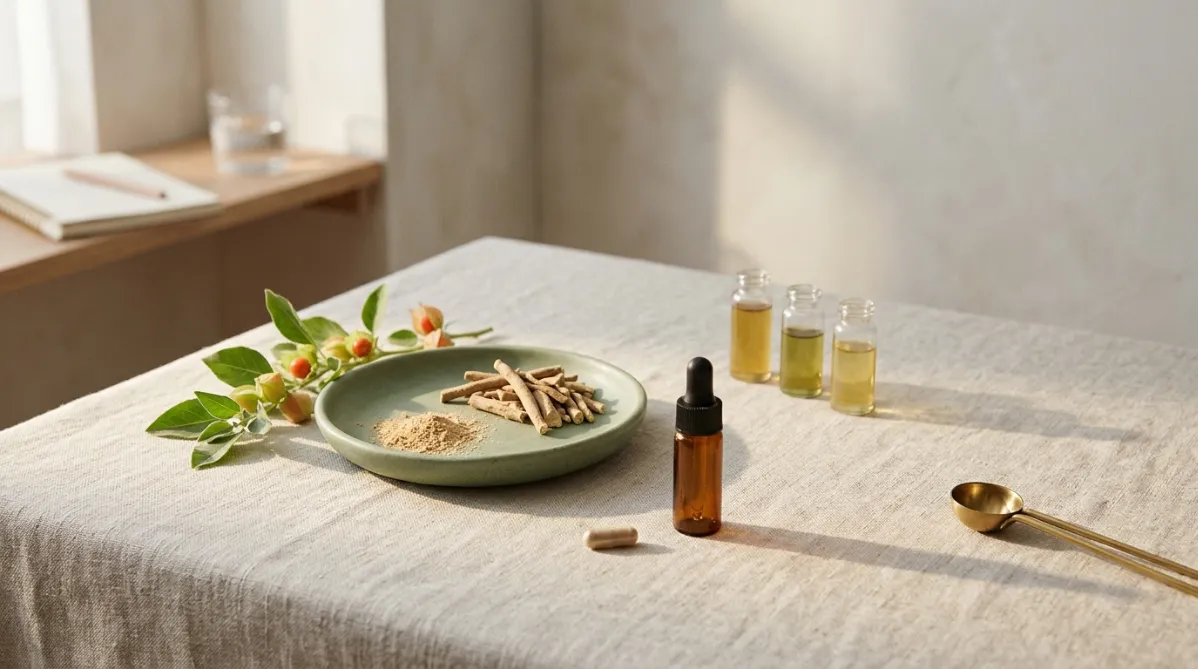
A softly lit, minimalist editorial still life on a pale oat-colored linen surface, shot from a slightly elevated three-quarter angle. In the center-left, a small handmade ceramic dish in matte sage green holds a modest pile of dried ashwagandha root pieces and a scattering of fine tan powder. A few fresh ashwagandha sprigs, with delicate green leaves and small orange-red berries in papery husks, rest beside it. In front, a single tiny capsule sits alone on the linen, with a slim glass dropper bottle in amber tint just behind it, suggesting a very small dose. To the right, a neat row of three small glass vials stands slightly out of focus, their contents a muted gold, hinting at comparison without any labels or text. A delicate brass measuring spoon lies at the edge of the frame, catching a thin highlight.

Soft morning window light falls from the upper left, casting long, gentle shadows and a warm glow across the textures: rough linen weave, matte ceramic, glossy glass, and the powdery root. The color palette is calming and earthy, with sage green, warm cream, soft terracotta, amber, and touches of muted coral from the berries. In the background, a blurred, airy room with a pale plaster wall and a hint of a wooden shelf holding a notebook and a small glass of water, adding a quiet wellness-journal atmosphere. Shallow depth of field, crisp focus on the dish and capsule, and generous negative space on the right third of the frame for headline overlay. The overall mood is calm, thoughtful, and slightly skeptical, like a contemporary health and science magazine feature, with natural, realistic photography, fine grain, and subtle film-like color grading.
science research

30 mg de Ashwagandha Reduzem o Estresse em 4 Semanas: o Que Você Precisa Saber

BY DR. GYMBRO ·

A maioria dos ensaios com ashwagandha usa de 250 a 600 mg por dia, mas este testou apenas 30 mg durante 28 dias em 60 adultos estressados. O grupo que recebeu ashwagandha relatou menos estresse e o cortisol salivar permaneceu estável durante um estressor de laboratório, enquanto o do grupo placebo aumentou. O porém é que os valores‑p ficam entre 0,04 e 0,047, a análise por protocolo não foi significativa e a maioria dos outros desfechos não mostrou diferença. O fabricante do extrato ainda financiou o estudo. Aqui está o que os dados sustentam, quem pode se beneficiar e o que não fica comprovado.

A soft, editorial still life photographed in a calm bedside setting at dusk, in landscape format. On a pale oak nightstand sits a single smooth, off-white oval caplet resting on a small matte ceramic dish in warm oatmeal tones. Next to it is a half-full glass of water with delicate condensation. Behind them, a small amber glass supplement bottle with a minimal cream label stands slightly out of focus. A few dried ashwagandha roots and a sprig of green leaves with small orange-red berries are arranged loosely across the wood grain in the foreground, adding an organic, botanical feel.

The background is a softly blurred bedroom with linen bedding in muted sage and sand tones. A warm lamp with a paper shade casts a golden glow from the left. Through a sheer curtain, deep blue twilight hints at evening. The light is gentle and directional, with long soft shadows and a subtle film-grain texture.

A small analog alarm clock with a muted face sits in the blurred distance, suggesting nighttime without dominating the scene. To the right, a folded cream notepad and a slim pen suggest research and note-taking, adding a quiet editorial touch. The composition follows the rule of thirds, with the caplet and dish in the lower-left third and generous negative space on the right for headline overlay.

The palette is earthy and restrained: sage green, warm beige, soft terracotta, and muted navy. The mood is thoughtful, trustworthy, and wellness-focused, like a modern health journal or a minimalist lifestyle magazine. Shallow depth of field with a crisp focus on the caplet, shot at eye level with an 85mm lens aesthetic, and high-end, natural, and tactile.
science research

Um comprimido de ashwagandha à noite supera o placebo. Leia isto antes de comprar

BY DR. GYMBRO ·

Em um ensaio duplo‑cego com 226 participantes, um comprimido de ashwagandha tomado uma vez ao dia após a refeição, preferencialmente à noite, superou o placebo em estresse, ansiedade e bem‑estar mental ao longo de oito semanas. As diferenças atingiram p < 0,0001 tanto nas análises por intenção de tratar quanto por protocolo, e não foram relatados eventos adversos graves ou relacionados ao produto. Contudo, o resumo não informa a dose nem o tipo de extrato, e dois autores são funcionários da fabricante. A seguir, veja o que o estudo demonstra, o que deixa de fora e quem deve pensar duas vezes antes de experimentar.

A wide landscape editorial photograph of a modern, softly lit home gym corner with pale oak flooring and a matte white wall. In the foreground, a chalk-dusted barbell rests across a minimalist bench, shot at a low angle with shallow depth of field. On a small natural-wood side table beside it sits a ceramic dish holding a few amber-colored capsules, a handful of dried ashwagandha roots, and a few green leaves. A matte glass of water and a folded linen towel sit nearby. A slim open notebook with a pen lies next to the dish, suggesting careful reading and note-taking, with blurred handwritten columns that suggest comparison, but no legible text.

Soft morning window light enters from the left, casting long, gentle shadows and a warm golden glow across the scene. The palette is muted and earthy: sage green, warm sand, cream, charcoal gray, and touches of terracotta. A single potted green plant in the background adds texture. Two weight plates in stacked, muted tones lean against the wall, slightly out of focus.

The composition follows the rule of thirds, with the barbell and supplement dish on the left and generous negative space on the right for headline overlay. The mood is calm, trustworthy, and analytical, like a contemporary health and science magazine cover. Crisp detail, natural film-like grain, subtle color grading, and a clean, uncluttered, premium lifestyle feel. No people, no text, no logos, no futuristic elements.
supplements

Ashwagandha SR quase dobrou o ganho no supino em 90 dias — entenda os detalhes

BY DR. GYMBRO ·

Uma cápsula de ashwagandha de liberação sustentada, tomada uma vez ao dia, quase dobrou o ganho de força no supino em comparação ao placebo em um estudo de 90 dias. Os participantes que usaram 300 mg de AshwaSR acrescentaram 15,31 kg ao seu 1‑RM, enquanto o grupo placebo somou 7,33 kg. Contudo, o aumento de testosterona nos homens não superou o placebo, o estudo foi financiado pelo desenvolvedor do produto e os valores de VO₂máx parecem exagerados. Veja o que realmente foi demonstrado, a dose utilizada, para quem pode ser indicado e quem deve evitar.

This page is available in