Dr. Gymbro
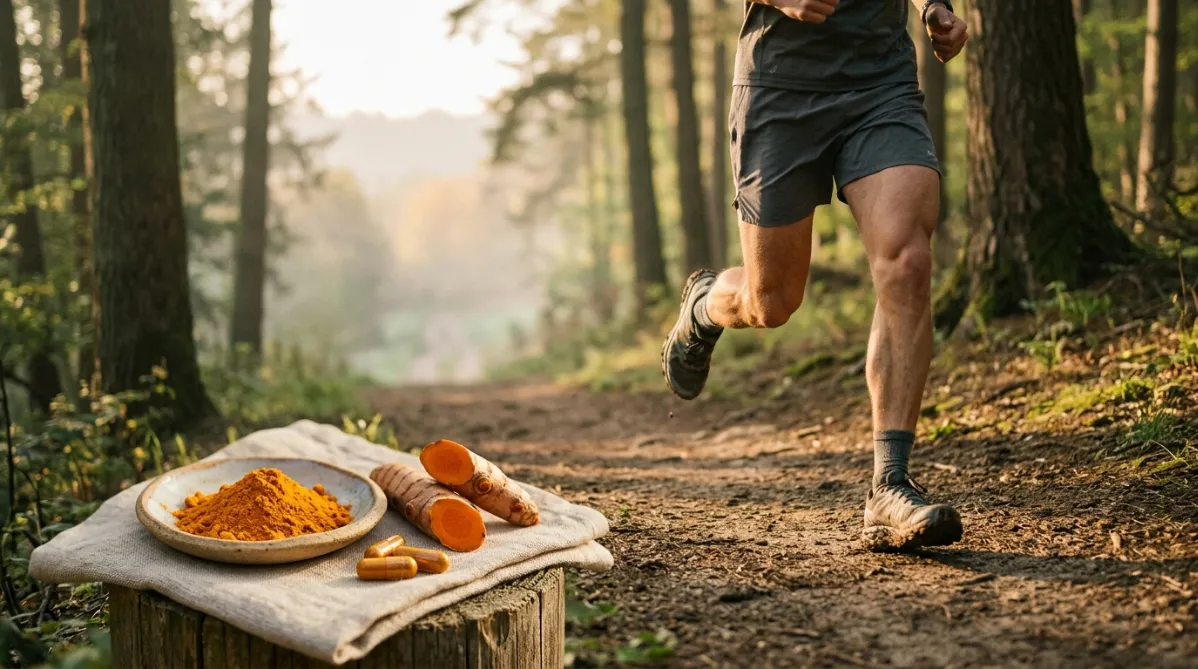
A wide, editorial-style photograph of a male runner mid-stride on a gently sloping forest trail at early morning, shot from a low three-quarter angle. Soft golden light filters through tall trees and casts long dappled shadows across the packed dirt path. The runner is captured from the waist down and slightly from the side, wearing charcoal running shorts and worn trail shoes, with the quadriceps and thigh muscles defined and naturally lit. A fine mist hangs in the background, and the slope descends toward a blurred, softly glowing horizon.

In the foreground, slightly out of focus on a weathered wooden post or flat mossy stone at the trail's edge, rests a small ceramic dish holding a pile of vivid golden-orange turmeric powder. Beside it sit two fresh turmeric roots, one cut open to show a deep saffron interior, and a few amber capsules. A thin linen cloth is draped beneath them. The saturated yellow-orange of the turmeric contrasts with the cool green and muted brown tones of the forest, creating a strong color anchor on the left third of the frame.

The composition follows the rule of thirds, with the turmeric in the lower left foreground and the runner in the right two-thirds, leaving open negative space in the upper left for headline text. Shallow depth of field, creamy bokeh, and natural film-like grain give it a refined, modern health-and-science magazine feel. The palette is warm and earthy: golden amber, moss green, soft cream, and deep umber. The lighting is natural and gentle, with subtle rim light on the runner's calves and hamstrings. No text, no logos, no graphics, and no futuristic elements. The result should feel clean, calm, and aspirational, like a cover image for a premium wellness and sports-nutrition journal.
Recovery

Curcumina Meriva Reduz Danos Musculares Visíveis por RM após Corrida em Descida

Dr. Gymbro · · 4 min read

O Gancho: Menos Músculos Danificados na RM

Correr em descida desgasta quadríceps e isquiotibiais. Cada passada é uma contração excêntrica; por isso, uma descida íngreme pode deixar você “andando escada abaixo ao contrário” por dias. Um ensaio randomizado de 2014, publicado no Journal of the International Society of Sports Nutrition, investigou se uma curcumina com boa biodisponibilidade poderia atenuar esse dano. O destaque foi que menos participantes que usaram curcumina apresentaram lesão muscular visível por RM nos compartimentos posterior e medial de ambas as coxas, em comparação ao grupo placebo.

O estudo é pequeno e tem limitações, descritas abaixo, mas o achado de imagem é o mais interessante e merece atenção.

O Que os Pesquisadores Fizeram

Drobnic e colegas recrutaram 20 homens saudáveis e moderadamente ativos e os randomizaram para curcumina ou placebo correspondente. O desenho foi um ensaio piloto simples‑cego: os participantes não sabiam qual produto estavam recebendo, embora os investigadores possivelmente soubessem.

Ambos os grupos realizaram um teste de corrida em descida para induzir dano muscular excêntrico. Quarenta e oito horas depois, a equipe avaliou o dano de três formas:

  • RM dos músculos da coxa
  • Marcadores sanguíneos de dano muscular e inflamação
  • Biópsia muscular (histologia)

Os participantes também relataram a intensidade da dor.

Dose e Timing

O protocolo é simples de reproduzir no papel:

  • Produto: Meriva, um sistema de entrega Phytosome curcumina‑lecitina
  • Dose: 1 g duas vezes ao dia, totalizando 2 g de Meriva por dia
  • Curcumina efetiva: cerca de 200 mg por dose, ou aproximadamente 400 mg de curcumina ao dia
  • Início: 48 h antes da corrida em descida
  • Fim: 24 h após a corrida
  • Duração total: 4 dias

O número "2 g" refere‑se ao complexo Meriva completo, não à curcumina pura. Muitas pessoas confundem esses valores ao comparar rótulos, portanto verifique quanto de curcumina seu produto realmente contém por porção.

O Que Funcionou

O achado mais robusto foi nas imagens. Significativamente menos indivíduos no grupo de curcumina apresentaram evidência em RM de lesão muscular nos compartimentos posterior ou medial de ambas as coxas. A RM é mais objetiva que uma escala de dor, o que torna esse resultado mais convincente que relatos subjetivos isolados.

Os marcadores sanguíneos de dano muscular e inflamação tenderam a ser menores com curcumina; apenas um alcançou significância estatística: interleucina‑8 (IL‑8) às 2 h pós‑exercício.

O Que Não Funcionou: Dor e Mecanismo

O resultado de dor é mais tímido do que os manchetes sugerem. Quem tomou curcumina relatou menos dor nas pernas em geral, porém as diferenças significativas apareceram apenas nas coxas anteriores direita e esquerda. Não houve redução generalizada de rigidez.

Outros dois desfechos não mostraram diferença:

  • Marcadores de estresse oxidativo: nenhum efeito
  • Histologia muscular: nenhum efeito

Isso é importante porque a hipótese do estudo era que a curcumina atenuaria o estresse oxidativo. Como os marcadores oxidativos não mudaram, o mecanismo permanece obscuro. Os autores reconhecem isso e pedem estudos maiores para "esclarecer melhor o mecanismo de ação".

Aviso: Vínculos Industriais e Forma de Biodisponibilidade

Meriva é um produto de marca da Indena SpA, de Milão, e o resumo do artigo cita a empresa. Estudos com ingredientes proprietários costumam envolver pessoas ligadas ao fabricante. Antes de tratá‑lo como evidência neutra, leia a declaração de conflitos de interesse completa.

A forma de entrega também é central. A curcumina padrão tem baixa absorção. Meriva associa a curcumina à lecitina para melhorar a biodisponibilidade. Esses resultados se aplicam a essa formulação, não ao açafrão de cozinha ou a cápsulas genéricas de curcumina. Não presuma que um pó barato terá o mesmo efeito.

Limitações

  • Apenas 20 participantes, portanto sub‑potencializado e exploratório.
  • Simples‑cego, o que deixa espaço para viés.
  • Homens saudáveis e moderadamente ativos apenas. Os achados podem não se aplicar a mulheres, idosos ou atletas de elite.
  • Desfechos secundários heterogêneos, com apenas um marcador sanguíneo significativo entre vários.
  • Sem dados de desempenho. Menos dano na RM não prova recuperação mais rápida ou melhor rendimento no treino.

Os autores concluem que a curcumina "tem potencial" para prevenir a dor muscular de início tardio (DOMS). Essa frase cautelosa reflete melhor os dados do que alegações de que ela "previne" ou "cura" a dor.

Como Aplicar na Prática

Se quiser experimentar o protocolo, o estudo oferece um modelo:

  1. Escolha uma forma bioavailable, de preferência a baseada em lecitina Phytosome usada aqui.
  2. Ajuste a dose: 2 g do complexo por dia, divididos em duas doses de 1 g.
  3. Inicie dois dias antes de um evento conhecido de dano muscular, como uma prova em descida, um bloco de treino excêntrico intenso ou uma trilha de trekking exigente.
  4. Continue por 24 h depois.
  5. Mantenha expectativas realistas. Você pode observar menos dano nas imagens, mas o benefício em dor foi limitado.

Isso não é conselho médico. Produtos de curcumina podem interagir com anticoagulantes e podem não ser adequados para quem tem problemas na vesícula biliar; consulte um profissional de saúde antes de usar, caso se enquadre em alguma dessas situações.

Conclusão

Este piloto oferece um sinal promissor, porém preliminar. O achado em RM é o destaque, o benefício de dor é regional e a evidência bioquímica é escassa. Uma replicação maior, duplo‑cego e com financiamento independente seria necessária para confirmar se a curcumina Meriva merece um lugar em um regime de recuperação.
Original study

Read the original research on pubmed.ncbi.nlm.nih.gov →

This article summarizes published research for general information. It is not medical advice.

DG

Written by

Dr. Gymbro

Dr. Gymbro writes for Dr. Gymbro: science-backed fitness, nutrition & performance.

Related Articles

A wide, editorial-style still life photographed from slightly above on a pale oat-colored linen surface, lit by soft natural window light from the left. At the center sits a rustic ceramic bowl of finely ground golden-tan ginger powder, with a small wooden spoon resting in it and a light dusting of spice across the cloth. Beside it lie several whole ginger rhizomes, knobby and honey-brown. One is sliced open to show its pale yellow, fibrous interior, and a few paper-thin slices fan out in the foreground. On the right, a folded heather-gray gym towel, a matte sage-green resistance band coiled loosely, and a single brushed-steel dumbbell sit just inside the frame, softly out of focus. A glass of warm amber ginger tea steams faintly near the upper right, with a thin curl of lemon peel inside. A few fresh green leaves and a small linen pouch of dried ginger add texture. The palette is warm and muted: cream, soft gold, sage, terracotta, and charcoal accents. The shallow depth of field keeps the ginger bowl and sliced root crisp while the gym elements melt into a gentle blur. Shadows are long and soft, and the negative space on the upper left leaves room for a headline. The mood is calm, clean, and modern, like a contemporary wellness or science journal cover. It is a natural, tactile, high-resolution photograph with subtle film grain and no text, no people, and no futuristic elements.
recovery

2 g de Gengibre Reduzem a Dor Muscular no Dia Seguinte em Cerca de 25 % em Dois Estudos

BY DR. GYMBRO ·

Um tempero comum da cozinha acabou de ser comparado a uma das queixas mais frequentes da academia: a dor muscular do dia seguinte. Em dois ensaios duplo‑cegos, quem tomou 2 g de gengibre por dia durante 11 dias sentiu cerca de 25 % menos dor 24 h após um treino excêntrico intenso. O gengibre, porém, não melhorou de forma clara a força ou o inchaço, e ninguém o comparou ao ibuprofeno. Vejamos o que a pesquisa mostra, por que pode funcionar, as limitações dos dados e quem pode considerar experimentar.

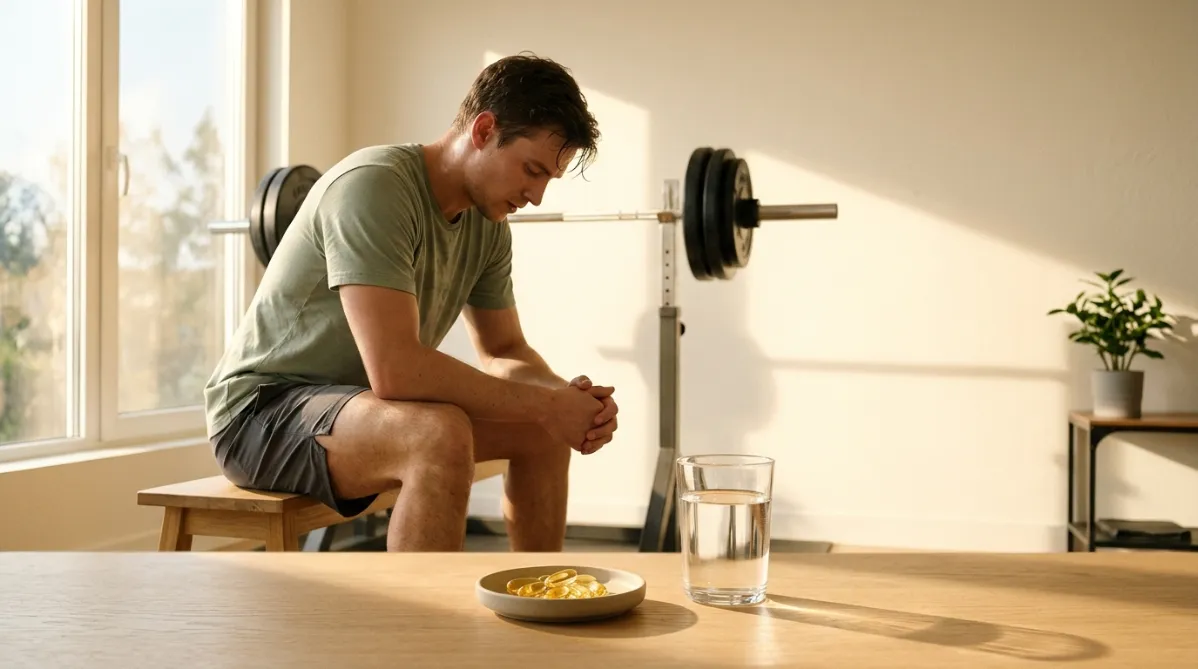
A sunlit, minimalist home gym corner photographed in soft golden morning light, with a young athletic man seated on a wooden bench, leaning forward with his elbows resting on his knees, catching his breath after a hard leg session. He wears a muted sage-green t-shirt and charcoal shorts, his face turned slightly away from the camera, calm and focused. A matte ceramic dish in the foreground holds a few small, translucent golden softgel capsules, with a glass of water beside it catching the light and casting a soft caustic shadow across a pale oak floor. Behind him, a loaded barbell rests on a squat rack, slightly out of focus, and a tall window pours warm sunlight diagonally across the scene, creating long gentle shadows and a hazy glow. A small potted green plant sits on a shelf at the edge of the frame. The color palette is warm and editorial: cream, soft gold, sage green, pale wood, and charcoal accents. Shallow depth of field, with crisp focus on the capsules and glass in the lower third and a creamy bokeh background. The composition leaves generous negative space on the right side for a headline overlay. The mood is clean, modern, and aspirational, like a high-end wellness magazine or a trendy health journal feature. Shot on a 50mm lens, natural light, fine film grain, subtle matte finish, landscape 16:9 framing.
recovery

Vitamina D acelera a recuperação de força em homens que não eram deficientes

BY DR. GYMBRO ·

Homens com níveis perfeitamente normais de vitamina D ainda recuperaram a força mais rapidamente após um treino de pernas intenso ao tomarem 4.000 UI por dia. Em um ensaio randomizado, controlado por placebo, com 28 homens ativos, a força isométrica máxima retornou cerca de 8 % melhor em 24 h. Os marcadores de dano muscular ALT e AST também aumentaram menos. Contudo, a dor muscular não melhorou. Veja o que o estudo encontrou, suas limitações e quem realmente pode se interessar.

A bright, airy editorial photograph shot from above at a slight angle, showing a tall clear glass of deep violet blueberry smoothie on a pale oak wooden table. The smoothie has a creamy, velvety texture with a few lighter swirls, and a small cluster of fresh blueberries with dusty blue skins rests on the rim of the glass. A matte white ceramic bowl of whole blueberries sits to the left, with a few berries scattered naturally across the tabletop. A folded linen napkin in soft oatmeal tones and a stainless steel straw add subtle texture.

In the softly blurred background, a rolled-up sage green yoga mat leans against a light wall next to a pair of clean white running shoes and a small pair of brushed-metal dumbbells. A sliver of warm morning sunlight enters from the left window, casting gentle diagonal shadows and a golden glow across the table, with soft highlights on the glass and the berries' surface bloom.

The color palette is fresh and modern: deep indigo and violet from the smoothie, balanced by cream, warm beige, soft sage green, and touches of white. The composition follows the rule of thirds, with the glass placed on the right third and generous negative space on the left, suitable for headline overlay. Shallow depth of field, crisp focus on the glass and berries, creamy bokeh in the background. The mood is calm, healthy, and aspirational, like a contemporary wellness magazine or a trendy health journal website. Natural, realistic, high-end food and lifestyle photography style, 16:9 landscape format, clean and uncluttered.
nutrition

Smoothie de mirtilo ajuda pernas doloridas a recuperar a força mais rápido

BY DR. GYMBRO ·

Dez mulheres, 300 contrações excêntricas intensas do quadríceps e um smoothie de mirtilo. Neste ensaio cruzado randomizado, a bebida à base de fruta acelerou a recuperação da força isométrica máxima em 60 h (p = 0,047), enquanto o placebo com capacidade antioxidante semelhante não trouxe benefício. Isso indica que a vantagem não se deve apenas aos antioxidantes. Apenas um desfecho foi significativo e a amostra foi pequena, de modo que a evidência é promissora, mas não conclusiva. A seguir, explicamos como o estudo foi realizado, o que encontrou e como aplicar a estratégia nos treinos de pernas mais exigentes.

A wide, softly lit editorial still life on a warm off-white linen surface. At the center-left, a matte ceramic bowl holds a small mound of fine golden-yellow quercetin powder, with a few scattered capsules beside it. Next to the bowl sit fresh red onions (one halved to show its translucent purple layers), a few capers, and a small cluster of ripe apples with the skin on, all natural quercetin sources. On the right side of the frame, a sleek matte-black dumbbell rests at an angle beside a folded slate-gray gym towel. A minimalist glass beaker of water with a thin lemon slice sits just behind it.

Soft diffused morning window light enters from the upper left, casting gentle long shadows and subtle highlights on the powder and glossy onion skin. The color palette is muted and sophisticated: butter yellow, deep plum, warm cream, charcoal, with small touches of sage green from a single eucalyptus sprig. A subtle, out-of-focus background of pale plaster wall and a wooden shelf adds depth.

Shallow depth of field, shot from a slightly elevated three-quarter angle with a 50mm lens feel. Generous negative space in the upper right for a title overlay. The mood is clean, calm, and modern, like a premium wellness and science journal feature: tactile textures, natural materials, restrained composition, high-end editorial photography, and no text or logos.
science research

1 g/dia de quercetina antes de roscas excêntricas: o giro do IGF

BY DR. GYMBRO ·

O que acontece quando você faz carga de 1 g/dia de quercetina durante 14 dias antes de atacar os bíceps com trabalho excêntrico? Em um pequeno estudo cruzado controlado por placebo, marcadores de dano muscular como CK, LDH e mioglobina diminuíram, assim como o IL‑6. Curiosamente, a resposta do IGF‑I aumentou e o pico de IGF‑II apareceu dias antes do usual. Contudo, com apenas doze homens e sem dados de hipertrofia, isso indica um sinal promissor de recuperação, não garantia de crescimento muscular. Aqui está o que o estudo encontrou e como usar a informação com prudência.

This page is available in