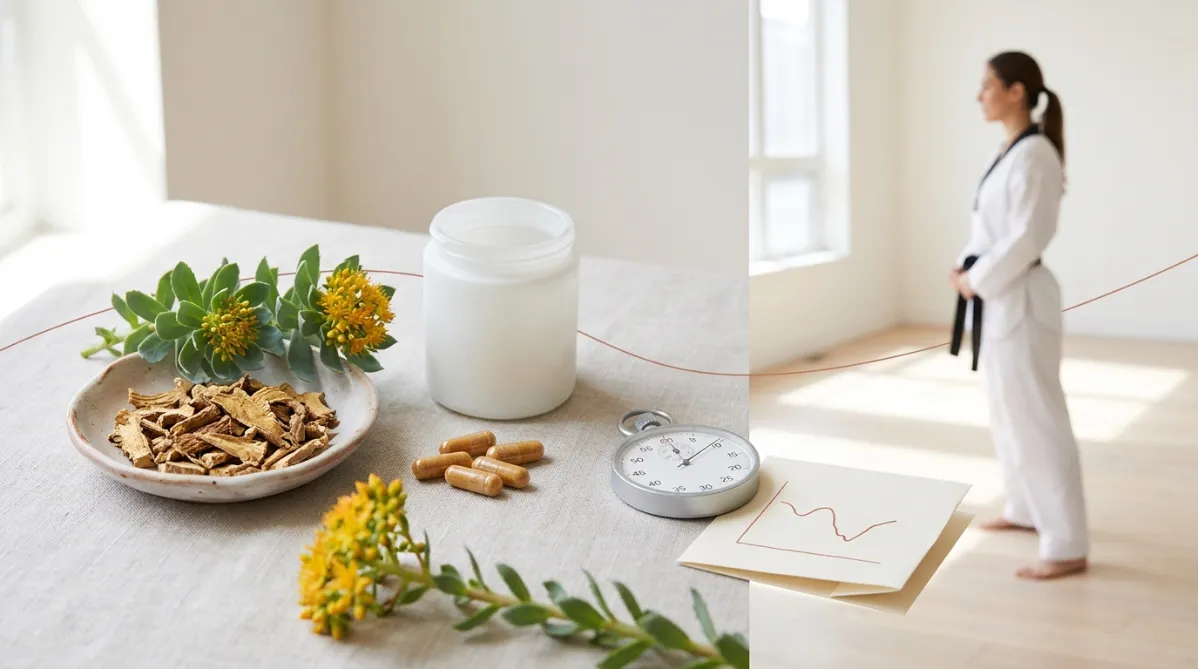
Premenstrual symptoms can wreck a training week. Irritability, poor focus, bad sleep, cravings and cramps don't care that you have a competition coming up. A new randomised trial suggests a cheap, widely sold herb might blunt some of that. The result that got our attention is a 60-millisecond improvement in visual reaction time. Before you add it to your cart, you need to know how small the study was and what the herb did not do.
O estudo: quem, o que e tamanho
Researchers from Allameh Tabataba'i University in Tehran and the German Sport University Cologne published the trial in the Journal of the International Society of Sports Nutrition. It was a randomised, double-blind, placebo-controlled trial, the strongest design for a supplement question like this.
The sample was small. Twenty-four female taekwondo athletes with moderate-to-severe premenstrual syndrome (PMS) were split into two groups of 12. One group took 500 mg per day of standardised Rhodiola rosea extract for 10 days during their estimated symptomatic premenstrual phase. The other group took a placebo. Researchers measured symptoms before and after with the Premenstrual Symptoms Screening Tool (PSST), along with reaction time, blood markers, perceived exertion and aerobic performance.
A descoberta principal: um cérebro mais rápido
After adjusting for baseline values, the Rhodiola group had a visual reaction time 60 ms faster than placebo (p < 0.001). In a combat sport, where reading an opponent's movement is half the job, that is the number that grabs attention. The paper tested a visual reaction task, though, not actual sparring or competition. How much of that 60 ms carries over to the mat is still an open question.
Sintomas: uma longa lista de melhorias
Compared with placebo, Rhodiola significantly reduced several PMS symptoms (p < 0.05):
- Irritability
- Depression
- Anxiety
- Social withdrawal
- Decreased concentration
- Hypersomnia (oversleeping)
- Food cravings
- Crying
- Skin problems
- Abdominal pain
That covers mood, cognition, appetite and physical discomfort, which is a wide spread for a single herb. The symptoms were self-reported, though. Even with a placebo control, subjective scales in a small group can be noisy.
Serotonina, GABA e esforço
Peripheral serum serotonin and GABA were both significantly higher in the Rhodiola group than in the placebo group (p < 0.001). These are neurotransmitters tied to mood, calm and arousal, so the finding fits the symptom improvements. The authors measured them in blood, however. Blood levels don't reliably show what is happening in the brain, so treat this as a hint about a mechanism, not proof of one.
The athletes also reported that exercise felt easier. Post-exercise rating of perceived exertion fell by 1.40 Borg units compared with placebo (p = 0.006). The same work felt less taxing.
O que a Rhodiola NÃO fez
This is the part the supplement ads leave out. Time to exhaustion and estimated VO₂max did not differ between groups (p > 0.05). Rhodiola made the athletes feel better and react faster, but it did not improve the aerobic measures tested. If you hoped for a new endurance record, this study doesn't support that.
Dicas práticas
Dose: The trial used 500 mg per day of standardised Rhodiola rosea extract. The paper summary doesn't give the standardisation percentages, so check that your product states what it is standardised to.
Timing: Participants took it for 10 days during the estimated symptomatic premenstrual phase. It was a short, targeted window, not year-round use. Whether the effects hold up with longer or continuous use is unknown.
Who it may be for: Female athletes with moderate-to-severe PMS who notice that mood, focus and perceived effort drop in the days before their period. The evidence applies directly to young female taekwondo athletes. Other sports and populations are extrapolation.
Who should skip it or ask a professional first:
- Anyone on antidepressants or other serotonin-affecting medication. The study showed higher serotonin levels, so get medical advice first.
- Anyone with bipolar disorder or other mood conditions under treatment.
- Pregnant or breastfeeding women. This study doesn't address safety there.
- Tested athletes should choose third-party-certified products and check their governing body's rules.
- Anyone with severe PMS or PMDD. Persistent, disabling symptoms deserve a medical evaluation, not just a supplement.
Limitações que você não pode ignorar
The authors say so themselves. With only 12 people per group, the results are fragile, and chance or individual variation can have an outsized effect. The premenstrual phase was estimated, not confirmed with hormone testing, so some participants may have been in a different phase than assumed. Ten days is short, and the study can't speak to long-term effects. The performance tests were also not sport-specific, and no direct physiological measurements were taken beyond blood markers and estimated VO₂max. The authors call for larger trials with hormonal confirmation, longer interventions and sport-specific performance tests. The study reported no conflicts of interest.
Conclusão
This small but well-designed trial suggests a short course of Rhodiola rosea during the premenstrual window may improve PMS symptoms, sharpen visual reaction time and make exercise feel easier for female athletes. It did not improve time to exhaustion or estimated VO₂max. It is promising early evidence, not a verdict. If you try it, treat it as a cautious experiment, keep a symptom log, and talk to a clinician if you take medication or have a mood condition.