Dr. Gymbro
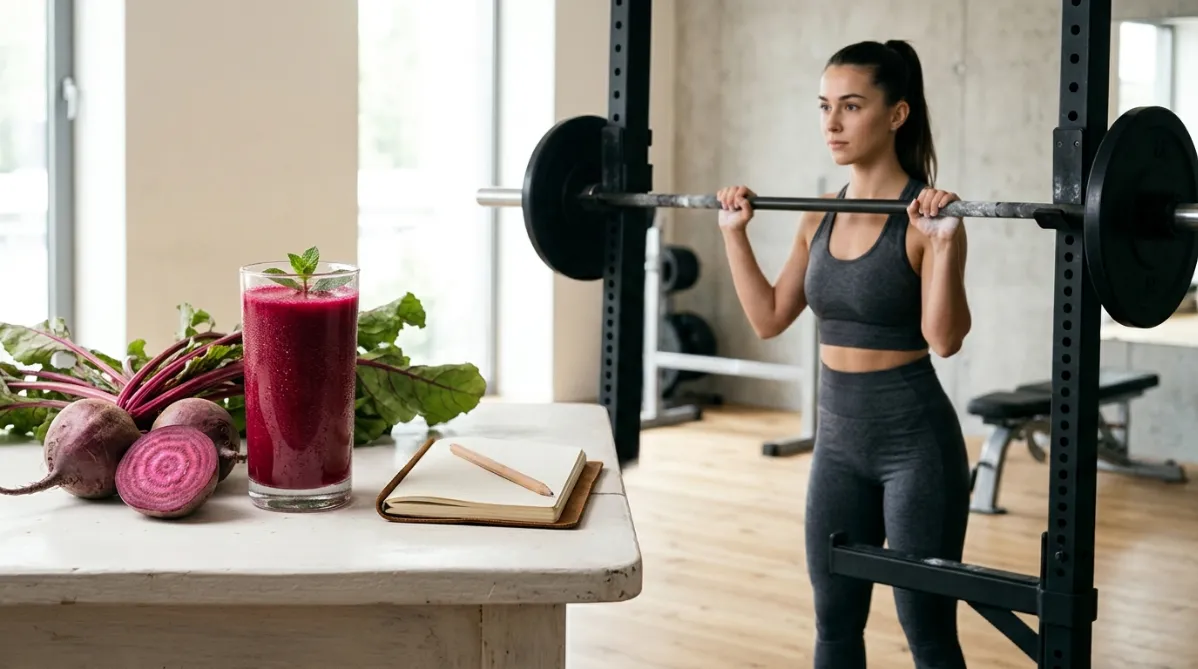
A wide, editorial-style photograph of a bright, modern gym corner softened by morning window light. In the foreground, a rustic matte-white ceramic table holds a tall clear glass of deep magenta beetroot juice, beads of condensation on the glass, a few fresh whole beetroots with leafy crimson-veined stems beside it, and one beetroot sliced in half to reveal its vivid concentric purple-pink rings. Next to the glass sits a small, neat notebook with a pencil, suggesting a research note, with no legible text. Behind the table, slightly out of focus, a young woman lifter with a tidy ponytail and a fitted charcoal training set stands at a barbell resting on a squat rack, chalk-dusted hands gripping the bar, calm and focused expression. A loaded bench with a bar is visible further back, with matte black plates and a light wooden floor. The palette is restrained and trendy: warm off-white, soft concrete gray, muted sage green accents from the beet leaves, and a bold beetroot magenta as the focal color. Shallow depth of field with a creamy bokeh background, natural side lighting casting long gentle shadows, subtle film grain. Composition follows the rule of thirds, with the juice and beets on the left third and the lifter on the right, leaving clean negative space in the upper area for a headline overlay. Mood is thoughtful, clean, and slightly skeptical, like a contemporary health and science journal cover. Realistic photography style, high-end magazine look, no text, no logos, no futuristic elements.
Nutrition

Suco de beterraba decepciona mulheres levantadoras — e ainda reduz o supino

Dr. Gymbro · · 4 min read

Você já ouviu o hype: suco de beterraba, o suplemento roxo que supostamente transforma os vasos sanguíneos em superestradas e faz a barra disparar como um foguete. Um novo ensaio randomizado com mulheres treinadas em resistência acabou de colocar essa promessa à prova. O resultado? Nenhum benefício no agachamento e uma leve queda na potência do supino em uma carga.

O que os pesquisadores realmente testaram

Uma equipe liderada por pesquisadores da Pepperdine University, com colaboradores da University of Virginia, McMaster, Birmingham City e Loughborough, publicou o estudo no European Journal of Applied Physiology (2026). Dezoito mulheres treinadas em resistência participaram de um desenho cruzado, duplo‑cego e randomizado. Cada participante passou por ambas as condições, o que torna a comparação mais limpa que comparar dois grupos distintos.

As duas bebidas foram:

  • Placebo (PL): suco de beterraba sem nitrato, com teor praticamente nulo.
  • Suco de beterraba (BR): suco rico em nitrato, fornecendo cerca de 6,7 mmol de nitrato, ou aproximadamente 415 mg.

Ambas foram consumidas 2,5 horas antes do exercício, janela de tempo comumente usada em pesquisas com nitrato.

O treino: rápido, leve a moderado, explosivo

Não se tratou de um teste de força máxima. As participantes fizeram séries de três repetições explosivas de agachamento com barra e de supino em 55 %, 60 % e 65 % da sua one‑rep max, com dois minutos de repouso passivo entre as séries. Um transdutor linear mediu a potência pico e média, bem como a velocidade em cada série. O protocolo foca nos esforços rápidos e potentes que o nitrato costuma prometer melhorar.

A manchete: agachamento não apresentou efeitos

Para o agachamento, não houve diferenças entre as condições em nenhuma das variáveis (todos P > 0,05). O suco de beterraba não aumentou a potência nem a velocidade em nenhuma das três cargas. Os autores concluíram que a ingestão aguda de nitrato não melhora o desempenho no agachamento nessa população.

O twist: supino ficou ligeiramente pior em 60 %

O supino também foi neutro, com uma exceção. Em 60 % da 1RM, o suco de beterraba obteve desempenho inferior ao placebo:

  • Potência média: 201 ± 61 W com BR vs. 206 ± 61 W com placebo (P = 0,047, gz = ‑0,48)
  • Velocidade média: 0,68 ± 0,08 m/s com BR vs. 0,70 ± 0,08 m/s com placebo (P = 0,049, gz = ‑0,50)

A diferença foi de cerca de 5 W e 0,02 m/s. Ambos os valores‑p mal ultrapassaram o limiar de 0,05, e o efeito apareceu apenas em uma carga. As séries de 55 % e 65 % não mostraram diferenças. Com tantas variáveis analisadas, esse achado pode muito bem ser um resultado estatístico fortuito. Os autores não afirmam que o nitrato prejudica levantadoras; dizem que são necessárias mais pesquisas para determinar se o nitrato tem efeito ergolítico (reduzido) em mulheres treinadas em resistência.

Como ler isso com honestidade

Trata‑se de dados humanos, não de animais ou células, mas tem limitações. A amostra foi pequena (18 mulheres), a dose foi única e aguda, e apenas três cargas leves a moderadas e séries de três repetições foram testadas. O estudo não informa nada sobre levantamentos máximos pesados, séries de alta repetição até a falha, ou suplementação diária por semanas. Os autores declararam que não há conflitos de interesse.

Conclusões práticas

Dose e tempo usados no estudo: cerca de 6,7 mmol de nitrato (aprox. 415 mg), ingeridos 2,5 horas antes do treino. Verifique o rótulo do seu produto, pois o teor de nitrato varia muito entre sucos e shots.

Quem provavelmente não deveria se preocupar: se você é mulher que levanta para força e potência no agachamento e no supino, este estudo não dá motivo para esperar um impulso de pré‑treino do suco de beterraba. No melhor dos casos, não fez nada; em uma carga do supino ficou ligeiramente pior.

Quem ainda pode se beneficiar: este estudo não responde essa questão, pois não avaliou desempenho aeróbico ou sprints. A pesquisa com nitrato historicamente foca em desempenho de endurance e de alta intensidade; atletas dessas áreas ainda podem ter razões para experimentar. Considere isso como contexto de fundo, não como conclusão deste artigo.

Modo inteligente de experimentar: se você gosta de suco de beterraba, não altere o resto da sua rotina. Experimente em alguns dias de treino, registre a velocidade da barra ou a percepção de desempenho, e compare com dias sem ele. Se não ajudar, você estará apenas pagando por uma bebida roxa cara.

Conclusão final

O suco de beterraba não é um pré‑treino mágico para a potência da barra em mulheres. Neste ensaio, não gerou ganhos no agachamento e provocou uma leve queda no supino em uma única carga, o que precisa ser replicado antes de se tirar conclusões definitivas. A lição maior é que a boa reputação de um suplemento em um esporte não se traduz automaticamente para a plataforma de levantamento de peso.

Original study

Read the original research on pubmed.ncbi.nlm.nih.gov →

This article summarizes published research for general information. It is not medical advice.

DG

Written by

Dr. Gymbro

Dr. Gymbro writes for Dr. Gymbro: science-backed fitness, nutrition & performance.

Related Articles

A wide editorial still life on a clean, pale oatmeal-colored linen surface, lit by soft natural window light from the left. In the center-left, a small clear glass shot glass filled with deep magenta-crimson beetroot juice catches a glowing highlight, with a few droplets beaded on the surface beside it. Behind it sit two whole beetroots with their leafy stems, the skins a dusty burgundy and the stems a vivid pink-red, and one beetroot sliced in half to reveal concentric rings of magenta and soft pink. To the right, a vintage-style brass stopwatch rests at an angle on the linen, its white face crisp and its hands frozen, slightly out of focus in the foreground edge. A faint curve of a sprinting track lane, in muted terracotta with thin white lines, sweeps diagonally across the blurred background, hinting at a running track without showing any people. Scattered across the surface are a few small, delicate beet-colored splashes and a light dusting of coarse sea salt. The palette is restrained and modern: warm cream, terracotta, dusty rose, deep magenta, and touches of sage green from the leaves. Shallow depth of field and a gentle film-like grain give it a contemporary lifestyle-magazine feel. The composition leaves generous negative space on the upper right for title overlay. Minimalist, tactile, calm, and sophisticated, in the style of a high-end health and science journal's editorial photography, 16:9 landscape.
nutrition

Suco de beterraba aumentou nitrito 35 vezes, mas corredores não ficaram mais rápidos

BY DR. GYMBRO ·

Um estudo randomizado, duplo‑cego e controlado por placebo com 12 velocistas masculinos mostrou que 70 mL de suco de beterraba elevaram o nitrito salivar em cerca de 35 vezes, mas não melhoraram os tempos nos sprints de 60 m e 100 m, a altura do salto nem a maioria das medidas de função muscular. Veja o que foi testado, as limitações do experimento e quem realmente pode se beneficiar do suco de beterraba.

A wide, editorial-style still life photographed on a pale warm-gray concrete surface in soft, diffused morning window light. On the left side, a tall clear glass filled with deep magenta-crimson beetroot juice sits beside two halved raw beetroots, their concentric rings of vivid fuchsia and purple clearly visible, with a few small green-and-red-veined leaves draped casually nearby. On the right side, a matching clear glass of cloudy white creatine solution rests next to a small matte ceramic bowl heaped with fine white powder and a minimal wooden scoop, a light dusting of powder scattered across the surface. In the center, between the two sides, a simple matte black barbell grip and a single chalk-dusted weight plate edge rise into the frame at a low angle, hinting at lifting without showing a person. The composition is split in a balanced, symmetrical way, with a subtle vertical shadow line dividing the saturated magenta tones on the left from cool, neutral whites and creams on the right. The background is softly blurred with a muted sage-green and oatmeal-toned wall, with plenty of negative space at the top for a headline overlay. Shallow depth of field, crisp focus on the glasses' condensation droplets and the textured beetroot flesh. The color palette is limited and refined: magenta, cream, charcoal, and soft sage. The mood is clean, modern, and health-journal chic, like a contemporary wellness magazine cover, with natural shadows, a tactile matte finish, and subtle film-like grain. No text, no logos, no futuristic elements.
nutrition

Suco de Beterraba vs. Creatina: Quem Vence no Levantamento em 72 horas?

BY DR. GYMBRO ·

Um ensaio randomizado cruzado comparou suco de beterraba e creatina durante cerca de 72 h de suplementação em levantadores iniciantes. A creatina foi a única que aumentou as repetições no supino a 80 % de 1RM, enquanto o suco de beterraba se destacou em velocidade da barra, oxigenação muscular, frequência cardíaca máxima e recuperação de HRV. O resumo não informa doses nem timing, então apontamos o que falta. Confira o placar completo e descubra quem deve escolher qual suplemento.

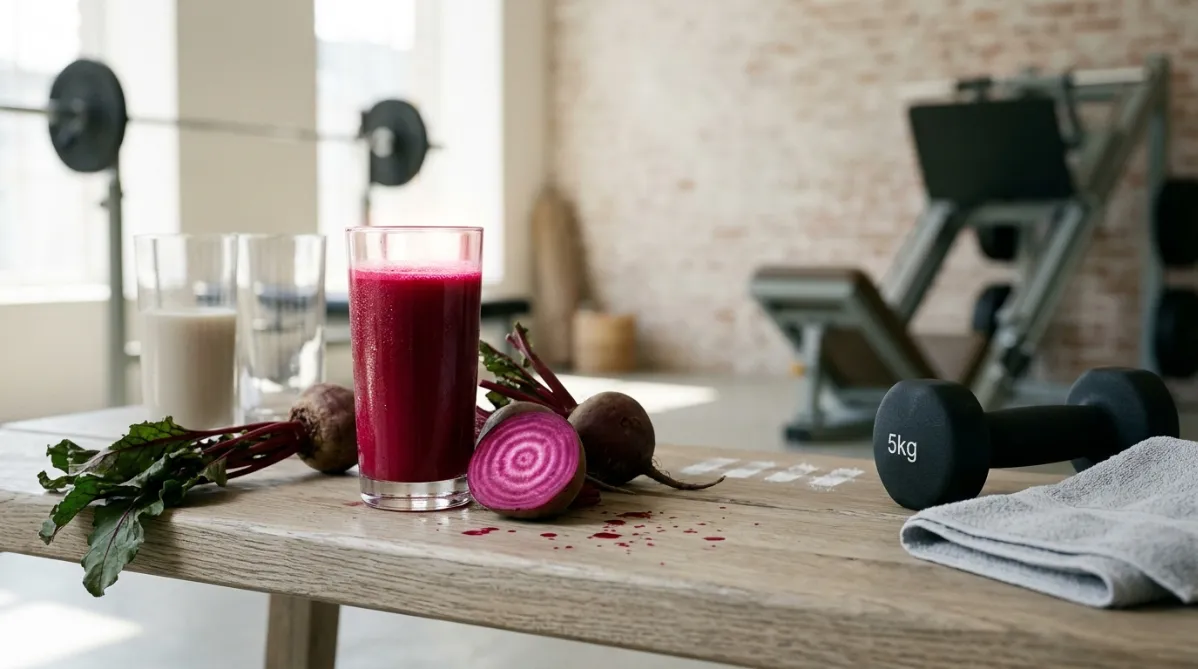
A wide, editorial-style still life photographed in soft natural window light, set on a pale oak gym bench or a light concrete surface. In the center foreground, a tall clear glass of deep magenta-crimson beetroot juice catches the light, with a faint luminous glow along its rim and condensation beading on the outside. Two other glasses sit slightly behind it, one holding a pale, neutral-colored liquid and one empty. They suggest the placebo and no-treatment conditions without any labels. Beside the glasses, a halved raw beetroot shows concentric rings of vivid fuchsia and violet. A few whole beets with their leafy stems and dark green and burgundy leaves are scattered casually nearby.

On the right side of the frame, slightly out of focus, a matte black women's-size dumbbell and a neatly folded light gray towel rest on the bench. Behind them, the soft blur of a minimalist, airy training space includes a barbell rack and a leg press machine in muted tones. The background is bright and neutral, in warm off-white, soft sand, and light gray, so the magenta of the juice is the dominant accent color.

A small, restrained motif of four evenly spaced chalk marks or four small round weight plates arranged in a neat row on the bench hints at the "four sets" of the trial. A few drops of beet juice have splashed onto the surface, forming a tasteful organic pattern.

The composition follows the rule of thirds, with the glass of juice on the left third and open negative space on the right for headline text. Shallow depth of field, crisp focus on the glass and beet, subtle film-like grain, and a calm, modern, trendy magazine aesthetic. The palette is magenta, deep burgundy, sage green, cream, and soft gray. The mood is quiet, skeptical, and scientific without any laboratory imagery, with clean lines and an elegant, minimal feel.
supplements

Suco de Beterraba Não Aumentou Nem Uma Repetição em Mulheres Treinadas em Resistência

BY DR. GYMBRO ·

O suco de beterraba é divulgado como potencializador natural de repetições, mas um ensaio duplo‑cego cruzado com mulheres treinadas em resistência não encontrou nenhum benefício. Dezesseis participantes ingeriram suco rico em nitrato (12,8 mmol), um placebo ou nada antes de quatro séries de supino e leg press até a falha. O total de repetições, a percepção de esforço, a frequência cardíaca, a pressão arterial e o lactato permaneceram inalterados. Os resultados não descartam a beterraba definitivamente, mas sugerem que o efeito ergogênico do nitrato pode ser limitado para essa população e esse protocolo.

A sunlit, minimalist kitchen counter in a modern home, photographed from a slightly elevated three-quarter angle with soft natural morning light spilling in from a window on the left. In the center sits a matte white ceramic mug of black coffee with a thin curl of steam, beside a small glass jar of deep magenta beetroot powder with a wooden scoop resting on the lid. A scattering of fine crimson powder dusts the pale oak surface in an artful, casual swirl. Nearby, a halved raw beetroot reveals vivid concentric rings of purple and pink, next to a few roasted coffee beans and a neatly folded charcoal gym towel. In the soft-focus background, a pair of clean white running shoes and a stainless steel water bottle sit on a floating shelf, hinting at a pre-workout routine. A single sprig of green beet leaves adds a fresh accent.

The color palette is warm and editorial: creamy neutrals, espresso browns, and rich beet magenta, with gentle highlights and long soft shadows. The composition has generous negative space on the right side for headline text, shallow depth of field, and a crisp, tactile texture on the ceramic, powder, and wood grain. The mood is calm, health-conscious, and contemporary, like a lifestyle feature in a premium wellness magazine or a trendy nutrition journal. Clean, balanced, natural, with subtle film-like grain and a slightly muted, high-end finish.
science research

Cafeína de Pré‑Treino Rigidifica Artérias; Pó de Beterraba Compensa

BY DR. GYMBRO ·

Um ensaio cruzado randomizado mostrou que uma dose pré‑treino de cafeína (6 mg/kg) aumentou marcadores de rigidez arterial em 2,5 h. Quando adicionou‑se ao protocolo um pó de beterraba contendo 400 mg de nitrato, esses marcadores voltaram aos níveis do placebo. Pressão arterial e função endotelial permaneceram inalterados, indicando um efeito sutil, não um alerta clínico. O estudo incluiu apenas 24 jovens adultos saudáveis e usou uma única dose, deixando dúvidas sobre uso crônico e em populações mais velhas ou hipertensas. A seguir, o que os dados revelam, o que não revelam e como interpretar se você depende de cafeína antes do treino.

This page is available in