Dr. Gymbro
A wide, editorial-style flat lay photographed from above on a pale warm-gray linen surface in soft natural window light. At the center, a small open amber glass jar tips gently onto its side, spilling a few cream-colored capsules across the fabric. Next to the jar sits a loose arrangement of fresh mushrooms: a cluster of golden-tan reishi with glossy, lacquered caps, a few slender white enoki stems, a halved shiitake showing its pale gills, and a curl of turkey tail with concentric bands of rust, cream, and charcoal. A small wooden scoop holds a pile of fine beige mushroom powder.

On the left third of the frame, a matte black sports watch with a minimal face lies beside a folded sage-green running shirt and a pair of lightweight off-white running shoes, hinting at athletic training without showing a person. A slim white notebook with a single pencil rests nearby, open to a blank page with a faint hand-drawn line graph trending upward, in thin graphite strokes.

On the right side, a pair of clear glass beakers and a single small petri dish with a soft amber-tinted liquid add a subtle laboratory note, kept calm and organic. A single sprig of dried herbs and a few scattered oat-colored grains add texture.

The palette is earthy and refined: oatmeal, soft sage, terracotta, warm amber, and charcoal accents against the muted neutral background. Shadows are soft and diffused, with a gentle highlight on the glass and the glossy reishi cap. The composition leaves generous negative space in the upper right for a headline overlay. Shallow depth of field blurs the edges slightly, while the central mushrooms and capsules stay crisp. The overall feel is modern, clean, and trendy, like a wellness and science magazine cover, with tactile natural textures, minimal styling, and a quiet sense of curiosity and skepticism.
Science & Research

Uma Cápsula de Cogumelo Elevou VO2max em 14,8 % — Mas Há um Grande Problema

Dr. Gymbro · · 4 min read

Um salto de 14,8 % no VO2max seria um resultado notável

Treinadores de elite passam anos buscando ganhos como esse, e ele aparece aqui, após apenas 40 dias de uso de uma cápsula de cogumelo. Esse número chamativo foi publicado no último artigo da revista Antioxidants e deve ser encarado com cautela, pois o estudo não contou com grupo placebo.

O número chamativo

O artigo (Kumar, Gill, Verma & Singh, Antioxidants 2026;15(11):1386) relata que 50 atletas saudáveis do sexo masculino, entre 18 e 22 anos, ingeriram 320 mg/dia de um extrato multico​gume rico em beta‑glucanos durante 40 dias. O VO2max relativo subiu de 46,26 para 53,12 mL/kg/min, um aumento de 14,8 % (p < 0,001). O VO2max absoluto cresceu 11,6 %. A cobertura da NutraIngredients ainda menciona que o tempo até a exaustão aumentou.

O suplemento era comercializado como "7‑in‑1 Mushroom Complex Extract". O material que analisei não especifica quais espécies de cogumelo foram usadas, portanto não farei suposições.

O grande problema: sem placebo, sem controle

Trata‑se de um estudo piloto não controlado, de braço único, com desenho pré‑pós. Não houve grupo placebo, nem randomização, nem cegamento. Os próprios autores descrevem os resultados como geradores de hipóteses.

Isso importa por três motivos:

  • O treinamento continuou. Os atletas mantiveram a rotina de treinos durante os 40 dias. Um jovem atleta pode melhorar o VO2max em seis semanas apenas com o treinamento, e esse desenho experimental não permite separar os efeitos.
  • Efeito de expectativa. Todos sabiam que estavam tomando um suplemento. A motivação pode influenciar um teste de esforço máximo, e nada no estudo controla esse fator.
  • População restrita. Os participantes eram todos homens jovens e saudáveis, de modo que os resultados não se aplicam a mulheres, idosos ou praticantes não‑atléticos.

O protocolo incluiu alguns cuidados: período de wash‑out de suplementação de 14 a 17 dias e dieta isocalórica padronizada. Essas medidas ajudam, mas não substituem um grupo controle.

O que mais mudou no sangue e na respiração

Os achados secundários são mistos e mais difíceis de interpretar:

  • Quociente respiratório de pico (RQ) subiu de 1,096 para 1,308 – um valor incomumente alto, que pede cautela na interpretação.
  • Hematócrito diminuiu de 44,5 % para 42,1 %, o que vai na direção oposta à ideia tradicional de "mais glóbulos vermelhos, mais oxigênio".
  • Volume corpuscular médio (MCV) aumentou.
  • Contagem de leucócitos caiu de 7,53 para 6,80 × 10⁹/L, com neutrófilos em baixa e linfócitos em alta.

Um hematócrito menor ao mesmo tempo em que o VO2max aumenta é curioso; o estudo não consegue explicar esse fenômeno. Pode ser um efeito fisiológico real, um deslocamento de volume plasmático ou apenas ruído. Sem um braço controle, ninguém pode afirmar a causa.

Experimentos em células: interessantes, mas outra questão

O artigo também apresenta uma parte de laboratório. Os pesquisadores usaram cardiomiócitos de rato (linha H9c2) e induziram hipóxia química com cloreto de cobalto (CoCl₂). Testaram três compostos isoladamente:

  • Beta‑glucano a 20 µg/mL
  • Taurina a 40 µM
  • L‑arginina a 50 µM

Todos melhoraram a atividade metabólica (de 67,29 % nas células apenas em hipóxia para 83,65–97,40 % nas tratadas) e reduziram a expressão de HIF1A, marcador da resposta celular à hipóxia. As medições Seahorse da função mitocondrial mostraram alterações que não atingiram significância estatística.

Há, porém, um descompasso entre esse trabalho e o ensaio em humanos. O experimento celular testou compostos puros em células de rato sob um modelo químico de baixa oxigenação, enquanto o estudo humano avaliou um extrato de cogumelo em atletas. Os dados celulares podem sugerir um mecanismo plausível, mas não demonstram que a cápsula age dessa forma nas pessoas.

O que a evidência pode (e não pode) sustentar

Pode sustentar: a existência de um sinal que vale a pena investigar. Uma mudança pré‑pós tão grande, com p‑valor baixo em 50 indivíduos, associada a dados celulares que apontam para vias de hipóxia, justifica a realização de um ensaio adequado.

Não pode sustentar: a afirmação de que o extrato de cogumelo eleva o VO2max em cerca de 15 %. Adaptação ao treino, efeito de expectativa, familiaridade com o teste e variação de medição podem, isoladamente ou em conjunto, explicar parte ou a totalidade da mudança. Um ensaio bem conduzido, controlado por placebo, provavelmente mostraria um efeito muito menor, se houver.

Lições práticas

  • Dose estudada: 320 mg/dia de um extrato multico​gume rico em beta‑glucanos.
  • Duração: 40 dias. O material revisado não especifica o horário de ingestão, portanto não há orientação baseada em evidência sobre o melhor momento.
  • Público‑alvo: homens jovens, saudáveis e treinados que queiram conduzir um experimento pessoal cuidadoso. Mesmo assim, encare como experimento, não como auxílio de performance comprovado. Registre seus próprios resultados sob condições consistentes.
  • Quem deve evitar ou consultar um profissional primeiro: pessoas alérgicas a cogumelos, gestantes, lactantes, indivíduos com condições médicas e quem utiliza medicação prescrita, especialmente fármacos que modulam o sistema imune. Atletas que testarem o produto também devem verificar rótulos e certificações de terceiros. Essa é uma cautela geral, não um achado do artigo.
  • O que não fazer: substituir fundamentos comprovados de performance (treinamento estruturado, sono, alimentação) por uma cápsula.

Conclusão

Um aumento de 14,8 % no VO2max é o tipo de número que se espalha rápido, e a ausência de grupo placebo é a razão para desacelerar. Este piloto oferece aos pesquisadores uma hipótese, não aos atletas um resultado definitivo. O verdadeiro teste será um ensaio randomizado, controlado por placebo, com composição de cogumelo bem definida, amostra mais diversificada e avaliação cegada. Até lá, a pergunta "a cápsula de cogumelo realmente acrescenta 15 % ao VO2max?" continua sem resposta.
Original study

Read the original research on doi.org →

This article summarizes published research for general information. It is not medical advice.

DG

Written by

Dr. Gymbro

Dr. Gymbro writes for Dr. Gymbro: science-backed fitness, nutrition & performance.

Related Articles

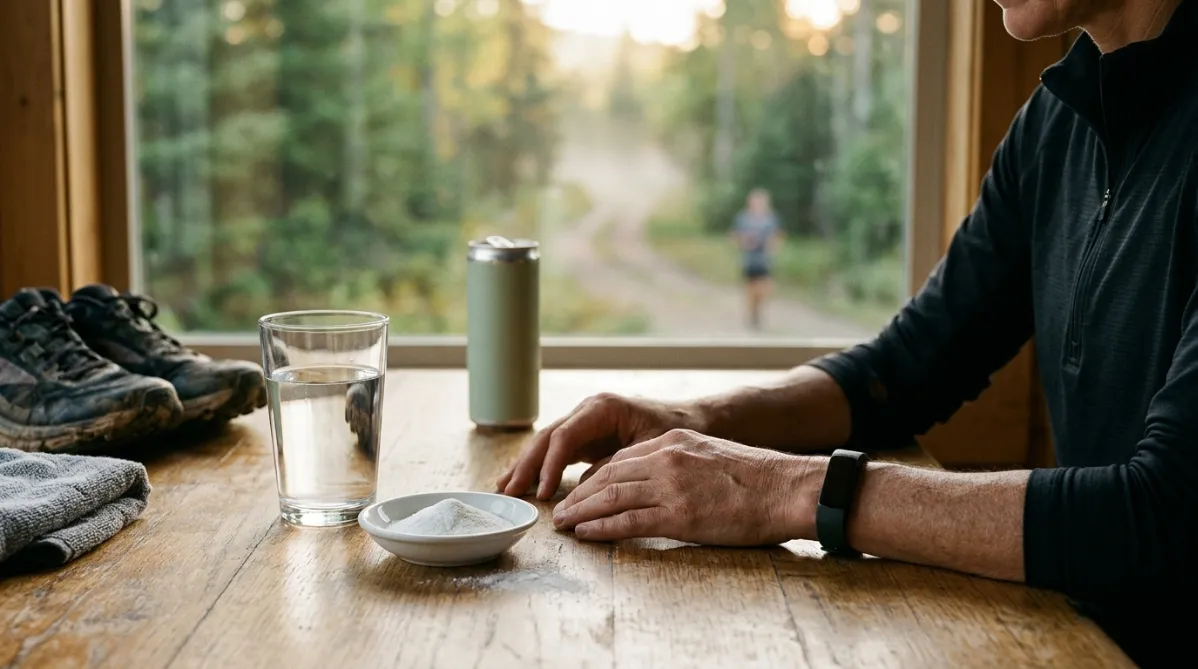
A landscape editorial photograph of a lone runner's hands resting on a weathered wooden table beside a small white ceramic dish of fine white powder and a clear glass of water, shot in soft morning light. A slim matte aluminum energy drink can, unbranded with a minimalist pale sage-green label, stands slightly out of focus in the background, with a single scoop of powder dusted lightly on the tabletop. A pair of worn running shoes and a folded gray towel sit at the edge of the frame. Through a large window behind them, a blurred misty trail winds through green trees at sunrise, with warm golden light spilling across the scene.

The color palette is calm and modern: creamy off-white, sage green, warm honey gold, and soft charcoal. The composition follows the rule of thirds, with the dish and glass in the lower left third and generous negative space on the right for a title overlay. The depth of field is shallow, with a crisp focus on the powder's delicate texture and tiny glints of light on the glass rim. The mood is clean, thoughtful, and quietly energetic, like a contemporary health and science magazine feature. Natural grain, subtle film-like softness, and gentle shadows give it an authentic lifestyle-editorial look. There are no text, logos, or futuristic elements, only tactile, real-world materials like wood, ceramic, glass, cotton, and metal.
nutrition

O Ingrediente da Bebida Energética que Aumenta a Resistência por Conta Própria

BY DR. GYMBRO ·

Todo mundo fala de cafeína, mas o outro ingrediente da lata de energético pode estar silenciosamente fazendo seu próprio trabalho. Uma meta‑análise de 2018, com 10 estudos, encontrou que a taurina isolada melhorou o desempenho de resistência (g de Hedges = 0,40) e que uma dose única parece ser suficiente. Nem a dose (1–6 g) nem o tempo de suplementação alteraram o efeito de forma relevante. O problema é que a base de evidência é pequena e os intervalos de confiança são amplos, transformando esse achado em um sinal promissor e não em uma garantia. Veja o que o estudo revelou e como testar a taurina de forma sensata.

A wide, landscape editorial photograph with soft natural morning light. In the foreground, a rustic matte ceramic bowl rests on a pale oak wooden table, filled with vivid deep-green spirulina powder heaped in a gentle mound. A small wooden spoon dusted with the powder lies beside it, and a few scattered green flecks dust the surface. Next to the bowl sits a clear glass of water with a swirl of emerald green just blending in, catching sunlight and casting soft green-tinted shadows.

In the middle ground, slightly out of focus, a pair of worn running shoes in muted sage and cream tones sits on the edge of the table, laces loosely undone. A simple analog stopwatch with a clean white face lies beside them, its hands frozen at a moment suggesting a close finish. A folded linen towel in warm oatmeal tone drapes casually nearby.

The background is a softly blurred outdoor setting seen through a large window: a quiet tree-lined running path at dawn, with golden-hazy light, dewy greenery, and a faint mist. The color palette is calm and modern: deep emerald, sage, cream, warm wood, and touches of soft gold. The composition leaves generous negative space on the right side for headline text, with a shallow depth of field, crisp detail on the powder texture, and a clean, minimalist, lifestyle-magazine aesthetic. Subtle film-like grain, natural shadows, and a fresh, healthy, energetic mood. No people, no text, no logos.
nutrition

Spirulina ajudou corredores a durar 32 % mais tempo — o detalhe

BY DR. GYMBRO ·

Corredores que usaram spirulina por quatro semanas conseguiram aguentar cerca de 32 % a mais em um esforço máximo após uma corrida exaustiva de duas horas. O mesmo estudo registrou um aumento de 10,9 % na oxidação de gordura e níveis mais elevados do antioxidante glutationa. Mas antes de encher o carrinho, há um detalhe: apenas nove homens participaram e o ganho real foi de cerca de 39 segundos. Veja o que a pesquisa revelou, por que pode funcionar e como testar com segurança.

A wide, editorial still life photographed in soft natural window light on a pale oatmeal-colored linen surface. At the center sits a small, rustic ceramic dish holding a handful of dried golden-orange Rhodiola rosea root pieces and a few fresh, fleshy green-gray succulent rosettes with rosy-pink tips. Beside it, a single matte amber glass capsule bottle lies on its side, with two cream-colored capsules spilling out. On the left, a minimalist analog stopwatch with a brushed brass case rests slightly out of focus, its hands suggesting a duration just past the quarter-hour mark. On the right, a worn, chalk-dusted steel kettlebell handle and a folded charcoal gym towel fill the negative space, hinting at lifting without showing a full gym scene.

In the foreground, a neat row of seven tiny ceramic pill cups arranged in a gentle diagonal line, the first cup holding one capsule and the rest sitting empty, as a quiet visual metaphor for a single dose versus daily dosing. A sprig of dried alpine moss and a few small speckled pebbles add organic texture. The background is a softly blurred warm-gray plaster wall with a gentle gradient shadow cast by a window frame, creating diagonal light stripes across the scene.

The palette is muted and earthy: sage green, terracotta, warm cream, brushed brass, and soft charcoal, with one subtle pop of coral from the Rhodiola tips. Shallow depth of field, crisp focus on the root and capsules, and fine film-like grain. The composition leaves generous clean negative space in the upper left for a headline overlay. The overall feel is a modern wellness and science journal: calm, tactile, minimal, and sophisticated, with a slightly moody, high-end magazine look. There is no text, no people, and no futuristic elements.
nutrition

200 mg de Rhodiola aumentam o tempo até a exaustão em 24 segundos; quatro semanas de uso diário não acrescentam nada

BY DR. GYMBRO ·

Uma dose única de 200 mg de *Rhodiola rosea* tomada uma hora antes do exercício elevou o tempo até a exaustão de 16,8 para 17,2 minutos e aumentou o VO₂peak em um estudo duplo‑cego e cruzado. O detalhe curioso é que quatro semanas de suplementação diária não geraram nenhum efeito adicional nem alteraram nenhuma das variáveis medidas. O ganho foi pequeno – cerca de 24 segundos – e força, tempo de reação e atenção permaneceram inalterados. Veja o que o estudo realmente mostrou, quem poderia testar uma dose aguda e por que não se deve contar com “carregar” a rhodiola.

A sunlit outdoor running track in late afternoon, shot from a low angle with shallow depth of field. In the foreground, a matte black bottle with a minimal off-white label sits on the edge of a warm terracotta-colored track lane, beside a folded white towel and a small glass of amber liquid catching golden light. Condensation beads on the bottle. A faint heat shimmer rises from the track surface and softens the background.

In the midground, slightly out of focus, a lean athlete in a sage-green tank top and charcoal shorts runs on a treadmill-like stretch of track, a thin sheen of sweat on their shoulders, their expression focused and calm. Their motion is gently blurred, suggesting endurance and rhythm. Long soft shadows stretch across the lane lines.

The background fades into hazy peach, apricot, and pale yellow tones, with the suggestion of tall trees and a distant stadium wall. Warm sun flare enters from the upper right, creating a subtle glow and a few soft light streaks across the frame.

Subtle editorial touches: a small notebook with a pencil and a stopwatch rest beside the bottle, hinting at data and timing without any text legible. The color palette is warm and muted, with terracotta, cream, sage, and charcoal accents, and a fine film-like grain. The composition leaves open negative space on the left third for a headline overlay. The overall mood is clean, modern, and health-journal inspired, natural and aspirational, with a calm scientific curiosity rather than hype.
nutrition

Bebidas de Cetona no Calor: Mais Resistência e Memória Mais Aguçada?

BY DR. GYMBRO ·

Bebidas de cetona costumam ser associadas a biohackers que queimam gordura, mas um novo estudo sob estresse térmico indica que elas podem ajudar a terminar sessões mais intensas. Em 17 homens treinados, a combinação de cetona monoéster e cafeína aumentou o tempo até a exaustão para 8,9 minutos contra 7,0 minutos com carboidrato e cafeína, após 90 minutos de corrida em esteira a 34 °C. A precisão da memória de trabalho no teste de 1‑back também melhorou, enquanto frequência cardíaca e temperatura central não apresentaram diferenças relevantes. Contudo, não houve benefício no teste de 2‑back, no tempo de reação ou na tarefa de acertar e evitar. O estudo foi pequeno, apenas com homens e de sessão única. Veja o que os dados realmente revelam e o que ainda não foi comprovado.

This page is available in