Dr. Gymbro
←

#muscle soreness

10 articles
nutrition

12 Weeks of 715 mg DHA Cut Post-Workout Soreness. Here's the Catch

BY DR. GYMBRO ·

A 12-week trial in people who train five or more days a week found that 715 mg/day of microencapsulated DHA raised the Omega-3 Index by about 2.4 points. Soreness was lower at both 24 and 48 hours after brutal eccentric cycling, and jump height recovered better at 48 hours, with a moderate effect size. But this isn't an acute recovery hack: the benefits appeared only after three months of daily intake. The trial was small, with 38 participants and uneven groups of 12 control and 26 DHA, so the results are promising but not definitive. Here's what the dose, timeline and caveats mean for you.

nutrition

Dark Chocolate Added 4.3 cm to Women's Jumps. Should You Care?

BY DR. GYMBRO ·

A new study found trained female CrossFit athletes jumped about 4.3 cm higher after three days of 30 g/day of 85% dark chocolate than with placebo chocolate. Knee strength outcomes improved too, but muscle soreness largely didn't budge. Before you stock up, the authors themselves call the effects unusually large and flag unmodeled period and carryover effects. This breakdown covers the dose, timing, who it might help, and why this is a promising signal rather than proof.
A bright, modern gym scene in soft natural morning light, shot in landscape with shallow depth of field. In the foreground, a matte white scoop sits on the rim of a minimalist matte-black tub of white powder, with a few fine grains scattered across a light oak wooden bench. Beside it is a clear glass shaker bottle filled with a pale, cloudy liquid, with condensation beads on the surface. In the soft-focus midground, a hack squat machine stands with a loaded barbell sled and stacked plates in brushed steel and black rubber. A lifter in a fitted charcoal t-shirt and shorts, face turned away, is mid-set with strong, defined quads and calves, and a light sheen of sweat catches the sunlight. Tall industrial windows in the background cast long golden light beams across a polished concrete floor, with a hint of green from a potted plant in the corner. The palette is warm and editorial: cream, sage green, charcoal, and a touch of terracotta orange. A small, neat notebook with a pen lies open on the bench, with tally marks hinting at counted reps. The composition follows the rule of thirds, with the supplement and shaker on the lower left, the lifter and machine on the right, and open negative space at the top for headline overlay. The style is clean, contemporary lifestyle photography, like a premium wellness magazine, with subtle film grain, natural color grading, and crisp detail on the foreground objects.
nutrition

8 g Citrulline Malate Added ~11 Hack Squat Reps—And Less Soreness

BY DR. GYMBRO ·

One 8 g scoop of citrulline malate an hour before leg day added about 11 extra hack squat reps in a new double-blind crossover trial. The same lifters also reported less soreness at 24 and 48 hours than on placebo. Strangely, blood lactate and perceived exertion didn't budge, so the session didn't feel easier. Here's who might benefit, how the study dosed it, and why the small sample and single-session design mean you shouldn't oversell the result.
A landscape editorial photograph with a clean, modern wellness-journal look, shot in soft natural morning light. In the foreground, a matte ceramic bowl of white powder sits on a pale oak surface with a wooden scoop beside it. A frosted glass tumbler of water stands next to it, and a few loose capsules in muted sage green are scattered nearby. Behind them, slightly out of focus, a lean athlete's lower legs and calves are visible as he sits on the edge of a plyo box, one hand resting on his calf. He wears neutral clothing, with sand-colored shorts and white training shoes. The setting is a minimalist, airy gym studio with concrete walls, a large window casting diffused golden light, and a rack of dumbbells softly blurred in the background. The palette is warm cream, soft sage, pale wood, and muted terracotta accents. The composition uses generous negative space on the left third for headline overlay, shallow depth of field, and subtle film grain. A folded white towel and a small notebook with a pencil rest on the surface, hinting at a research and tracking theme. The mood is calm, credible, and contemporary, like a premium health and fitness magazine cover, with crisp detail on the textures of powder, ceramic, glass, and skin.
recovery

10 g of EAAs Cleared Calf Swelling by 72 Hours—Placebo Didn't

BY DR. GYMBRO ·

Ten grams of essential amino acids around a brutal calf workout reduced next-day soreness compared with placebo. Calf swelling also returned to baseline by 72 hours, while the placebo group stayed puffy. The catch: the Achilles tendon showed no benefit, the soreness effect was modest, and the trial involved only 36 young men. One author advises supplement brand Legion Athletics, though the paper says this had no role in the study. Here's who might benefit, who can skip it, and how much weight the findings can bear.
A wide, softly lit editorial still life on a pale oat-colored linen surface, shot from a slightly elevated three-quarter angle. On the left, a matte ceramic bowl in warm cream holds fine, pale golden-beige yeast protein powder, with a small wooden scoop resting beside it and a few loose dusty swirls on the linen. In the center, two tall frosted glass tumblers stand side by side. One holds a creamy, light tan shake with a delicate froth, and the other holds clear water with a faint ripple, creating a quiet visual contrast. On the right, a loosely folded charcoal gym towel, a brushed-steel shaker bottle, and a single small kettlebell in muted sage green sit slightly out of focus.

A few elements hint at the science without looking clinical. A minimalist matte-white notebook lies open with soft, blurred handwriting and a hand-drawn bar chart in thin pencil. Beside it rests a slim brass pen. A single sprig of dried wheat and a small dish of baker's yeast granules on a wooden board nod to the ingredient's fermentation origin.

Natural morning window light enters from the upper left, casting long, gentle shadows and a warm highlight along the glass rims. The palette is earthy and calm: oat, cream, soft terracotta, sage, and warm gray, with a subtle peachy glow in the background. The backdrop is a smooth plaster wall in muted putty tone, with a faint shadow of a window frame across it.

The composition leaves generous negative space in the upper third for a title overlay. Shallow depth of field keeps the glasses and bowl crisp while the gym props melt softly into the background. The overall mood is modern, wholesome, and trustworthy, with the feel of a contemporary health and nutrition magazine. The photograph has fine film-like grain and natural texture, and no text, logos, or labels appear anywhere.
recovery

Yeast Protein Blend Rivals Whey for Soreness and CK—With a Catch

BY DR. GYMBRO ·

Yeast protein is showing up in protein powders as a whey alternative, and a new randomized trial in well-trained athletes put a yeast-whey blend to the test after a punishing eccentric workout. Versus water, the blend lowered creatine kinase and, in men, soreness, while behaving much like plain whey. But the control was water only, not calorie-matched, and many findings were exploratory after multiple-comparison correction. Here's what the data show, what they don't, and who might want to try it.
A warm, softly lit editorial scene of an older woman in her early seventies, with short silver hair and a calm, focused expression. She sits on the edge of a light oak bench in a bright, airy home gym, one hand resting on her thigh as she pauses between sets. She wears a muted sage-green athletic top and charcoal leggings. A well-worn leg extension machine sits blurred in the background, and a tall window floods the room with golden morning light.

In the foreground, slightly out of focus, a small ceramic dish on a pale wooden surface holds two translucent amber softgel capsules. Next to it sit a glass of water and a folded linen towel in warm cream. A single sprig of green algae-like seaweed rests beside the dish as a quiet nod to the algae-oil source. The sprig is delicate and natural, with no laboratory elements.

The color palette is earthy and modern: sage green, warm amber, oatmeal beige, and soft terracotta accents, with gentle highlights on the capsules. The composition follows the rule of thirds. The woman sits on the right, and the capsules and water fill the lower left. Negative space in the upper left keeps the layout clean for a headline overlay.

The photographic style is contemporary lifestyle editorial, shot on a 50mm lens at f/2, with shallow depth of field, soft natural grain, and subtle film-like tones. The mood is thoughtful, reassuring, and quietly skeptical. The scene suggests curiosity about whether a popular supplement delivers, with no drama and no clinical coldness. The image should look like the cover of a trendy health and wellness journal: clean, minimal, human, and sophisticated, with realistic textures in the skin, fabric, wood, and glass.
nutrition

Omega-3 for Sore Legs After 65? The Trial Had a Twist

BY DR. GYMBRO ·

Omega-3 supplements are often marketed as a way to ease muscle soreness and speed recovery. A new randomised, placebo-controlled trial put that claim to the test in 43 healthy adults aged 65 to 85 after a demanding eccentric leg-extension session. After eight weeks on 2 g of algae-oil omega-3, functional recovery was no better than placebo, and strength was lower at 24 and 72 hours. The biochemical response did look different, but different is not the same as better. Here is exactly what changed, what didn't, and what older lifters should take from it.
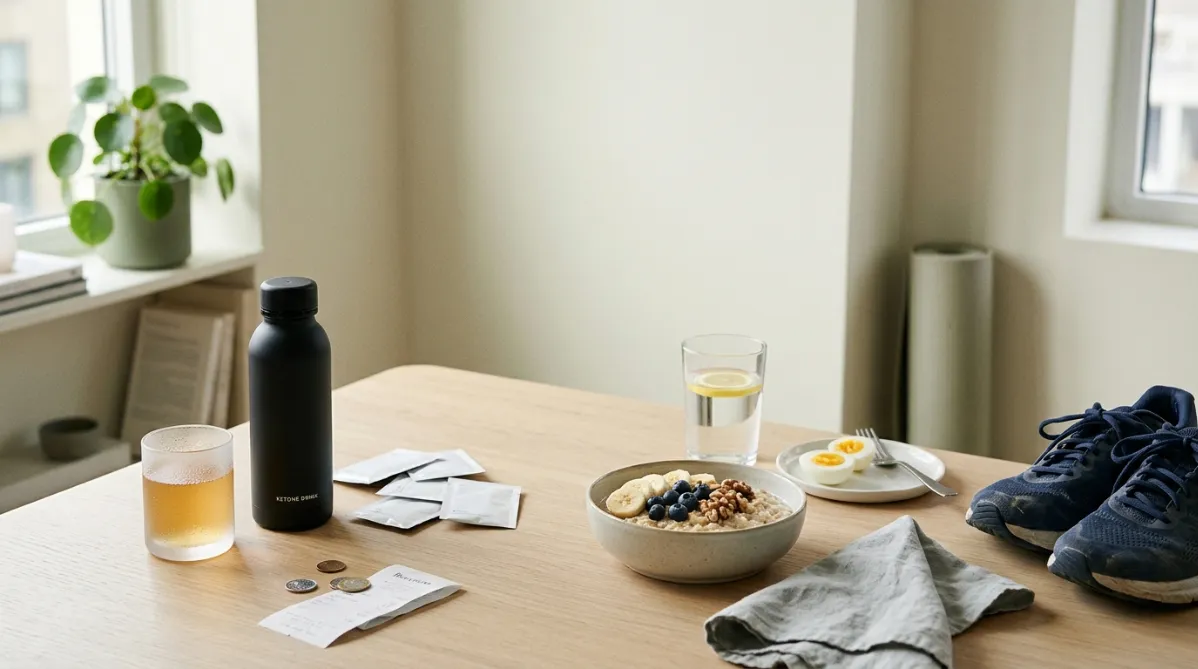
A calm, editorial still life photographed from a slightly elevated angle on a pale oak table in soft morning window light. On the left, a sleek matte-black single-serve ketone drink bottle with a minimal label stands next to a small frosted glass filled with a pale amber liquid, with a few condensation droplets on its surface. A modest scatter of small unmarked white sachets lies beside it, hinting at a pricey supplement habit. On the right, a thoughtfully arranged group of simple, proven recovery staples: a ceramic bowl of oatmeal topped with sliced banana and blueberries, a tall glass of water with a lemon slice, a boiled egg halved on a small plate, and a folded soft gray linen towel. A pair of well-worn running shoes rests casually at the edge of the frame, with a neatly rolled yoga mat leaning against the wall behind them. In the background, a softly blurred sunlit corner of a modern apartment shows a green potted plant and a cream wall. A few coins and a crisp folded receipt sit near the ketone bottle, a subtle nod to the cost question.

The palette is muted and earthy, with warm creams, sage green, soft charcoal, and touches of amber and berry blue. The light is diffused and natural, with gentle long shadows and shallow depth of field that keeps the foreground objects crisp. The composition is balanced with generous negative space across the top third for headline overlay, and the mood is thoughtful, grounded, and quietly skeptical. The look is a modern lifestyle magazine photograph, clean and minimal, with fine film-like grain and a trendy wellness-journal feel. Landscape 16:9 format.
recovery

Are Ketone Drinks Worth It for Recovery? The Data Says Probably Not

BY DR. GYMBRO ·

Ketone drinks are marketed as a recovery shortcut, but a new systematic review and exploratory meta-analysis found little to back that up. Compared with control, exogenous ketones showed no significant benefit for muscle soreness, glycogen resynthesis, creatine kinase or physical performance. Post-exercise lactate even slightly favored the control condition, and reaction-time improvements were isolated. The evidence comes mostly from active men, so there are caveats. Here's what the data mean for your wallet and what to prioritize instead.
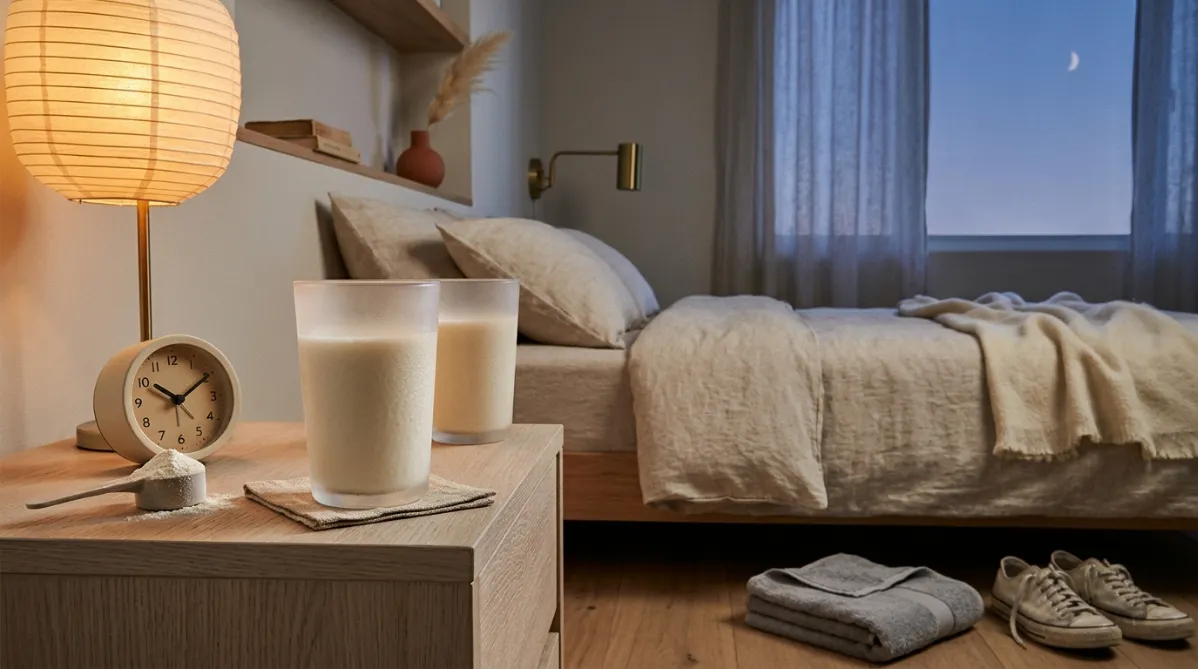
A serene, softly lit bedside scene in a modern minimalist bedroom, photographed in a warm editorial style. On a pale oak nightstand sit two matching frosted glass tumblers of creamy white protein shake, one slightly closer to the camera in sharp focus, the other gently blurred behind it. Beside them rests a small analog alarm clock with a matte cream face, its hands showing a late-evening hour, and a single ceramic scoop dusted with fine white powder on a linen coaster. A folded gray gym towel and a pair of worn sneakers are tucked at the edge of the frame, hinting at an earlier workout.

In the background, a neatly made bed with textured oatmeal linen bedding and a rumpled cream throw blanket glows under the amber light of a small paper-shade lamp. A sheer curtain filters deep indigo twilight from a window, with a faint crescent moon visible. The palette is muted and calming: warm cream, soft sand, dusty blue, and touches of terracotta from a small clay vase holding a dried pampas stem.

Shallow depth of field, gentle film-like grain, soft window light mixing with the warm lamp glow, long soft shadows across the wood grain. Composition follows the rule of thirds with the glasses on the left third and open negative space on the right, suitable for headline overlay. The mood is quiet, thoughtful, and contemporary, like a lifestyle and science feature in a trendy wellness journal. Clean, natural, tactile, with no text, no people, and no futuristic elements.
nutrition

Whey Before Bed Halved Time to Fall Asleep. Casein Didn't

BY DR. GYMBRO ·

Everyone says casein is the bedtime protein, but a new randomized, double-blind crossover trial in humans found something odd. After resistance training, 40 g of whey taken 30 minutes before bed cut median sleep-onset time to 9 minutes versus 19 with a carb control, and also reduced next-day soreness. Casein did not significantly beat control. The catch: only nine people took part, and whey wasn't statistically better than casein head-to-head. Here's what the numbers show and what they can't prove.
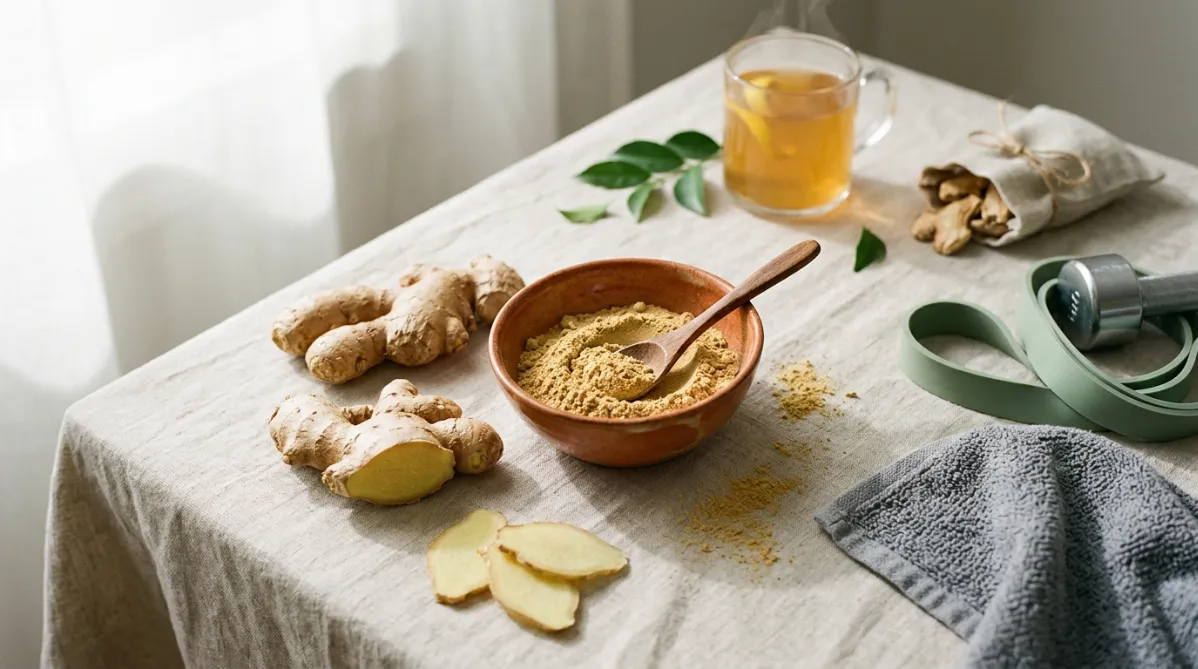
A wide, editorial-style still life photographed from slightly above on a pale oat-colored linen surface, lit by soft natural window light from the left. At the center sits a rustic ceramic bowl of finely ground golden-tan ginger powder, with a small wooden spoon resting in it and a light dusting of spice across the cloth. Beside it lie several whole ginger rhizomes, knobby and honey-brown. One is sliced open to show its pale yellow, fibrous interior, and a few paper-thin slices fan out in the foreground. On the right, a folded heather-gray gym towel, a matte sage-green resistance band coiled loosely, and a single brushed-steel dumbbell sit just inside the frame, softly out of focus. A glass of warm amber ginger tea steams faintly near the upper right, with a thin curl of lemon peel inside. A few fresh green leaves and a small linen pouch of dried ginger add texture. The palette is warm and muted: cream, soft gold, sage, terracotta, and charcoal accents. The shallow depth of field keeps the ginger bowl and sliced root crisp while the gym elements melt into a gentle blur. Shadows are long and soft, and the negative space on the upper left leaves room for a headline. The mood is calm, clean, and modern, like a contemporary wellness or science journal cover. It is a natural, tactile, high-resolution photograph with subtle film grain and no text, no people, and no futuristic elements.
recovery

2 Grams of Ginger Cut Next-Day Muscle Pain by ~25% in Two Trials

BY DR. GYMBRO ·

A common kitchen spice just went head-to-head with one of the gym's most universal complaints: next-day muscle soreness. In two double-blind trials, people who took 2 grams of ginger daily for 11 days reported roughly 25% less pain 24 hours after punishing eccentric exercise. But ginger didn't clearly improve strength or swelling, and nobody tested it against ibuprofen. Here is what the research shows, why it might work, where the evidence falls short, and who should consider trying it.
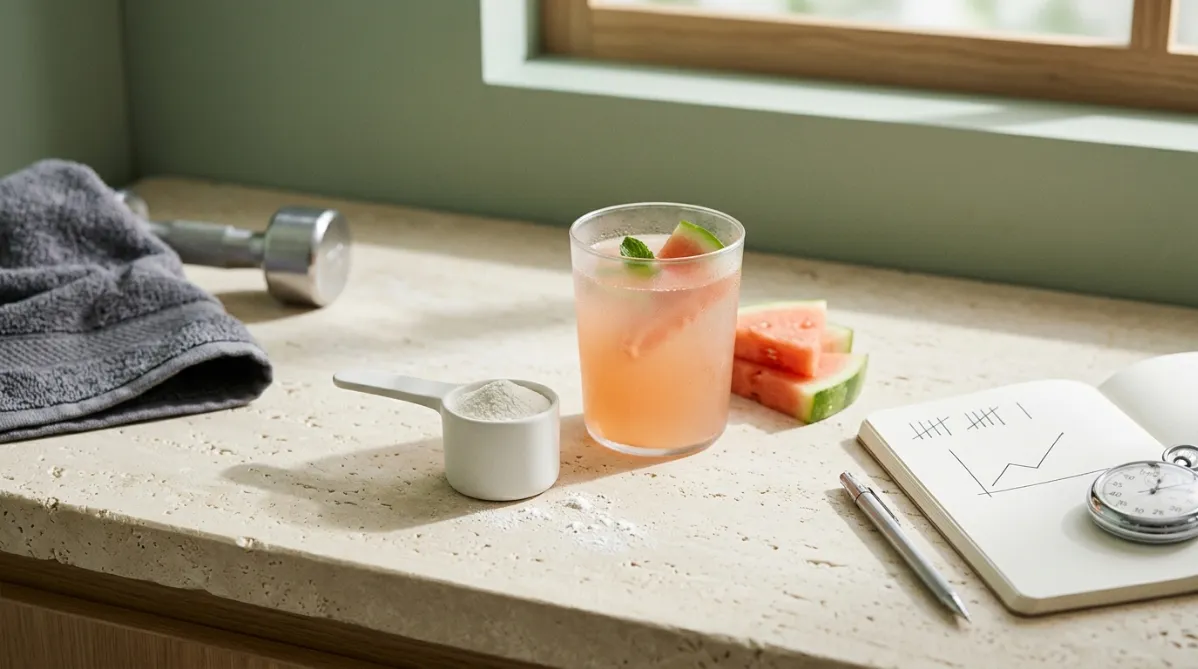
A wide, editorial-style still life photographed on a pale limestone countertop in soft morning window light. At the center sits a matte white scoop of fine white powder resting beside a frosted glass tumbler of cloudy, pale pink-orange water, with a few watermelon slices and a halved wedge showing glossy coral flesh and thin green rind, a nod to citrulline's natural source. To the left, a neatly folded charcoal gym towel and a brushed steel dumbbell rest at the edge of the frame, slightly out of focus. To the right, a minimalist open notebook with a few hand-drawn tally marks and a simple line graph sketched in black ink rises toward the right edge, next to a slim mechanical pencil and a small analog stopwatch with a clean white face. A few loose grains of powder are scattered across the stone, catching the light. Soft diagonal shadows fall across the surface from a nearby window, and a gentle sage-green wall in the background adds calm contrast. The palette is warm cream, watermelon coral, sage green, and soft graphite gray, with plenty of negative space on the upper left for headline overlay. Shallow depth of field, crisp focus on the powder scoop and watermelon, subtle film grain, natural tones, and a clean, modern wellness-journal aesthetic. Shot at eye level with a slight downward angle, like a contemporary health and science magazine cover. No text, no logos, no people.
nutrition

8 g Citrulline Malate = 53% More Reps and 40% Less Soreness? What the Study Shows

BY DR. GYMBRO ·

A 2010 crossover trial found that 8 g of citrulline malate was linked to about 53% more bench press reps in the final evaluated set and roughly 40% less soreness at 24 and 48 hours. The catch is that the biggest rep gain showed up late in the session, once fatigue had built up. Here is what the study actually tested, how to apply the dose and timing sensibly, who stands to benefit, and why the 14.63% rate of stomach discomfort and the study's limits deserve attention.

This page is available in