Dr. Gymbro
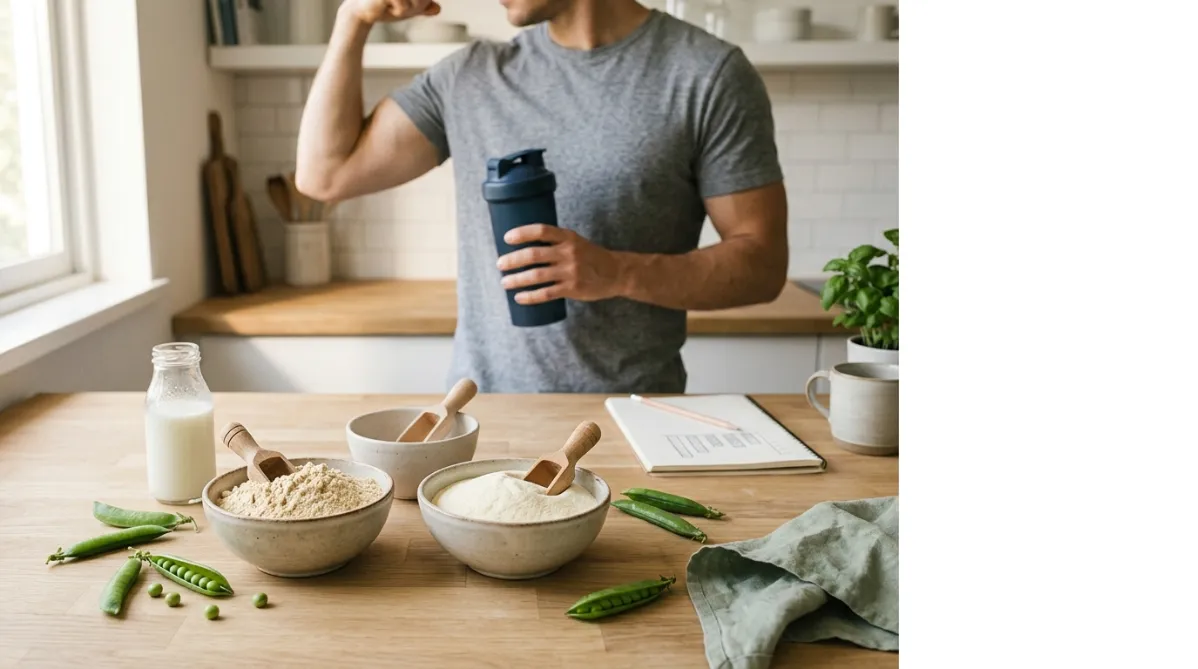
A wide landscape editorial photograph shot from above at a slight angle, showing a bright, minimalist kitchen counter of pale oak wood. Three matching ceramic bowls in soft matte tones (warm cream, sage green, and muted terracotta) sit in a loose row. Each holds a different protein powder: fine ivory whey, slightly coarser beige soy, and speckled pale yellow-green pea protein. A small fourth pile of tiny gray-black chia seeds sits apart on a folded linen napkin, off to the side, to suggest the lone outlier. Wooden scoops rest in each bowl, with a few soft dustings of powder on the surface. In the foreground, a clear glass shaker with a creamy blended drink and a single sprig of fresh mint stands beside a small stack of fresh produce: a halved avocado, a handful of edamame pods, and a few green peas in an open pod. A matte white notebook and a thin brass pen are tucked at the edge of the frame, suggesting research and note-taking. Natural morning light pours in from the left through an unseen window, casting long, soft shadows and gentle highlights on the powder textures. The color palette is calm and earthy, with creams, sage, soft terracotta, and warm wood tones, and a clean, slightly muted editorial grade. Shallow depth of field keeps the bowls crisp while the background, a blurred white tiled wall and a hint of a trailing green plant, melts away. Plenty of negative space on the right side of the frame leaves room for a headline overlay. The overall mood is fresh, trustworthy, and modern, like a contemporary wellness and science journal.
Nutrition

乳清蛋白对初学者未必更优,大豆与豌豆恰好可替代

Dr. Gymbro · · 1 min read

如果你刚开始力量训练,面前摆着一罐乳清蛋白和一罐豌豆蛋白,担心植物来源的蛋白会影响增肌效果,那么最新的一项荟萃分析给出了答案。当研究者把所有使用DEXA(双能X射线吸收法)测量的试验数据合并后,植物蛋白组的效果并未显著逊于乳清组。需要强调的是,这并不等同于两者完全相等,作者在文中也明确指出了这一点。

30秒了解研究

巴西圣保罗州立大学(UNESP)的Callegari等人于2026年在《国际运动营养学会杂志》(Journal of the International Society of Sports Nutrition)上发表了系统评价与荟萃分析(2026;23(1):2752317)。他们检索了PubMed、Web of Science和ScienceDirect,遵循PRISMA 2020指南,并在PROSPERO(CRD420251145410)注册了研究方案。最终纳入了5项符合条件的试验。

纳入标准严格:

  • 研究对象: 18‑59岁、未接受系统训练的成年人
  • 干预措施: 阻力训练+植物蛋白或乳清蛋白补充
  • 结局指标: 采用DEXA测定的体成分(瘦体重、脂肪量)

该研究为开放获取,DOI:https://doi.org/10.1080/15502783.2026.2752317,PubMed编号 PMID 42954267。

主要发现

无论是植物蛋白还是乳清蛋白,只要配合阻力训练,都能显著提升瘦体重并降低体脂。两组之间的差异在统计学上不显著。作者因此得出结论:大豆和豌豆蛋白同样可以在初学者的阻力训练期间促进体成分的积极变化,完全可以视为乳清的可行替代品。

这一发现值得注意,因为长期以来乳清蛋白被视为“最佳”增肌蛋白。该分析在训练方案和总蛋白摄入量相同的前提下,未发现蛋白来源对初学者体成分产生可检测的差异。

在你换之前先看细节

“未见显著差异”并不等同于“已证实等效”。作者多次强调,受限于仅有5项研究且置信区间较宽,当前的分析无法排除真实差异的可能。文中明确指出,这些结果不应被解读为生理等价性,仍需更大样本、足效能的随机对照试验来验证。

需要关注的三大局限:

  • 仅限未训练成年人。 初学者对任何合理的训练和蛋白组合反应都较为显著,结果并不适用于已有训练基础的高阶训练者,那类人群的差异更容易被检测到。
  • 蛋白摄入量匹配。 本研究控制了总蛋白摄入和训练变量,未考察如果把同等体积的乳清换成蛋白含量更低的植物产品,或在整体蛋白摄入不足的情况下会出现何种情况。
  • 样本量小。 仅5项试验的证据基础不足以支撑广泛的概括性结论。

综上所述,乳清对初学者并非必不可少,但也不能说植物蛋白已经被证实与之等同。

奇亚蛋白怎么办?

目前暂无足够证据支持奇亚蛋白的增肌功效。该综述仅检索到一项涉及奇亚蛋白的研究,且未发现对瘦体重有显著提升。作者因此提醒,关于奇亚蛋白的结论仍然不明确,不能直接套用大豆或豌豆的结论。

实际应用要点

本文摘要未给出具体剂量,以下内容基于一般运动营养原则,而非本次荟萃分析的直接发现。

  • 每日总蛋白首位。 常用的力量训练推荐摄入量约为体重每公斤1.6克蛋白。以75 kg的训练者为例,日摄入约120 g蛋白,补剂的作用是帮助达标,而非单独产生奇效。
  • 每次摄入量。 植物蛋白的亮氨酸含量通常低于乳清,而亮氨酸是启动肌肉蛋白合成的关键氨基酸。实际操作中,常建议将豌豆或大豆蛋白的单次剂量适当增加,或选用含有多种蛋白的混合粉,并将蛋白摄入分散到3‑4餐中。这是一种基于生理原理的预防性做法,本文并未对其进行实验验证。
  • 摄入时间。 研究并未探讨“窗口期”。总体来看,保持每日总蛋白摄入的持续性比严格限定摄入时间更重要。可在训练后、餐间或任何有助于达标的时点补充。

谁该选哪种蛋白

植物蛋白(大豆或豌豆)适合以下人群:

  • 素食者或严格素食者
  • 对乳制品或乳糖不耐受
  • 关注可持续性、环保因素的用户(作者在文中也提到)
  • 刚入门的力量训练者,寻求性价比高且易于融入饮食的补剂

乳清蛋白仍然合适的情况:

  • 对乳制品耐受且偏好其口感
  • 想要使用研究基础最为丰厚的蛋白来源
  • 当地市场上乳清更便宜或更易获取

需要慎重的情形:

  • 对大豆或豌豆过敏,务必检查标签
  • 已经是高级别的训练者,因为本证据仅针对未训练成年人
  • 期待奇亚蛋白快速增肌,因目前证据不足,请保持观望

结论

过去“乳清是初学者必备”这一观念在本次荟萃分析后显得不那么稳固。对未训练成年人而言,在蛋白摄入量与训练方案相匹配的前提下,大豆和豌豆蛋白在瘦体重和脂肪量变化上并未显著落后于乳清。但由于仅有5项试验且置信区间宽广,结论仍需进一步验证。关键是保证每日总蛋白摄入、坚持规律训练,并选择自己最容易坚持的蛋白粉。

来源:Callegari IOM, Silva GM, Oliveira AG. Is plant‑based protein supplementation as effective as whey protein? A systematic review and meta‑analysis in untrained adults undergoing resistance training. J Int Soc Sports Nutr. 2026;23(1):2752317. doi:10.1080/15502783.2026.2752317. PMID: 42954267.
Original study

Read the original research on pubmed.ncbi.nlm.nih.gov →

This article summarizes published research for general information. It is not medical advice.

DG

Written by

Dr. Gymbro

Dr. Gymbro writes for Dr. Gymbro: science-backed fitness, nutrition & performance.

Related Articles

A wide, softly lit editorial flat-lay on a pale oat-colored linen surface, shot from slightly above. Three matte ceramic bowls sit in a loose diagonal across the frame. One holds fine, creamy beige pea protein concentrate, another holds paler, powdery pea protein isolate, and the third holds bright white whey protein isolate. Each bowl has a small wooden scoop resting beside it, with a few fine dustings of powder on the linen. Fresh green pea pods, split open to show round peas, spill naturally in the left foreground. A small glass pitcher of milk sits near the right edge, next to a half-full glass of a smooth, pale green-beige shake with condensation on the surface.

Behind the bowls, a few sprigs of dried wheat and soft eucalyptus leaves add organic texture. In the upper right, a shallow white ceramic plate holds a small arrangement of gut-friendly foods: sliced banana, a spoonful of plain yogurt, and a few oats. Delicate watercolor-style abstract shapes in sage green, warm coral, and soft mustard float subtly in the background. They suggest microscopic organisms, like loose dots, rods, and clustered circles, but stay painterly and minimal, not scientific or futuristic.

Natural window light enters from the left, casting long, gentle shadows and a warm, airy glow. The palette is muted and modern: sage green, cream, warm beige, blush, and touches of terracotta. The composition leaves generous clean negative space on the right third for a headline overlay. The depth of field is shallow, with the nearest pea pods and the front bowl crisp and the background softly blurred. The style is high-end wellness magazine photography with a subtle tactile, handmade feel, calm, fresh, and contemporary, in a 16:9 landscape format.
science research

哪种蛋白粉能改造你的肠道?四周内豌豆蛋白的表现

BY DR. GYMBRO ·

一项为期四周的瑞典随机对照试验将豌豆蛋白浓缩物、豌豆蛋白分离物和乳清蛋白分离物进行比较,观察肠道菌群的变化。两种豌豆蛋白均显著影响了肠道多样性,并分别提升了不同的有益菌种。浓缩物使Bifidobacterium longum和Anaerobutyricum hallii丰度上升,分离物则促进了Lactobacillus crispatus和Limosilactobacillus frumenti的增长。研究者提醒,这些菌群变化的功能意义仍未明朗。下面看看这些结果对你下一桶蛋白粉意味着什么。

A wide, editorial-style flat lay shot from directly above on a pale oak table in soft morning window light. At the center, an open matte cream-colored protein powder tub sits tipped slightly, with a wooden scoop resting beside it and a small, elegant dusting of fine powder spilling across the wood grain. To the left, a neat balanced arrangement of whole foods: two soft-boiled eggs in a ceramic dish, a small bowl of Greek yogurt with a drizzle of honey, a handful of almonds, and a halved avocado. To the right, a minimalist brass kitchen scale holding a small ceramic bowl, with a handwritten notebook page beside it showing simple pencil-drawn bar charts and a few scribbled numbers, no legible text. A matte shaker bottle in muted sage green stands near the top edge, along with a folded linen napkin in warm oatmeal tone. The color palette is restrained and modern: warm creams, soft sage, terracotta accents, and natural wood, with gentle diffused shadows and subtle film-like grain. Composition leaves generous negative space on the left third of the frame for headline overlay. The mood is calm, thoughtful, and quietly skeptical, like a contemporary health and science magazine cover. Shallow depth of field, crisp textures on powder and ceramic, high-end lifestyle photography, clean and uncluttered.
nutrition

蛋白粉的隐藏真相:热量相同,效益消失

BY DR. GYMBRO ·

蛋白粉真的能提升你的表现和恢复吗,还是只是在摄入额外的热量?一项涵盖 75 项随机对照试验、1206 名运动员的贝叶斯荟萃分析表明,蛋白粉确实有益,但效果并不显著。更有意思的是,所有显著结果都来自能量摄入未匹配的研究。论文给出的最明确的建议是:每日额外摄入约 1 g/kg 蛋白质(即总摄入约 2 g/kg)。下面我们一起看看数据到底支持什么结论,时机与蛋白来源的说明如何,以及哪些人可以不必购买这瓶粉。

A bright, airy, minimalist kitchen counter in soft morning light, shot from a slightly elevated three-quarter angle in a wide landscape composition. Two matching ceramic bowls sit side by side on a pale oak butcher-block surface. The left bowl holds fine, creamy-beige pea protein powder with a small wooden scoop resting in it. The right bowl holds smooth, ivory-white whey powder with an identical scoop. Between and slightly behind them sits a third, smaller empty bowl with a plain scoop, hinting at the placebo. Scattered around the bowls are fresh green pea pods, some split open to reveal bright, round peas, and a small glass bottle of milk with delicate condensation. A sage-green linen napkin is folded loosely at the edge of the frame.

In the soft-focus background, a young man in a fitted heather-gray t-shirt is seen from the shoulders down, casually flexing one arm while holding a matte shaker bottle, the biceps subtly defined and the pose relaxed and natural. A minimalist notebook with a pencil and a simple hand-drawn bar chart lies open on the counter, suggesting analysis without legible text. A small potted herb plant and a ceramic mug add warmth.

The color palette is muted and editorial: warm cream, sage green, soft terracotta, pale wood, and touches of charcoal. Light streams in from a window on the left, casting gentle long shadows and a subtle golden glow across the powders so their textures look fine and tactile. Shallow depth of field keeps the bowls crisp while the background melts into a creamy blur. The look is modern lifestyle-magazine photography, clean and uncluttered, with generous negative space on the right third of the frame for headline overlay. It is natural, appetizing, and trustworthy, in the style of a contemporary wellness and nutrition journal.
nutrition

豌豆蛋白 vs 乳清:新手结果出人意料

BY DR. GYMBRO ·

植物蛋白真的能像乳清一样帮助增肌吗?一项为期 12 周、共计 161 名男性的试验让豌豆蛋白、乳清蛋白和安慰剂同台竞技,结果让人眼前一亮:豌豆蛋白组的二头肌厚度提升了 20.2%,而安慰剂组仅为 8.6%。不过整体受试者之间的差异仅呈现出趋势,真正的亮点来自子组分析。下面我们一起看看这项研究的具体发现、未得到证实的方面,以及素食或乳糖不耐受的健身者该如何使用。

A wide, editorial flat-lay photograph shot from directly above on a pale warm-gray stone countertop, lit by soft natural morning window light with gentle diagonal shadows. On the left, a neatly arranged cluster of whole-food protein sources: two seared chicken breast slices with a golden crust, a small ceramic bowl of creamy Greek yogurt topped with blueberries, three halved soft-boiled eggs with jammy orange yolks, a handful of raw almonds, and a small pile of dried lentils scattered on a linen napkin. At the center, a matte white shaker bottle and a wooden scoop resting in a pile of fine vanilla-colored protein powder, a few grains dusted artfully across the surface. On the right, a minimalist kitchen scale in matte black displaying a portion of food, next to an open notebook with a hand-drawn curve that rises steeply and then flattens into a plateau, drawn in a deep terracotta ink pen, with a small dot marking the bend. A brass pen lies beside the notebook. A single dumbbell with a brushed steel finish sits partially in frame at the upper right corner, grounding the fitness theme without feeling gym-like. Color palette: warm cream, sage green, terracotta, soft charcoal, and butter yellow accents, with generous negative space along the top edge for title overlay. Shallow depth of field, crisp textures, subtle film grain, modern lifestyle magazine aesthetic, clean and calm composition, 16:9 landscape.
nutrition

到底需要多少蛋白质才能最大化肌肉?——1.6 克/公斤平台阐释

BY DR. GYMBRO ·

你是否一直以为每磅体重需要摄入超过 2 克蛋白质才能增肌?对 49 项试验、1863 名成年人的荟萃分析显示,肌肉增益在每日约 1.6 克/公斤时出现平台期。其上限置信区间约为 2.2 克/公斤,为健身者提供了一个实用的范围,而不是随意的大剂量。经训练的举重者从补剂中获益最大,且随年龄增长效应会下降。下面看看这些数字对你的餐盘、摇杯和预算意味着什么。

This page is available in