Two hundred loaded jumps will flatten almost anyone. By day three, the question for a volleyball player is whether her legs have their spring back. A new crossover trial in the Journal of the International Society of Sports Nutrition suggests beetroot juice (BRJ) may help with exactly that, but only in some areas. The headline finding is a better jump at 72 hours. The finer print matters more than the headline.
What the researchers actually did
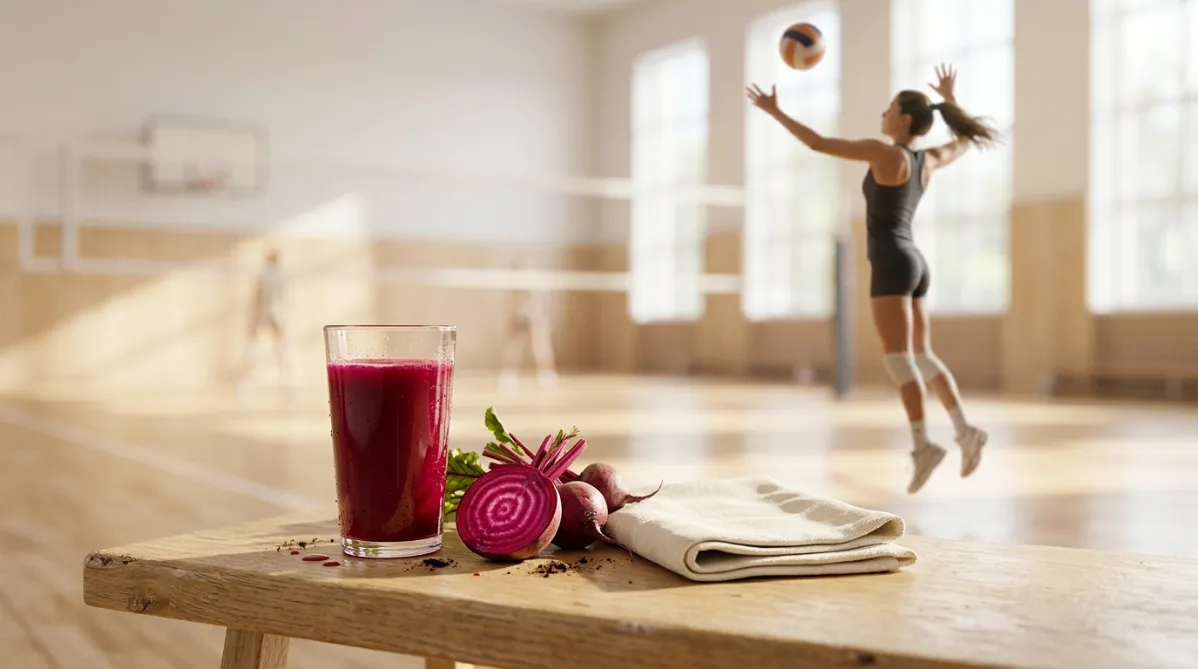
Zhang and colleagues recruited 17 female university volleyball players for a randomized, double-blind, placebo-controlled crossover study. Four players did not complete the second period, so 13 completed both. The team used linear mixed models to handle the missing data. After baseline testing, players performed 200 loaded vertical jumps to induce exercise-induced muscle damage (EIMD). They then drank either BRJ or a placebo at 24, 48 and 72 hours afterward.
The outcome list was broad: countermovement jump (CMJ) height, a volleyball-specific agility test, pressure pain threshold (PPT) at the thigh and calf, thigh circumference as a swelling proxy, visual analog scale soreness, and low-velocity knee isokinetic strength. Holm-adjusted planned contrasts guarded against false positives from all those comparisons.
The 72-hour headline: jump height
CMJ height was the clearest functional signal. At 72 hours post-damage, players jumped higher under BRJ than under placebo (P = 0.033, d = 1.01). An effect size around 1.0 is large by sports-science standards. For a sport built on vertical explosiveness, a gap that shows up on day three is the kind of result coaches notice.
There is a catch. The overall treatment × time interaction for CMJ was only a trend (P = 0.062). The statistical test asking whether BRJ changed the recovery curve did not formally clear the usual bar. The 72-hour contrast is encouraging, but it is not a slam dunk.
Calf pain threshold also favored beetroot
Calf pressure pain threshold also favored BRJ at 72 hours, and here the interaction was strong (P < 0.001). Players tolerated more pressure on the calf before it hurt. That fits a jumping-heavy protocol that loads the calves hard. It also suggests BRJ may have modulated local muscle tenderness rather than just overall performance.
What beetroot did not do
The results were selective, as the authors' title says. Several measures showed no consistent BRJ advantage:
- Soreness (VAS): it changed over time in both conditions, with no clear difference between them.
- Agility time: it recovered over the days, but BRJ did not speed it up in a clear way.
- Thigh PPT and thigh circumference: no consistent benefit, so no clear evidence of reduced swelling.
- Low-velocity knee isokinetic strength: no consistent treatment-related edge.
So BRJ did not make players feel less sore, and it did not visibly reduce swelling. It also did not improve most strength outputs. Anyone selling beetroot as a cure-all for muscle damage will not find support here.
Why might beetroot help at all?
Beetroot is rich in dietary nitrate, which the body converts to nitric oxide. Nitric oxide supports blood flow, and beetroot also contains antioxidant compounds such as betalains. That has led researchers to propose BRJ as a way to improve oxygen and nutrient delivery to damaged muscle and to blunt some of the inflammatory and oxidative stress after hard eccentric work. The new data do not test these mechanisms directly, so treat them as plausible explanations rather than proven pathways.
Practical takeaways for athletes
The abstract does not spell out the nitrate dose, so check the full paper before copying the protocol. Here is how the findings might be used sensibly:
- Timing: the study dosed at 24, 48 and 72 hours after the damaging session. That suggests a short, multi-day course after a brutal jump or plyometric block, rather than a one-off shot.
- Dose range: in the wider beetroot literature, doses typically fall around 300 to 600 mg of nitrate (roughly 5 to 10 mmol) per serving. That often means about 70 mL of concentrated juice or a larger volume of regular juice. Check the nitrate content on the label, because brands vary widely.
- Who it is for: trained athletes, especially jump-heavy team-sport players, who face a big plyometric hit and need to be sharp again in two to three days. It is a possible tool for congested training or tournament weeks.
- Set expectations: think of beetroot as a modest add-on aimed at jump performance and calf tenderness. It does not replace sleep, adequate protein and calories, or sensible load management.
- Practicalities: try it in training first. Beetroot can turn urine and stool pink or red, which is harmless but can be alarming, and some people have stomach upset. Mouthwash use can blunt nitrate conversion. People with kidney stone history or on blood-pressure medication should talk to a clinician first.
Limits you should keep in mind
This is a small study. Thirteen completers is not much, and large effect sizes in small samples often shrink when the work is repeated. The participants were all trained female university volleyball players, which is useful given how little female team-sport data exists, but the findings may not transfer to men, to other sports, or to untrained people. The jump-protocol damage model is also not the same as a real match week. The CMJ interaction was only a trend (P = 0.062), and the many outcomes tested raise the risk that a few positives are chance findings, even with the Holm correction.
The bottom line
Beetroot juice was not a recovery miracle in this trial, and the authors do not claim it was. It did produce a higher jump and a better calf pain threshold at 72 hours, which are meaningful results for jumpers. Soreness, agility, swelling and most strength measures were unchanged. Treat BRJ as a targeted experiment for players whose priority is getting their bounce back by day three, and wait for larger replications before calling it a standard recovery protocol.