Dr. Gymbro
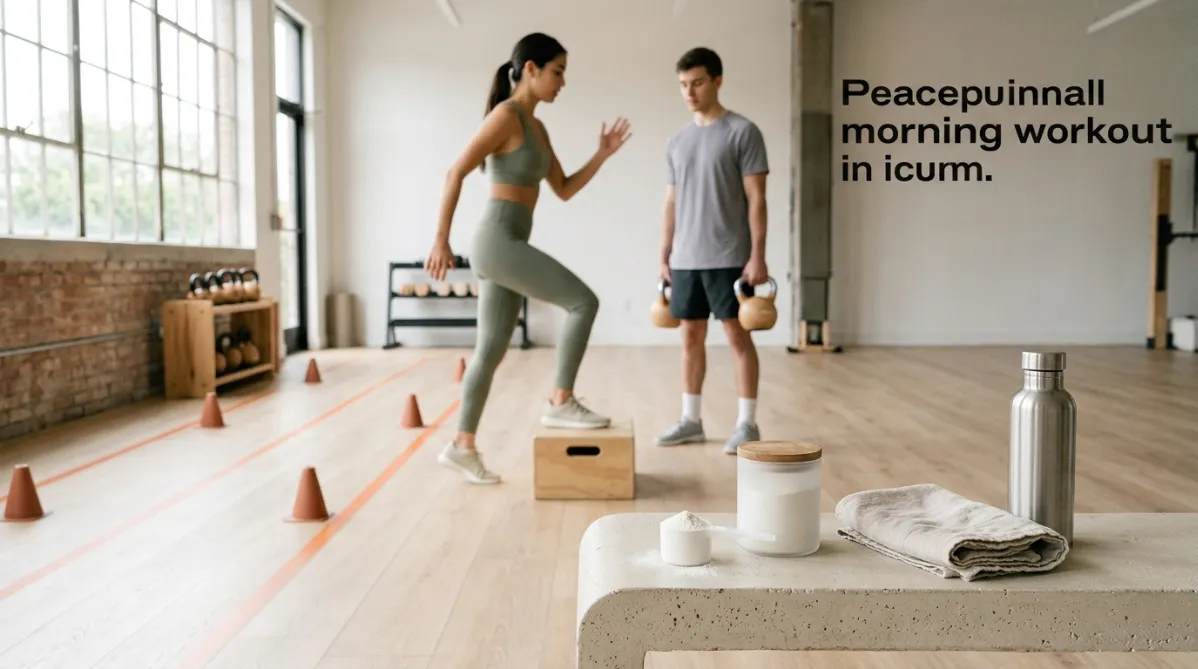
A wide, softly lit editorial photograph of a bright, minimalist gym studio with pale oak flooring and large windows letting in diffuse morning light. In the foreground, a matte white ceramic scoop of fine white powder sits beside a simple frosted glass jar on a light concrete bench. A neutral linen towel and a stainless steel water bottle rest next to them. Slightly out of focus in the midground, a young woman in a sage-green athletic set and a young man in a soft gray tee are mid-circuit, one stepping over a low plyometric box and the other holding a kettlebell. Their motion is captured with a gentle blur. Behind them, a row of painted lines on the floor marks a shuttle-run lane, with small terracotta-colored cones spaced evenly along it. The palette is calm and modern: warm cream, sage, soft terracotta, and muted charcoal, with a touch of pale blue in the shadows. The composition uses generous negative space on the right side of the frame for a title overlay. Depth of field is shallow, the grain is subtle and film-like, and the style is contemporary lifestyle journalism, clean and crisp, with a slightly airy, high-key exposure and natural shadows. No text, no logos, no futuristic elements.
Science & Research

Beta-Alanine Raised Carnosine in Beginners but Didn't Boost Fitness

Dr. Gymbro · · 4 min read

Your blood chemistry changed. Your fitness didn't. That is the awkward headline from a new randomized, placebo-controlled trial of beta-alanine in untrained young adults, and it matters if you are a beginner about to spend money on a tub of pre-workout powder.

The Short Version: Training Worked, Beta-Alanine Didn't Add Anything

Researchers led by Pinter and Csala, publishing in BMC Sports Science, Medicine and Rehabilitation, put 46 healthy, untrained young adults through six weeks of progressive multicomponent circuit training. 43 finished: 23 in the beta-alanine group and 20 on placebo. The average age was 22.3 years. Participants trained three supervised sessions per week.

Circuit training improved shuttle-run performance and estimated VO2max, both at p<0.001. Beta-alanine did not add a statistically significant extra boost to either. The treatment-by-time interaction was p=0.125 for shuttle run and p=0.073 for estimated VO2max. The VO2max figure is closer to the threshold than the shuttle-run one, but it did not cross it, so this trial gives no basis for claiming a benefit.

What Beta-Alanine Did Change

The supplement was not inert. Beta-alanine produced significant interactions for plasma histidine and for post-exercise plasma carnosine (both p<0.05). In other words, the compound did what it is supposed to do biochemically. Carnosine is the molecule beta-alanine is meant to build up, and it is thought to help buffer acidity during hard exercise.

The jump from "carnosine went up" to "performance went up" is exactly where the trial pushes back. The authors conclude that changes in plasma carnosine should not be read as evidence of functional improvement. A lab marker can move without your 20-minute shuttle test, your sprint finish or your leg strength moving with it.

What Else Stayed Flat

Beta-alanine showed no significant added effect on any of the other outcomes:

  • Maximal isometric knee-extension torque
  • Body composition
  • Blood lactate
  • Forced vital capacity (FVC)

So the supplement did not give a hidden strength bump, a body-composition edge or a measurable change in lung function over this period.

How the Trial Was Run

The dose was 50 mg/kg of body weight per day, about 3.5 g daily for a 70 kg person, for six weeks. This is in the range commonly used in beta-alanine research, so the null result is hard to blame on an obviously token dose. Supplementation was double-blind and placebo-controlled, and the data were analyzed with a 2x2 mixed ANOVA. That design asks whether the beta-alanine group improved more than placebo over time, beyond what training alone delivered.

This was a human trial, not an animal or cell-culture study, so the finding applies to people. It also targets a gap in the literature. The authors note that evidence in untrained people, particularly females, and in combination with multicomponent training is limited.

Caveats Worth Knowing

Six weeks is short, and 43 completers is a modest sample. A small trial can miss a small real effect, especially with a p-value like 0.073 on estimated VO2max. The study also relied on estimated VO2max rather than a lab-measured value, and it tracked plasma markers rather than muscle carnosine. The trial was retrospectively registered (NCT07404540), which is worth noting when weighing the evidence.

On transparency, Scitec Nutrition provided the supplements free of charge, and the paper states the company had no role in the study. Funding also came from Gedeon Richter. Notably, a supplement-company-donated product produced a null performance result, and the authors reported it plainly.

Practical Takeaways for Beginners

Prioritize the training. In this trial, the circuit sessions did the heavy lifting for aerobic fitness. Three sessions a week, progressively harder, produced highly significant gains with or without the supplement.

Skip the expense for now. If you are new to training, the data do not support paying for beta-alanine in hopes of faster fitness gains. Spend that money on consistent training, decent food and sleep.

Who beta-alanine is actually for. The broader research literature points to trained athletes doing high-intensity efforts of roughly 1 to 4 minutes, such as hard intervals, rowing, middle-distance work or repeated sprints. This is background from wider research, not something this trial tested. The present study does not show it helps novices.

Dose. If you do try it later, the dose in this trial was 50 mg/kg/day, about 3.5 g for a 70 kg person, taken daily for six weeks. Benefits in the wider literature depend on consistent daily intake over weeks rather than a single pre-workout hit.

Expect tingles. Beta-alanine is widely known to cause a harmless pins-and-needles sensation, often on the face and hands, especially at larger single doses. This trial summary doesn't report side effects, so that is general knowledge. Splitting the daily dose into smaller servings is the usual workaround.

The Bottom Line

Beta-alanine can raise carnosine-related markers, but in untrained young adults doing circuit training for six weeks, that did not translate into extra gains in shuttle-run performance, estimated VO2max, strength, body composition or blood lactate. For a beginner, the training itself is the product. Save the supplement question for when you are trained, chasing marginal gains in hard 1 to 4 minute efforts, and ready to test whether it helps you.
Original study

Read the original research on doi.org →

This article summarizes published research for general information. It is not medical advice.

DG

Written by

Dr. Gymbro

Dr. Gymbro writes for Dr. Gymbro: science-backed fitness, nutrition & performance.

Related Articles

A wide, editorial-style still life photographed on a pale warm-gray concrete surface in soft morning window light. In the center sits an open, matte white supplement tub with a scoop resting beside it, a small mound of fine white powder spilling onto the surface. Next to it is a clear glass of water with a faint cloudy swirl of dissolved powder. A few loose capsules in muted coral and cream tones are scattered casually in the foreground. Behind them, slightly out of focus, is a clean running track lane in terracotta red with crisp white lines curving across the background. A pair of minimalist off-white sprint spikes rests on the edge of the track, laces loosely undone. A stopwatch with a brushed metal casing lies partially in frame at the right, its face reading a blurred, indistinct time.

The composition uses generous negative space on the left third, leaving a calm area of soft gray and cream for headline text. Shadows are long, gentle, and slightly cool, contrasting with the warm terracotta of the track. The palette is restrained: terracotta, bone white, soft sage green accents from a small leaf sprig tucked near the tub, and charcoal gray details. Shallow depth of field with a crisp focus on the scoop and powder, creamy bokeh behind. The mood is thoughtful, skeptical, and calm, like a modern wellness or science journal cover. Subtle film grain, natural color grading, and a tactile, tangible feel, with no text, no logos, and no futuristic elements.
nutrition

Beta-Alanine Is in Every Pre-Workout. Sprint Data Says It May Not Work

BY DR. GYMBRO ·

Beta-alanine is in almost every pre-workout, and the tingles make it feel like it's working. A 2026 multilevel meta-analysis of 17 randomized controlled trials found no benefit for repeated sprint ability, whether measured by mean performance, peak performance or fatigue decrement. Dose, duration and training status didn't change the picture. The authors suggest repeated sprints are limited by phosphocreatine recovery rather than acidosis, which is what beta-alanine targets. Here's who may still benefit, who can skip it, and what the study can't tell us.

supplements

High-Dose Vitamin D Cut Knee Arthritis Pain—But There's a Catch

BY DR. GYMBRO ·

Could the fix for your achy, swollen knees be sitting in your bloodwork? In a small randomized pilot trial, patients with inflamed knee osteoarthritis and very low vitamin D saw less pain and stiffness, plus lower CRP and IL-6 and calmer joints on ultrasound, after four months of a high-dose protocol versus placebo. But the study had only 30 patients, the loading doses were doctor-given injections, and cartilage and structure did not change. Here is what the data show, who it might apply to, and why you should test your levels rather than self-megadose.

A wide landscape editorial photograph of a lone male distance runner, seen from behind in soft three-quarter profile, pausing on a red-clay outdoor running track at golden hour. He wears a minimalist charcoal singlet and fitted shorts, with a faint sheen of sweat on his calves and shoulders. His hands rest loosely on his hips as he catches his breath, and the white lane lines curve gracefully into the distance. Low amber sunlight rakes across the track and casts long, soft shadows. A hazy line of trees and a pale peach sky blur into creamy bokeh behind him.

In the lower foreground, slightly out of focus, a small matte ceramic dish holds a few pomegranate seeds and halved walnuts, a nod to the natural food sources of urolithin A. Beside it sits a minimalist amber glass supplement bottle with a plain cream label, and a stopwatch lies face-up on the track's edge. The stopwatch is blurred just enough to read as an object, not a number.

The palette is warm and earthy, with terracotta, burnt orange, soft cream, and muted sage green. The look is refined and contemporary, like a high-end wellness or sports-science magazine, with natural film-like grain, shallow depth of field, and gentle contrast. The composition follows the rule of thirds. The runner sits in the right third, the still life anchors the lower left, and open negative space in the upper left leaves room for a headline overlay. The mood is calm and thoughtful, suggesting recovery, measured results, and quiet scientific skepticism rather than hype. No text, no logos, no futuristic elements.
nutrition

Urolithin A Didn't Make Elite Runners Faster—But Cut Muscle Damage

BY DR. GYMBRO ·

Urolithin A has been marketed as a "mitochondria supplement," so researchers tested it on elite male runners with a VO2max around 66. It did not make them faster over 3000 m. It did lower the muscle-damage marker CK and the athletes' perceived effort after racing. VO2max rose 5.4% in the UA group versus 3.6% on placebo, but that difference was not statistically significant. Here is what 1000 mg a day for four weeks did and didn't do, and what to keep in mind about the small samples and industry ties.

A wide editorial photograph of a lone runner captured mid-stride in the final stretch of a sunlit outdoor track, shot from a low angle with a shallow depth of field. The runner wears a fitted charcoal singlet and sage-green shorts. Their face is tense with effort, and their stride is long and powerful as they lean toward the finish line. Soft golden-hour light rakes across the scene and creates long shadows on the terracotta-red track. A faint haze of warm dust hangs in the air behind them.

In the lower left foreground, slightly out of focus, a minimalist still life sits on the edge of the track. A matte white scoop rests beside a small pile of fine white powder on a pale linen cloth. Next to it are a small amber glass jar and a ceramic cup of water. The objects are arranged with restraint, like a modern wellness magazine layout. They hint at supplements without any branding or text.

The background is a gentle blur of white lane lines, distant green trees, and a pale peach and cream sky. The color palette is warm and muted: terracotta, sand, sage, soft cream, and touches of deep charcoal. The mood is calm and focused, with a sense of restrained power and a decisive moment. The composition follows the rule of thirds. The runner sits on the right third, the still life anchors the lower left, and generous negative space in the upper left leaves room for a headline overlay.

The style is contemporary, clean, and slightly cinematic, like a high-end sports and science journal. It has fine film grain, natural color grading, crisp detail on the athlete, and creamy bokeh elsewhere. There is no text, no logos, no futuristic elements, and no digital interfaces. The scene is purely natural and tactile.
supplements

Creatine and Beta-Alanine Won't Raise VO2max, But May Win the Sprint

BY DR. GYMBRO ·

A 2026 review in Translational Sports Medicine takes a hard look at creatine and beta-alanine for endurance athletes. The verdict is that neither is a reliable way to raise VO2max, lactate threshold or time-to-exhaustion. Both may help in the moments that decide races, such as surges, climbs and finishing sprints. Weight gain from creatine could be a real drawback for runners. Here is what the evidence supports, where it falls short, and how athletes typically dose these supplements.

This page is available in