Dr. Gymbro
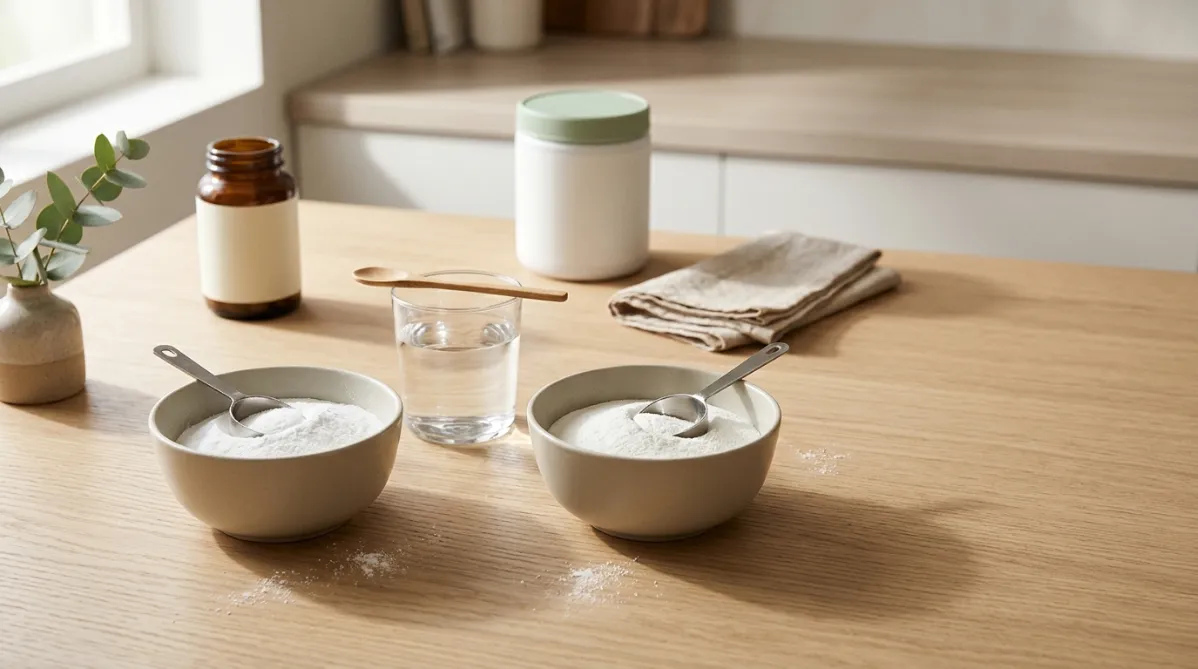
A wide, landscape editorial photograph of a clean, sunlit kitchen countertop in soft morning light. Two matching matte ceramic bowls sit side by side on a pale oak wood surface. One holds fine, bright white creatine powder, the other holds an almost identical powder, with a small stainless steel scoop resting in each. Between them sits a simple glass of water with gentle ripples and a thin wooden stirring spoon. In the soft-focus background, a minimalist amber glass supplement jar with a plain cream label and a sleek matte-white tub with a pastel sage-green lid stand slightly out of focus, suggesting a budget option and a premium option without any readable branding. A small, neatly folded linen napkin in warm oatmeal tones and a sprig of eucalyptus in a tiny stoneware vase add a calm, modern touch.

A few grains of powder are scattered naturally across the wood, catching the light. The color palette is warm neutrals with soft sage green, cream, and muted terracotta accents. The composition uses a shallow depth of field, a slightly elevated three-quarter angle, and generous negative space on the right side for title overlay. The lighting is natural window light from the left, creating long, gentle shadows and a subtle glow on the powder. The overall mood is calm, trustworthy, and thoughtful, like a contemporary health and wellness magazine or a minimalist lifestyle journal. High-resolution, crisp textures, film-like color grading, subtle grain, and a balanced, symmetrical sense of comparison between the two bowls.
Nutrition

This 'Better-Absorbed' Creatine Just Matched Plain Monohydrate

Dr. Gymbro · · 4 min read

Walk down any supplement aisle and you will find creatine in premium packaging, with promises of better solubility, smarter absorption and a gentler stomach. Plain creatine monohydrate, the cheap powder with the longest research record, sits next to it. A new crossover trial from the University of North Carolina at Chapel Hill put one of these newer products, OptiCreatine (CrO), head-to-head with monohydrate (CrM). Over five hours of blood sampling, the two were statistically indistinguishable.

What the researchers tested

The study, published in the Journal of the International Society of Sports Nutrition, was led by DelBiondo and Smith-Ryan. It enrolled 17 healthy, recreationally active adults (8 men, 9 women, average age 22). Each person came in twice after an overnight fast and consumed a single 5-gram dose, once as CrM and once as CrO. Neither the participants nor the researchers knew which product was which, and the order was randomized.

Blood was drawn at baseline and at 30, 60, 90, 120, 180, 240 and 300 minutes. The team then modeled how creatine moved through the bloodstream. They also used validated questionnaires to track stomach and gut symptoms.

Pharmacokinetics in plain words

Pharmacokinetics (PK) describes what your body does with a compound after you swallow it. Three numbers do most of the work:

  • Cmax: the highest concentration reached in the blood, or how high the wave gets.
  • Tmax: the time it takes to hit that peak, or how fast the wave arrives.
  • AUC: the area under the concentration-over-time curve, or how much total creatine showed up in the blood over the window.

The researchers also estimated an absorption rate constant (ka) and an elimination rate constant (kel), which describe how quickly creatine enters and leaves the blood.

The results: no daylight between the two

Serum creatine rose over time with both products (p < 0.0001), and there was no difference between them at any time point. That held for all participants (p = 0.707), for men alone (p = 0.318) and for women alone (p = 0.996). The PK numbers told the same story:

  • Cmax: mean difference of 7.66 μM (p = 0.82)
  • Tmax: mean difference of -0.04 hours, about two to three minutes (p = 0.54)
  • Absorption rate: p = 0.51
  • Elimination rate: p = 0.61
  • AUC: p = 0.74

There were no sex-by-treatment interactions, so neither product behaved differently in men versus women. GI symptoms were rated low in frequency and minimal in severity under both conditions, with similar profiles. The authors concluded CrO is a "viable delivery option" with no significant acute differences from monohydrate.

Notice what that conclusion says and what it does not. The newer form did not absorb worse, but it did not absorb better either.

What this study can't tell you

This is a small, short, acute study, so the limits matter:

  • One dose, one day. Participants took a single 5 g dose. The study did not look at daily use, loading phases or weeks of supplementation.
  • 17 young adults. The sample was healthy and recreationally active, with an average age of 22. The results may not carry over to older adults, athletes or clinical populations.
  • No performance outcomes. The study measured blood creatine, not strength, muscle mass, power or muscle creatine stores.
  • Fasted conditions. Absorption was tested after an overnight fast, so the results say nothing about taking creatine with a meal.
  • "No difference" is not "proven identical." With 17 people, the individual differences were large. The Cmax difference was 7.66 ± 50.37 μM, for example. The abstract reports standard difference tests, not a formal equivalence analysis, so "statistically similar" is the honest framing.
  • GI data were descriptive. Both products were well tolerated in healthy volunteers, so the study can't show whether either one helps people who already get stomach trouble from creatine.

The abstract also doesn't mention funding or product-maker involvement. Check the full paper for that before leaning on the findings.

Practical takeaways

Dose. The paper identifies creatine monohydrate as the most widely studied form, with strong evidence for efficacy, bioavailability and safety. The commonly recommended maintenance dose of 3 to 5 grams per day comes from the broader creatine literature, not from this trial. This study did show that a 5 g dose of monohydrate raises blood creatine reliably within hours.

Timing. This study doesn't settle timing questions, since it tested only one fasted dose. For most people, taking creatine consistently every day matters far more than the clock time.

When a newer form might matter. The theoretical case for alternatives is better solubility or less GI discomfort. This trial found no advantage on either front in healthy adults whose GI symptoms were minimal to begin with. If monohydrate upsets your stomach, an alternative form is a reasonable thing to try, but this study doesn't prove it will help. Practical tweaks like taking creatine with food or splitting the dose are common first steps. They are general advice, not findings from this paper.

How to shop.

  1. Start with plain creatine monohydrate. It has the deepest evidence base and is usually the cheapest.
  2. Be skeptical of "superior absorption" claims. In this trial, a newer form matched monohydrate but did not beat it.
  3. Compare the price per 5 g serving rather than the marketing copy.
  4. Look for third-party testing. That is a quality check on any supplement, separate from the form of creatine.

The bottom line

For most lifters, the premium creatine market is selling a solution to a problem monohydrate hasn't been shown to have. This study suggests OptiCreatine is a legitimate option that performs like monohydrate in blood levels and short-term tolerability. It does not show that you need to pay more for it. Longer trials that measure muscle creatine, performance and GI comfort in people who struggle with monohydrate would be needed to make a stronger case.
Original study

Read the original research on pubmed.ncbi.nlm.nih.gov →

This article summarizes published research for general information. It is not medical advice.

DG

Written by

Dr. Gymbro

Dr. Gymbro writes for Dr. Gymbro: science-backed fitness, nutrition & performance.

Related Articles

A modern editorial still life photographed from a slightly elevated angle on a pale, matte stone surface in soft natural window light. On the left, a heaping mound of fine white creatine monohydrate powder spills from a matte ceramic scoop, with a few crisp grains scattered across the surface. In the center, a small, minimalist amber glass capsule bottle sits tipped on its side, with a handful of off-white capsules spilling out. The label is blank and clean. On the right, a neat row of three clear glass lab-style vials rests on a slim oak tray. The vials hold different amounts of white powder: the first nearly empty, the second slightly fuller, the third filled almost to the brim. This quietly suggests the difference in dose and result. Beside the tray lies a simple stainless steel measuring spoon and a folded sheet of cream paper with soft, abstract bar-chart lines in muted sage green and terracotta. The lines are hand-drawn and unlabeled.

Behind the objects, slightly out of focus, a lean athletic forearm in a gray linen sleeve rests on the edge of the surface, one hand loosely holding a matte shaker bottle. This hints at a training context without showing a face. A single sprig of eucalyptus in the corner adds a soft organic touch.

The palette is warm neutral: bone white, oatmeal, soft sage, muted terracotta, and touches of amber. Shadows are gentle and long, with a shallow depth of field that gives creamy bokeh in the background. The mood is calm, clean, and trustworthy, like a premium health and science journal's feature spread, with generous negative space at the top and right for headline overlay. The composition is wide, balanced, and uncluttered, with subtle film-like grain and a natural, true-to-life color grade. No text, no logos, no futuristic elements.
nutrition

Kre-Alkalyn's Label Dose Didn't Lift Muscle Creatine, Biopsies Show

BY DR. GYMBRO ·

Buffered creatine like Kre-Alkalyn promises better absorption, lower doses and less bloating. A double-blind Texas A&M trial put that to the test with actual muscle biopsies in 36 trained lifters over 28 days. At the label dose of 1.5 g/day, muscle creatine barely moved, while monohydrate raised it clearly more. Strength, body composition and side effects showed no advantage for the buffered product. Here is what the numbers show and how to dose creatine instead.

A landscape editorial photograph of a clean, sunlit kitchen-counter or light oak table, shot from slightly above at a gentle angle. Three small matte ceramic bowls in muted sage green, warm sand, and soft white sit in a loose row. Each holds a different fine white powder, and each has a small wooden scoop resting beside it. The middle bowl is slightly closer to the camera and sharper in focus, with a faint dusting of powder spilling onto the surface. In the soft-focus background, a stainless steel shaker bottle and a half-peeled orange sit beside a folded linen napkin, suggesting citrus without being literal. A single lemon wedge sits near the left bowl, and a small dried apricot sits near the right, a subtle visual nod to citrate and pyruvate.

In the background, a blurred athletic scene: a running shoe resting on a wooden bench and a small notebook with a pen, suggesting a training log. Soft diffused morning light enters from the left through a window and casts long, gentle shadows. The palette is warm neutrals, creamy whites, soft greens, and a hint of terracotta orange. The look is a modern wellness magazine with a shallow depth of field, a fine-grain film feel, and generous negative space on the right third of the frame for title text. The mood is calm, trustworthy, and scientific yet approachable, with no text, labels, or logos.
nutrition

Creatine Pyruvate vs Citrate: One Form Kept Force Up Longer

BY DR. GYMBRO ·

Two fancy creatine forms beat placebo in a 28-day trial, but one kept muscle force elevated through all ten all-out intervals while the other faded. Creatine pyruvate raised force in every interval (p < 0.001), whereas creatine citrate's benefit disappeared by the sixth interval. Only pyruvate also improved relaxation velocity and resting oxygen consumption. Before you ditch your tub, there's a major catch: the study had no creatine monohydrate group. Here's what the numbers show, what they can't, and how to choose.

A wide, editorial-style photograph of a soccer pitch at golden hour, shot from a low angle at the edge of the touchline. In the foreground, a pair of worn leather cleats sits beside a small, matte white scoop and a minimalist ceramic jar of fine white powder resting on the dewy grass. A few loose grains of powder dust the blades of grass and catch the warm light. The jar is unbranded, with a clean, modern look.

In the midground, slightly out of focus, a lone player in a plain charcoal training kit stands mid-stride on the pitch, caught in a sprint. The motion blur in the legs suggests speed, and long shadows stretch across the freshly mowed stripes of the turf. A soccer ball rests a few meters ahead of the player.

Behind them, the stadium stands curve softly into the distance, rendered in a hazy, muted gradient of peach, soft amber, and pale blue sky. The mowing pattern on the grass forms clean diagonal lines that lead the eye toward the horizon. A thin white chalk line cuts across the frame, adding a subtle graphic element.

The palette is warm and restrained: sage and deep green grass, cream white, soft apricot light, and touches of charcoal. The mood is calm, thoughtful, and slightly skeptical rather than hyped, like a magazine feature on sports science. Shallow depth of field with a creamy bokeh background, fine film grain, and gentle natural contrast. The composition follows the rule of thirds, with the jar and cleats in the lower left and open negative space in the upper right, which leaves room for a headline overlay. The look is contemporary and clean, like a premium health and performance journal.
nutrition

Creatine for Soccer: 41 Studies, One Awkward Truth About Sprints

BY DR. GYMBRO ·

Creatine is everywhere, and soccer's sprint-heavy demands make it look like a perfect match. A new systematic review of 41 unique studies tested that idea and delivered a verdict that's more cautious than the marketing. Some trials showed benefits for repeated sprints, anaerobic power and strength, but the evidence was inconsistent and rated very low certainty. Recovery claims got little support, and body mass often rose without clear lean-mass gains. Here's what to take from it, who might benefit, and who should think twice.

A wide, editorial-style still life photographed on a pale warm-gray concrete surface in soft, diffused morning window light. On the left side, a tall clear glass filled with deep magenta-crimson beetroot juice sits beside two halved raw beetroots, their concentric rings of vivid fuchsia and purple clearly visible, with a few small green-and-red-veined leaves draped casually nearby. On the right side, a matching clear glass of cloudy white creatine solution rests next to a small matte ceramic bowl heaped with fine white powder and a minimal wooden scoop, a light dusting of powder scattered across the surface. In the center, between the two sides, a simple matte black barbell grip and a single chalk-dusted weight plate edge rise into the frame at a low angle, hinting at lifting without showing a person. The composition is split in a balanced, symmetrical way, with a subtle vertical shadow line dividing the saturated magenta tones on the left from cool, neutral whites and creams on the right. The background is softly blurred with a muted sage-green and oatmeal-toned wall, with plenty of negative space at the top for a headline overlay. Shallow depth of field, crisp focus on the glasses' condensation droplets and the textured beetroot flesh. The color palette is limited and refined: magenta, cream, charcoal, and soft sage. The mood is clean, modern, and health-journal chic, like a contemporary wellness magazine cover, with natural shadows, a tactile matte finish, and subtle film-like grain. No text, no logos, no futuristic elements.
nutrition

Beetroot Juice vs Creatine: Who Wins for Lifting in 72 Hours?

BY DR. GYMBRO ·

A new randomized crossover trial pitted beetroot juice against creatine over about 72 hours of supplementation in novice lifters. Creatine was the one credited with more bench press reps at 80% 1RM, while beetroot juice led on bar velocity, muscle oxygenation, peak heart rate and HRV recovery. The abstract doesn't report doses or timing, so we flag what's missing. Here's the full scorecard and who might choose which supplement.

This page is available in