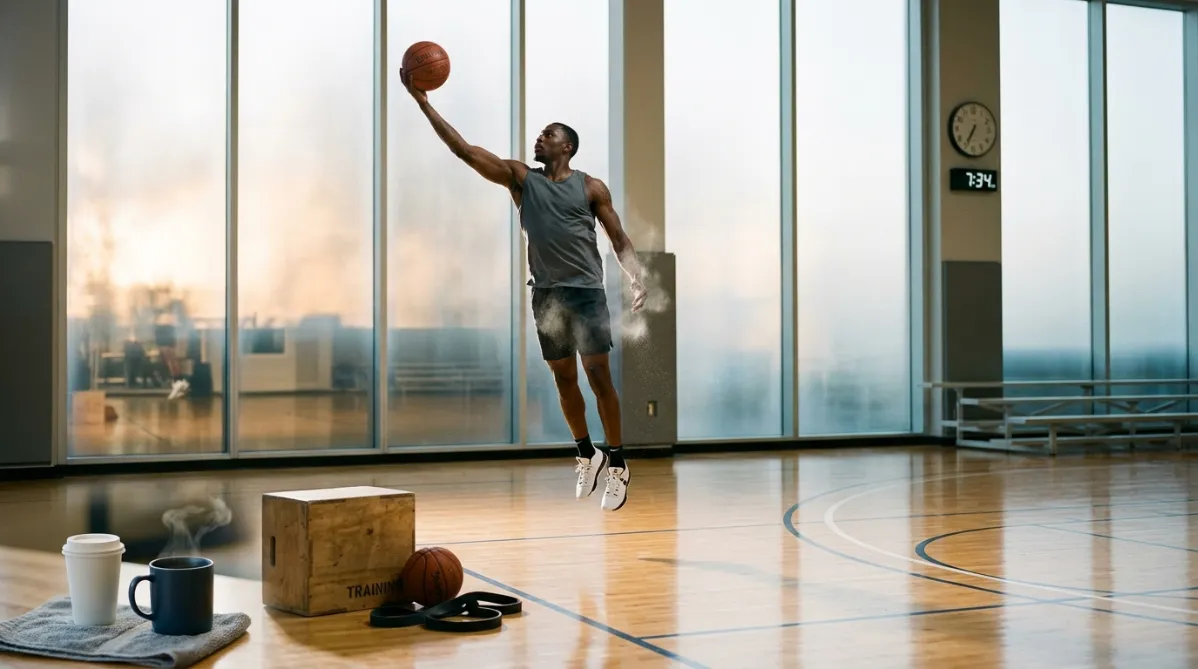
Most athletes treat caffeine and warm-ups as two separate boxes to tick. A new crossover trial suggests that might be leaving power on the table. Researchers in China tested what happens when you stack 5 mg/kg of caffeine on top of a post-activation potentiation enhancement (PAPE) warm-up, and the results beat both a standard warm-up and PAPE alone.
The catch? It was a small study in a very specific population. Here is what was found, what it means, and how to use it without overselling it.
The Short Version: What the Study Found
Published in the Journal of the International Society of Sports Nutrition (2026), the study recruited 24 male collegiate basketball players (average age about 20 years). It used a randomized crossover design, so every player completed all three conditions:
- CON: a standard warm-up
- PAPE+PLA: a PAPE warm-up plus placebo
- PAPE+CAF: a PAPE warm-up plus 5 mg/kg caffeine
Performance was measured with the Wingate anaerobic test, a 30-second all-out cycling sprint. Researchers recorded peak power, average power, total work, fatigue index, and rating of perceived exertion (RPE).
PAPE with placebo significantly beat the standard warm-up for peak power, average power, and total work (all p < 0.001). Adding caffeine pushed those numbers up again versus PAPE with placebo (p < 0.001). The authors describe this as a clear synergistic effect.
What Is PAPE, and Why Does It Matter?
PAPE is the idea that a short, intense muscular effort can temporarily improve performance in the efforts that follow. It differs from classic post-activation potentiation, which is more about twitch-level changes in the muscle. PAPE is what athletes feel as being primed, springy, and ready.
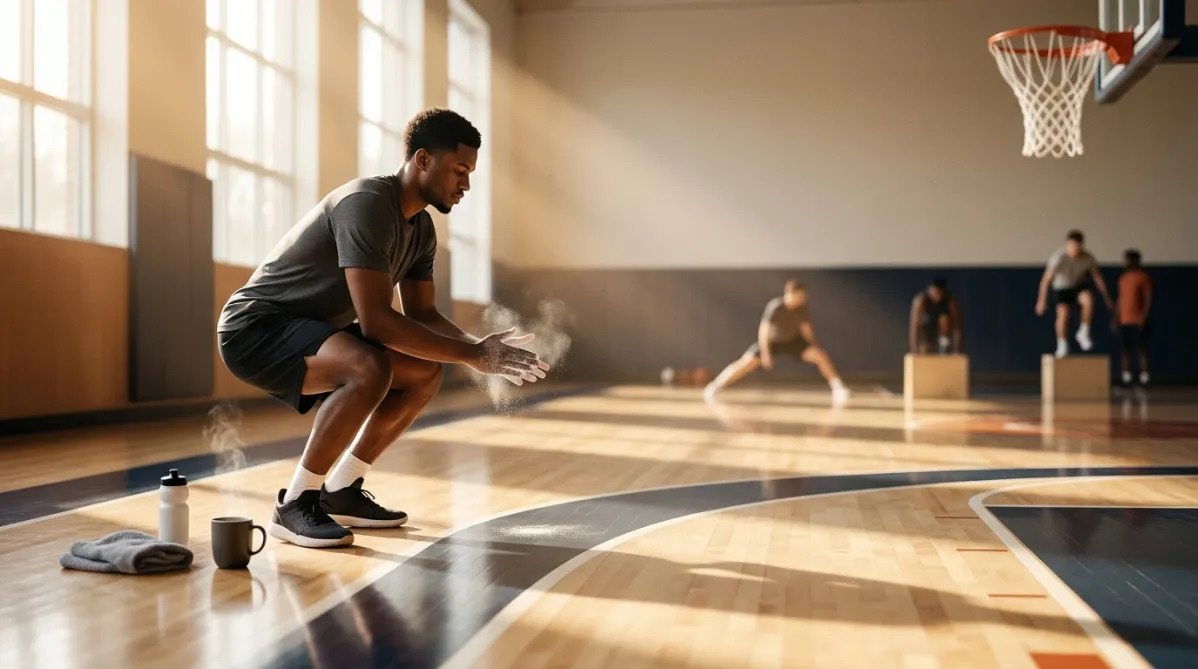
In this study, the activation set was a complex plyometric sequence: squat jumps, split jumps, and a 20-meter sprint. This is no exotic lab protocol. Any basketball or field sport athlete can do something similar in a gym or on a court with no equipment.
The takeaway is that a well-designed, explosive warm-up did more than just raise body temperature. It measurably improved anaerobic output compared with a standard warm-up.
The Caffeine Layer
Caffeine is among the most studied performance aids around, and the dose used here, 5 mg/kg, sits in the moderate-to-upper range of typical research protocols. For a 80 kg athlete, that is 400 mg, roughly four small cups of brewed coffee or a couple of strong pre-workout servings.
The interesting twist is that caffeine did not just add a little extra. It lifted peak power, average power, and total work beyond what the PAPE warm-up already delivered. It also reduced RPE (p < 0.001), meaning the same all-out effort felt easier.
One item did not move: fatigue index did not change significantly with either intervention (p = 0.06). So the athletes produced more power, but the rate at which they faded across the 30 seconds was not clearly improved.
How to Apply It: Dose, Timing, and Protocol
The abstract confirms the dose (5 mg/kg) and the warm-up structure. It does not specify timing in the text available, so check the full paper before copying a protocol exactly. As general context, many caffeine studies dose roughly 45 to 60 minutes before exercise, but treat that as a common convention rather than a finding from this trial.
A practical way to use the idea:
- Test caffeine in training first. Never debut 5 mg/kg on game day.
- Calculate your dose by body weight. Start lower, around 3 mg/kg, if you are sensitive.
- Finish your normal general warm-up, then add a short explosive block: squat jumps, split jumps, and a 20 m sprint.
- Allow adequate recovery between the activation set and your main effort. The abstract does not give the rest interval, so experiment carefully.
Who Should Try It (and Who Should Skip It)
Good candidates:
- Court and field athletes in explosive sports who already tolerate caffeine
- Lifters or sprinters looking for a pre-competition priming routine
- Athletes who feel flat in short, high-intensity efforts
Who should skip or be cautious:
- People with anxiety, heart rhythm issues, high blood pressure, or caffeine sensitivity
- Anyone who is pregnant or has been told by a clinician to limit caffeine
- Athletes who compete late in the evening and need to protect sleep
- Adolescents, since this study involved adults around 20
Limitations You Should Know About
Before you rebuild your pre-game routine, keep these caveats in mind:
- Small sample: 24 participants, all male collegiate basketball players. Results may not carry over to women, other sports, or elite professionals.
- Wingate is not a game. It is a cycling test. Real basketball involves jumping, cutting, and skill, which were not measured here.
- Fatigue index was unchanged, so repeated-sprint endurance may not improve.
- Acute effects only. The study tells us nothing about long-term adaptation.
- Individual response varies. Caffeine tolerance, genetics, and habitual intake affect results.
Bottom Line
This trial supports a simple idea: an explosive PAPE warm-up improves anaerobic power, and moderate-dose caffeine can add to it while making the effort feel easier. It is promising, practical, and cheap, but it is one small study. Treat it as a smart experiment to run in training, not a guaranteed performance hack.