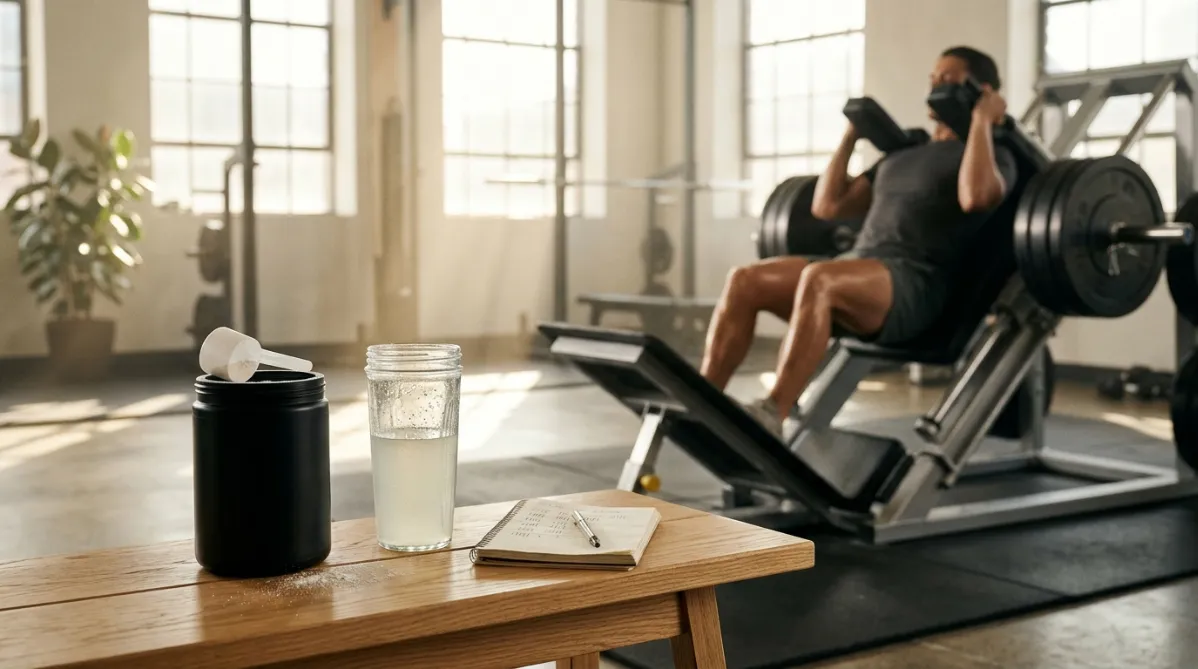
What if one pre-workout scoop could buy you roughly 11 extra reps on a brutal leg day and leave your quads feeling better two days later? That is the headline from a new double-blind crossover study in the Journal of Strength and Conditioning Research. It is promising, but it comes with caveats you should read before you buy a tub.
The Setup: Eight Sets to Failure
Researchers from Mississippi State, UT San Antonio, Stanford, the University of Wisconsin-Parkside and the University of Central Arkansas recruited 15 resistance-trained men. Each lifter did the same hack squat session twice, one week apart. Before one session they took 8.0 g of citrulline malate (CM), and before the other they took a placebo. Treatment order was randomized and counterbalanced, and neither the lifters nor the testers knew which was which.
Intake happened 60 minutes before training. The workout was 8 sets of hack squats at 67% of one-repetition max, each taken to failure, with 90-second rests between sets. That is a hypertrophy-style session built to accumulate fatigue, not a gentle warm-up.
The Headline Numbers
CM beat placebo on work capacity:
- Total repetitions: +10.7 reps (95% CI 1.4 to 20.0; p = 0.0265; Hedges' g = 0.61)
- Total workload: +1,064.7 units (95% CI 84.1 to 2,045.4; p = 0.0354; Hedges' g = 0.57)
- Overall rep performance: a significant condition effect (p = 0.0213)
Both effect sizes are moderate. Over eight sets, eleven extra reps works out to a bit more than one extra rep per set, which is the kind of gap that adds up across weeks of training.
The Bonus: Less Soreness at 24 and 48 Hours
The participants also reported significantly lower muscle soreness overall, and at both 24 and 48 hours after the session. This stands out because the CM group did more work and still reported feeling better afterward. Normally more volume means more soreness.
Soreness is a subjective rating, though, and it is not the same as faster muscle recovery or better long-term growth. Treat it as a perk, not proof of a recovery mechanism.
What Did NOT Change
The null results matter as much as the wins:
- Blood lactate rose after exercise in both conditions, with no difference between them.
- Rating of perceived exertion (RPE) showed no significant condition effect after sets 4 and 8, and no set-specific difference after adjustment.
- Diastolic blood pressure showed no meaningful condition effect.
So CM did not make the session feel easier, and it did not reduce lactate buildup. The lifters did more work at a similar perceived effort. That does not fit the popular idea that these supplements "clear lactate," and the authors' conclusion says the benefit appeared "without altering lactate accumulation or perceived exertion."
Heart rate and systolic blood pressure did show condition × time interactions, with CM-versus-placebo differences at 5 minutes post-exercise. These readings are secondary, and the abstract does not frame them as a main benefit.
Who This Is Actually For
The protocol points to one group: lifters who chase high-volume, near-failure lower-body work. If your program has hack squats, leg presses or similar movements for multiple hard sets with short rests, extra reps in the later sets are what you would be paying for. If you mostly train heavy, low-rep strength work with long rests, this study does not speak to you.
Practical Takeaways
- Dose: The study used 8 g of citrulline malate. Check your label, because the product's total weight may include the malate and other ingredients.
- Timing: Take it about 60 minutes before training, as in the protocol.
- Best use case: Brutal, high-volume leg sessions taken close to failure.
- Expectations: Expect possibly a few more reps and possibly less next-day soreness. Do not expect it to feel easier.
- Stay realistic: It is a small edge, not a replacement for sleep, protein or progressive overload.
The Fine Print
This paper does not prove that CM builds more muscle. Keep these limits in mind:
- Small sample: Only 15 trained men took part, so the results may not apply to women or beginners.
- Single session: Each condition was tested once, so this shows an acute effect only. It says nothing about long-term hypertrophy or strength.
- Wide confidence intervals: The lower bounds, 1.4 reps and 84.1 workload units, are close to zero, so the true benefit could be much smaller than the average.
- One exercise: The finding applies to hack squats and may not carry over to upper-body work.
- Subjective soreness: It was rated, not objectively measured.
Bottom Line
In this crossover trial, 8 g of citrulline malate taken an hour before a punishing hack squat protocol produced a statistically significant boost in total reps and workload, plus lower soreness for two days, without changing lactate or perceived exertion. For high-volume leg trainers, that makes CM a reasonable supplement to try. The evidence is still early. A longer training study would be needed to show whether extra reps in the gym translate into extra muscle over time.