Dr. Gymbro
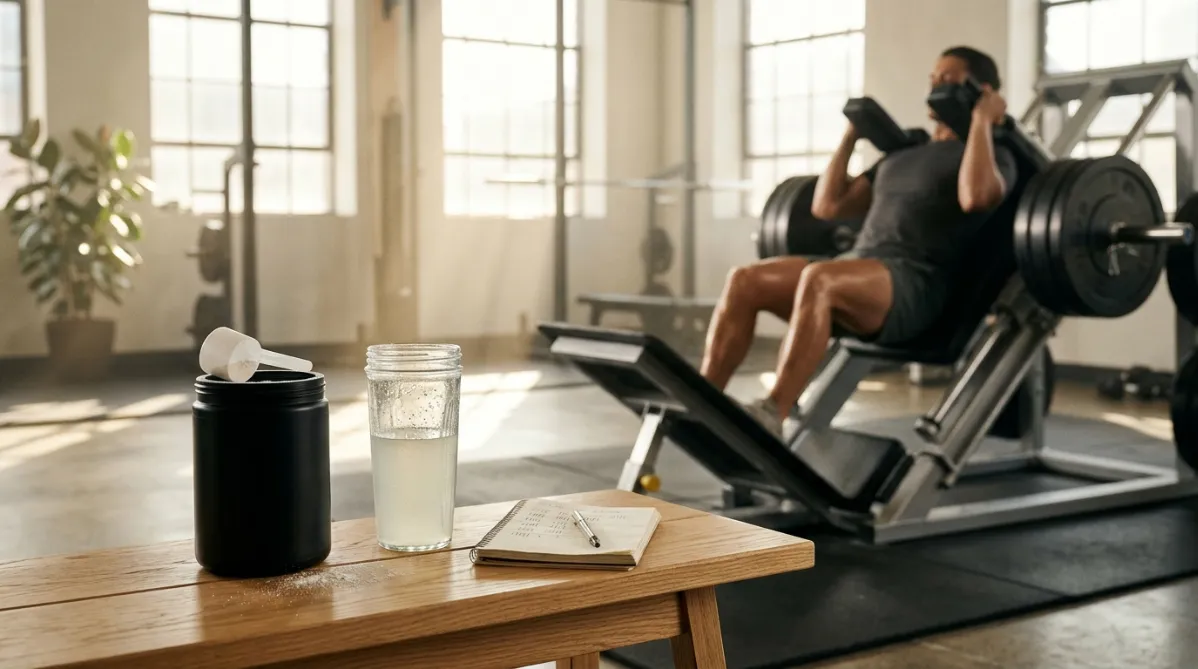
A wide landscape editorial photograph shot from slightly above, showing a clean matte stone countertop in soft morning light. On the left, a single frosted glass tumbler of pale pink-orange watermelon-colored drink sits with condensation beads on its surface, a thin slice of watermelon resting beside it. In the center, a minimalist matte white scoop rests on a small pile of fine white powder, with a few grains scattered naturally across the surface. Behind it, a blurred matte sage-green supplement tub with no legible text stands slightly out of focus. On the right, a neat arrangement of gym elements: a rolled linen towel, a slim stainless steel water bottle, and a pair of worn white running shoes with soft shadows. A small brass balance scale sits at the far right edge, one pan slightly higher than the other, hinting at weighing evidence versus hype. Scattered across the counter are a few cut watermelon rind wedges in vivid green and coral pink, adding natural color accents.

The color palette is warm and restrained: cream, soft blush pink, sage green, and warm gray, with a single pop of coral. Light enters from a window on the left, casting long, gentle diagonal shadows and a subtle highlight on the glass. Shallow depth of field with creamy bokeh in the background. Composition leaves generous negative space across the upper third and right side for headline text overlay. Style resembles a modern wellness magazine or trendy health journal cover: calm, tactile, minimal, slightly muted film-like grain, natural textures such as linen, stone, and glass. No people, no text, no logos, and no futuristic elements.
supplements

Citrulline Malate: Hype or Help? 30 Trials Say Barely

Dr. Gymbro · · 4 min read

If you've ever dumped a tub of tart, fruity pre-workout into a shaker and waited for the "pump" to kick in, there's a good chance citrulline malate (CM) was the headline ingredient. It's one of the most widely marketed ergogenic compounds in the supplement aisle. But a new systematic review and three-level meta-analysis in Nutrients (Wang, Fan, and Chang, 2026) suggests the performance story is much quieter than the label claims. The finding: a real but small bump, wrapped in a lot of uncertainty.

What Citrulline Malate Is Supposed to Do

CM combines the amino acid L-citrulline with malate, an intermediate in the Krebs cycle. The pitch has two parts. First, citrulline is converted to arginine in the body, which may raise nitric oxide availability, improve blood flow, and help deliver oxygen and nutrients to working muscle. Second, citrulline may aid ammonia clearance through the urea cycle, while malate may support aerobic energy production. Together, the theory goes, you get less fatigue, more reps, and better endurance.

That's a tidy mechanism, and it explains why CM shows up in so many pre-workouts. But a plausible mechanism is not the same as a reliable performance effect in humans, which is exactly what this meta-analysis set out to test.

What the Meta-Analysis Actually Found

The researchers searched six databases from inception through August 2025 and included randomized controlled trials of CM on exercise performance and/or perceived exertion. In total, 30 RCTs contributed 138 effect sizes from 644 participants. Because many studies report multiple outcomes, the team used a three-level random-effects model to handle those dependent effect sizes rather than treating each one as independent.

The headline result: CM was associated with a small improvement in overall exercise performance (Hedges' g = 0.16, p = 0.01). Statistically, that clears the bar. Practically, it's modest. A g of 0.16 is well under the conventional threshold for a "medium" effect, and it's the kind of difference that could be swallowed by day-to-day variability in your own training.

The caveats matter just as much as the number:

  • Wide prediction intervals. This means the true effect in a future study or a specific context could plausibly be much larger, near zero, or even in the wrong direction.
  • Limited statistical power. With 644 participants spread across many exercise types and protocols, the analysis can't confidently pin down subtler effects.
  • Low to very low GRADE certainty. The authors rated the overall evidence as low or very low, meaning future research is likely to change our confidence in the estimate.
  • No significant effect on perceived exertion. If you hoped CM would make hard work feel easier, the pooled data don't support that.

Acute vs. Chronic Supplementation

The review also compared acute dosing (taking CM shortly before a session) with chronic supplementation over days or weeks. The evidence looked more stable for acute protocols than chronic ones. That's a slight surprise for anyone who assumes loading over time is the smarter play.

But the authors are careful here: the statistical difference between protocol subgroups remained uncertain. In other words, acute looked steadier, but the data can't claim acute is truly better than chronic. Treat it as a hint, not a verdict.

Aerobic Endurance and Short Anaerobic Tasks: Exploratory Signals

Within the acute studies, exploratory subgroup analyses pointed toward possible benefits for aerobic endurance and short anaerobic tasks. This is the part most likely to get screenshotted by supplement marketers, so it deserves caution. These findings were exploratory, and they were not robust across sensitivity analyses. When the researchers stress-tested the results, the signals wobbled.

That doesn't mean CM does nothing for cyclists, runners, or sprint-style efforts. It means this dataset can't confirm it. The right reading is "worth investigating further," not "proven for endurance athletes."

Dose, Timing, Sex, and Training Status: No Clear Answers

Here's the question every lifter asks: how much, and when? The meta-analysis didn't find significant between-subgroup differences for dosage, ingestion timing, sex, or training status. That sounds like good news (it works for everyone!), but it's more likely a reflection of limited power and inconsistent study designs. The authors conclude plainly that reliable dosing, timing, and target populations have not been established.

They also flag a quality issue: future trials need verified supplement composition and standardized protocols. Products labeled "citrulline malate" can vary in the citrulline-to-malate ratio, which complicates comparisons across studies.

Practical Takeaways

  • Expect small, if any, gains. The pooled effect is small and the certainty is low. CM is not a game-changer.
  • Don't count on feeling less tired. Perceived exertion didn't improve significantly.
  • There is no validated protocol. Any specific gram amount or "30 minutes pre-workout" rule is not backed by this analysis.
  • Check your product. Composition and ratio matter, and label accuracy varies.
  • Prioritize the basics first. Progressive training, sleep, total calories, protein, and proven aids like creatine and caffeine have far stronger evidence bases.

Who Might Still Try It?

CM appears to be low-risk in the studies reviewed, so some people may reasonably experiment. Those most likely to consider it include recreational lifters or endurance athletes who already have their fundamentals dialed in and want to test a marginal gain, and people who enjoy it as part of a pre-workout and notice a personal benefit. If you try it, treat it as an n=1 experiment: keep training conditions consistent, track performance, and be honest about whether you see a difference.

The Bottom Line

Citrulline malate isn't a myth, but it's not the miracle the marketing suggests. The best available synthesis shows a small, context-dependent performance edge, undermined by wide prediction intervals, limited power, and low-to-very-low certainty. Until larger, better-standardized trials arrive, CM sits in the "maybe a little, maybe not" category: an optional extra, not a foundation.

Original study

Read the original research on pubmed.ncbi.nlm.nih.gov →

This article summarizes published research for general information. It is not medical advice.

DG

Written by

Dr. Gymbro

Dr. Gymbro writes for Dr. Gymbro: science-backed fitness, nutrition & performance.

Related Articles

A lone trail runner pauses on a high alpine ridge at dawn, holding a small enamel camp mug of steaming coffee, with thin ribbons of steam curling into crisp, cold air. She wears a fitted charcoal running vest and a muted sage windbreaker, and her breath is faintly visible. Behind her, layered mountain ranges fade into soft blue and lavender haze, and a sea of low clouds fills the valley below. Warm golden sunlight skims the ridgeline and rim-lights her profile, shoulders, and the rising steam. In the foreground, a scattering of dried alpine grasses and lichen-covered stones is in sharp focus, with a worn trail snaking toward the summit. Near the mug sits a small pair of trail running shoes with dusty soles and a simple analog wristwatch resting on a flat rock.

The composition follows a wide 16:9 editorial layout. The subject sits slightly right of center on the rule of thirds, leaving generous negative space in the pale peach-and-powder-blue sky on the left, where headline text could sit. The palette is restrained and modern: warm amber, soft cream, dusty sage, slate blue, and a touch of terracotta. The look is cinematic but natural, with shallow depth of field on the foreground details, gentle film grain, and a slightly matte finish. It evokes a high-end outdoor lifestyle magazine or a contemporary wellness journal. The mood is calm, focused, and quietly determined, capturing the contrast between thin, cold altitude air and the warmth of a coffee ritual. The image has no text, logos, or futuristic elements, and no gym equipment, only natural light, texture, and atmosphere.
nutrition

Caffeine in Thin Air: The Endurance Boost Hypoxia Can't Erase

BY DR. GYMBRO ·

Thin air wrecks endurance, but a new meta-analysis suggests caffeine can claw some of it back. Pooling nine placebo-controlled crossover studies (117 participants), researchers found a moderate-to-large performance boost in hypoxia (g = 0.76). The surprise is that oxygen saturation and perceived exertion didn't change, while heart rate, lactate, and ventilation went up. The evidence is rated low certainty and only 19 participants were women, so this is promising rather than proven. Here's who stands to benefit, who should skip it, and how to think about dose and timing.

A landscape editorial photograph of a lone runner's hands resting on a weathered wooden table beside a small white ceramic dish of fine white powder and a clear glass of water, shot in soft morning light. A slim matte aluminum energy drink can, unbranded with a minimalist pale sage-green label, stands slightly out of focus in the background, with a single scoop of powder dusted lightly on the tabletop. A pair of worn running shoes and a folded gray towel sit at the edge of the frame. Through a large window behind them, a blurred misty trail winds through green trees at sunrise, with warm golden light spilling across the scene.

The color palette is calm and modern: creamy off-white, sage green, warm honey gold, and soft charcoal. The composition follows the rule of thirds, with the dish and glass in the lower left third and generous negative space on the right for a title overlay. The depth of field is shallow, with a crisp focus on the powder's delicate texture and tiny glints of light on the glass rim. The mood is clean, thoughtful, and quietly energetic, like a contemporary health and science magazine feature. Natural grain, subtle film-like softness, and gentle shadows give it an authentic lifestyle-editorial look. There are no text, logos, or futuristic elements, only tactile, real-world materials like wood, ceramic, glass, cotton, and metal.
nutrition

The Energy Drink Ingredient That Boosts Endurance on Its Own

BY DR. GYMBRO ·

Everyone talks about caffeine, but the other ingredient on the energy drink can may be quietly doing its own work. A 2018 meta-analysis of 10 studies found that isolated taurine improved endurance performance (Hedges' g = 0.40), and a single dose appeared to be enough. Neither dose (1–6 g) nor supplementation length changed the effect in a meaningful way. The catch is a small evidence base and wide confidence intervals, so this is a promising signal, not a guarantee. Here's what the study found and how to try taurine sensibly.

A bright, modern gym scene in soft natural morning light, shot in landscape with shallow depth of field. In the foreground, a matte white scoop sits on the rim of a minimalist matte-black tub of white powder, with a few fine grains scattered across a light oak wooden bench. Beside it is a clear glass shaker bottle filled with a pale, cloudy liquid, with condensation beads on the surface. In the soft-focus midground, a hack squat machine stands with a loaded barbell sled and stacked plates in brushed steel and black rubber. A lifter in a fitted charcoal t-shirt and shorts, face turned away, is mid-set with strong, defined quads and calves, and a light sheen of sweat catches the sunlight. Tall industrial windows in the background cast long golden light beams across a polished concrete floor, with a hint of green from a potted plant in the corner. The palette is warm and editorial: cream, sage green, charcoal, and a touch of terracotta orange. A small, neat notebook with a pen lies open on the bench, with tally marks hinting at counted reps. The composition follows the rule of thirds, with the supplement and shaker on the lower left, the lifter and machine on the right, and open negative space at the top for headline overlay. The style is clean, contemporary lifestyle photography, like a premium wellness magazine, with subtle film grain, natural color grading, and crisp detail on the foreground objects.
nutrition

8 g Citrulline Malate Added ~11 Hack Squat Reps—And Less Soreness

BY DR. GYMBRO ·

One 8 g scoop of citrulline malate an hour before leg day added about 11 extra hack squat reps in a new double-blind crossover trial. The same lifters also reported less soreness at 24 and 48 hours than on placebo. Strangely, blood lactate and perceived exertion didn't budge, so the session didn't feel easier. Here's who might benefit, how the study dosed it, and why the small sample and single-session design mean you shouldn't oversell the result.

A wide, editorial-style still life photographed on a pale warm-gray concrete surface in soft morning window light. In the center sits an open, matte white supplement tub with a scoop resting beside it, a small mound of fine white powder spilling onto the surface. Next to it is a clear glass of water with a faint cloudy swirl of dissolved powder. A few loose capsules in muted coral and cream tones are scattered casually in the foreground. Behind them, slightly out of focus, is a clean running track lane in terracotta red with crisp white lines curving across the background. A pair of minimalist off-white sprint spikes rests on the edge of the track, laces loosely undone. A stopwatch with a brushed metal casing lies partially in frame at the right, its face reading a blurred, indistinct time.

The composition uses generous negative space on the left third, leaving a calm area of soft gray and cream for headline text. Shadows are long, gentle, and slightly cool, contrasting with the warm terracotta of the track. The palette is restrained: terracotta, bone white, soft sage green accents from a small leaf sprig tucked near the tub, and charcoal gray details. Shallow depth of field with a crisp focus on the scoop and powder, creamy bokeh behind. The mood is thoughtful, skeptical, and calm, like a modern wellness or science journal cover. Subtle film grain, natural color grading, and a tactile, tangible feel, with no text, no logos, and no futuristic elements.
nutrition

Beta-Alanine Is in Every Pre-Workout. Sprint Data Says It May Not Work

BY DR. GYMBRO ·

Beta-alanine is in almost every pre-workout, and the tingles make it feel like it's working. A 2026 multilevel meta-analysis of 17 randomized controlled trials found no benefit for repeated sprint ability, whether measured by mean performance, peak performance or fatigue decrement. Dose, duration and training status didn't change the picture. The authors suggest repeated sprints are limited by phosphocreatine recovery rather than acidosis, which is what beta-alanine targets. Here's who may still benefit, who can skip it, and what the study can't tell us.

This page is available in