Dr. Gymbro
A bright, minimalist editorial still life shot from a slightly elevated three-quarter angle on a pale oat-colored stone countertop, bathed in soft natural window light with gentle long shadows. In the center sit two matching matte white supplement scoops, side by side. One is heaped with fine white crystalline powder, the other holds an almost identical pile, so the viewer is invited to compare them. Beside them are two simple frosted glass tumblers of cloudy water, each with a small whisper of powder swirling at the bottom. A third glass of clear water sits slightly apart, as a quiet nod to the placebo.

Scattered around the scene are fresh, sliced watermelon wedges with vivid coral-pink flesh and pale green rinds, and a few sliced green apples with crisp white interiors, hinting at the natural sources of citrulline and malic acid. A small brushed-brass measuring spoon and a minimalist matte sage-green shaker bottle rest at the edge of the frame. Off to one side, a clean ceramic dish holds a few loose grains of powder, and a slim linen notebook with a pencil lies open to a blank page, suggesting data and study notes without any legible text.

The color palette is soft and modern: warm cream, blush coral, sage green, and touches of brass, with a faintly blurred background of a sunlit kitchen or studio with a pale plaster wall. Shallow depth of field keeps the scoops tack sharp while the background melts into a creamy bokeh. The composition leaves generous negative space on the left third of the frame for a title overlay. The overall mood is calm, trustworthy, and trendy, like a contemporary wellness and science journal cover, with crisp detail, subtle film-like grain, and a clean, airy, balanced feel.
Science & Research

Citrulline Malate vs L-Citrulline: Does Malate Actually Matter?

Dr. Gymbro · · 4 min read

The Quick Answer (Before You Buy Another Tub)

If you came here asking whether you need citrulline malate or whether plain L-citrulline will do, here is the honest version: in a new randomized, double-blind, placebo-controlled crossover trial, neither one beat placebo for acute neuromuscular performance in young, trained adults. And malate did not add anything on top of citrulline.

That is not the same as saying citrulline is useless. It means that in this specific setup, a single pre-workout dose did not measurably change strength, power, or rep performance. Here is what the study did and what you can reasonably take from it.

What the Researchers Actually Tested

The study, published in the International Journal of Sport Nutrition and Exercise Metabolism (2025) by Martín-Olmedo and colleagues, enrolled 43 trained participants (21 women, average age about 24). Each person completed three sessions in a counterbalanced order, so everyone served as their own control:

  • Placebo
  • L-citrulline (CIT): 5.3 g of citrulline
  • Citrulline malate (CMA): 5.3 g of citrulline plus 2.7 g of malate

The key design choice is that citrulline was matched across both active conditions. If CMA had outperformed CIT, the malate would be the obvious explanation. That makes this a clean test of the "malate or not" question.

Supplements were taken 45 minutes before testing. Researchers measured:

  • Maximal upper- and lower-limb neuromuscular performance (two-point method)
  • Ballistic performance (countermovement jump)
  • Strength-endurance: three sets of 10 reps in squat and bench press, with velocity tracking
  • Perceived exertion and emotional responses

The Results: A Wall of Null Findings

Across the board, nothing moved in a meaningful way.

  • Maximal neuromuscular performance: no significant improvements for CIT or CMA (all p ≥ .061)
  • Ballistic strength: no change (all p ≥ .348)
  • Total repetitions: no difference (all p ≥ .590)
  • Reps before the velocity-loss threshold: no difference (all p ≥ .623)
  • Mean velocity and velocity decline or maintenance: no difference
  • Perceived exertion and emotional state: no difference (both p ≥ .306)

The effect sizes were tiny, with partial eta-squared values at or below roughly .066 and mostly far lower. That suggests the lack of significance was not just a case of a promising signal slipping under the threshold. The data were close to flat.

So, Is Malate Worth Paying For?

Based on this trial, no. When citrulline was matched, CMA did not outperform plain L-citrulline on any outcome. If there is an additive benefit from malate, it did not show up in an acute dose during low- to moderate-volume training.

The theory behind malate is that, as a Krebs cycle intermediate, it could support aerobic energy production and help buffer fatigue. It is a reasonable idea, but this study did not find that it translated into better lifting performance in a single session.

There is a practical angle too. Products labeled citrulline malate often use ratios such as 2:1, and the label may list the combined weight. Check whether the number refers to citrulline or to the whole compound. In this trial, 8 g of CMA at a 2:1 ratio would be roughly the citrulline-matched dose. Don't assume 6 g of "CMA" gives you 6 g of citrulline.

Practical Dosing Takeaways

  • If you already use citrulline: you do not need to switch to malate based on this evidence. Plain L-citrulline is a fine and often cheaper option.
  • If you buy CMA anyway: do the math on the actual citrulline content per scoop.
  • Dose context: the trial used about 5.3 g of citrulline 45 minutes pre-exercise. Many studies in this area use somewhere in the 6–8 g range, so a higher dose or a different protocol might behave differently. This study cannot say.
  • Do not expect a dramatic acute kick: citrulline is not a stimulant, and this trial found no change in how hard sessions felt.

What This Study Cannot Tell You

It is important not to overclaim in either direction. A few caveats apply:

  • It was an acute study. Researchers tested a single dose. Chronic supplementation over weeks could behave differently, and this trial does not address that.
  • Training volume was low to moderate. Three sets of 10 reps is not high-volume work. Citrulline's proposed benefits, such as better blood flow and ammonia clearance, may matter more when volume is high or rest is short. The authors specifically limit their conclusion to low- to moderate-volume sessions.
  • The sample was young and trained. Results may not carry over to older adults, beginners, or elite athletes.
  • Other outcomes were not measured. Muscle pump, soreness, or endurance performance were outside the scope of this paper.

The Bottom Line

The headline for supplement shoppers is simple: malate did not make citrulline work better, and neither form improved neuromuscular performance in this crossover trial. If you enjoy your citrulline and it fits your budget, there is no strong reason to stop, but there is also no evidence here that you need the malate version. Treat it as a low-priority, optional supplement. Training consistency, progressive overload, sleep, and protein intake will still do far more for your strength than any pre-workout scoop.
Original study

Read the original research on pubmed.ncbi.nlm.nih.gov →

This article summarizes published research for general information. It is not medical advice.

DG

Written by

Dr. Gymbro

Dr. Gymbro writes for Dr. Gymbro: science-backed fitness, nutrition & performance.

Related Articles

A wide, editorial-style flat lay photographed from above on a pale warm-gray concrete surface, lit by soft natural window light with gentle long shadows. On the left, two matte ceramic bowls in muted sage green and cream sit side by side. One holds fine white crystalline powder, the other holds slightly coarser off-white powder. Between them, a small brass measuring scoop rests on the surface, dusted with powder. Behind the bowls, two simple amber glass jars with minimal cream labels and no legible text stand slightly out of focus.

On the right side, a pair of chalk-dusted black hex dumbbells and a worn leather lifting strap curve across the frame. A folded charcoal gym towel sits beneath them. A rumpled matte-black shaker bottle lies on its side near the top edge. A slice of watermelon, the natural source of citrulline, sits on a small white ceramic plate in the lower center. Its vivid coral-pink flesh and dark seeds add a saturated pop of color against the neutral palette. A few loose watermelon seeds and a scattering of white powder dust trail across the surface toward the dumbbells, tying the composition together.

In the lower left corner, an open notebook with blank cream pages holds a slim silver pen and a minimalist analog stopwatch. A thin line of hand-drawn tally marks suggests counted reps, with no readable words or numbers.

The palette is restrained and contemporary: warm grays, sage, cream, charcoal, and amber, with the watermelon's coral-pink as the single bright accent. The mood is calm, clean, and precise, like a modern wellness or science-journal feature. Shallow depth of field keeps the powder bowls and watermelon crisp while the background items soften slightly. Generous negative space across the upper center leaves room for a headline overlay. The photograph looks high-end and tactile, with a subtle film-grain finish.
nutrition

L-Citrulline vs Citrulline Malate: The Upper-Body Endurance Twist

BY DR. GYMBRO ·

Everyone argues over whether plain L-citrulline or citrulline malate is the better buy, but a new six-week trial found something more interesting. Both forms beat placebo for upper-body reps to failure, and both raised nitric oxide metabolite responses. The catch: neither form improved 1RM strength, and the leg results were only a trend. With just 33 trained men in the study, this is a promising signal rather than a verdict. Here's what the doses, timing questions, and fine print mean for your training.

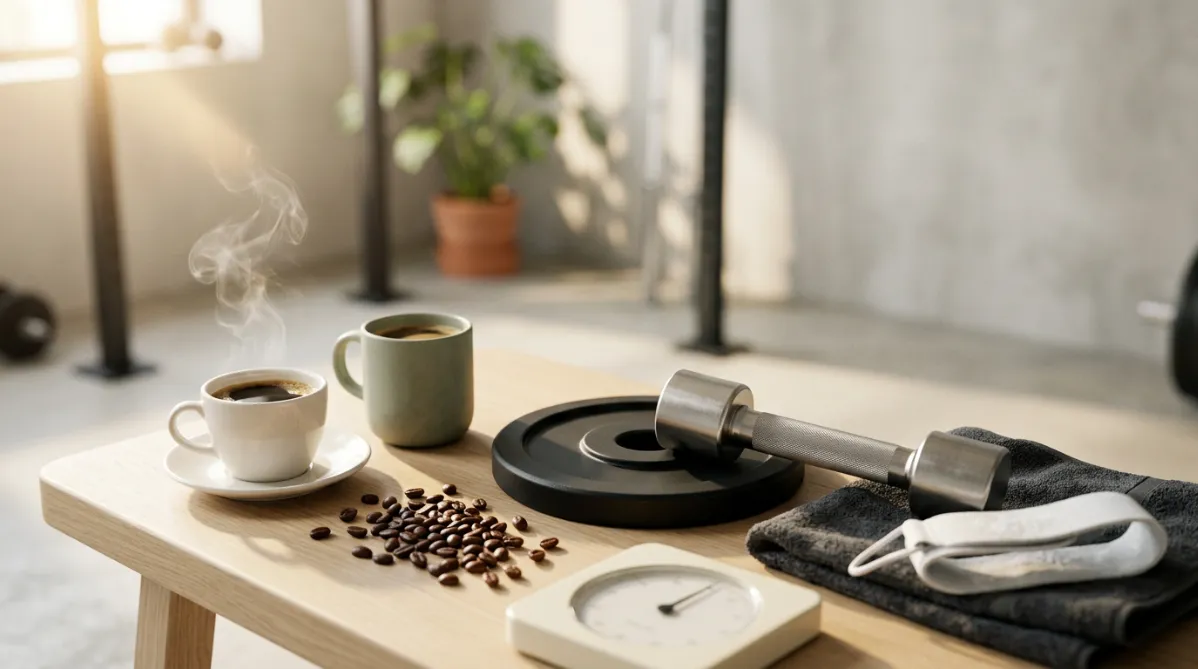
A wide, editorial-style flat lay photographed from slightly above on a pale oak gym bench with a soft matte finish. On the left, a small white ceramic cup of black coffee sits on a matching saucer, with a thin curl of steam rising and catching warm window light. Beside it is a second, slightly larger handleless stoneware mug in muted sage green, also filled with coffee, so the pair suggests one to two cups. In the center-right foreground rests a sleek matte-black steel barbell plate, partly overlapping a brushed-steel dumbbell with fine knurling. A folded charcoal gym towel and a clean white chalk-dusted wrist strap lie casually to one side. A small scatter of whole roasted coffee beans spills across the bench in front of the cups, glossy and deep brown. Near the bottom edge, a minimalist analog kitchen scale in soft cream with a thin black needle hints at precise dosing, without any readable numbers or text.

Soft morning sunlight streams in from the upper left, creating long, gentle shadows and a warm golden glow against cool neutral tones. The background is a softly blurred, airy home gym or boutique training studio with out-of-focus squat rack uprights, pale concrete walls, and a leafy green plant in a terracotta pot adding a touch of organic color. The palette is restrained and modern: warm cream, espresso brown, charcoal, sage green, and hints of brushed silver. Shallow depth of field keeps the cups and beans tack sharp while the background melts into creamy bokeh. The composition leaves generous negative space on the right third for a title overlay, with a balanced, calm, premium magazine feel, like a contemporary wellness and sports science journal. High-resolution, natural color grading, subtle film grain, realistic textures on ceramic, steel, and coffee crema.
nutrition

How Much Caffeine Before Lifting? A Meta-Analysis Says 1–2 mg/kg Still Works

BY DR. GYMBRO ·

The standard advice for caffeine before lifting is 3–6 mg/kg, which can mean several cups of coffee or a heavy scoop of pre-workout. A 2022 meta-analysis of 12 trials found that doses of just 0.9–2 mg/kg still improved muscular strength (d ≈ 0.17), muscular endurance (d ≈ 0.21), and mean bar velocity (d ≈ 0.56). For many lifters, that's about one to two cups of coffee. The effects are modest and the evidence comes from acute, single-session studies, but the findings suggest you may be able to get a similar benefit with less caffeine.

A wide, editorial-style still life photographed on a pale limestone countertop in soft morning window light. At the center sits a matte white scoop of fine white powder resting beside a frosted glass tumbler of cloudy, pale pink-orange water, with a few watermelon slices and a halved wedge showing glossy coral flesh and thin green rind, a nod to citrulline's natural source. To the left, a neatly folded charcoal gym towel and a brushed steel dumbbell rest at the edge of the frame, slightly out of focus. To the right, a minimalist open notebook with a few hand-drawn tally marks and a simple line graph sketched in black ink rises toward the right edge, next to a slim mechanical pencil and a small analog stopwatch with a clean white face. A few loose grains of powder are scattered across the stone, catching the light. Soft diagonal shadows fall across the surface from a nearby window, and a gentle sage-green wall in the background adds calm contrast. The palette is warm cream, watermelon coral, sage green, and soft graphite gray, with plenty of negative space on the upper left for headline overlay. Shallow depth of field, crisp focus on the powder scoop and watermelon, subtle film grain, natural tones, and a clean, modern wellness-journal aesthetic. Shot at eye level with a slight downward angle, like a contemporary health and science magazine cover. No text, no logos, no people.
nutrition

8 g Citrulline Malate = 53% More Reps and 40% Less Soreness? What the Study Shows

BY DR. GYMBRO ·

A 2010 crossover trial found that 8 g of citrulline malate was linked to about 53% more bench press reps in the final evaluated set and roughly 40% less soreness at 24 and 48 hours. The catch is that the biggest rep gain showed up late in the session, once fatigue had built up. Here is what the study actually tested, how to apply the dose and timing sensibly, who stands to benefit, and why the 14.63% rate of stomach discomfort and the study's limits deserve attention.

A landscape editorial photograph with a modern, clean magazine feel, shot on a pale warm-gray concrete surface in soft natural window light from the left. In the foreground, two matte white ceramic espresso cups sit side by side. The left cup holds a small amount of dark espresso with golden crema. The right cup is filled twice as high. Beside them, two small stainless steel scoops hold fine coffee-colored powder, one half full and one heaped, suggesting a dose comparison without any text or labels. A pair of worn red leather boxing gloves rests slightly out of focus behind the cups, laces loosely draped, with a white hand wrap rolled neatly beside them. A minimalist digital kitchen scale in matte black sits at the edge of the frame, with a few roasted coffee beans scattered across the surface. In the soft-focus background, a boxing gym corner appears: a hanging heavy bag in muted charcoal, pale wood plank flooring, and a tall window with diffused morning light. The palette is warm cream, espresso brown, brick red, and soft slate gray, with gentle shadows and a shallow depth of field. The composition follows the rule of thirds, with the cups and scoops in the lower left third and open negative space on the right for headline overlay. The look is tactile and refined, like a high-end health and performance journal. It has natural grain, subtle contrast, and a calm, confident mood. There are no people, no text, no logos, and no futuristic elements.
nutrition

Doubling Your Caffeine Barely Helped Boxers—Here's What Did

BY DR. GYMBRO ·

Think a double scoop of pre-workout means double the performance? A new crossover trial in 15 competitive boxers compared 3 mg/kg and 6 mg/kg of caffeine, and the bigger dose was not consistently better. Both doses raised jump height and power at 60 minutes, while 6 mg/kg only pulled ahead on a few outcomes like ballistic push-up power and knee torque. Here is the mg-per-kg conversion for common body weights, the timing the data supports, and the honest caveats, including that punching itself was never tested.

This page is available in