A modest 200 mg of caffeine, delivered inside a whole coffee fruit extract, made trained cyclists do more work in a hard 15-minute effort. The extract did not make their muscles refuel any faster afterward. That split result comes from a new randomized trial in the Journal of the International Society of Sports Nutrition (Pavis et al., 2026), and it is useful both for anyone eyeing the next "superfruit" pre-workout and for anyone who has heard that coffee cherry helps you refill glycogen.
What Is Coffee Cherry Extract, Anyway?
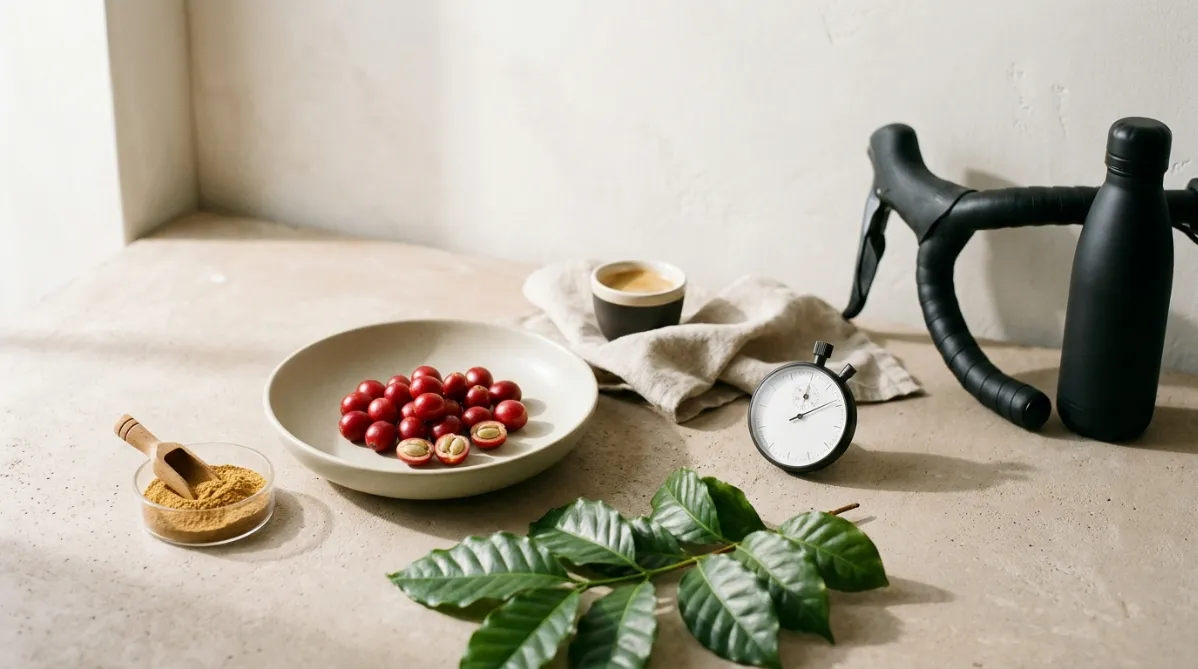
The coffee "bean" is the seed of a fruit. The fruit around it, the coffee cherry, is often discarded during processing. The extract tested here came from whole Coffea arabica cherry and was concentrated for caffeine and polyphenols, including chlorogenic acids. Each dose supplied 200 mg of caffeine and 15 mg of polyphenols.
That caffeine dose is relatively low by sports-nutrition standards. The researchers wanted to know whether a compound-rich, whole-fruit product could do two things: improve performance and speed up muscle glycogen resynthesis.
How the Study Was Run
The design was strong, but the group was small.
- Design: randomized, double-blind, placebo-controlled crossover trial
- Participants: 12 trained cyclists (11 men, 1 woman) with a V̇O2max of 55 ± 2 mL·kg⁻¹·min⁻¹
- Exercise test 1: 30 minutes on a cycle ergometer at about 79% V̇O2max, followed by a 15-minute time trial (TT1)
- Recovery: a second supplement was taken with 1 g/kg body mass of carbohydrate, and a second time trial (TT2) was done the following morning
- Measurements: blood samples throughout, plus muscle biopsies right after TT1 (0 h), then at 4 h and 24 h
Because every cyclist took both the extract and the placebo, each person served as their own control. That is a real strength in a small study.
The Headline Result: More Work, Lower Perceived Effort
Blood tests confirmed the supplement was absorbed. Plasma caffeine and chlorogenic acid were significantly higher with the extract than with placebo during exercise and recovery (p < 0.001).
The performance numbers followed. In the 15-minute time trial, cyclists produced 4.6% ± 1.5% more total work with the coffee cherry extract: 3.14 ± 0.15 vs. 3.02 ± 0.17 kJ/kg. The effect size was Hedge's g = 0.8 (95% CI 0.2 to 1.4), which is large, though the wide interval shows how uncertain the estimate is with only 12 people. The difference was statistically significant (p < 0.05).
Perceived exertion was also lower during the steady-state portion with the extract. The same work felt easier. Respiratory exchange ratio did not differ, so there was no clear sign that the supplement shifted fuel use in a dramatic way.
The Myth-Bust: No Glycogen Refuelling Boost
The other half of the hypothesis did not hold up. Muscle glycogen rose substantially during recovery in both conditions, as expected when athletes eat carbohydrate. From 0 to 4 hours, glycogen increased by 64 ± 13 mmol/kg dw with placebo and 44 ± 10 mmol/kg dw with the extract. From 4 to 24 hours, it rose by 53 ± 8 and 45 ± 10 mmol/kg dw, respectively. The authors describe the increases as similar between conditions, and the extract was not shown to enhance glycogen resynthesis.
The extract did not accelerate glycogen storage in this setup. Carbohydrate intake drove refuelling, and the supplement added nothing detectable on top. Some caffeine research has suggested that caffeine plus carbohydrate can boost glycogen storage, but this trial did not find that with a 1 g/kg carbohydrate dose. The abstract also does not report the TT2 performance result, so we can't say what happened to next-morning performance.
Why Should You Be Cautious?
Several limitations matter before you rush to buy a bottle.
- Tiny sample. Twelve cyclists, only one of them female, limits how far the findings can be generalized.
- No caffeine-only arm. The study compared the extract to placebo, not to plain 200 mg caffeine. We can't tell whether the benefit came from caffeine, the polyphenols, or both together. Despite the "coffee cherry vs. plain caffeine" framing, this trial did not test that head-to-head.
- One product, one dose. The results apply to this specific extract, not to every coffee fruit product.
- Industry funding. The grant came from FutureCeuticals, and three authors are its employees. The University of Exeter authors state they kept full independence in interpreting the data and deciding to submit. The trial was pre-registered (NCT05404841), which is a point in its favor.
- Short-effort performance. A 15-minute time trial does not necessarily reflect a multi-hour race or a lifting session.
Practical Takeaways
Dose: The tested dose was 200 mg caffeine with 15 mg polyphenols from the extract, taken before exercise. For context, that caffeine amount is roughly what you would get from about two typical cups of brewed coffee, though cup strength varies widely.
Timing: In the study, the supplement was taken before the exercise bout. The abstract does not specify the exact lead time, so follow the product label and what you already know works for you with caffeine.
Who it may suit: Trained endurance athletes who want a performance edge from a lower caffeine dose, or those who prefer a whole-fruit product to standard caffeine pills. It is a reasonable thing to trial in training, not on race day.
Who should skip it (general guidance, not from the paper): People who are caffeine-sensitive, have anxiety or sleep problems, have heart rhythm issues or high blood pressure, are pregnant, or train late in the evening should be careful or check with a clinician first.
What it won't do: Don't count on it to speed up glycogen refuelling. If you need to restore muscle fuel quickly, the carbohydrate matters most, and this study gives no reason to expect the extract to help.
Bottom Line
In this small, well-controlled crossover trial, a whole coffee cherry extract with a low caffeine dose improved cycling time-trial work by 4.6% and made steady effort feel easier. The "helps you refuel" claim, however, was not supported. Larger studies with a caffeine-only comparison are needed to find out whether the coffee fruit does anything that plain caffeine can't.