Dr. Gymbro
A landscape editorial still life in soft natural window light, set on a pale oak tabletop with a matte warm-white wall behind it. In the center-left, a few glossy strands of dark olive-brown kelp (Ecklonia cava) drape in an elegant curve over a shallow ceramic bowl in muted sage green. Next to the bowl, a small pile of fine, dry brown seaweed powder sits beside a minimalist wooden scoop. On the right, an unbranded matte-white supplement tub and a few loose cream-colored capsules are spilled neatly across the surface. A brushed steel cycling water bottle stands slightly out of focus in the background, with a folded gray cycling cap beside it. In the foreground, a clean white notebook with a thin pencil rests next to a simple analog stopwatch, hinting at a performance trial without any text or numbers visible.

The palette is earthy and calm: sage, olive, warm sand, cream and soft charcoal, with one subtle terracotta accent from a small ceramic dish. Long soft shadows fall diagonally across the table, and a gentle highlight catches the wet sheen of the seaweed. Shallow depth of field, with a creamy blurred background and crisp detail on the seaweed texture and capsules. The composition leaves generous negative space on the upper right for a headline overlay. Shot as if with a 50mm lens at f/2.8, top-down angle tilted about 30 degrees, in a modern wellness-magazine style that is minimalist, tactile and refined, with a subtle film-like grain and natural color grading.
Nutrition

Does Brown Seaweed in Your Pre-Workout Actually Do Anything?

Dr. Gymbro · · 4 min read

You've probably seen it on a label without noticing: Ecklonia cava, a brown seaweed extract, tucked into the ingredient list of a pre-workout or fat burner. A new randomised trial in trained cyclists put it to a direct test. It nudged blood glucose up slightly. It did not change sprint power, lactate, oxygen uptake or fat burning.

What the researchers tested

The study, published in Nutrients in 2026 by Ali and colleagues, asked a simple question: does a single dose of Ecklonia cava (EC) change how the body responds to steady cycling, or how much power a rider can produce in sprints afterwards?

Twelve experienced male cyclists took part. The design was a randomised, double-blind, placebo-controlled crossover trial. That is a strong format for a small study, because every rider acts as their own control. Each cyclist completed both the EC condition and the placebo condition, and neither the riders nor the researchers knew which was which during testing.

The authors declared no conflicts of interest.

The protocol, step by step

  • Dose: 263 mg of EC extract or placebo
  • Timing: taken 30 minutes before exercise
  • Steady ride: 60 minutes at 55% of each rider's maximum work rate
  • Sprint block: three maximal 20-second sprints straight after

During the steady ride, the team measured blood glucose, blood lactate, heart rate, oxygen uptake and respiratory exchange ratio (RER). RER is a common proxy for whether the body is leaning more on fat or carbohydrate for fuel. During the sprints they tracked peak power, mean power, glucose and lactate. Data were analysed with linear mixed-effects models that accounted for treatment, time, their interaction, the testing period and the order in which conditions were given.

The one thing that moved: a small glucose bump

Blood glucose was higher overall after EC than after placebo: 4.23 ± 0.23 versus 4.02 ± 0.33 mmol/L. The mean difference was 0.213 mmol/L (95% CI 0.046 to 0.379; p = 0.023).

That is a small change, and both averages sit in a fairly ordinary range. There is a second caveat. The treatment × time interaction was not significant (p = 0.939). In plain terms, the study did not show glucose behaving differently over the course of the ride. It was a modest overall offset, not a clear pattern that built or shifted as exercise went on. The authors themselves describe it as a "modest overall elevation".

What did not move: nearly everything else

EC did not affect submaximal blood lactate, heart rate, oxygen uptake or RER (all p ≥ 0.096). That matters for the "fat burner" angle. If the extract were meaningfully shifting fuel use, RER would be the place to see it, and it did not budge in a detectable way.

The sprint results were equally flat:

  • Peak power: difference of -2.58 W (95% CI -29.51 to 24.35; p = 0.832)
  • Mean power: difference of 5.93 W (95% CI -2.47 to 14.33; p = 0.167)
  • Post-sprint glucose: p = 0.481
  • Post-sprint lactate: p = 0.060
  • Treatment × time interactions: none for any sprint outcome (all p ≥ 0.267)

The post-sprint lactate figure is the closest to the usual threshold, but it did not cross it, and the authors do not treat it as a finding.

How much weight can this carry?

Be honest about the limits. Twelve riders is a small sample. The confidence interval around peak power runs from roughly -30 W to +24 W, so the study cannot rule out a small effect in either direction. Absence of evidence here is not proof of absence.

The participants were all experienced male cyclists, so the results may not transfer to women, beginners or other sports. The trial tested a single acute dose, one timing window and one exercise format. It says nothing about weeks of daily use, other doses, or effects on things like recovery, inflammation or body composition. Those would need separate trials.

This is a human trial, not an animal or cell study, which is a point in its favour. But it is one small study, and the authors conclude only that the findings "do not support an acute ergogenic effect" under the conditions tested.

Practical takeaways

Dose and timing: the study used 263 mg, 30 minutes before exercise. Nothing in the results suggests that this protocol improves performance, so there is no evidence-based dosing recommendation to offer for athletic benefit.

If you're buying it for performance: the evidence does not justify paying a premium for it. If you're racing or training hard, money is better spent on things with a stronger track record, such as carbohydrate fuelling for longer efforts, caffeine, and consistent sleep and food. Those are well-supported by broader sports nutrition research, though they were not tested in this paper.

If you're buying it as a fat burner: this trial found no change in RER, so it gave no sign of shifting fuel use during moderate cycling.

Who might still care: researchers and people curious about glucose regulation may find the small glucose effect interesting. Anyone with a medical condition affecting blood sugar, or on glucose-related medication, should talk to a clinician before adding a concentrated seaweed extract. This study did not examine those groups.

Check the label: pre-workouts often combine many ingredients, so it is hard to tell what, if anything, is doing the work. A single-ingredient result like this is a useful reminder that a trendy name on a tub is not evidence.

The bottom line

In trained cyclists, one 263 mg dose of Ecklonia cava extract raised blood glucose a touch and left performance and the other measured physiology essentially unchanged. It is a small study, so it is not the final word, but it gives you no reason to expect a boost from this seaweed on race day.
Original study

Read the original research on pubmed.ncbi.nlm.nih.gov →

This article summarizes published research for general information. It is not medical advice.

DG

Written by

Dr. Gymbro

Dr. Gymbro writes for Dr. Gymbro: science-backed fitness, nutrition & performance.

Related Articles

A wide editorial still life on a pale, warm-toned concrete surface in soft morning window light. In the center-left, a shallow matte ceramic bowl holds a small pile of bright red coffee cherries with glossy skins, a few sliced open to reveal pale mucilage and paired green-tan beans. Beside it, a small glass dish of fine, golden-brown powdered extract with a tiny wooden scoop resting on its edge. A sprig of coffee plant leaves, deep green and waxy, arcs across the foreground.

On the right side, slightly out of focus, a sleek road cyclist's handlebar and a matte black water bottle lean against a light plaster wall, suggesting athletic training without showing a person. A minimalist analog stopwatch with a clean white face and thin black hands sits in the mid-ground, angled toward the camera, its hands paused near the fifteen-minute mark. A folded linen cloth in oatmeal beige and a single small espresso cup with a thin crema ring add quiet texture.

The color palette is restrained and modern: cherry red, sage green, cream, soft terracotta, and charcoal accents. Light comes from the left, casting long, gentle shadows with a subtle warm glow and a hint of dust in the air. Shallow depth of field with crisp focus on the cherries and stopwatch, creamy bokeh in the background. Composition leaves open negative space in the upper right for a headline overlay. The overall feel is a clean, trendy health-and-science magazine cover: tactile, natural, minimal, and calm, shot in a 16:9 landscape frame with fine film-like grain and true-to-life tones.
nutrition

Coffee Cherry Extract: 200 mg Caffeine Lifted Cycling Output 4.6%

BY DR. GYMBRO ·

A low 200 mg caffeine dose from whole coffee cherry extract helped trained cyclists produce 4.6% more work in a 15-minute time trial. But the popular idea that it speeds up glycogen refuelling didn't hold up. This randomized, double-blind crossover trial involved just 12 cyclists and was industry-funded, with no plain-caffeine comparison group. Here's what the data show, what they don't, and who might want to try it.

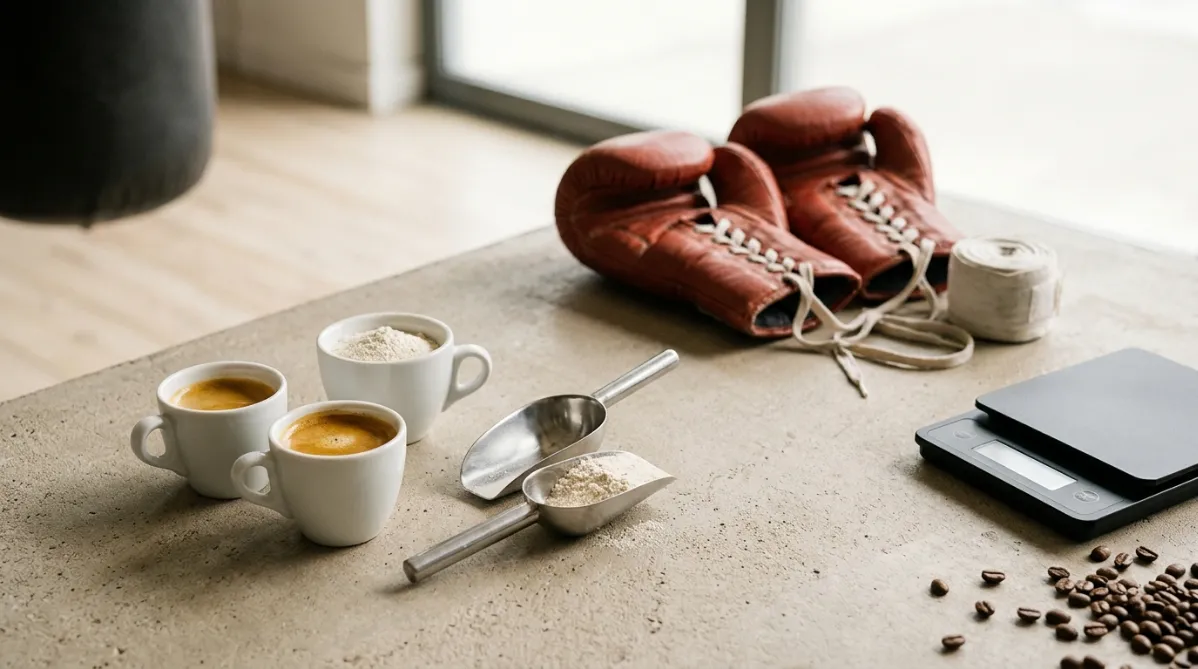
A landscape editorial photograph with a modern, clean magazine feel, shot on a pale warm-gray concrete surface in soft natural window light from the left. In the foreground, two matte white ceramic espresso cups sit side by side. The left cup holds a small amount of dark espresso with golden crema. The right cup is filled twice as high. Beside them, two small stainless steel scoops hold fine coffee-colored powder, one half full and one heaped, suggesting a dose comparison without any text or labels. A pair of worn red leather boxing gloves rests slightly out of focus behind the cups, laces loosely draped, with a white hand wrap rolled neatly beside them. A minimalist digital kitchen scale in matte black sits at the edge of the frame, with a few roasted coffee beans scattered across the surface. In the soft-focus background, a boxing gym corner appears: a hanging heavy bag in muted charcoal, pale wood plank flooring, and a tall window with diffused morning light. The palette is warm cream, espresso brown, brick red, and soft slate gray, with gentle shadows and a shallow depth of field. The composition follows the rule of thirds, with the cups and scoops in the lower left third and open negative space on the right for headline overlay. The look is tactile and refined, like a high-end health and performance journal. It has natural grain, subtle contrast, and a calm, confident mood. There are no people, no text, no logos, and no futuristic elements.
nutrition

Doubling Your Caffeine Barely Helped Boxers—Here's What Did

BY DR. GYMBRO ·

Think a double scoop of pre-workout means double the performance? A new crossover trial in 15 competitive boxers compared 3 mg/kg and 6 mg/kg of caffeine, and the bigger dose was not consistently better. Both doses raised jump height and power at 60 minutes, while 6 mg/kg only pulled ahead on a few outcomes like ballistic push-up power and knee torque. Here is the mg-per-kg conversion for common body weights, the timing the data supports, and the honest caveats, including that punching itself was never tested.

A landscape editorial photograph of a lone runner's hands resting on a weathered wooden table beside a small white ceramic dish of fine white powder and a clear glass of water, shot in soft morning light. A slim matte aluminum energy drink can, unbranded with a minimalist pale sage-green label, stands slightly out of focus in the background, with a single scoop of powder dusted lightly on the tabletop. A pair of worn running shoes and a folded gray towel sit at the edge of the frame. Through a large window behind them, a blurred misty trail winds through green trees at sunrise, with warm golden light spilling across the scene.

The color palette is calm and modern: creamy off-white, sage green, warm honey gold, and soft charcoal. The composition follows the rule of thirds, with the dish and glass in the lower left third and generous negative space on the right for a title overlay. The depth of field is shallow, with a crisp focus on the powder's delicate texture and tiny glints of light on the glass rim. The mood is clean, thoughtful, and quietly energetic, like a contemporary health and science magazine feature. Natural grain, subtle film-like softness, and gentle shadows give it an authentic lifestyle-editorial look. There are no text, logos, or futuristic elements, only tactile, real-world materials like wood, ceramic, glass, cotton, and metal.
nutrition

The Energy Drink Ingredient That Boosts Endurance on Its Own

BY DR. GYMBRO ·

Everyone talks about caffeine, but the other ingredient on the energy drink can may be quietly doing its own work. A 2018 meta-analysis of 10 studies found that isolated taurine improved endurance performance (Hedges' g = 0.40), and a single dose appeared to be enough. Neither dose (1–6 g) nor supplementation length changed the effect in a meaningful way. The catch is a small evidence base and wide confidence intervals, so this is a promising signal, not a guarantee. Here's what the study found and how to try taurine sensibly.

A landscape editorial photograph in soft natural morning light. In the foreground on a rustic light oak table, a small cluster of fresh Rhodiola rosea plants with thick succulent blue-green leaves and tiny golden-yellow flower clusters rests beside a few dried, knobby amber-brown rhizome pieces. A matte ceramic cup of pale golden herbal tea sits beside them, with a thin curl of steam and a small linen cloth. The plants and roots are sharp, with fine texture and dewy highlights.

In the softly blurred background, a lean cyclist in a fitted charcoal jersey stands beside a road bike on a quiet country lane at sunrise. Rolling green hills fade into pale mist behind them, and warm light rims the rider's shoulders. The cyclist tightens a glove, calm and focused, in a pre-ride moment of preparation. A water bottle is mounted on the bike frame, and a simple analog stopwatch with a brushed metal casing lies on the table near the herbs, hinting at timed effort.

The palette is muted and modern: sage green, warm cream, soft gold, and slate gray, with gentle peach tones from the sunrise. Shallow depth of field, a clean, airy composition with generous negative space on the right third for headline text, and subtle film grain. The mood is calm, health-conscious, and quietly athletic, like a premium wellness and sports science magazine cover. No text, no logos, no futuristic elements.
science research

Rhodiola Rosea: A Stimulant-Free Pre-Workout for Hard Cardio?

BY DR. GYMBRO ·

A 2013 crossover trial found that a single 3 mg/kg dose of Rhodiola rosea an hour before a 6-mile bike time trial shaved the finish time from 25.8 to 25.4 minutes. Warm-up heart rate dropped from 140 to 136 bpm, and perceived exertion fell from 6.6 to 6.0. The gain is small, around 1.5%, and comes from only 18 people, so it's no miracle. Still, the effort-perception angle makes it an intriguing stimulant-free option for endurance athletes. Here's what the data show and how to try it sensibly.

This page is available in