Dr. Gymbro
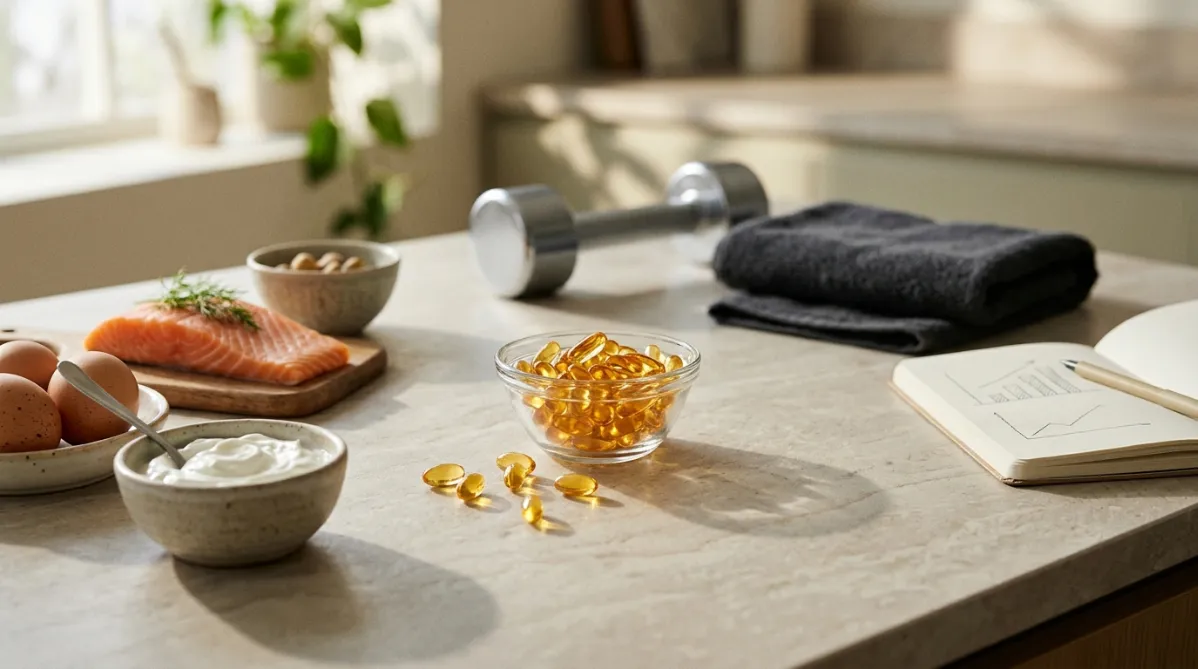
A bright, modern editorial still life shot from a slightly elevated angle on a pale warm-gray stone countertop, bathed in soft natural window light with gentle diffused shadows. In the center, a small glass bowl holds a scatter of translucent golden-amber fish oil softgel capsules, a few spilled casually onto the surface and catching the light like tiny glowing beads. Beside the bowl sits a single chrome dumbbell with a matte finish, slightly out of focus, and a neatly folded charcoal gym towel. To the left, a clean arrangement of alternative "better spent" items: a ceramic dish of raw eggs, a wedge of salmon fillet on a wooden board with a sprig of dill, and a small bowl of Greek yogurt with a spoon, all styled with restraint. A minimalist notebook with a thin pen lies at the right edge, with faint, abstract pencil-drawn bar charts and a flat horizontal line suggesting "no effect," legible only as soft shapes with no readable text. The color palette is muted and sophisticated: warm cream, soft sage green, sandy beige, and pops of golden amber from the capsules, with a single accent of coral from the salmon. Shallow depth of field keeps the capsules crisp while the background melts into a creamy blur of a sunlit kitchen with a hint of green plant leaves. The composition leaves generous negative space on the right third for title overlay, in a 16:9 landscape format. The mood is calm, thoughtful, and quietly skeptical, in the style of a contemporary health and science magazine, with a crisp editorial photography look, fine grain, and natural color grading. No people, no futuristic elements, and no text.
Science & Research

Fish Oil for Gains? 8 Trials Say Don't Count on It

Dr. Gymbro · · 4 min read

You've seen the pitch: omega-3s reduce inflammation, boost muscle protein synthesis, and help you recover and grow. So a bottle of fish oil in the cabinet must be quietly working on your gains, right? A new systematic review and meta-analysis in Nutrition suggests you shouldn't count on it. Across the available randomized trials in healthy adults without obesity, omega-3 supplementation showed no clear benefit for fat-free mass or muscle strength.

What Was Actually Tested

The research team, led by Silva with colleagues Simões and Artioli from Brazilian universities, set out to answer a narrow question. Does supplementing with isolated omega-3 fatty acids change fat-free mass (FFM) or muscle strength in healthy adults who are not obese? They searched PubMed, Embase, CINAHL, and Web of Science from inception through 25 February 2026.

Only randomized, placebo-controlled trials of isolated omega-3 supplementation qualified. That matters, because it strips out confounders like combined supplement stacks or diet overhauls. Risk of bias was assessed with the Cochrane RoB 2 tool, and the certainty of the evidence was graded using GRADE. Those are the standard, rigorous tools for this kind of work.

The Numbers

For fat-free mass, four studies made it into the meta-analysis. The pooled result was a standardized mean difference (SMD) of 0.26, with a 95% confidence interval of -1.14 to 1.66 (P = 0.60). That interval is enormous. It spans everything from a meaningful loss to a large gain, so the data simply can't pin down an effect.

For muscle strength, eight studies contributed 22 dependent effects, analyzed with a three-level random-effects model. The SMD was -0.02 (95% CI -0.38 to 0.34; P = 0.92). That's essentially zero, and the interval is far tighter than for FFM, though it still allows for a small effect in either direction. The authors rated the certainty of evidence as very low for the findings.

Why the Hype Existed

The enthusiasm isn't pulled from thin air. Omega-3 fatty acids are polyunsaturated fats built into cell-membrane phospholipids, and researchers have proposed that they exert anabolic and anti-inflammatory effects. In theory, changing membrane composition could influence how muscle cells respond to nutrients and training. Lower inflammation could, in turn, support recovery.

That's a tidy mechanistic story, and supplement marketing loves tidy stories. But a plausible mechanism is not the same as a real-world payoff. Biology that looks promising in cell studies or specific populations, such as older adults or clinical groups, often fails to show up in healthy, trained or recreationally active people. This meta-analysis is a reminder that the jump from mechanism to meaningful muscle is where many supplements stumble.

Read the Fine Print: "No Clear Evidence" Isn't "Proven Zero"

Honesty matters here. The authors' conclusion is carefully worded: current evidence is insufficient to conclude that omega-3 improves FFM or strength. That is not the same as proving omega-3 does nothing.

The FFM analysis rests on just four trials, and its confidence interval is so wide that a real benefit or harm can't be ruled out. The certainty of evidence was very low, which means future, better-designed studies could change the picture. Differences in dose, duration, training status, and measurement methods across trials may also blur the results. The fair reading is this: there's no good reason to expect a muscle or strength payoff, and the research hasn't shown one.

Who Might Still Take Omega-3

None of this makes fish oil useless. People take omega-3s for reasons that have nothing to do with lifting numbers. Those with low dietary intake of fatty fish may want to fill a nutritional gap, and omega-3s are often discussed in the context of heart and general health. This review simply didn't test those outcomes, and it shouldn't be read as a verdict on them.

If you already enjoy salmon, sardines, or a fish oil capsule for general health reasons, this study isn't a reason to panic or toss the bottle. The point is narrower: don't spend money on it expecting it to build muscle or raise your squat.

Practical Takeaways

  • Don't buy fish oil for muscle or strength. The best available evidence in healthy non-obese adults doesn't support it.
  • Prioritize protein. Hitting a solid daily protein target remains the foundation of building and keeping lean mass.
  • Train hard and progressively. Resistance training with progressive overload drives strength and FFM far more than any capsule.
  • Consider creatine. It has a much stronger track record for strength and lean mass than omega-3, and it's inexpensive.
  • Sleep and total calories matter. Recovery and energy intake quietly decide whether training turns into progress.
  • Keep omega-3 for other reasons, if any. Treat it as a general-health choice, not a gains tool.

The Bottom Line

Eight trials and 22 effects found strength basically flat, and four trials couldn't establish any FFM effect. With very low certainty and a small evidence base, the door isn't slammed shut, but the burden of proof now sits firmly with the supplement. Until stronger trials say otherwise, put your money and effort into the basics that reliably work: protein, progressive training, and creatine.
Original study

Read the original research on pubmed.ncbi.nlm.nih.gov →

This article summarizes published research for general information. It is not medical advice.

DG

Written by

Dr. Gymbro

Dr. Gymbro writes for Dr. Gymbro: science-backed fitness, nutrition & performance.

Related Articles

A softly lit, minimalist strength-training studio photographed in a modern editorial style. In the foreground, a matte black barbell loaded with weight plates rests on a light oak platform, with fine chalk dust floating in warm morning light. Beside it on a pale concrete bench sits a simple ceramic scoop of white creatine powder, with a small spill of fine crystals catching the light, next to a minimal frosted glass jar with no label. A matte sage-green shaker bottle and a folded cream towel sit nearby. In the soft-focus background, tall windows let in diffused golden sunlight, casting long, gentle shadows across the floor. A rack of neatly arranged dumbbells is blurred in muted charcoal tones.

The color palette is calm and sophisticated: warm off-white, sand, sage green, soft charcoal, and touches of terracotta. A small open notebook with a pencil lies on the bench, suggesting research and data tracking, with abstract hand-drawn bar graph lines faintly visible on the page but not legible. The composition follows the rule of thirds, with the barbell and powder on the left and generous negative space on the right for headline text. Shallow depth of field, crisp textures on the metal knurling and powder grains, subtle film grain, and a contemporary wellness-magazine look. Clean, airy, and editorial, with a grounded, scientific yet approachable mood. Landscape 16:9 composition.
science research

Creatine Plus Lifting: Bigger Strength Gains, No Dosing Winner

BY DR. GYMBRO ·

A meta-analysis of 63 studies and 1,489 participants asked how much creatine adds on top of lifting. The strength boost was moderate and consistent in both upper and lower body, while the lean mass gain was smaller and fat mass didn't significantly change. The surprise is that dosing strategy, daily dose and protocol did not significantly influence the results. Age emerged as the one exploratory clue, with larger strength effects in younger participants. Here is what the paper actually found, and what it can't tell you.

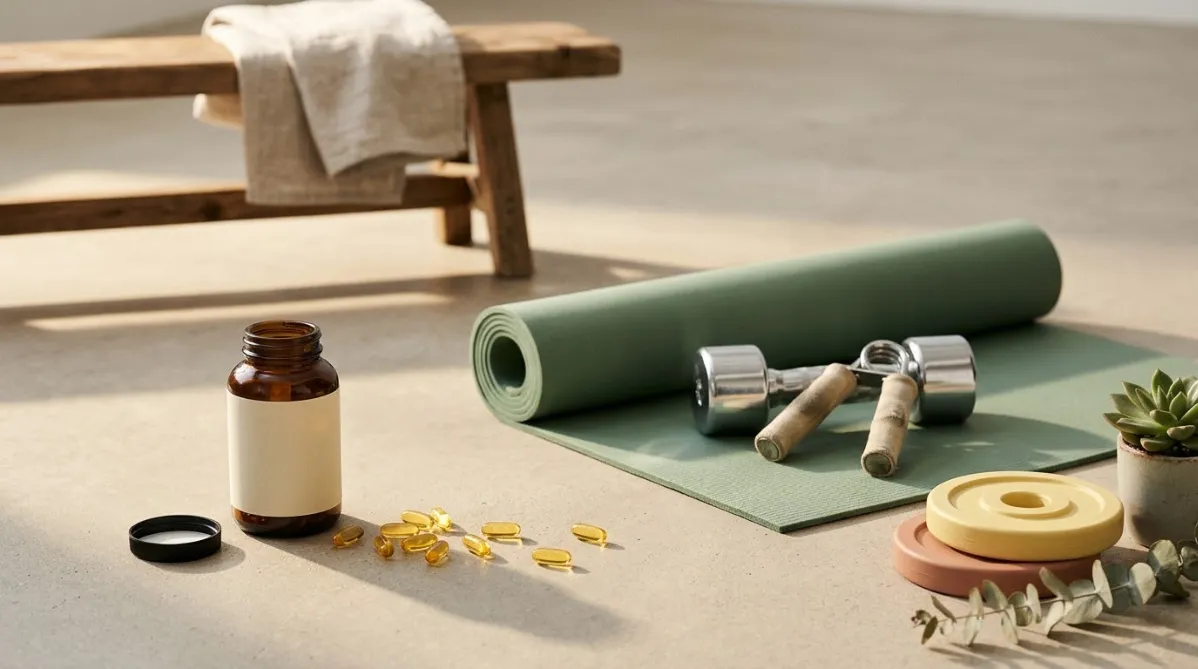
A soft-lit editorial still life on a pale warm-gray concrete surface, shot from a slightly elevated three-quarter angle in a wide landscape frame. On the left, a single amber glass supplement bottle with a minimalist cream label, its lid set beside it. A few golden-yellow softgel capsules are scattered in a loose arc across the surface, catching the light like small drops of honey. At the center-right, a matte sage-green yoga mat is partly unrolled, with a polished chrome dumbbell resting on it. Next to the dumbbell sits a worn canvas hand gripper, a nod to the handgrip finding. Behind them, a wooden gym bench is slightly out of focus, and a folded linen towel sits on top of it.

Warm morning sunlight enters from the upper left through a large window. It casts long, gentle diagonal shadows and a faint golden glow across the scene, a quiet reference to vitamin D and sunshine. A sprig of dried eucalyptus or a small potted succulent adds an organic touch near the bottom right. A small, neatly stacked pile of two or three matte pastel-toned weight plates in butter yellow and dusty terracotta adds color blocking.

The palette is muted and modern: butter yellow, sage, warm sand, soft terracotta, and off-white, with a single strong amber accent from the bottle. The depth of field is shallow, with crisp focus on the capsules and bottle and a creamy blur falling off toward the background. The negative space on the upper right is clean and uncluttered, which leaves room for a headline overlay. The overall feel is calm, minimalist, and contemporary, like a premium health and wellness magazine or a trendy online journal. The grain is subtle, the contrast gentle, and the textures tactile: brushed metal, frosted glass, linen, and concrete. There are no people, no text, and no futuristic elements.
science research

Vitamin D Won't Shred You or Build Muscle, With One Exception

BY DR. GYMBRO ·

A new dose-response meta-analysis of 28 randomized trials and 1,675 adults asked whether adding vitamin D to exercise beats exercise alone. Blood vitamin D levels jumped by about 34 nmol/L, but body weight, BMI, fat mass, body fat percentage, and fat-free mass didn't improve beyond training alone. Leg press strength didn't either. The exception: modest knee extension gains (+4.36 kg) and handgrip improvements in older adults and at higher doses. Here's who might benefit and what to do before you buy another bottle.

A calm, modern editorial still life shot from a slightly elevated angle on a pale oak tabletop, bathed in soft natural window light from the left. At center sits a clear glass of water beside a small matte ceramic bowl holding a mound of fine white creatine powder, with a wooden scoop resting next to it and a few loose grains dusted across the surface. To the right, a neatly arranged printed lab report on cream paper, with blurred rows of numbers and a single line highlighted in soft coral pink marker, partially overlapped by a minimalist silver pen. A folded pair of thin-framed glasses sits at the edge of the paper. In the foreground, a small glass vial with a pale amber liquid sample and a second empty vial stand upright, suggesting blood and urine testing, with gentle refraction and soft caustic light on the wood. Behind them, a sprig of eucalyptus in a small stone vase adds a touch of green. The background is a softly blurred, warm off-white wall with a gentle gradient shadow and a hint of a window frame. The palette is muted and refined: warm creams, sage green, soft coral, pale amber, and light oak, with crisp whites in the powder. Shallow depth of field, with the powder bowl and highlighted lab line in sharp focus and the edges falling away into creamy blur. Generous negative space on the right third of the composition for text overlay. The overall feel is clean, trendy health-journal photography, tactile and editorial, with subtle film-like grain, natural shadows, and a quiet, reassuring mood. No people, no text legible, no futuristic elements.
supplements

Creatine Raised Kidney Markers in 26 Trials. Probably Not Damage

BY DR. GYMBRO ·

You start creatine, get bloodwork, and your creatinine is up while your eGFR looks worse. A 2026 meta-analysis of 26 randomized trials (1,036 participants) found exactly that: creatinine rose 0.14 mg/dL and creatinine-based GFR fell about 10.75 mL/min. But when kidney filtration was measured with Cr-EDTA, the drop didn't appear, and urea, albuminuria and proteinuria were unchanged. Here's why the lab number misleads, what to tell your doctor, and who should check with a nephrologist first.

A wide, editorial-style photograph of a female athlete captured mid-jump in a bright, minimalist indoor training space with pale concrete floors and tall frosted windows that let in soft diffused morning light. She is frozen at the peak of a countermovement jump, knees tucked slightly, arms swinging upward, wearing a fitted sage-green training top and charcoal shorts. Her shadow stretches long on the floor below her, which emphasizes the height of the leap.

In the foreground at the lower left, a clean arrangement of supplement items sits on a light oak wooden plyo box: several matte, unlabeled ceramic jars and small amber glass bottles in cream, terracotta, and muted olive tones. Loose white powder is spilled in a soft arc beside a wooden scoop. A few capsules and a small pile of pale yellow beet-colored crystals add texture. Beside them are a folded linen towel and a stainless steel shaker bottle. The items are slightly out of focus, which creates shallow depth of field and leads the eye toward the athlete in the mid-ground.

The color palette is warm and modern: creamy off-white, soft sand, sage green, and subtle terracotta accents, with gentle natural shadows. The background is a clean, slightly blurred wall with a thin horizontal line of light, which suggests a measuring-stick rhythm without literal numbers. Fine particles of chalk dust hang in the air around her feet, lit by a shaft of sunlight.

The composition follows the rule of thirds, with the athlete on the right third and open negative space on the upper left, suitable for headline overlay. The style is contemporary lifestyle and sports-science journal photography, with a crisp, high-resolution, soft-contrast, matte finish and a subtle film-like grain. The mood is calm, premium, and trustworthy, in the spirit of a modern health and performance publication.
science research

Best Supplements for Jump Height and Power: HMB, Betaine Surprise

BY DR. GYMBRO ·

A massive new network meta-analysis of 119 trials ranked supplements for jump height and power, and the winners aren't who you'd expect. HMB led peak power with a 64.7 W gain, while betaine topped countermovement jump at 3.7 cm. Creatine, beta-alanine, vitamin D, and caffeine also showed benefits. But the certainty of evidence was very low for most comparisons, and the eye-catching iron result came from just one study. Here's the ranking by outcome and what to actually do with it.

This page is available in